

Pre-Market Routine: A 15-Minute Template for Traders
Build a pre-market routine in 15 minutes. Step-by-step template covering plan review, chart markup, alerts, and session boundaries so you trade with a plan, not on impulse.
Why a Pre-Market Routine Changes Everything
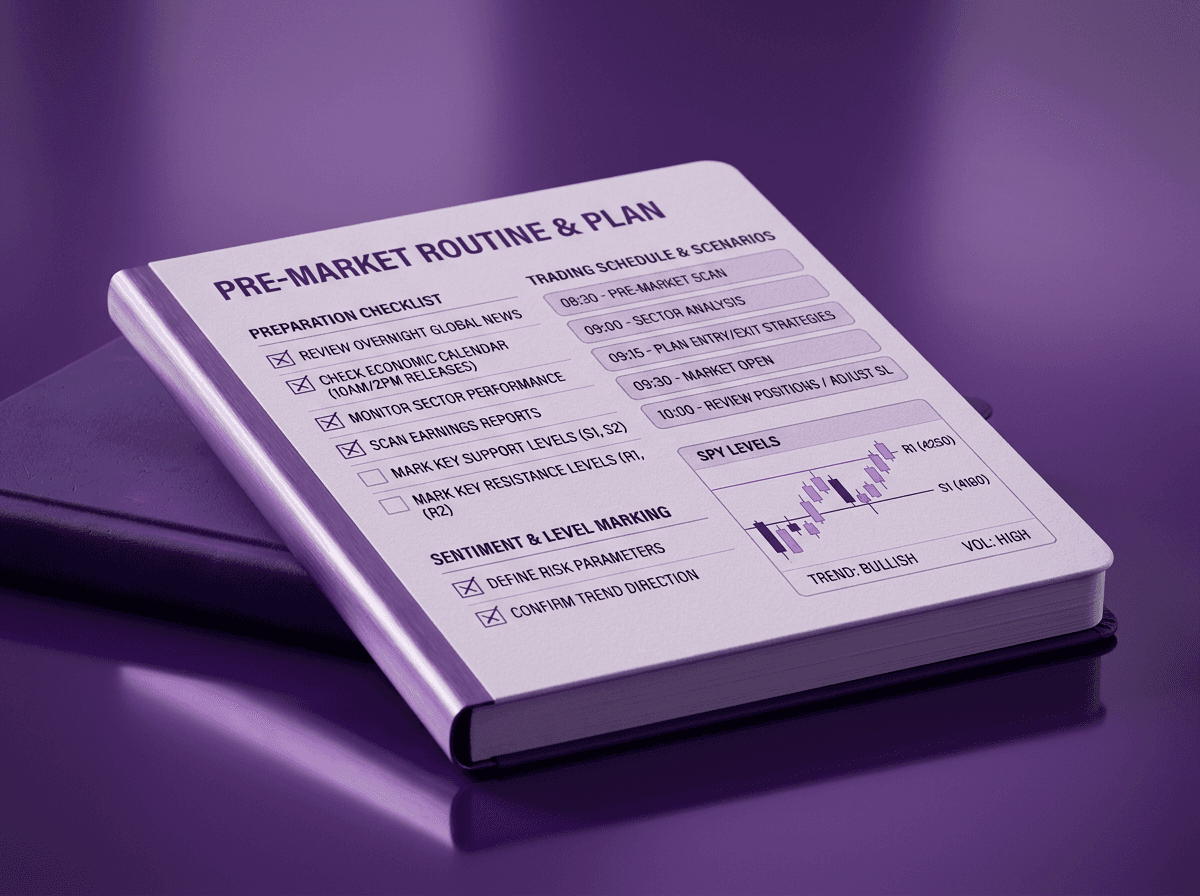
A pre-market routine is the 15 to 30 minutes before the session where you make every trading decision for the day. Not under pressure. Not with money on the line. You review your plan, mark your levels, set alerts, and define your stop point. Four steps. And they separate consistent traders from the ones who blow up every few weeks.
Ever opened your charts with zero plan and just started clicking? Most traders do this daily. They open charts when the market is already moving, scramble for setups, and make emotional entries because they never defined what they were looking for. That is not trading. That is reacting.
The gap between a good trader and a struggling one is rarely strategy. It is preparation. Think of it like a pilot's preflight checklist. No pilot skips the walkthrough just because the last flight went fine. A routine removes the biggest source of bad trades: improvisation. With no plan, every candle looks like an opportunity. With a plan, most candles are noise, and you know which ones actually matter.
TL;DR:
A pre-market routine is four steps in 15 to 30 minutes: review your plan, mark charts, set alerts, define boundaries.
It makes trading proactive instead of reactive, so you are executing a plan, not chasing price.
Alerts let you step away from the screen, which kills boredom trades and overtrading.
Boundaries set while you are calm protect you from decisions you would make after two losses.
Consistency beats intensity. Ten minutes of prep every day is better than an hour once a week.
The Four-Step Template
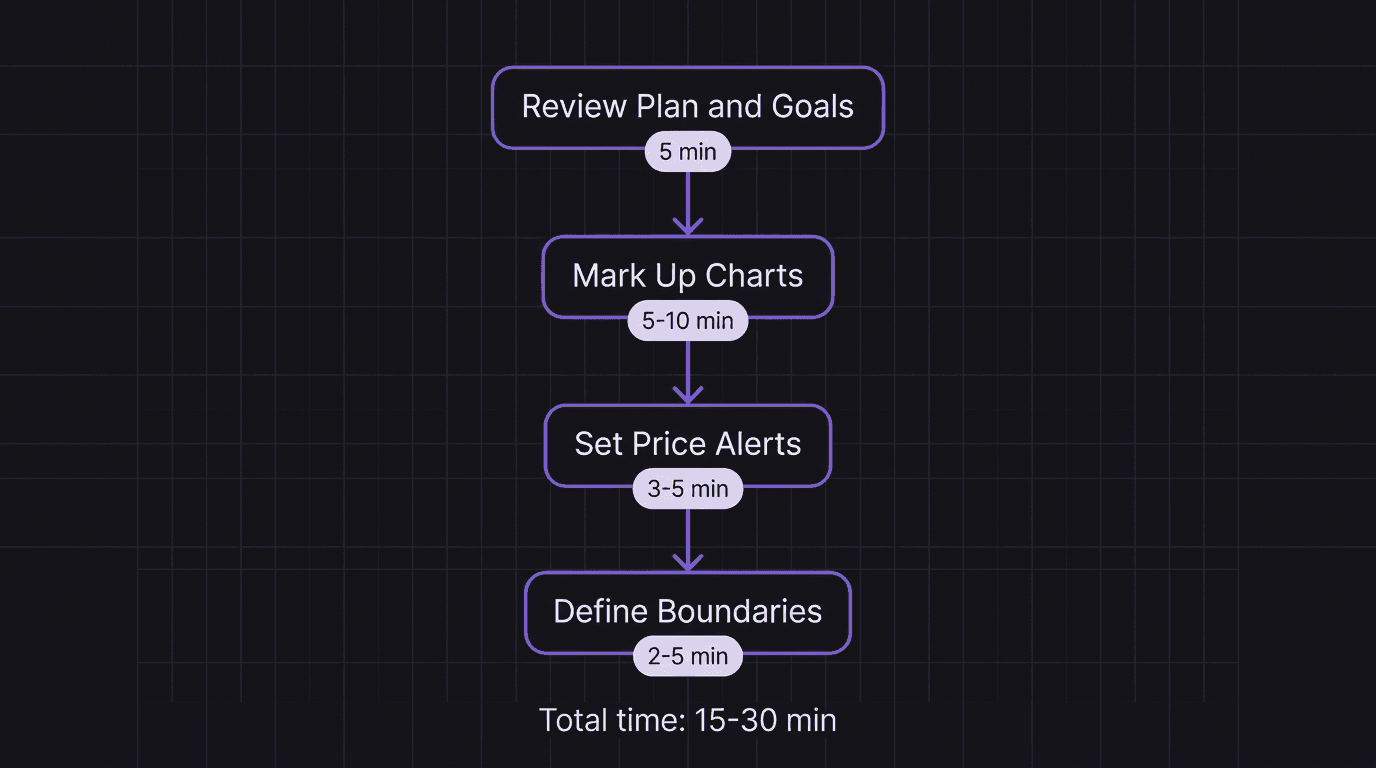
Four steps, done in order. Skip one and the structure falls apart because each step feeds the next.
Step | Task | Time |
|---|---|---|
1 | Review your plan and goals | 5 min |
2 | Mark up your charts | 5-10 min |
3 | Set alerts at points of interest | 3-5 min |
4 | Define today's boundaries | 2-5 min |
Plan review tells you what to look for. Chart markup tells you where to set alerts. Alerts tell you when to engage. Boundaries tell you when to stop. The sequence matters.
Step 1: Review Your Plan and Goals
Open your trading plan. Read it. Not skim it. Actually read your entry criteria, your risk rules, your edge. Then check your weekly goals.
Five minutes. Zero cost. And it is the step traders drop first because it "feels unnecessary" when things are going well. That is exactly how the wheels come off. You stop following rules not because you forgot them, but because you stopped reminding yourself they exist.
What to Look At
Entry criteria. What setups are you allowed to take? If it does not match your plan, it does not exist today.
Risk parameters. Risk per trade. Daily loss limit. You probably know these numbers, but reading them hits differently than keeping them in the back of your mind.
Process goals. Not PnL targets. Things like: how many trades today? What is your discipline focus this week? Are you working on patience, or cutting losses faster?
This is priming. You are loading your rules into working memory so they are ready the moment a setup appears and your gut says "just take it."
Step 2: Mark Up Your Charts
Plan is fresh. Open your charts and apply it. Start on the higher timeframe (daily or 4H) and work down.
Levels That Matter
Key support and resistance. Where has price reacted before? These are your anchors.
Trend direction. Is the higher timeframe bullish, bearish, or choppy? If choppy, write that down. It changes how aggressive you should be.
Supply and demand zones. Order blocks, imbalances, whatever your strategy uses. Mark them clearly.
Prior day high and low. The most-watched intraday levels. They anchor your daily bias.
Keep It Clean
Three to five levels, maximum. If your chart looks like a coloring book, you have too many levels and none of them mean anything. Fewer levels, clearer decisions.
The goal is not to predict where price goes. It is to define what would need to happen for you to act. "I think EUR/USD is going up" is a guess. "If EUR/USD pulls back to 1.0870 and gives me a bullish reaction at the premium and discount zone, I have a trade" is a plan.
Some traders do heavy markup on weekends (all pairs, weekly and daily levels) and use the pre-market session to refine for the day. That works well if you trade multiple instruments. Either way, every level you care about should already be on the chart before the market opens.
Step 3: Set Alerts at Your Levels
You have levels marked. Now set price alerts at each one.
This single step separates reactive traders from proactive ones. Without alerts, you sit in front of the screen watching every tick, waiting for something to happen. That is exhausting. And after two hours of staring, you start taking setups outside your plan just because you need something to happen. Sound familiar?
Where to Place Alerts
Each support or resistance level where you would look for a setup.
Your stop-loss zones on existing positions.
Levels where your bias gets invalidated (if price breaks this, your plan for the day changes).
With alerts set, you walk away. Do other work. When price reaches a level that matters, your phone buzzes. You come back, assess the price action, and decide if it matches your criteria. Yes? Execute. No? Reset the alert or move on.
Alerts are not just convenience. They are a discipline tool. They physically remove you from the screen, which removes the temptation to overtrade. If you struggle with trading discipline, this is one of the simplest fixes.
Step 4: Define Today's Boundaries
Before the session starts, write down the conditions under which you stop trading. Not in your head. On paper or in your tool.
Daily loss limit. A hard number (dollar or percentage). Hit it, close the platform. Not "I'll see how I feel."
Max trade count. For most traders, two to four is plenty. Anything beyond that is usually overtrading dressed up as opportunity.
Time cutoff. If your kill zone ends at noon, close the laptop at noon. Not 12:15 because "this setup is almost there."
Emotional override. Frustrated, anxious, or revenge-driven at any point? That is your signal to stop, regardless of trade count or PnL.
Why set these before the session? Because right now you are calm and rational. Once you are down on a trade, your brain is not making rational decisions. It is trying to recover a loss. The boundaries you set at 7 AM protect you from the person you become at 11 AM after two consecutive losers.
A Pre-Market Routine in Action: GBP/USD London Open
Here is what a real pre-market routine looks like, start to finish.
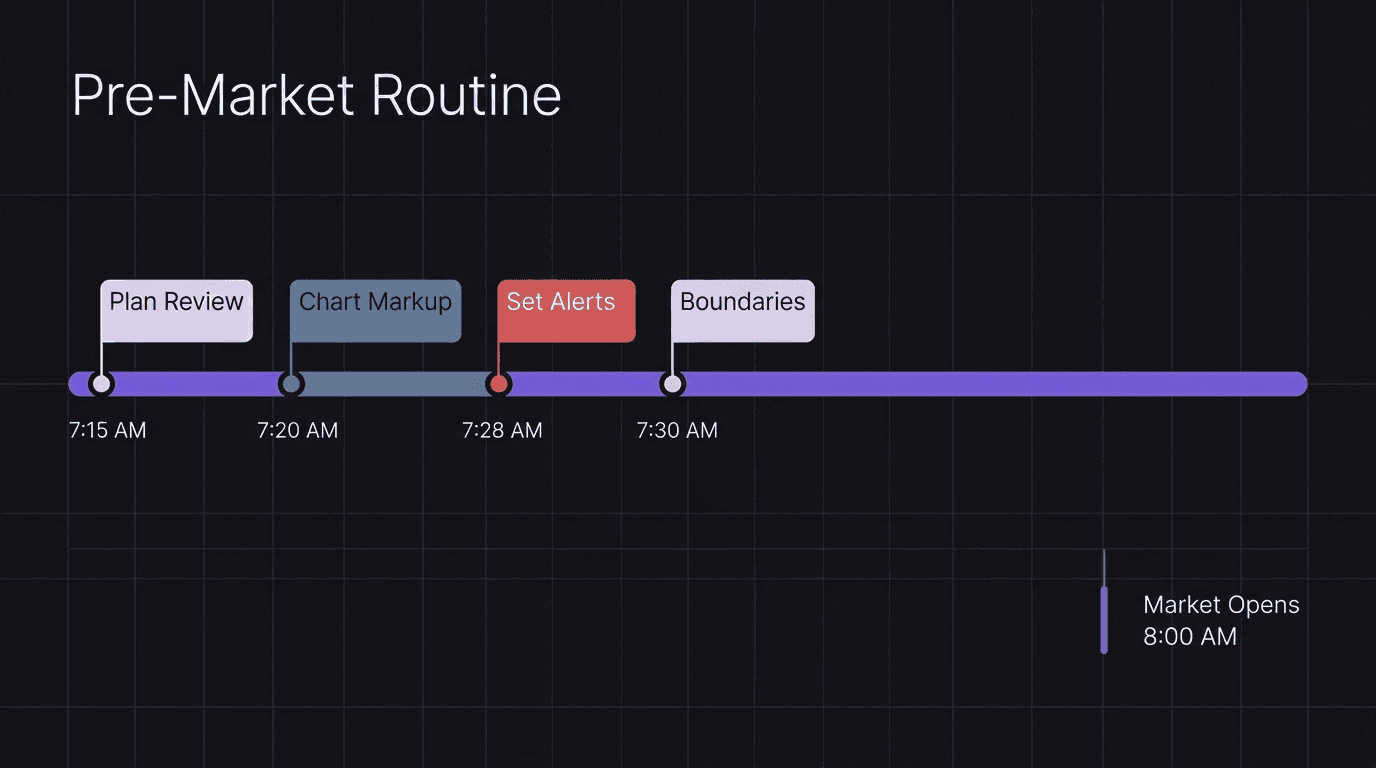
Tuesday morning, 7:15 AM GMT. London opens in 45 minutes. A swing trader pulls up her plan and reads through the rules: trend-continuation entries only, 1% risk per trade, max two trades, stop at 1.5% daily loss.
Chart markup (7:20 AM). She opens GBP/USD on the daily chart. Price closed Monday at 1.2685, sitting above a demand zone at 1.2640-1.2660 that held twice last week. Daily trend is bullish. She marks the demand zone, prior day high at 1.2710, and a supply zone at 1.2745 from Thursday. Three levels. Clean chart.
Alerts (7:28 AM). Alerts set at 1.2660 (bottom of demand), 1.2710 (prior day high), and 1.2745 (supply zone). Phone goes on the desk. Charts minimized.
Boundaries (7:30 AM). She writes in her journal: "2 trades max. 1.5% daily loss limit. Done by 12 PM. If I feel frustrated after a loss, I walk away for 30 minutes before considering trade two."
The session (8:00 AM onward). At 8:47 AM, her phone buzzes. GBP/USD hit 1.2660. She opens the 15-minute chart, sees a liquidity sweep below the demand zone followed by a strong bullish engulfing candle. Matches her criteria. She enters long at 1.2668 with a stop at 1.2638 (below the sweep low) and a target at 1.2710. Price reaches 1.2710 by 10:30 AM. She closes for +42 pips and does not look at charts again until her post-session review.
No scrambling. No staring at screens for three hours. The routine did the work before the session started.
What Happens When You Skip It: EUR/USD Revenge Trade
Now the other side.
A trader wakes up late on a Wednesday. Skipped the gym, skipped his plan review, and opens TradingView at 8:20 AM because he saw a tweet about EUR/USD dropping. No levels marked. No alerts. No boundaries.
EUR/USD is falling hard, already down 60 pips from the Asian session high. He thinks "I missed the move" and shorts at 1.0815, chasing momentum with no plan and no stop-loss. Price bounces 25 pips against him. He moves his stop further away. It bounces another 20. He adds to the position because "it has to come back down."
It does not come back down. Not in time. He closes both positions at 1.0860 for a combined 1.8% account loss. Then he takes a revenge trade on GBP/USD (a pair not even on his watchlist) trying to make it back. That loses too. Day ends down 3.2%.
Every mistake traces back to the same root: no routine. No plan review, so he traded outside his criteria. No markup, so he had no levels. No alerts, so he chased. No boundaries, so nothing stopped him after the first loss. A ten-minute pre-market routine would have prevented all of it.
What Brad Goh's Routine Looks Like
Brad Goh, EdgeFlo's founder, keeps his routine simple. During his learning phase, he treated trading like a skill to build: structured blocks for studying, practicing, and reviewing. His current routine is leaner. Gym and meditation in the morning. Three hours of deep work. Then one to two hours of live trading, followed by a review session.
The key detail: he spends one to two hours on trading per day. Total. The rest is preparation, review, and recovery. Saturday is for marking up charts for the week ahead. Sunday is a full rest day.
His pre-market step is non-negotiable: review the plan and goals before every session. Not occasionally. Every session. And after every trade, he journals it, asking what he can learn from losses and how he can replicate wins. That post-session review feeds the next morning's routine, creating a feedback loop where each day's preparation gets sharper.
The principle is not his specific schedule. It is the ratio. Most traders spend five hours watching charts and five minutes reviewing. Brad flips that. Preparation and review surround trading, not the other way around.
Building the Habit
A pre-market routine only works if you do it every day. Not when you feel like it. Not only on volatile days. Every single day.
How do you get there?
Start Small
If 30 minutes feels like too much, do 10. Review your plan. Mark one level. Set one alert. Write down your loss limit. That already puts you ahead of most traders who open charts cold.
Anchor It
Tie the routine to something you already do. Right after coffee. Right after the gym. Right after you sit down at your desk. Same idea as a chef doing mise en place before service: you prep your station before the orders start flying. Anchoring it to an existing habit makes it automatic faster.
Schedule It
Put it in your calendar as a recurring event. Brad uses Google Calendar for this. If it is not scheduled, it is optional. And you will skip it on exactly the days you need it most.
Track Completion, Not Results
Do not measure your routine by whether you made money. Measure it by whether you completed all four steps. The connection between preparation and execution quality takes weeks to show up in the data. Trust the process before you see the numbers.
Protect the Wind-Down
Your pre-market routine starts the night before. Plan the next day before bed. Set your wake-up. Do not check charts after dinner. Traders who burn out are not the ones who trade too much. They are the ones who never stop thinking about trading.
How EdgeFlo Supports Your Pre-Market Routine
EdgeFlo's Edge Plan Builder stores your plan, criteria, and goals in one screen, so your pre-market review does not involve digging through scattered notebooks. The pre-market checklist prompts you through each preparation step before the session starts.
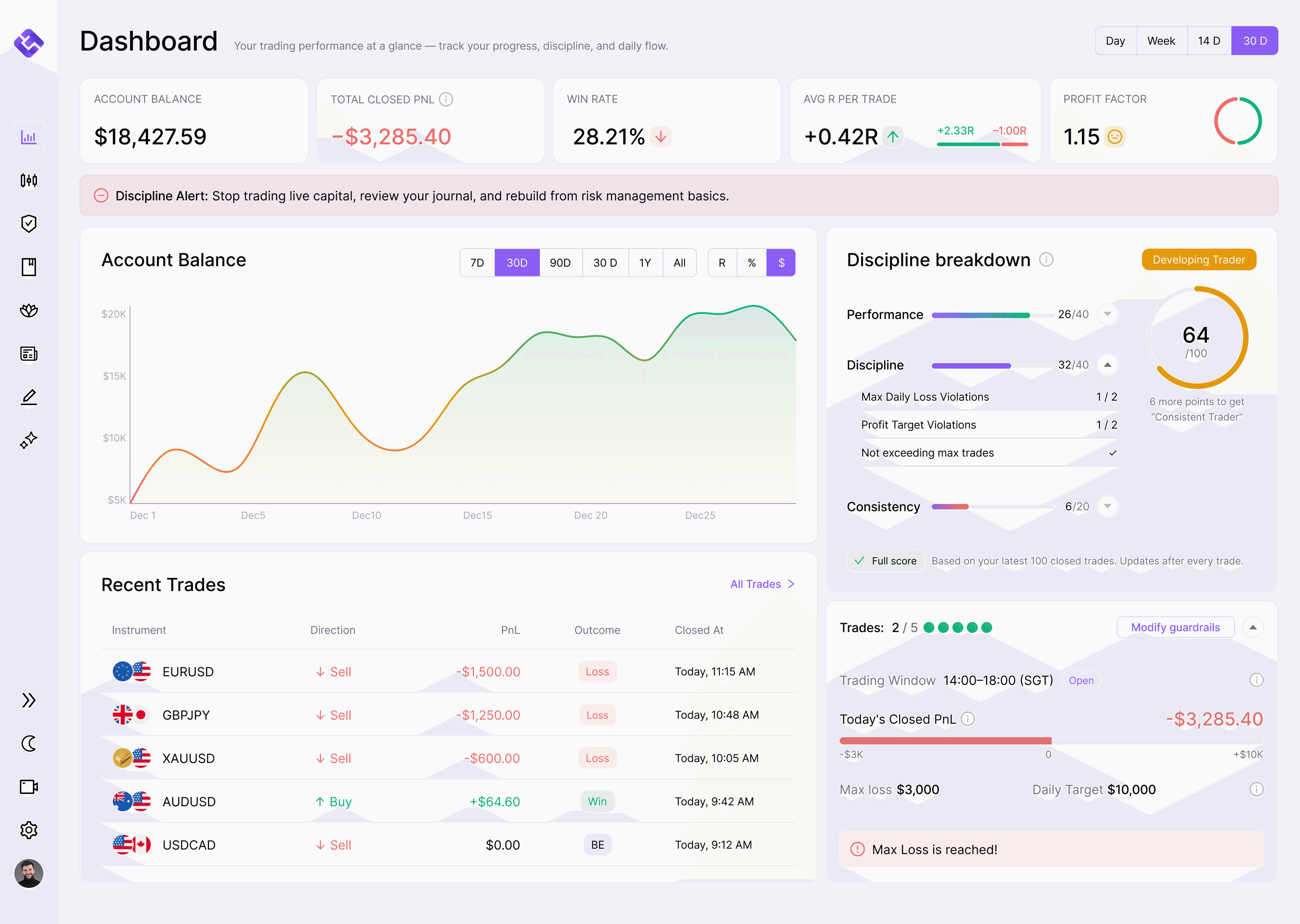
For Step 4, guardrails let you set your daily loss limit and max trade count. If you hit your limit, the trade button is restricted. You can override it, but you have to actively choose to break your own rule. That friction makes the decision conscious instead of automatic.
After each session, the journal auto-imports your trades and surfaces patterns over time, so tomorrow's pre-market review includes data, not just memory.
The Edge Brief
Receive Insights on trading psychology, discipline, and the behavioral patterns that create consistent traders from our Founder and the EdgeFlo team, delivered to your inbox.
Think different. Trade different.
What should a pre-market trading routine include?
How long should a pre-market routine take?
Why do traders skip pre-market preparation?
How do I stop overtrading during the session?

Turn discipline on.
Every session.
EdgeFlo is the environment serious traders operate inside.
Start 7-Day Free Trial
Cancel anytime.
No long-term commitment.

Think Different, Trade Different.