

5 Trading Mistakes That Drain Accounts (And How to Fix Each One)
The 5 most expensive trading mistakes beginners make, from wrong-timeframe bias to mid-range entries. Each one has a system-based fix.
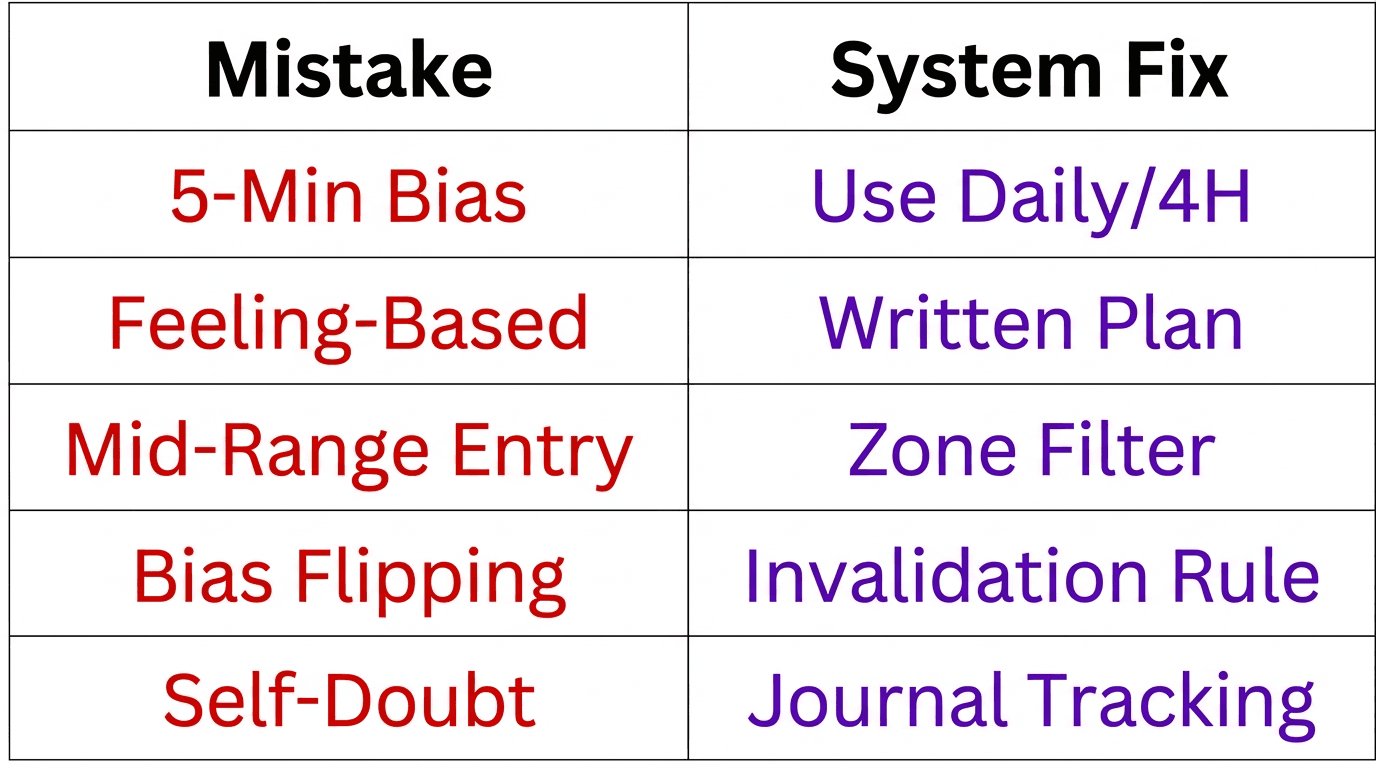
Most trading mistakes have nothing to do with picking the wrong entry. They're process failures. Finding bias on the wrong timeframe, trading feelings instead of a plan, entering mid-range, flipping your bias every candle, refusing to trust your own analysis after you set it.
These five account for the majority of avoidable losses among newer traders. And the fix for each one is not more screen time or more willpower. It's a system that removes the decision from the moment of pressure and moves it to a structured process you complete before the session starts.
TL;DR
Build directional bias on the daily or 4H chart first. The 5-minute chart is for execution timing, not direction.
Write your plan before the open, not in your head. A real bias has a direction, target, and invalidation point.
Stop trading the middle of the range. The highest-probability entries happen at premium and discount extremes.
Your bias only changes when your invalidation is hit. Not when a candle is red. Not when you feel uncertain.
Track bias accuracy separately from P&L. You might be right on direction and wrong on execution, and those are different problems.
Mistake 1: Using the 5-Minute Chart for Your Bias
One of the worst trading mistakes beginners make is building their daily directional bias from a low timeframe chart. The 5-minute chart shows noise. Every wick, every pullback, every fakeout looks like a signal.
You end up reacting to each move instead of trading around a broader structure.
The 5-minute chart is not the problem. Using it for the wrong job is. It's an execution tool, where you time entries after you already know your direction. Think of it like GPS turn-by-turn directions. Useful once you know your destination, but it can't tell you where you should be driving in the first place.
What Goes Wrong
You see three green candles and decide you're bullish. Two red candles later, you flip bearish. Your "bias" changes every few minutes.
You enter trades that look clean in isolation but fight the higher timeframe trend.
You overtrade because every small move looks like a setup.
A Wrong-Timeframe Mistake in Action
> EUR/USD, March 2025. A trader opens their 5-minute chart at the London open and sees price pushing up from 1.0835. Three strong bullish candles. They go long at 1.0842, placing a stop at 1.0830. But on the 4H chart, price had just tapped into a supply zone at 1.0850 after a multi-day downtrend. Within 20 minutes, price reversed hard, sweeping their stop and continuing to 1.0810. The 5-minute chart said "buy." The 4H chart said "you're buying into resistance in a downtrend." The 4H was right.
The Fix
Build your daily bias on the daily or 4-hour chart first. Where is price relative to key levels? What's the prevailing trend? Then drop to the 1-hour for confirmation. Only use the 5-minute for entry timing after your bias is set.
Higher timeframes carry more weight because they represent larger pools of capital and longer-term positioning. When your 5-minute setup aligns with your daily bias, probability improves. When it contradicts the daily, you're fighting the current.
A pre-market routine that walks you through higher timeframe analysis before the session eliminates the temptation to skip straight to the 5-minute chart.
Mistake 2: Trading Your Feelings Instead of Your Plan
"I feel bullish today." That's not a bias. That's a mood. And moods make terrible trading decisions.
A real directional bias has three components: a plan (what conditions must be true), a target (where price is likely heading), and an invalidation (what proves you wrong). If you can't state your bias in one sentence that includes all three, you don't have a bias. You have a feeling.
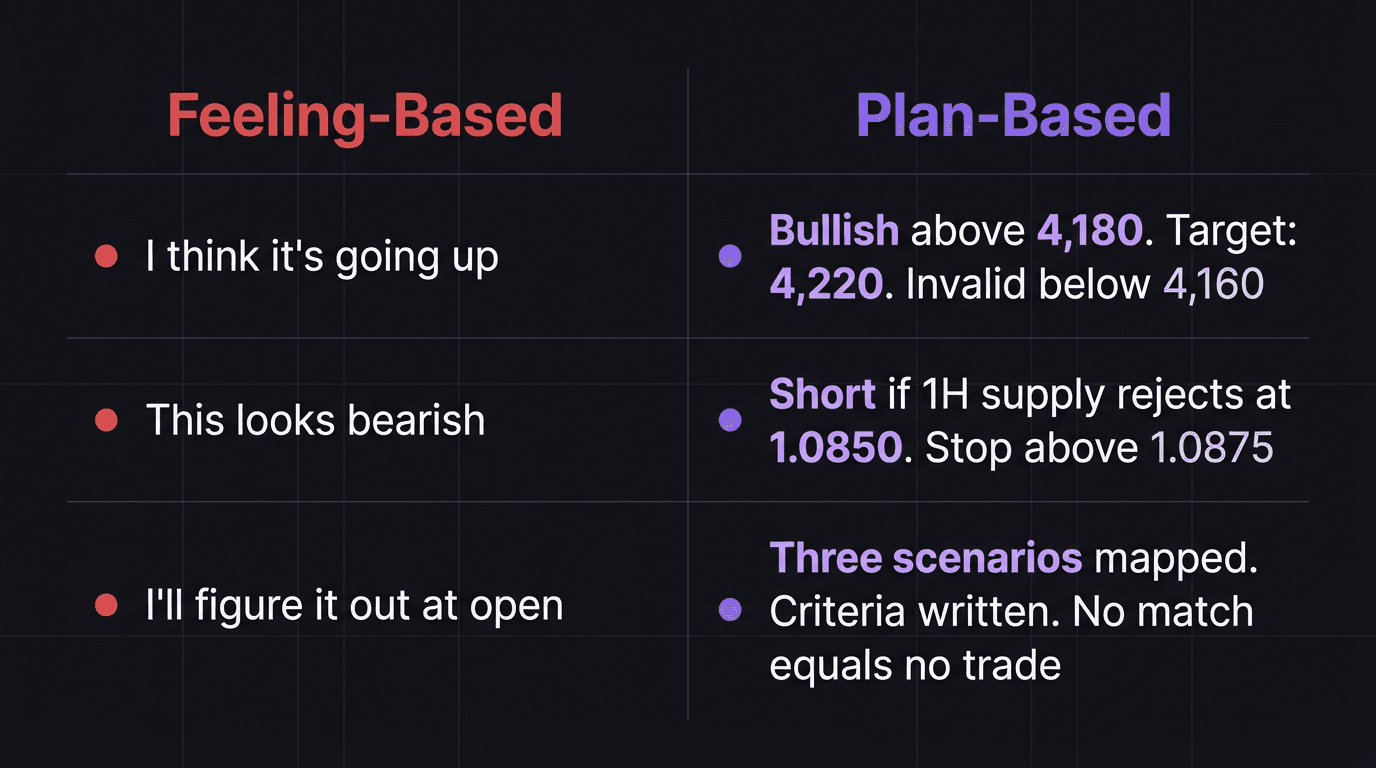
Feeling vs. Plan
Feeling-Based | Plan-Based |
|---|---|
"I think it's going up" | "Bullish above 4,180. Target: 4,220. Invalidation: close below 4,160" |
"This looks bearish" | "Short if price rejects the 1H supply zone at 1.0850. Stop above 1.0875" |
"I'll figure it out once the market opens" | "Three scenarios mapped. Entry criteria written. If none trigger, I sit out" |
Sound familiar? Most traders have sat in that left column more times than they'd like to admit.
The problem is that feeling-based trading feels productive. You're at the screen, watching price, placing trades. But without a defined plan, every trade is a coin flip wrapped in confirmation bias.
The Fix
Write your plan before the market opens. Not in your head. On paper or in a structured template. Include your directional bias, at least one entry scenario, your stop, and the condition that proves you wrong.
If the market doesn't meet your criteria, you don't trade. That last part is the hardest, and it's where most of these common trading mistakes actually live.
Mistake 3: Trading in the Middle of a Range
The middle of a range is what experienced traders call "no man's land." It's where retail traders donate money. The highest-probability trades happen at the extremes: at premium zones for shorts and discount zones for longs. The middle offers neither edge.
Would you buy a car when it's priced dead-center between retail and wholesale? Probably not. You'd wait for the discount. Same logic on a chart.
Why Mid-Range Entries Bleed Accounts
No directional pressure. Price in the middle can go either way with roughly equal probability.
Stops get hunted. Stops placed mid-range get clipped more often because price oscillates through this zone before committing.
Poor risk-to-reward. You're too far from the nearest level for a tight stop, and too far from the opposite extreme for a meaningful target.
Here's the math. If a stock ranges between $100 and $110, buying at $105 gives you $5 of upside and $5 of downside. That's 1:1 at best. Buying near $101 gives you $9 of upside with $1 of risk. Same stock, dramatically different trade.
The Fix
Before entering any trade, identify where price sits within the current range. If it's in the middle third, step aside. Wait for price to reach premium or discount before engaging. This single rule eliminates a surprising number of losing trades for most beginners.
This connects to overtrading too. Many traders overtrade because they feel compelled to always be in the market. Defining zones where you do not trade reduces trade count, improves win rate, and keeps capital safe during the lowest-probability conditions.
Mistake 4: Changing Your Bias Every Candle
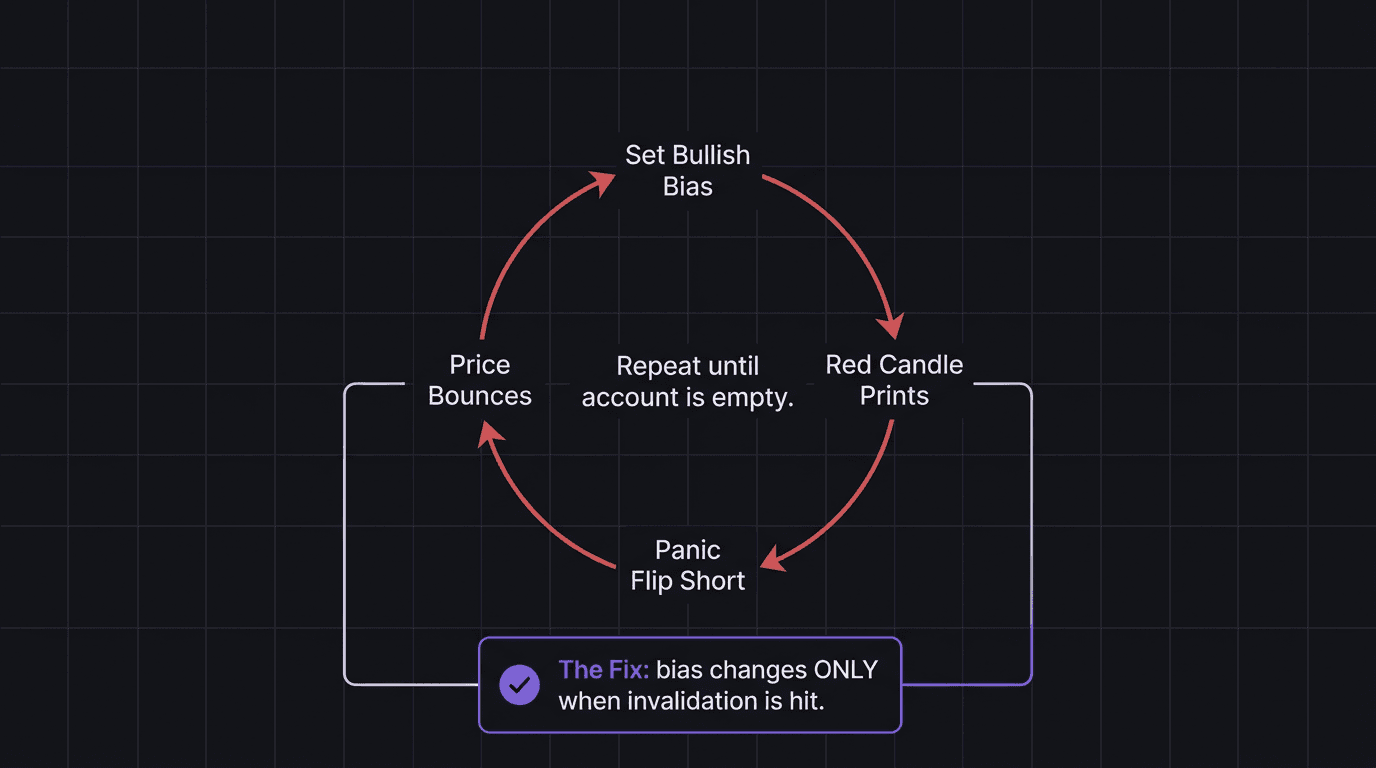
You set your bias before the session: bullish. Ten minutes in, a red candle prints. Now you feel bearish. Another green candle, bullish again.
This is not analysis. This is reacting.
Flipping your bias every candle leads directly to revenge trading. Each flip triggers a new trade. Each failed trade triggers another flip. The cycle burns through your account and your confidence at the same time.
Why This Happens
No invalidation point. Without a clear "I'm wrong if X happens," every move against you feels like the bias was wrong.
Anchored to the 5-minute chart (see Mistake 1). Small moves feel enormous.
Confusing pullbacks with reversals. In trending markets, pullbacks against your bias are normal. They're not signals to flip.
A Bias-Flipping Spiral
> GBP/USD, New York session. A trader sets a bullish bias based on a 1H market structure break above 1.2640. Price pulls back to 1.2625, a normal retracement. The trader panics, closes the long, and flips short at 1.2622. Price bounces from the discount zone at 1.2615 and rallies to 1.2680. The trader flips long again at 1.2660, chasing. By the end of the session, they've taken four trades, lost on three, and the original bias was correct the entire time. Total damage: three unnecessary losses and one reduced winner.
Ever watched yourself do exactly this and known halfway through the session that you were spiraling? That's the frustrating part. You can see the mistake happening in real time and still struggle to stop.
The Rule
Your bias only changes when your invalidation is hit. Not when a candle is red. Not when you feel uncertain. Not when someone on social media says the opposite. Only when the specific condition you wrote down before the session is reached.
Write this before the open: "My bias is [direction]. It changes only if [specific condition]." Then hold to it. If price hits your invalidation, accept it, reassess, and either set a new bias or stop trading for the session.
Mistake 5: Not Trusting Your Bias After Setting It
This one is subtler. You do the work. You analyze the higher timeframe. You write your plan. You set your bias. And then, when it's time to execute, you hesitate. You watch the perfect entry pass by because you didn't trust what you spent 30 minutes preparing.
Ever had that moment where you see the setup form exactly as you planned, and you still can't pull the trigger? You're not alone.
Where the Doubt Comes From
Not enough reps. You haven't practiced the bias-setting process enough to see it work consistently. Every trade still feels like a guess, even when valid analysis backs it.
Unresolved past losses. A previous trade where your bias was correct but the trade lost anyway (bad timing, wrong execution, or just normal distribution of outcomes) planted doubt. Now every correct bias still feels risky.
You don't build trust by shouting affirmations at yourself. Trust is built through a specific chain: consistency in process leads to competence, competence builds confidence, confidence creates conviction. Skip a step and the chain breaks.
The Fix
Track your bias accuracy separately from your trade outcomes. If your bias was correct 6 out of 10 days but your trades still lost money, the problem isn't your bias. It's your execution. A trading journal that separates bias accuracy from trade P&L gives you the data to see where the real breakdown is.
When you can see that your process works more often than not, trusting it becomes a matter of evidence, not emotion. The hesitation fades because you have proof.
How EdgeFlo Helps You Build the System
Every mistake on this list has the same root cause: relying on in-the-moment decisions instead of structured preparation. EdgeFlo is built around that idea.
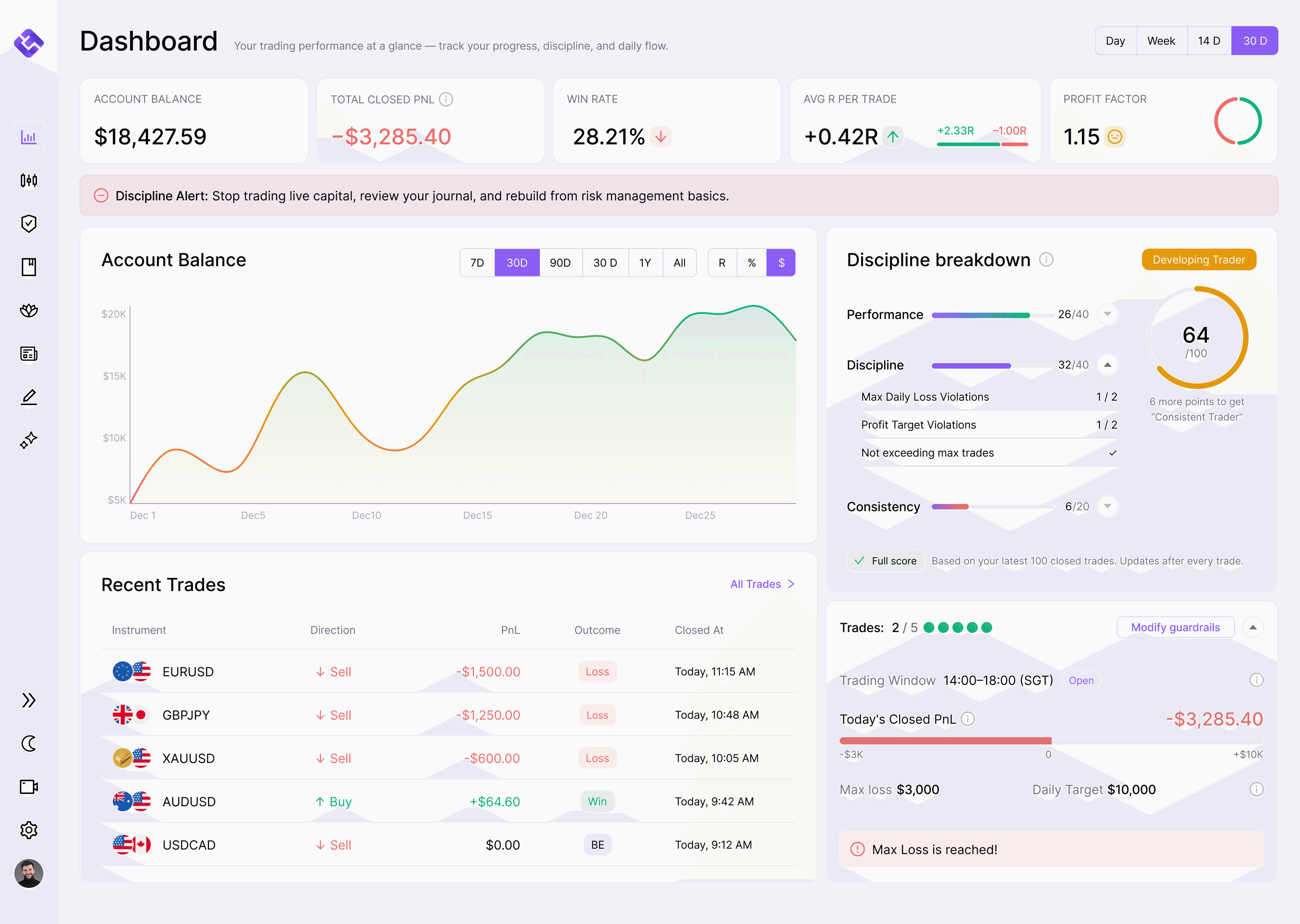
The pre-market checklist walks you through higher timeframe analysis, bias setting, and zone identification before the market opens. Guardrails flag when you hit your daily loss limit and add friction before your next trade (you can override, but you have to choose to). And the journal tracks your bias accuracy separately from P&L, so you build the evidence base that turns hesitation into conviction.
The traders who survive long enough to become profitable aren't the ones with the most willpower. They're the ones who built environments where good decisions are the default.
The Edge Brief
Receive Insights on trading psychology, discipline, and the behavioral patterns that create consistent traders from our Founder and the EdgeFlo team, delivered to your inbox.
Think different. Trade different.
What is the biggest trading mistake?
What is the 2% rule in trading?
What is the 84% rule in trading?
How do I stop making the same trading mistakes?

Turn discipline on.
Every session.
EdgeFlo is the environment serious traders operate inside.
Start 7-Day Free Trial
Cancel anytime.
No long-term commitment.

Think Different, Trade Different.