

Post-Trade Review: 10 Minutes That Compound Your Edge
A 10-minute post-trade review framework with five questions to ask after every trade. Includes a walkthrough of reviewing a losing trade.
A post-trade review is the ten minutes after closing a trade where you write down what happened, why you took it, and what you would change. Most traders skip this step entirely. The ones who do it consistently are the ones who actually improve.
Every chart, every session, every trade carries a lesson. But you only see it if you stop and look. A post-trade review forces that stop.
This article gives you a concrete 10-minute framework, five questions to run through after every trade, and a walkthrough of what a real losing-trade review looks like.
TL;DR
A post-trade review takes 10 minutes and covers context, execution, emotional state, and the one lesson worth remembering.
Five specific questions after each trade separate process quality from random outcomes.
Reviewing losing trades is where edge compounds fastest, but only if you focus on process, not the P&L number.
Winners who track and journal trades consistently outperform those who rely on memory and gut feel.
Why Most Traders Review Wrong (Or Not at All)
Here is what most traders do after a losing trade: close the chart, open a new one, and try to make the money back. Sound familiar?
And after a winning trade? Even worse. They screenshot the P&L, maybe post it somewhere, and move on feeling good. No notes on why the setup worked. No record of whether they actually followed the plan or got lucky.
Winners track their trades. They journal their trades. That is the difference between a trader who has three years of experience and a trader who has one year of experience repeated three times.
The most common trading mistakes come from repeating the same errors without realizing it. You revenge-trade the same pair. You move your stop on the same type of setup. You size up after wins and size down after losses. Without a review, these patterns stay invisible.
Some traders do review, but they focus on the wrong thing. They stare at the P&L. They second-guess the exit. They replay what the market did after they closed. None of that is useful. The market will do something different tomorrow. Your process is the only thing you can control.
The 10-Minute Review Framework
You do not need an hour. You need ten focused minutes. Here is how to split them.
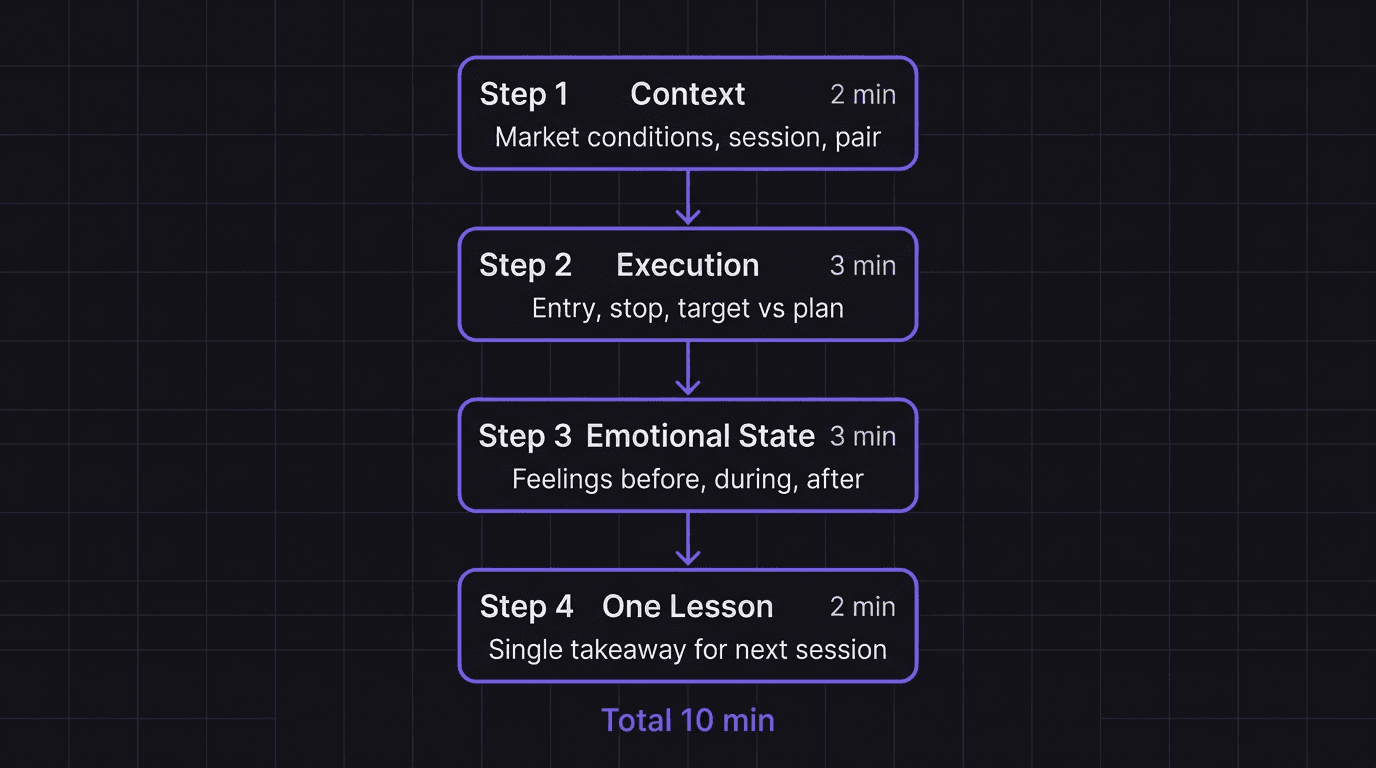
Minutes 1-2: Context. What pair did you trade? What session? What was the broader market doing? Was there news? Write two sentences, not two paragraphs. You are setting the scene, not writing a novel.
Minutes 3-5: Execution. Did your entry match your plan? Was your stop where you said it would be? Did you hit your target or adjust it mid-trade? This is the core of the review. Compare what you planned with what you actually did.
Minutes 6-8: Emotional state. How did you feel before the trade? During? After? This is where most traders get uncomfortable, and that is exactly why it matters. If you felt anxious before entry, write it down. If you moved your stop because you were scared, write it down. Every screenshot you take, every journal entry you write, builds a record of your emotional patterns.
Minutes 9-10: One lesson. Not five lessons. One. What is the single thing you would do differently? Or, if the trade was clean, what is the one thing you want to repeat? Write it as a sentence you could read before tomorrow's session.
A complete trading review process can include deeper analysis over weekends. But this daily 10-minute version is the minimum. Skip it and you are trading blind.
Five Questions to Ask After Every Trade
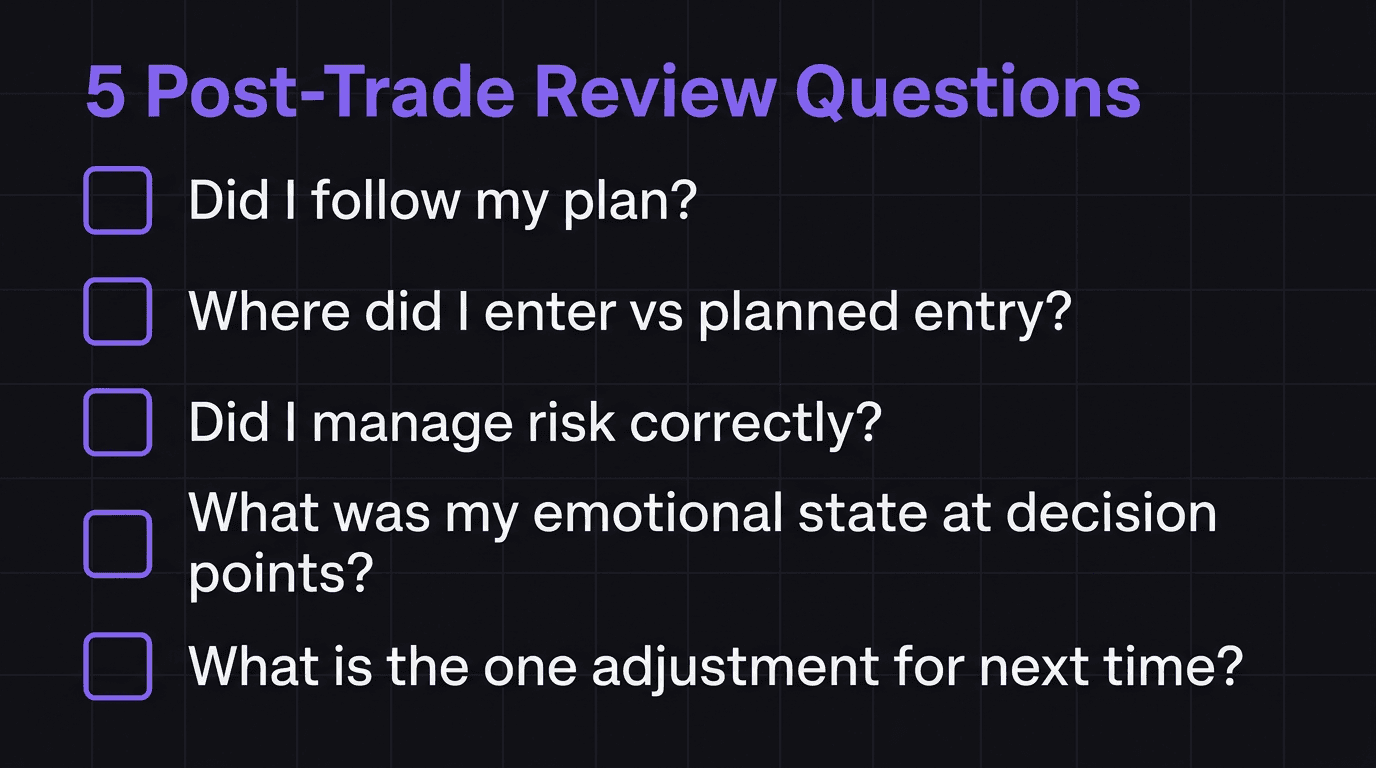
Keep these five questions somewhere you can see them. On a sticky note. In your trading journal template. On a whiteboard next to your screen.
1. Did I follow my plan?
This is the only question that matters for process. A trade can lose money and still be a good trade if you followed your rules. A trade can make money and still be a bad trade if you broke them.
2. Where did I enter relative to my planned entry?
Did you get in at your level, or did you chase? If you entered early because of FOMO, note it. If you waited and got a better fill, note that too. Patterns show up here fast.
3. Did I manage risk correctly?
Was your position size right? Did you move your stop? Did you add to a loser? Every losing trade you review for risk management teaches you something about how you handle pressure.
4. What was my emotional state at the decision points?
Not just "I felt fine." Get specific. Were you impatient at entry? Relieved at exit? Angry that it stopped you out? These emotional tags are the most underrated data in trading.
5. What is the one adjustment for next time?
Not a list of 10 things. One concrete change. "Wait for the candle close before entering." "Do not trade GBP pairs during NFP." "Size down when I have had two consecutive losses." Something you can act on in your next session.
Walkthrough: Reviewing a Losing Trade
Theory is fine. Seeing it in practice is better. Here is what a 10-minute review looks like on a real setup.
The Trade: EUR/USD Short on the 1H Chart
Setup: You spotted a lower high forming on EUR/USD 1H near 1.0870 during the London session. Your plan said short below 1.0865 with a stop at 1.0895 and a target of 1.0810. Risk was 1% of your account.
What happened: Price wicked through 1.0865 and you entered the short. It moved to 1.0845, then reversed hard on a USD data miss. Stopped out at 1.0895 for a full 1% loss.
The review:
Context (2 min): London session, EUR/USD, lower high on 1H. US data release at 8:30 AM EST was on the calendar. I saw it but thought price would hit target before the release.
Execution (3 min): Entry was at plan. Stop was at plan. But I knew there was a data release 40 minutes after entry and my target was 55 pips away. That is a plan problem, not an execution problem. The setup was valid but the timing was wrong.
Emotional state (3 min): I felt confident at entry. Too confident. I ignored the data release because the setup looked clean. After the stop hit, I felt frustrated and opened a new chart immediately looking for another trade.
One lesson (2 min): Do not enter swing trades within one hour of a scheduled USD data release. Add this as a rule.
That review took eight minutes to write. The lesson is specific, actionable, and prevents the same mistake. This is how edge compounds. Every losing trade that you review, every hour you spend refining your approach, stacks up over weeks and months.
Notice what the review did not include: "I should have held longer." "The market was rigged." "I need a better strategy." Those are not lessons. Those are feelings dressed up as analysis.
If you are forward testing a new setup, reviews become even more important. Each trade is a data point. Without the review, you are collecting data you never analyze.
How EdgeFlo Structures Your Reviews
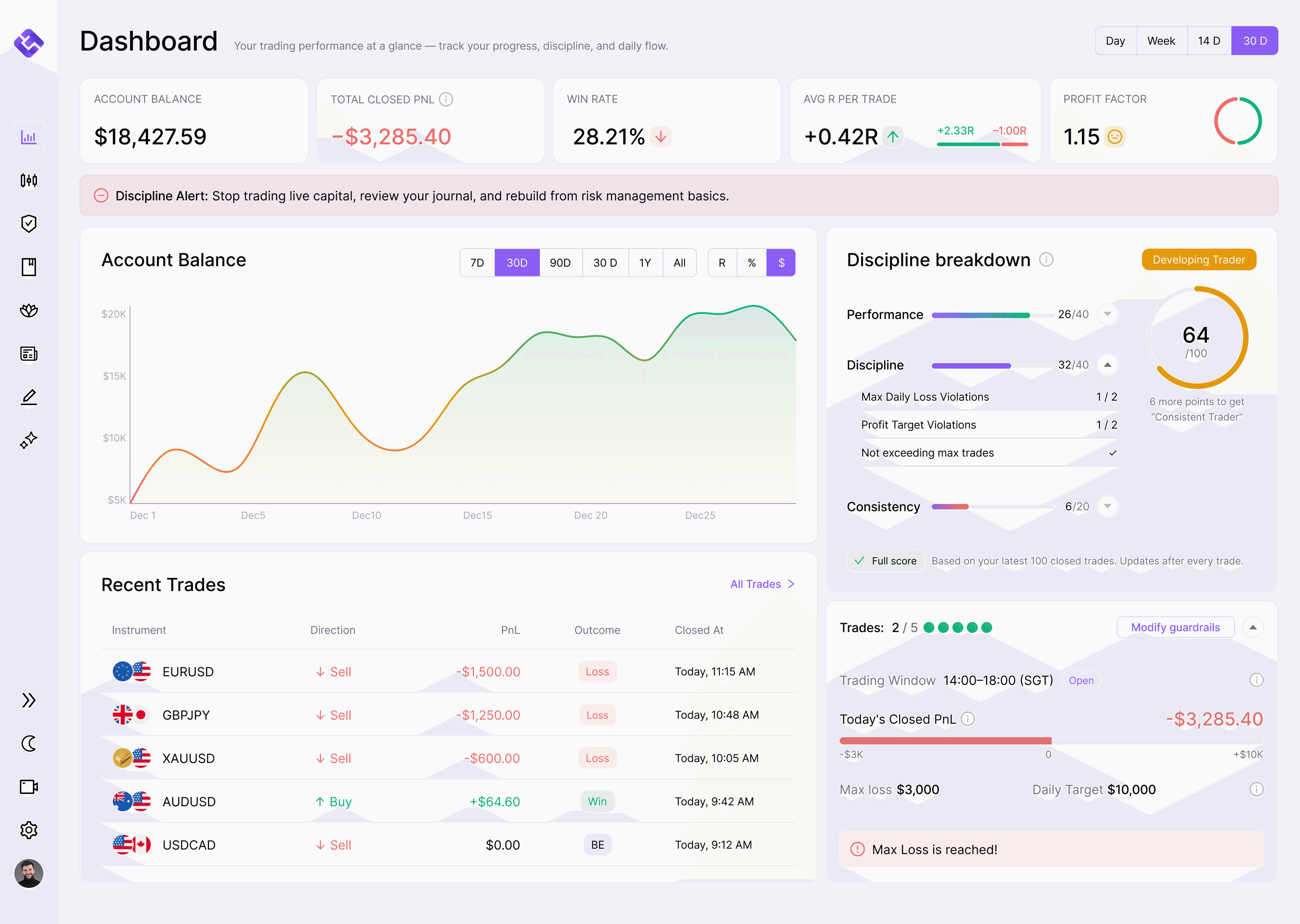
EdgeFlo's Edge plan builder includes post-trade self-reporting built into the workflow. After you close a trade, the journal entry is already structured around the questions that matter: what was the plan, what did you do, and what did you feel.
Emotion tagging on journal entries lets you label your state at each decision point. Over time, this builds a pattern map. You start seeing that your worst trades cluster around the same emotional triggers. That is the kind of data you can not get from a spreadsheet.
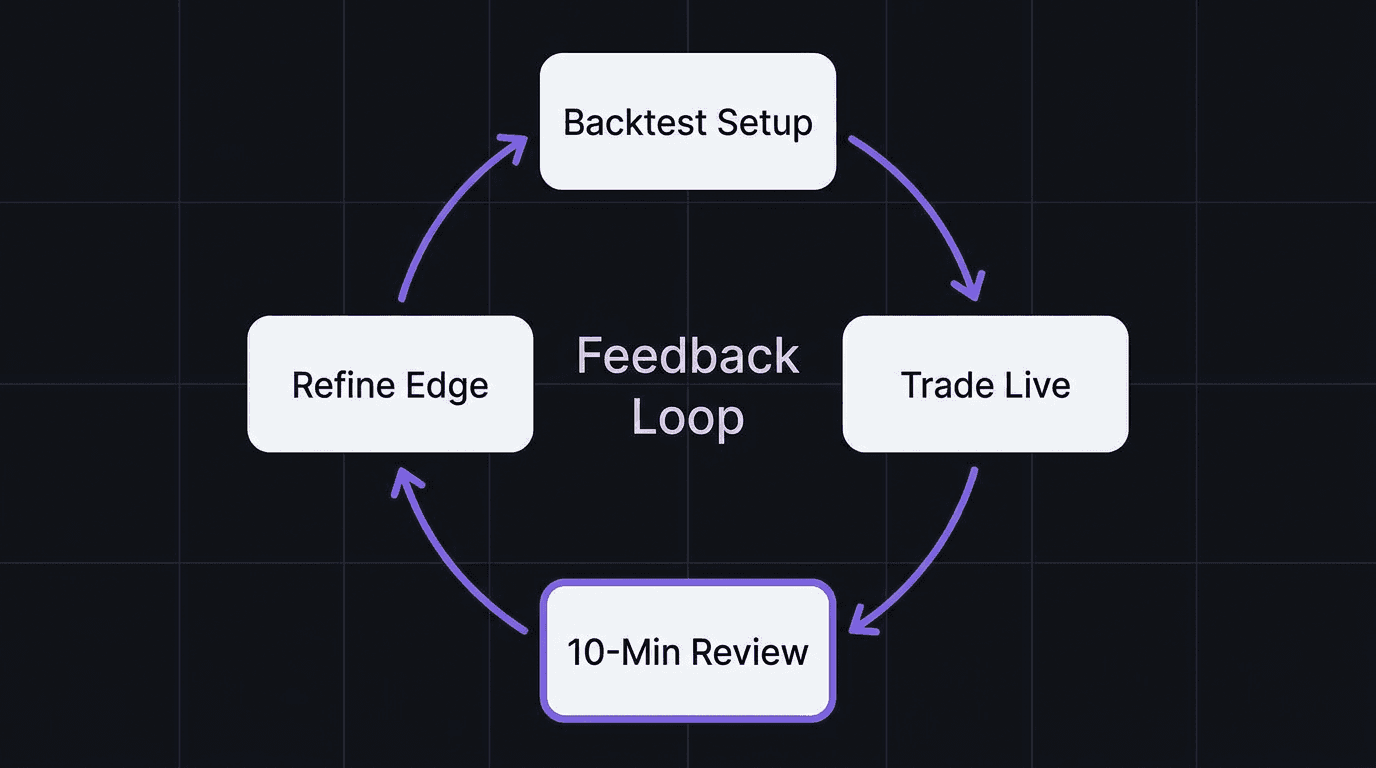
Combined with backtesting trading strategy records, your review data becomes a feedback loop. You test a setup, trade it live, review the results, and refine. That cycle is how a lifelong student approaches trading. Not by reading more books, but by extracting lessons from every session and feeding them back into the process.
The Edge Brief
Receive Insights on trading psychology, discipline, and the behavioral patterns that create consistent traders from our Founder and the EdgeFlo team, delivered to your inbox.
Think different. Trade different.
How long should a post-trade review take?
Should I review winning trades or just losing ones?
What is the most important question to ask in a post-trade review?
Can I do my post-trade review at the end of the day instead of after each trade?

Turn discipline on.
Every session.
EdgeFlo is the environment serious traders operate inside.
Start 7-Day Free Trial
Cancel anytime.
No long-term commitment.

Think Different, Trade Different.