

Forex Kill Zones: Pick One Session, Trade It Well
The four forex kill zones with exact times, active pairs, and realistic pip ranges. Plus how to pick one session and build your trading plan around it.
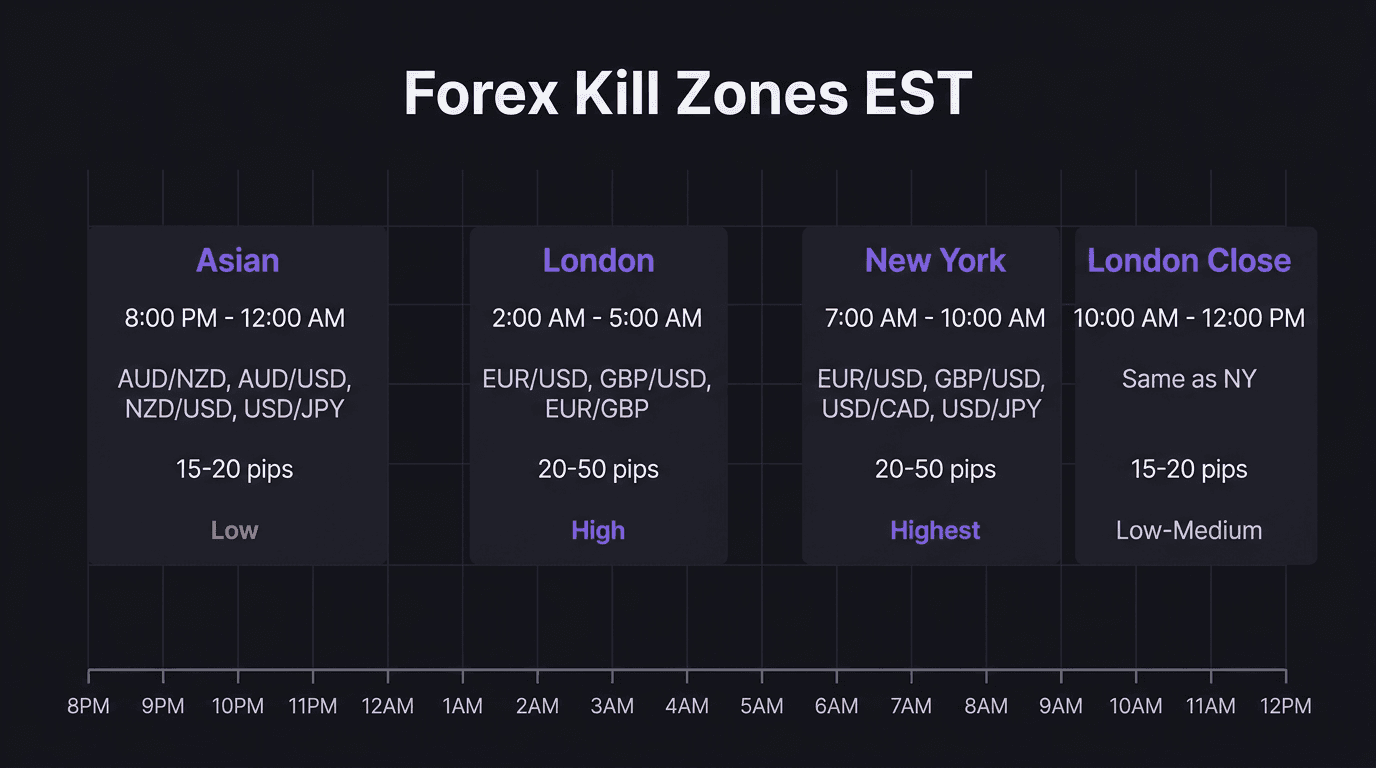
Forex kill zones are the four windows during the trading day when volume, volatility, and liquidity peak. The Asian session runs from 8:00 PM to 12:00 AM EST. London opens at 2:00 AM to 5:00 AM EST. New York fires up from 7:00 AM to 10:00 AM EST. And the London Close winds down from 10:00 AM to 12:00 PM EST.
If you are trading outside these windows, you are probably clicking into setups with zero momentum behind them. Like showing up to a flea market after every vendor has packed up. The stalls are still there, but nothing is moving.
The fix is simple but hard to execute: pick one kill zone, study how price behaves during those hours, and build your trading plan around that single session.
TL;DR
Four kill zones exist: Asian (low volume, tight ranges), London (first directional move), New York (highest volume, news risk), and London Close (mean reversion).
Pick one session that fits your schedule and pairs, then commit to it for at least 90 days.
London frequently sweeps Asian session highs or lows before making the real move of the day.
Trading all four sessions leads to fatigue, scattered pattern recognition, and inconsistent results.
Your kill zone choice belongs in your trading plan with specific pairs, entry criteria, and a hard stop time.
What Kill Zones Are (and Why They Matter)
A kill zone is a time window where institutional activity concentrates. Banks, hedge funds, and large institutions place the bulk of their orders during these periods. That concentrated order flow creates the volume and volatility you need for clean entries and directional moves.
Outside kill zones? The market drifts. Spreads widen. Fakeouts multiply. You take trades that look fine on the chart but go nowhere because there is no real participation behind them.
Ever wondered why your setup looked perfect but price just sat there? You were probably trading in dead hours.
The four kill zones map to the major forex sessions around the world. Each one has a distinct personality: different pairs move, different pip ranges are realistic, and different patterns show up.
Kill Zone | Time (EST / UTC-4) | Active Pairs | Typical Range | Volume |
|---|---|---|---|---|
Asian | 8:00 PM - 12:00 AM | AUD/NZD, AUD/USD, NZD/USD, USD/JPY | 15-20 pips | Low |
London | 2:00 AM - 5:00 AM | EUR/USD, GBP/USD, EUR/GBP | 20-50 pips | High |
New York | 7:00 AM - 10:00 AM | EUR/USD, GBP/USD, USD/CAD, USD/JPY | 20-50 pips | Highest |
London Close | 10:00 AM - 12:00 PM | Same as NY | 15-20 pips | Low-Medium |
You do not need to memorize all four. You need to understand which one fits your life and your preferred pairs.
The Asian Kill Zone
Time: 8:00 PM to 12:00 AM EST (UTC-4)
The Asian session covers Tokyo and Sydney. Volume is the lowest of the four windows. USD pairs tend to consolidate, which means price often trades in a tight range.
That tight range matters more than it looks. Asian session highs and lows become liquidity levels that London frequently targets later. Think of the Asian range as a trap that gets set overnight, waiting for London to spring it.
Who trades this
If you work a 9-to-5 in North America, the Asian session falls during your evening. You can watch price after dinner without a 2:00 AM alarm. The tradeoff: smaller moves and fewer setups.
Pairs: AUD/NZD, AUD/USD, NZD/USD, USD/JPY.
Expect: 15-20 pip moves. Do not expect big directional runs here. The value is precision on smaller moves, not size.
The London Kill Zone
Time: 2:00 AM to 5:00 AM EST (UTC-4)
London is where the forex market wakes up. European institutional desks open, volume surges, and you get the first real directional move of the day.
The Asian sweep pattern
Here is the pattern that makes London so tradeable: price sweeps the Asian session high or low, grabs that liquidity, and then moves in the true daily direction. If the daily bias is bullish, London often sweeps the Asian low first, then rallies.
This interplay between the Asian range and London's liquidity sweep is one of the most reliable setups in forex. Wait for the sweep, confirm a market structure shift, then enter.
Who trades this
European traders get this during normal morning hours. For North American traders, it means 2:00 AM to 5:00 AM. Not casual. But many serious traders pick London specifically because the setups tend to be cleaner.
Pairs: EUR/USD, GBP/USD, EUR/GBP.
Expect: 20-50 pip moves. Some of the cleanest directional setups of the day, but you have to actually be awake for them.
Example: London Sweeps the Asian Low on GBP/USD
> On a Tuesday in late February, GBP/USD ranged between 1.2640 and 1.2668 during the Asian session. At 2:15 AM EST, price dipped to 1.2635, sweeping below the Asian low by 5 pips and triggering stop losses clustered below 1.2640. Within 20 minutes, a bullish displacement candle printed on the 15-minute chart, breaking back above 1.2640 and shifting structure to the upside. A trader who waited for that structure shift entered long at 1.2648 with a stop below 1.2630. Price rallied to 1.2710 by 4:30 AM, a 62-pip move. The setup worked because the trader waited for confirmation instead of guessing the sweep was done.
The New York Kill Zone
Time: 7:00 AM to 10:00 AM EST (UTC-4)
New York brings the highest volume of any kill zone. London and New York overlap here, so both European and American institutions are active at the same time. Two heavyweights in the ring at once.
This is also where most high-impact news drops. NFP, CPI, FOMC: they hit during this window and can create sharp, fast moves.
The London retrace pattern
A common New York setup: price retraces back into the London range. If London pushed price up aggressively, New York often pulls back into supply and demand zones within that range before continuing (or reversing). That pullback gives you entries.
Who trades this
If you are in North America, this is your most accessible kill zone. 7:00 AM to 10:00 AM fits a normal morning. The tradeoff: news-driven volatility adds a layer of risk. You need clear rules for how you handle economic releases.
Pairs: EUR/USD, GBP/USD, USD/CAD, USD/JPY. Any USD pair gets elevated volume here.
Expect: 20-50 pip moves. Strong volume means strong moves, but news events mean you need a plan for the first few minutes after a release.
The London Close
Time: 10:00 AM to 12:00 PM EST (UTC-4)
The London Close is the tail end of the European session. Volume drops as European desks wind down. Price often retraces toward the daily mean, pulling back from whatever extremes London and New York established.
Think of it like the tide going out. The big waves already happened. Now the water settles back to where it started. That is your mean-reversion window.
Who trades this: Traders who want a midday session in North American time. Less intense than London or New York, which suits people who prefer calmer conditions. Fewer setups, smaller moves.
Pairs: Same as the New York session.
Expect: 15-20 pip moves. Not where you find the big runs. Where you find smaller, controlled pullbacks.
How to Pick Your Kill Zone
This is the single biggest decision most beginners skip. They learn about all four sessions and try to trade them all. That path leads to fatigue, scattered focus, and blown confidence.
So why does everyone try it? Because it feels like more screen time equals more profit. It does not.
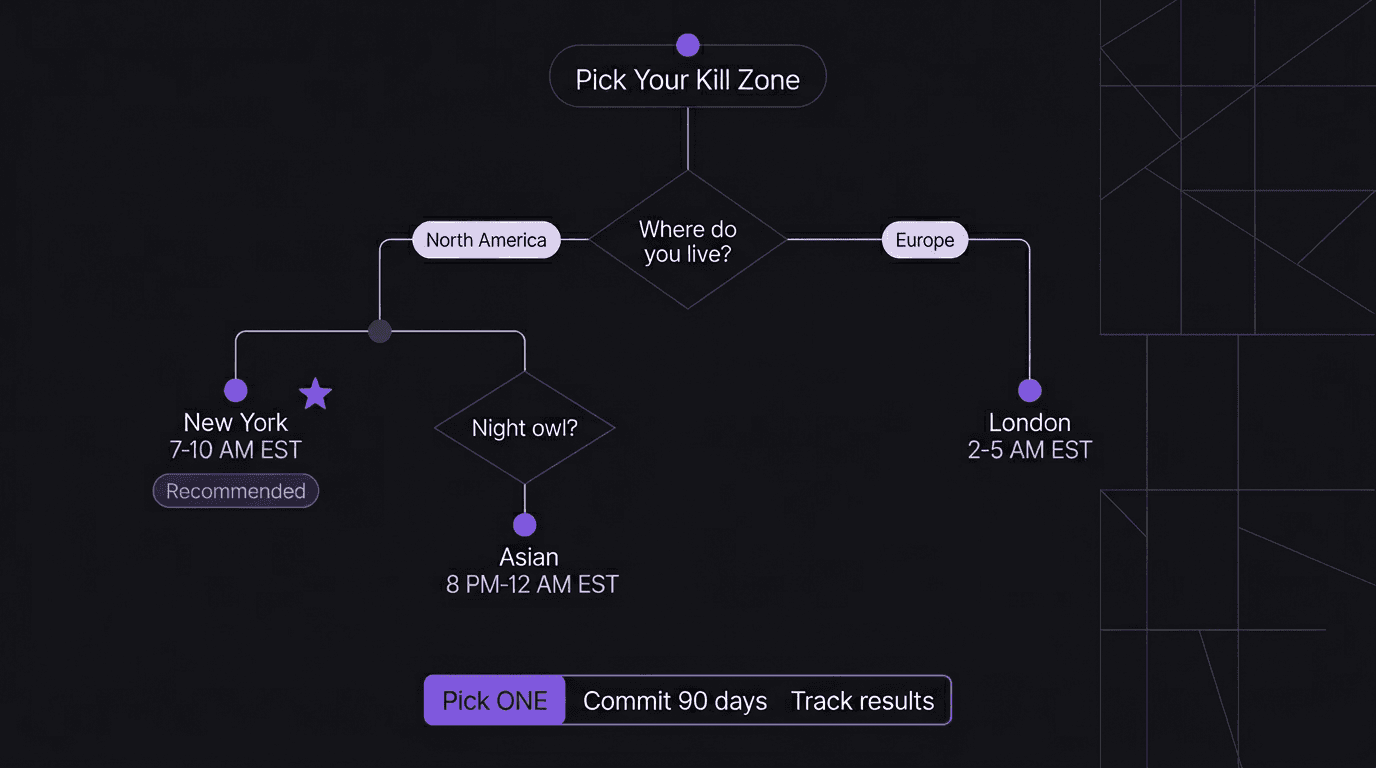
Pick one. Commit for at least 90 days. Here is what should drive your choice:
1. Your schedule. If you cannot be alert and focused during a kill zone, do not trade it. A drowsy trader at 3:00 AM makes worse decisions than no trader at all. Be honest about when you are actually sharp.
2. Your pairs. If you trade EUR/USD and GBP/USD, the Asian session is not your window. Match your kill zone to the pairs that move during those hours.
3. Your life. Trading should fit your life, not consume it. If waking up at 2:00 AM wrecks your sleep and your relationships, that cost shows up in your P&L. Pick the session you can sustain for months without burning out.
Once you pick, backtest it. Pull up 30-60 days of price action during that window. Document what setups appear, how price behaves, what your win rate looks like. Build data before you build confidence.
Example: The Mistake of Trading Every Session
> A trader (based in Chicago) decided to "maximize opportunity" by trading all four kill zones. He started with the Asian session at 8:00 PM, moved to London at 2:00 AM, traded the New York open at 7:00 AM, then stuck around for the London Close at 10:00 AM. By 11:00 AM, he had been watching charts for over 14 hours. During his first week, his Asian and London results were decent: 3 wins out of 4 trades. But his New York and London Close trades were a disaster: 1 win, 5 losses. He was taking trades out of fatigue, not conviction. The entries he skipped in hour one, he chased in hour twelve. After two weeks of net-negative results despite a solid strategy, he cut down to New York only. His win rate jumped from 38% to 56% within a month. The strategy did not change. His energy did.
Kill Zones in Your Trading Plan
A kill zone is not just a time to watch charts. It is a structural piece of your trading plan.
Your plan should specify:
Which kill zone you trade. One. Written down.
Which pairs you focus on. Two to three max.
Entry criteria specific to that session. London sweeps are different from New York retracements. Your setups should reflect your chosen window.
News rules. Especially for New York: do you trade through releases, or wait 15 minutes?
Start and stop time. A kill zone is a window, not an obligation. If your setup does not show in the first 90 minutes, close the charts. That discipline is what separates traders who fear missing out from traders who protect their edge.
How many times have you stayed past your planned stop time "just in case"? That is the habit your plan needs to kill.
How EdgeFlo Supports Kill Zone Discipline
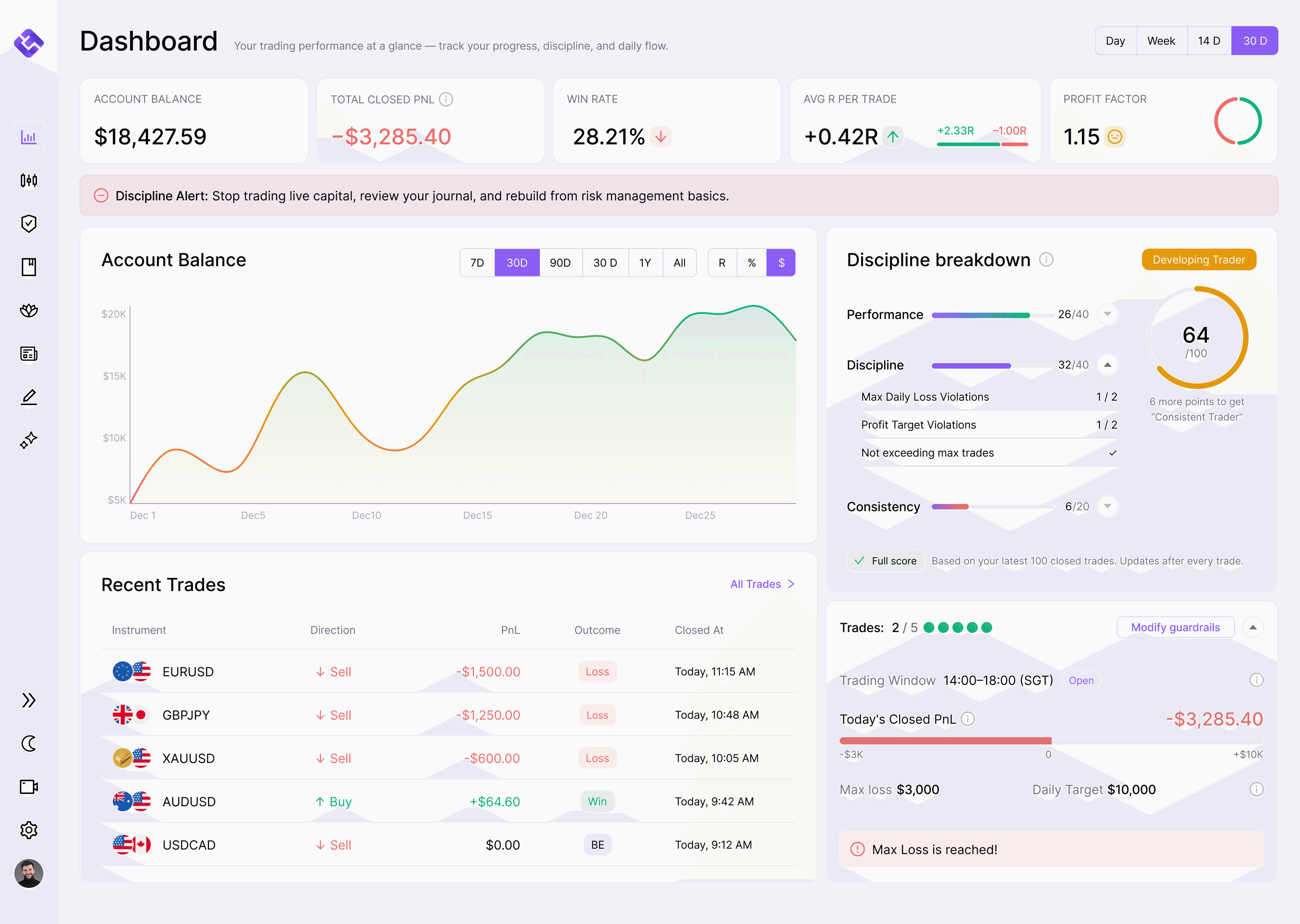
EdgeFlo's Edge Plan Builder lets you set session-specific rules that stay visible while you trade. You write down which kill zone, which pairs, and what conditions must be met. When your session starts, your plan sits next to your chart.
Guardrails can flag trade attempts outside your chosen session window. If you set active hours to 7:00 AM to 10:00 AM, trades outside that window require a deliberate override. You can still place them, but the friction is intentional. It makes you pause and ask: "Is this part of my plan?"
Your trade journal tags each trade by session. Over time, you see your win rate broken down by kill zone and time of day. That data tells you whether your chosen session actually produces results, or whether you need to adjust.
The Edge Brief
Receive Insights on trading psychology, discipline, and the behavioral patterns that create consistent traders from our Founder and the EdgeFlo team, delivered to your inbox.
Think different. Trade different.
What are kill zones in forex?
What time is the New York kill zone?
Which forex kill zone is best for beginners?
Why should I only trade one kill zone?

Turn discipline on.
Every session.
EdgeFlo is the environment serious traders operate inside.
Start 7-Day Free Trial
Cancel anytime.
No long-term commitment.

Think Different, Trade Different.