

4 Trading Fears That Wreck Your Execution
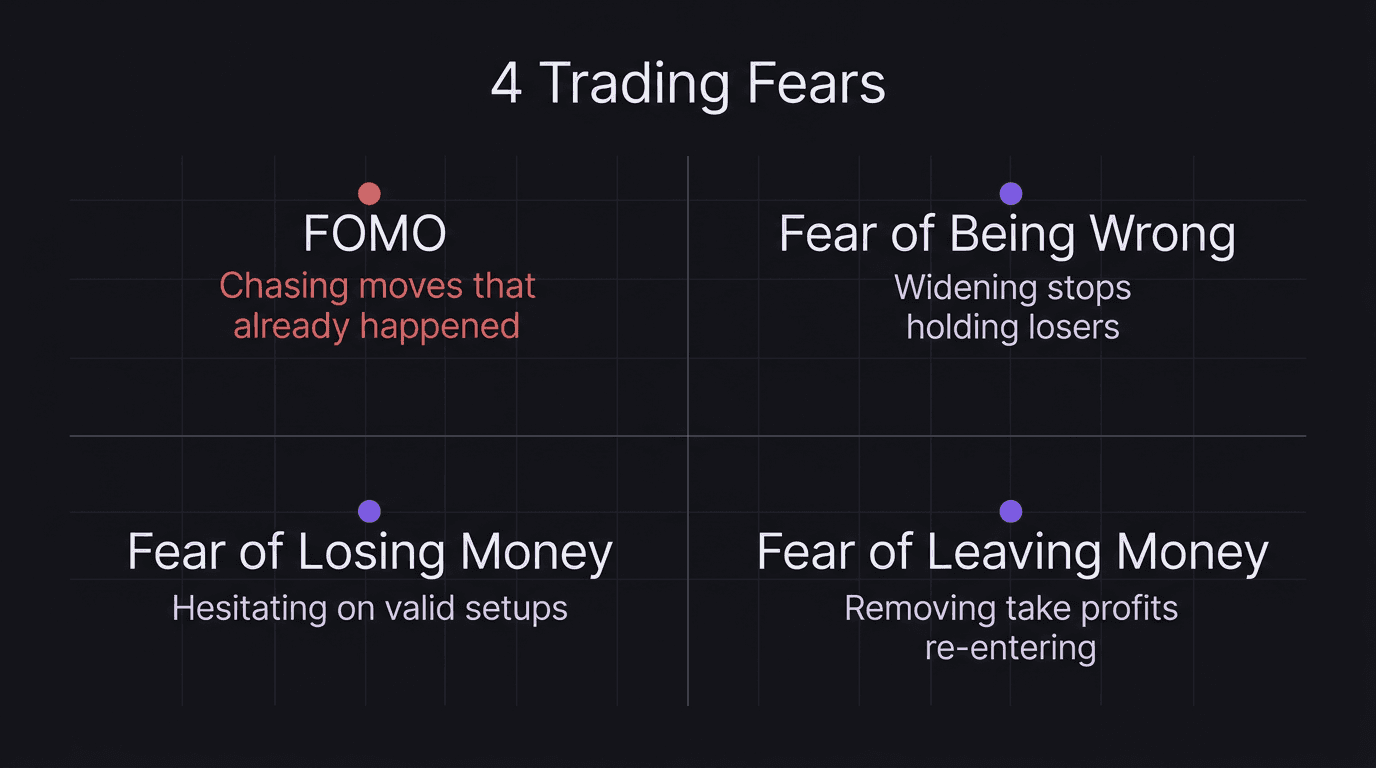
Trading fear comes in four forms: FOMO, fear of being wrong, fear of losing money, and fear of leaving money on the table. Here are system-based fixes for each.
Trading fear is the hesitation that stops you from pulling the trigger on a valid setup, or the panic that makes you break every rule you wrote down last weekend. It shows up as four distinct problems: FOMO, fear of being wrong, fear of losing money, and fear of leaving money on the table.
Each one wrecks your execution in a different way. And willpower alone will not fix any of them.
What actually works is building structure: rules, limits, and environments that make fear irrelevant to your process. Not gone. Just irrelevant.
TL;DR
Trading fear is not one thing. It splits into four types: FOMO, fear of being wrong, fear of losing money, and fear of leaving money on the table. Each needs a different fix.
Willpower fails under pressure. Structure beats discipline every time. Pre-defined rules, position sizing, and daily loss limits do the heavy lifting.
FOMO entries almost always underperform planned entries. Your journal data will prove this faster than any mindset work.
Fear of loss usually means your account size is wrong. If losing a trade would affect your rent, the problem is capital, not psychology.
Concrete examples and reps build conviction. Backtesting and 100+ trades on one system shrink fear faster than reading about it.
What Trading Fear Actually Is
Fear in trading is not about the market. It is about uncertainty.
You sit down, see a setup that matches your criteria, and freeze. Your finger hovers over the button. Maybe the entry is too late. Maybe the news will go against you. Maybe this is the trade that blows your account.
So you do nothing. Or worse, you do something stupid.
That gap between seeing a valid setup and acting on it? That is trading fear. It fires before the trade, not during it.
The root cause is almost always one of two things:
You have not tested your edge enough to trust it. Without proof that your system works over a meaningful sample, every trade feels like a coin flip with real money. Backtesting your strategy is the fastest way to close this gap.
You have no pre-defined plan for the trade. When you improvise, you carry the full weight of every decision in real time. That cognitive load creates anxiety, and your brain reads anxiety as danger.
The goal is not to feel no fear. It is to build systems where your decisions do not depend on how you feel.
Fear of Missing Out (FOMO)
FOMO is the urge to chase a move that already happened. You see EUR/USD spike 70 pips on NFP, your planned entry is long gone, but the candle is still green. So you jump in with no setup, no edge, no plan.
Why FOMO Is So Destructive
You enter trades that do not match your criteria
You skip risk management because you are rushing
You increase size to "make up" for the move you missed
You end up in a revenge trading cycle after the loss
FOMO is not greed. It is the belief that this opportunity is unique and will not come back. That belief is almost always wrong. Quality setups repeat. Think of it like missing your bus. There is another one in 15 minutes. You do not need to sprint into traffic.
Example: Chasing GBP/USD at London Open
> A trader watches GBP/USD gap up 45 pips at the London open on March 14, moving from 1.2680 to 1.2725 in the first 15 minutes. Their plan called for a pullback entry at the 1.2700 level after a liquidity sweep, but the pair never pulled back. It just kept running. At 1.2740, they jumped in long with no setup and doubled their normal position size to "catch up." GBP/USD reversed at 1.2755 (right into a premium zone), hit their stop at 1.2710 for a 30-pip loss at 2x size. That single FOMO trade wiped out three days of planned wins.
The planned pullback entry never triggered that day. And that is fine. There was a clean setup the next morning.
The Fix
Accept that there is always another trade. Markets open every day.
Write down your exact entry criteria. If current price action does not match, you do not trade. Period.
Set a max trades per day limit. When you know you only get three shots, you stop being reactive and start being selective.
Tag emotional state in your trade journal. Over 20-30 trades, compare FOMO entries against planned entries. The performance gap usually kills the urge faster than any mindset technique.
Fear of Being Wrong
This one is ego-driven. You take a trade, it moves against you, and instead of cutting the loss, you widen your stop. You hold. You add to the position. You tell yourself the market will come back.
Why? Because closing the trade means admitting you were wrong.
How It Shows Up
Widening stop losses after entry
Holding losers far past your invalidation point
Averaging down without a plan
Avoiding your trading journal because you do not want to see the results
Repeating the same trading mistakes because you never review them
Ever caught yourself moving a stop loss "just 10 more pips" because you were not ready to take the L? That is this fear running the show.
The Fix
Separate being right from making money. Professional traders are wrong on 50-60% of their trades. That is not failure. With a 1:2 risk-reward ratio and a 40% win rate, you are profitable. Being wrong on individual trades is built into the math.
Pre-define your exit before entry. Write your stop loss and take profit before you click buy. No exceptions.
Set a daily loss limit. A daily cap removes the temptation to hold losers "just a little longer." When you hit it, you are done.
Do more reps. Fear of being wrong shrinks with volume. After 100 trades on the same system, you stop caring about any single result because you have watched the edge play out over a real sample.
Fear of Losing Money
This is the most straightforward fear, and it does the most obvious damage. You are afraid of losing capital, so you either avoid trading entirely or take positions so small they cannot generate meaningful returns.
Here is the paradox: traders who fear losing money tend to overlever when they finally do trade, trying to make back what they "should have" earned while they sat out. Fear of loss creates the exact overleveraged blowup it was trying to prevent.
How It Shows Up
Hesitating on valid setups (the classic "fear of pulling the trigger")
Taking tiny positions that cannot move the needle
Then overleveraging the next trade out of frustration
Trading with money you cannot afford to lose, which amplifies every emotion
Example: The Undersized-to-Overleveraged Cycle
> A trader with a $5,000 account watches three valid EUR/JPY setups pass during the London kill zone without entering because they are afraid of losing. Each setup plays out for 40-60 pips in the planned direction. Frustrated after watching $300+ in missed gains, they enter the fourth setup at 3x their normal position size, skipping their usual supply and demand confirmation. EUR/JPY reverses. They lose $450 on a single trade because their sizing was emotional, not mechanical. The fear of losing $50 on a normal-sized trade led to a $450 loss on a revenge-sized one.
The Fix
Control what you risk, not what you feel.
Trade with money you can genuinely afford to lose. If losing your trading capital would affect rent or bills, your fear is rational. The problem is account size, not psychology.
Use fixed-percentage position sizing. Risk 1-2% per trade. When you know the worst case on any single trade is $50-100 on a $5,000 account, fear has less to feed on.
Start with micro lots. Prove your system works at small size before scaling. The goal at the start is not profit. It is building the track record that gives you conviction.
Fear of Leaving Money on the Table
You had a winning trade. It hit your take profit. You closed it. Then the market kept going another 100 pips in your direction.
Now you are angry. Next time, you hold past your target. The trade reverses. You give back your profits. Sound familiar?
This fear drives overtrading: the compulsion to capture every move and never miss a pip.
How It Shows Up
Removing take profit targets to "let winners run" without a trailing plan
Re-entering after a winning trade because "there is more to get"
Trading every session, every pair, every setup until you are exhausted
Never feeling satisfied with profitable days
The Fix
You do not need the whole pie. You need your slice, consistently. No one captures every move. Trying to turns a disciplined strategy into random gambling.
Master one setup. One pattern, one timeframe, one market. When you narrow your focus, you stop chasing and start executing. Think sniper, not machine gun.
Define your take profit before entry and honor it. If your system says exit at 1:2 R:R, exit at 1:2 R:R. What happens after you close is irrelevant to your process.
Track your "what if I held" data. Record what would have happened if you stayed in. Over 50 trades, you will usually find that planned exits outperform "let it run" exits. Data replaces emotion.
Why Willpower Always Fails
Every trader who has tried to "just be disciplined" already knows this. You commit to following your rules on Sunday night. By Tuesday afternoon, after two stop-outs and a missed entry, you are back to emotional trading. You widen a stop. You chase a move. You double your size.
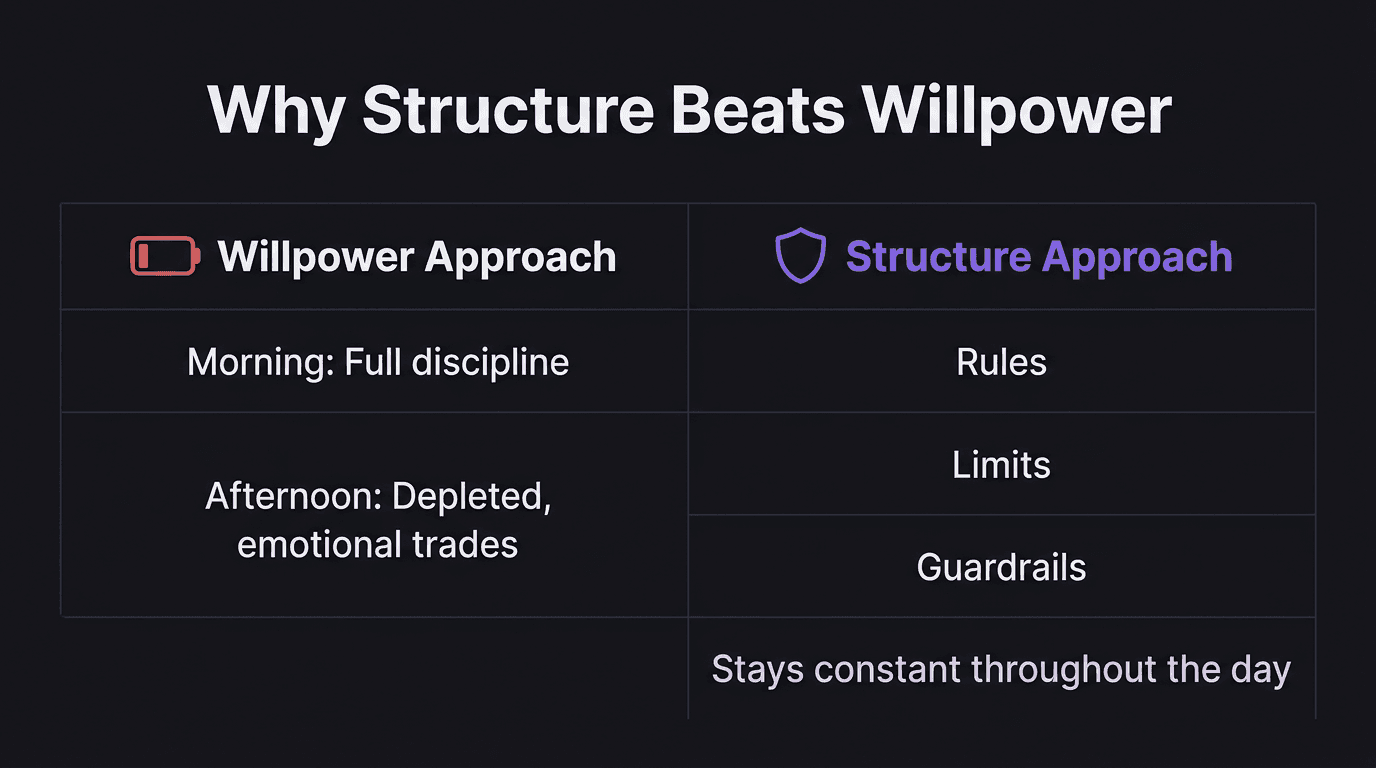
Why does this keep happening? Because willpower is a depletable resource. It is like a phone battery. Full charge in the morning, dead by 2 PM if you have been running apps nonstop. When cortisol spikes and your P&L is red, the rational part of your brain takes a back seat. You cannot think your way out of a fear response in real time.
The traders who actually handle fear are not the ones with iron willpower. They are the ones who built environments where fear-driven decisions are harder to execute. They front-loaded their discipline into rules, limits, and systems. When fear shows up (and it always does), the structure holds even when their resolve does not.
A solid pre-market routine is one of the simplest ways to front-load that structure before the session starts.
How EdgeFlo Helps You Trade Through Fear
The four trading fears never fully go away. Experienced traders still feel them. The difference is that they have systems making fear irrelevant to execution quality.
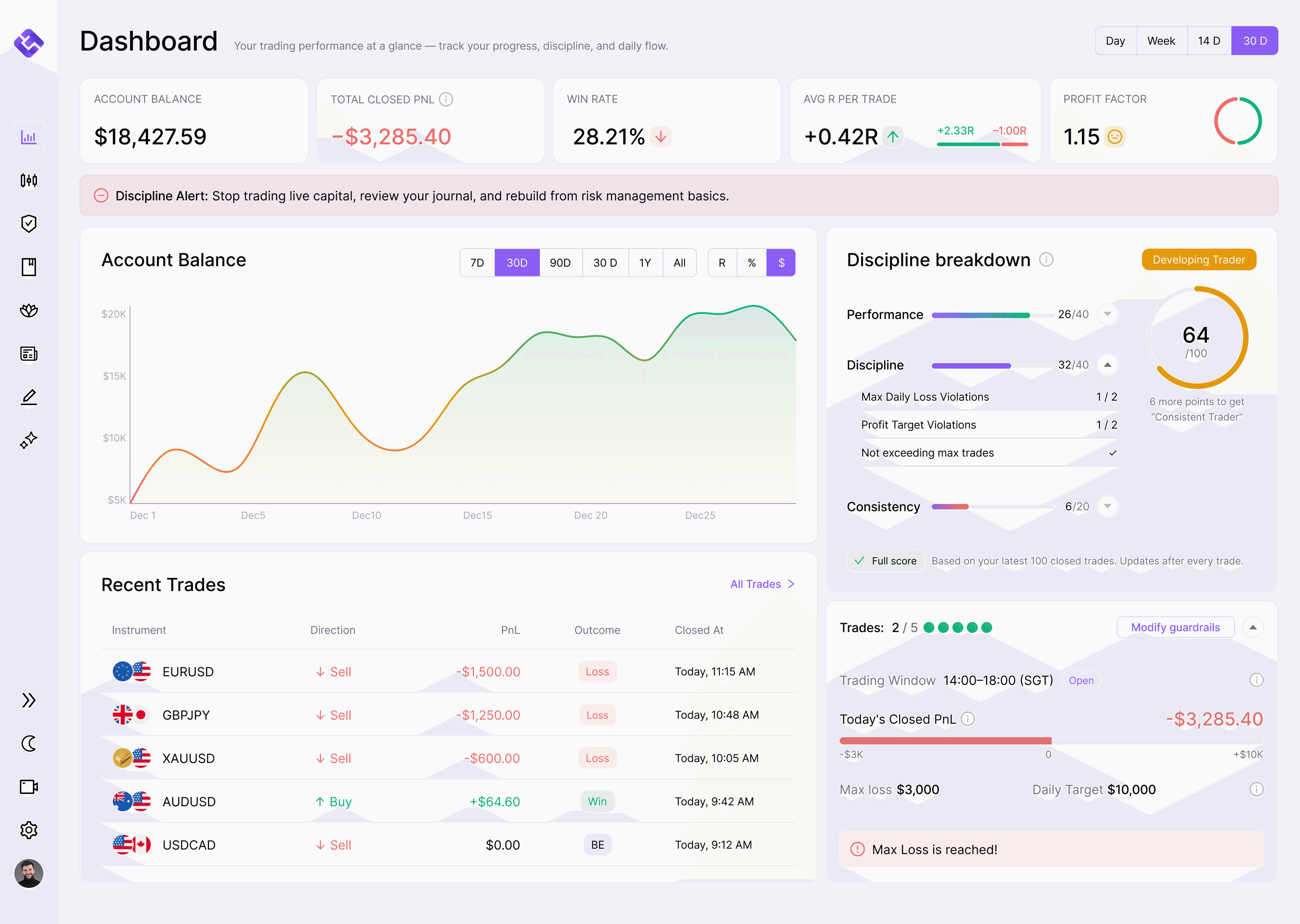
EdgeFlo's Edge Plan Builder keeps your if-then rules visible next to your chart, so there is no room for improvisation when a setup appears. Position size is calculated from your risk rules, not your emotions. Guardrails help you stay within your daily loss limit, max trades, and risk per trade. If you hit a limit, the platform flags it (you can override, but you have to choose to).
After each trade, the journal tags your emotional state, building a dataset that reveals which feelings lead to which outcomes. If you are tilted after a loss, Sanctuary walks you through a guided reset before your next trade. Over time, FloAI surfaces fear-related patterns from your data (maybe you overtrade on Fridays, maybe your FOMO entries lose 3x more than planned ones) so you can fix what you cannot see in the moment.
The Edge Brief
Receive Insights on trading psychology, discipline, and the behavioral patterns that create consistent traders from our Founder and the EdgeFlo team, delivered to your inbox.
Think different. Trade different.
What are the 4 fears of trading?
Why do 90% of traders fail?
How do you overcome fear of loss in trading?
How do I stop FOMO trading?

Turn discipline on.
Every session.
EdgeFlo is the environment serious traders operate inside.
Start 7-Day Free Trial
Cancel anytime.
No long-term commitment.

Think Different, Trade Different.