

Forced Trades: The Cost of Trading Bored
No clear setup? That is the market telling you to wait. Learn why boredom pushes traders into low quality entries and how session rules prevent forced trades.
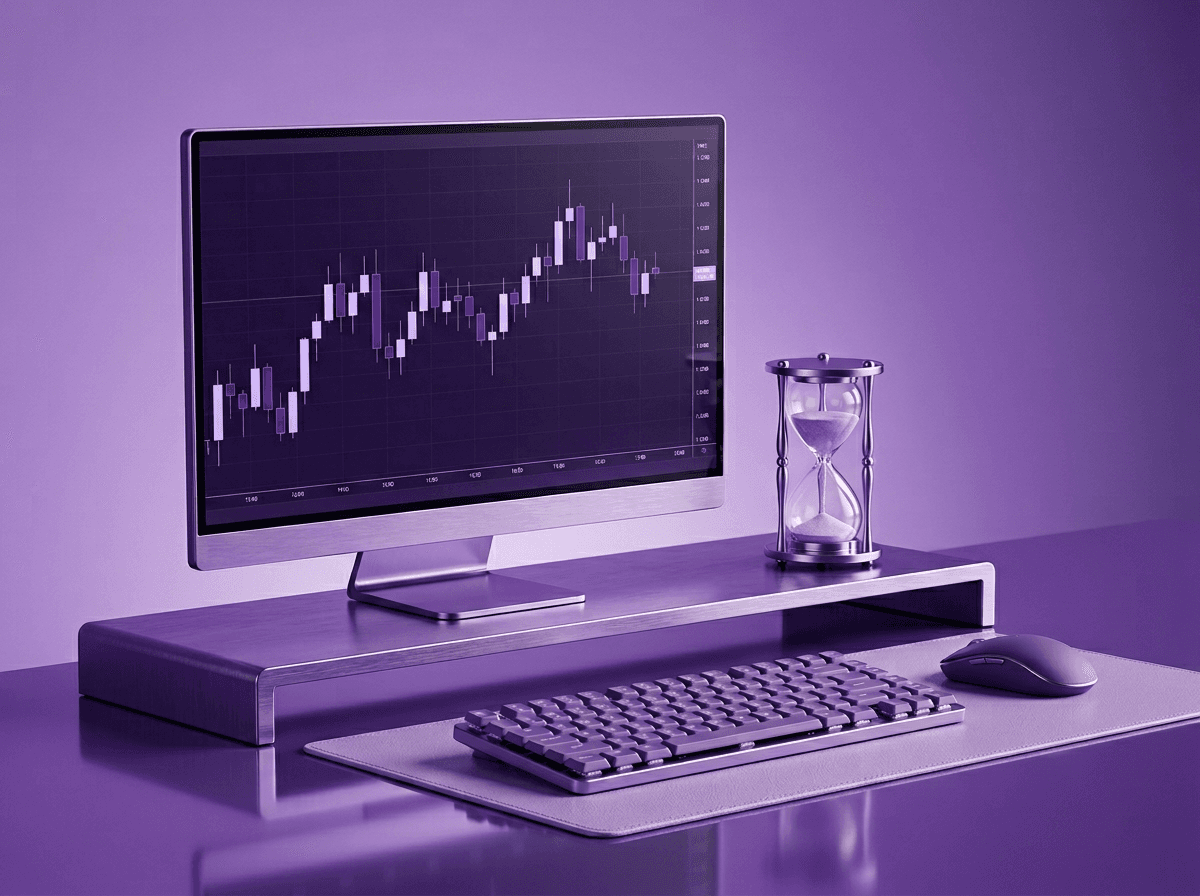
Two hours into your session. No setup. No clear direction. Price is chopping sideways in a tight range and every candle looks the same.
You start zooming in. The 5-minute chart looks like it might be forming something. Squint a little and that consolidation could be a flag. Or a wedge. Or maybe a double bottom if you tilt your head.
You take the trade. Not because it meets your criteria. Because you are bored and sitting in front of a chart doing nothing feels wrong.
Thirty minutes later, you are down 1R on a trade that was never a trade. You knew it when you entered. The market did not fail you. You failed your own rules because boredom made "anything" feel better than "nothing."
TL;DR
Boredom is the most underrated reason traders take bad entries.
Forced trades happen when you lower your criteria to justify being active.
The market does not owe you a setup every session. Some days have zero valid entries.
Session time limits and daily trade caps are the structural fix.
Stepping away from the screen is a trading skill, not a sign of weakness.
Why Boredom Is More Dangerous Than Fear
Fear gets all the attention. Fear of missing out, fear of losing, fear of being wrong. But boredom causes more cumulative damage because it is subtle. You do not feel boredom as a threat. It feels like impatience. Like wasted time. Like you should be doing something productive.
And for a trader sitting in front of charts, "doing something productive" usually means taking a trade.
This is the trap. Trading is one of the few activities where doing nothing is often the optimal action. But your brain does not reward doing nothing. It rewards activity, decisions, engagement. So you manufacture reasons to enter.
Ever talked yourself into a trade that felt questionable the moment you clicked the button? That is boredom in action. Not greed. Not FOMO. Just the quiet pressure of an empty session.
What Forced Trades Actually Cost
A forced trade is not just one bad entry. It starts a chain reaction.
You take a low-quality trade. It loses (because low-quality trades lose more often). Now you are down 1R and frustrated. So you take another trade to recover, this time with even less patience for your criteria. That one might lose too. Now you are down 2R and in full overtrade mode, chasing setups that do not exist to dig out of a hole that did not need to exist.
The initial forced trade cost you 1R. The emotional cascade it triggered cost you 3R or more. All because you could not sit still for two hours.
Walkthrough: The $750 Cost of One Bored Trade
You are trading a $50,000 account with 1% risk ($500 per trade) on EUR/USD. Your trading plan requires a higher timeframe bearish bias, a 15-minute market shift, and a flip zone with a liquidity sweep before entering short.
Today, the 4-hour chart is bearish. But on the 15-minute, price is chopping sideways with no clear internal structure shift. Your confluences are not lining up.
After 90 minutes of watching, you spot what looks like a supply zone forming on the 5-minute chart. No market shift. No liquidity sweep. Just a zone. You enter short anyway at 1.0920 with a 15-pip stop at 1.0935, trading 3.3 lots.
Price immediately moves against you. It pushes through 1.0935 and stops you out. Loss: $495.
Frustrated, you enter another short 20 minutes later when price dips back to the same area. Same weak setup, same missing confluences. This time the stop is 20 pips at 1.0945. You trade 2.5 lots.
Stopped out again. Another $500 loss.
The day ends with two trades, two losses, and $995 gone. Zero of those trades met your plan criteria. The market eventually did give a valid setup three hours later, but by then you had already hit your daily loss limit and were not in any state to take it.
Total cost of boredom: $995 in direct losses plus a missed opportunity on a valid setup.
The Session Rules That Prevent Forced Trades
Willpower does not fix boredom. Structure does. Here are four rules that make forcing trades structurally harder:
Rule 1: Set a Session Time Limit
Define how long you will sit in front of charts per session. Two hours for London. Three hours for New York overlap. Whatever fits your strategy and your life.
When the time is up, you are done. Whether you took zero trades or three. The clock decides, not your restlessness.
Rule 2: Cap Your Daily Trades
Set a maximum number of trades per day. For most strategies, this is 2 to 4. If you hit the cap, you stop. No exceptions.
This cap forces you to be selective. When you know you only have 3 bullets for the day, you stop wasting them on marginal setups.
Rule 3: Use a Setup Checklist (No Exceptions)
Before every entry, run through your checklist. Higher timeframe bias confirmed? Check. Lower timeframe shift? Check. Zone mitigated? Check. Liquidity swept? Check.
If any box is empty, you do not enter. Not "I think it is close enough." Not "it will probably confirm in a minute." Either the setup is there or it is not. The checklist is binary.
Rule 4: Build a Walk-Away Trigger
Define a specific condition that tells you to leave the screen. "If no valid setup appears within 90 minutes, I close the chart and do something else." "If price is inside a tight range with no structural shift, I set alerts and step away."
Walking away is not quitting. It is patience in action. The market will be there tomorrow. Your capital needs to be there too.
What to Do Instead of Forcing Trades
When the market gives you nothing, use the time productively:
Review yesterday's trades in your journal.
Backtest your strategy on a different pair.
Update your watchlist for tomorrow's session.
Exercise, read, or do anything that is not staring at choppy price action.
Professional traders spend a significant portion of their screen time not trading. The ability to sit through a dead session without taking a single trade is a skill. It does not feel like one. But it is the skill that separates traders who survive from traders who bleed out slowly through forced entries.
How EdgeFlo Guards Against Forced Trades
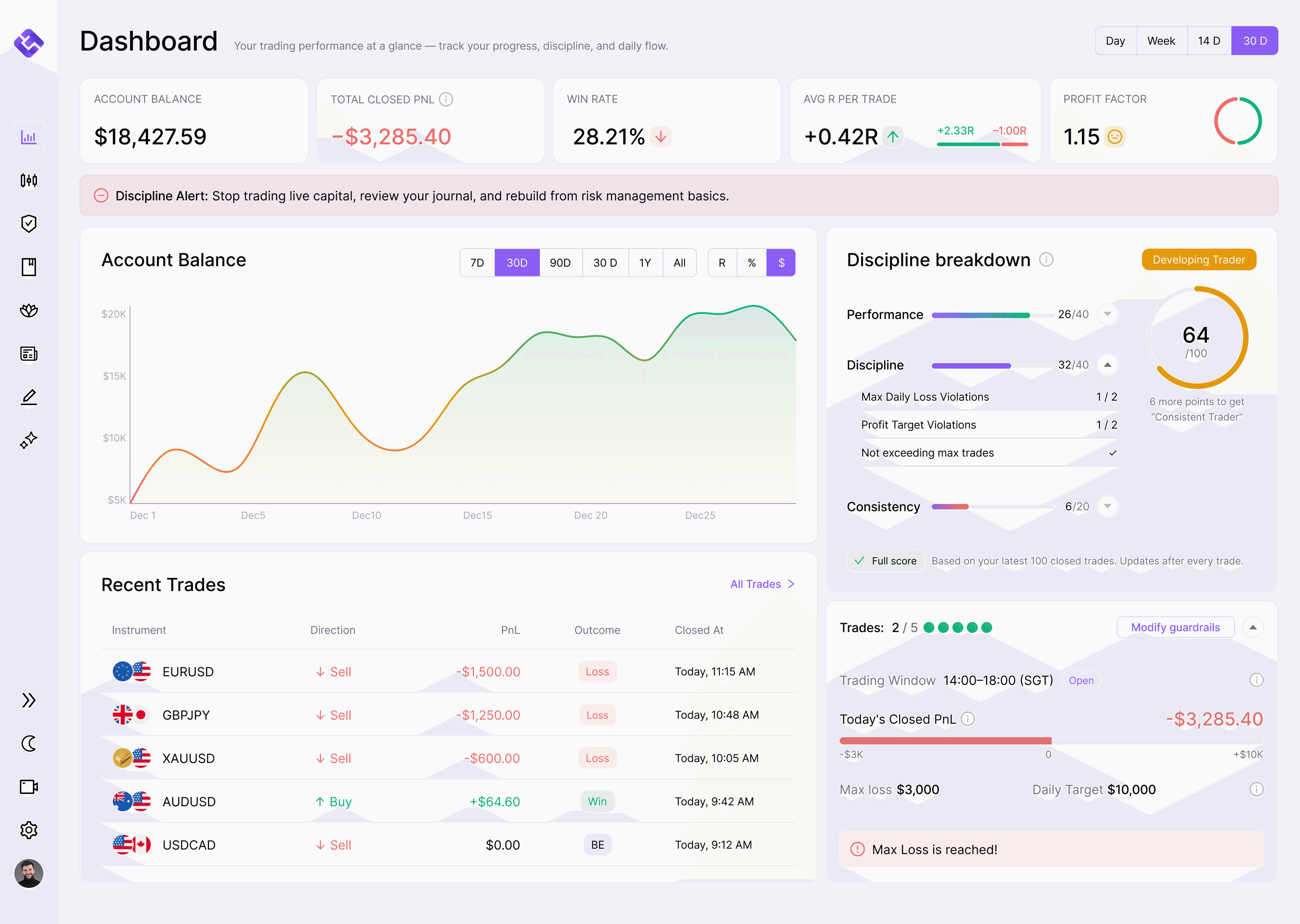
EdgeFlo's guardrails can restrict the maximum number of trades per day. Once you hit your cap, the platform makes it harder to open new positions. You can still override (the choice is always yours), but the friction forces a conscious decision: "Am I overriding because this is a genuine A+ setup, or because I am bored?"
The pre-market routine prompts you to define your session plan before you see a chart, reinforcing the criteria you need to see before entering. When boredom pushes you to lower those criteria mid-session, the plan you wrote 30 minutes ago is still visible, reminding you what an actual setup looks like.
The Edge Brief
Receive Insights on trading psychology, discipline, and the behavioral patterns that create consistent traders from our Founder and the EdgeFlo team, delivered to your inbox.
Think different. Trade different.
What is a forced trade?
Why does boredom cause bad trades?
How do I stop forcing trades when nothing is happening?
Is it normal to have days with zero trades?

Turn discipline on.
Every session.
EdgeFlo is the environment serious traders operate inside.
Start 7-Day Free Trial
Cancel anytime.
No long-term commitment.

Think Different, Trade Different.