

Forex Leverage Explained: Why 1:100 Is the Smart Limit
Learn how forex leverage works, why 1:100 is enough for most traders, and how higher leverage turns small drawdowns into blown accounts.
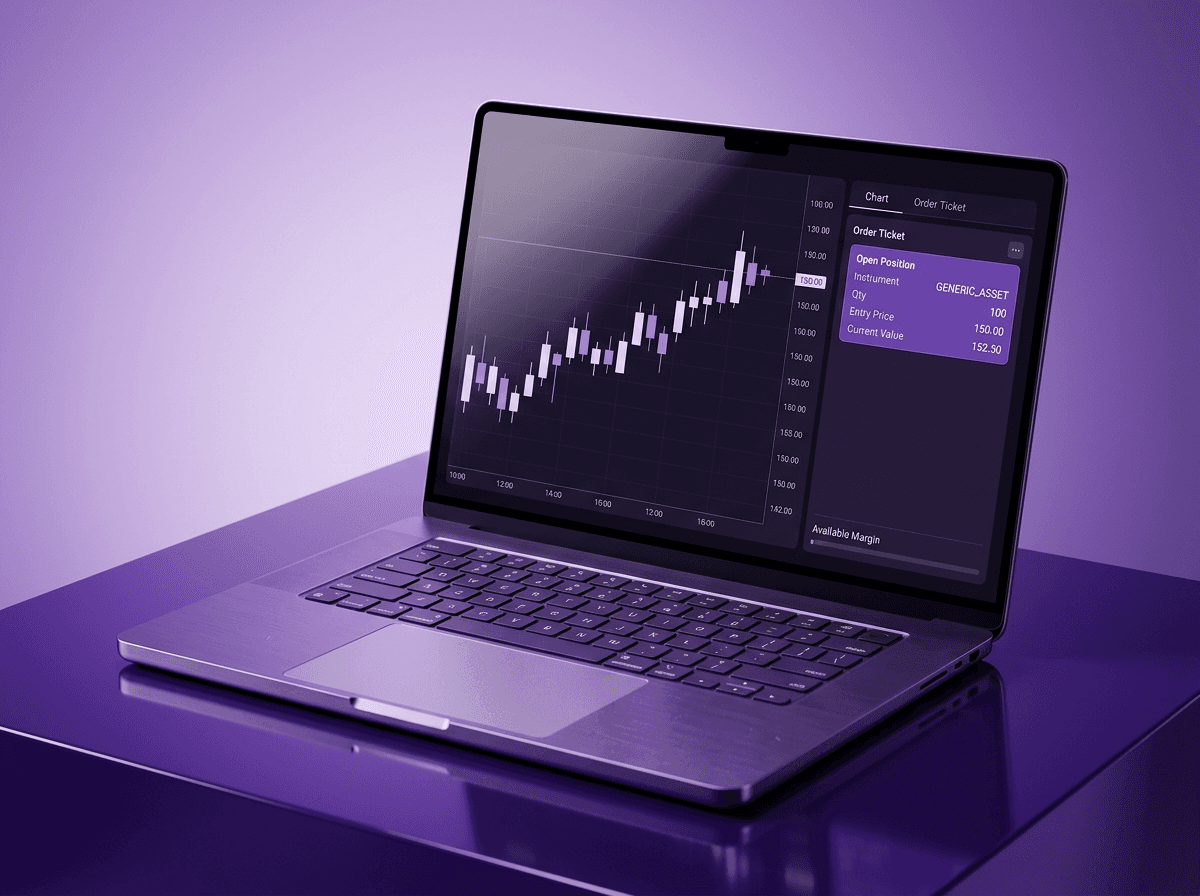
Forex leverage is borrowed capital from your broker that lets you control a larger position than your account balance alone. With 1:100 leverage, a $1,000 account controls $100,000 in currency. That sounds powerful, and it is. The problem is that the same multiplier works against you on every losing trade.
Most beginners hear "leverage" and think "more profit." The correct framing: leverage multiplies both gains and losses by the same factor. A 10-pip move in your favor at 1 standard lot earns you $100. That same 10-pip move against you costs $100. On a $100 account with 1:1000 leverage, that one loss ends your career before it starts.
TL;DR
Leverage is borrowed capital that increases your position size beyond your account balance.
1:100 leverage on a $1,000 account gives you $100,000 in buying power (1 standard lot).
Higher leverage does not change pip value, but it lets you trade bigger lots, which increases dollar exposure per pip.
At 1:1000 leverage, a $100 account can trade 1 standard lot where a 10-pip drawdown equals a total wipeout.
Leverage does not matter if you control your lot size; the real protection is risk per trade, not the leverage number.
How Leverage Actually Works
Think of leverage like a credit limit. Your broker is not giving you money. They are letting you borrow purchasing power, and your account balance is the collateral.
Here is the math: multiply your account balance by the leverage ratio. That is your buying power.
$1,000 account at 1:100 = $100,000 buying power
$1,000 account at 1:50 = $50,000 buying power
$100 account at 1:100 = $10,000 buying power
$100 account at 1:1000 = $100,000 buying power
Buying power determines the maximum lot size you can open. A standard lot (1.0) requires roughly $100,000 in position value for major pairs. A mini lot (0.1) requires $10,000. A micro lot (0.01) requires $1,000.
So a $1,000 account with 1:100 leverage can technically open 1 standard lot. Can, not should.
Why 1:100 Is Enough
At 1:100, a $1,000 account has the buying power to trade up to 1.0 lots. That is already more than most traders should ever use on that balance.
If you follow proper position sizing rules (risking 0.5% to 1% per trade), you will never need more buying power than 1:100 provides. On a $1,000 account risking 1%, your risk is $10 per trade. At 1:5 risk-to-reward, your target is $50. You do not need 1:500 leverage to capture that.
The only thing higher leverage does is remove the ceiling on how badly you can oversize a position. It does not make good trades more profitable. It makes bad decisions more expensive.
The $100 Account Trap
This is where it gets dangerous, and where most new traders learn the hard way.
Walkthrough: $100 Account at 1:1000
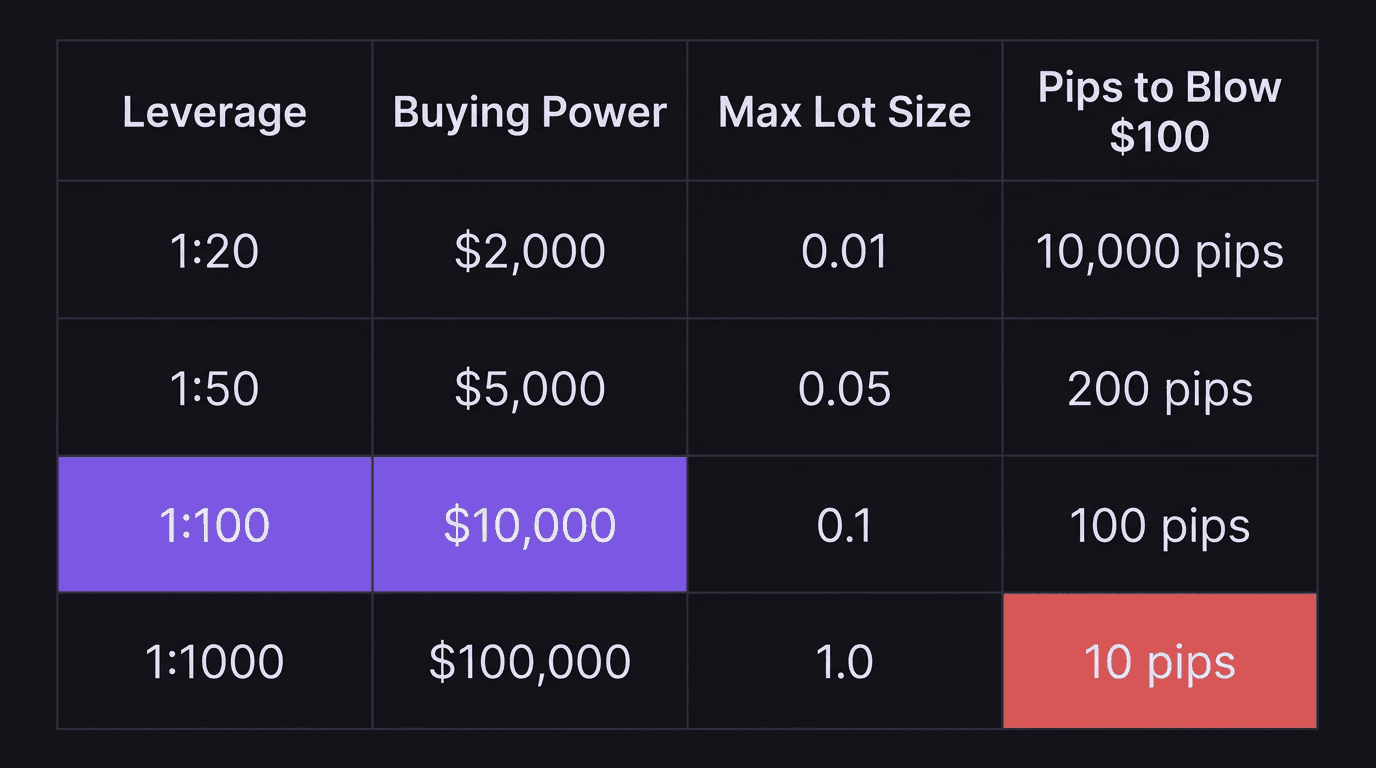
You open a $100 account with 1:1000 leverage. Your buying power is $100,000. That lets you open 1.0 standard lot on EUR/USD.
At 1 standard lot, every pip is worth $10. Your account has $100 in it.
5 pips against you = $50 loss (50% of your account)
10 pips against you = $100 loss (100% of your account, blown)
Ten pips. That is the normal noise of a 5-minute candle on EUR/USD during London session. You did not even make a bad trade. The market just breathed, and your account stopped breathing.
Now compare that to 1:100 leverage on the same $100 account. Your buying power is $10,000. Maximum lot size: 0.1 (mini lot). Every pip is worth $1.
10 pips against you = $10 loss (10% of your account)
50 pips against you = $50 loss (50% of your account)
100 pips against you = $100 loss (account blown)
Still risky if you max out the lot size, but you have 100 pips of breathing room instead of 10. That is the difference between surviving a normal pullback and getting liquidated before your trade idea even plays out.
Walkthrough: The Smart Setup at 1:100
Same $100 account, 1:100 leverage. Instead of maxing out the lot size, you risk 1% per trade ($1) with a 20-pip stop loss on GBP/USD.
Your lot size: $1 risk divided by 20 pips = $0.05 per pip. That is roughly 0.005 lots (a half-micro lot, or 5 units on platforms that allow it).
If you win at 1:5 R, your target is 100 pips. Profit: 100 pips times $0.05 = $5.
Five dollars does not sound exciting. But you still have your $100 account. You can take another 99 trades like this before blowing up (at 1% risk each). That is the point. You survive long enough to improve.
Leverage Is Not the Real Control
Here is the part most leverage articles miss: leverage is just a ceiling. It sets the maximum lot size you can trade. It does not force you to trade that size.
You decide your lot size. You decide your risk per trade. If you have 1:500 leverage but choose to risk only 0.5% per trade using proper lot size calculations, the leverage ratio is irrelevant. You will never approach the ceiling.
The danger is that beginners do not know how to calculate lot size correctly. They open an account with 1:500 or 1:1000 leverage, see they can open 5 lots, and think "bigger lot equals bigger profit." It does. It also equals bigger loss, faster. And the account blows before the lesson sinks in.
That is why 1:100 is the recommendation. Not because higher leverage is inherently evil. Because it removes the guardrail that would have stopped you from making the $10,000 mistake on a $100 account.
The Double-Edged Sword (with Numbers)
Leverage amplifies everything. Same trade, same direction, same pair. Different leverage, different outcome.
Say EUR/USD moves 50 pips in your favor on a $1,000 account:
At 0.01 lots (1:20 leverage): 50 pips times $0.10 = $5 profit
At 0.1 lots (1:100 leverage): 50 pips times $1 = $50 profit
At 1.0 lots (1:100 leverage, maxed): 50 pips times $10 = $500 profit
Now flip it. Same 50-pip move, but against you:
At 0.01 lots: $5 loss (0.5% drawdown)
At 0.1 lots: $50 loss (5% drawdown)
At 1.0 lots: $500 loss (50% drawdown)
A 50% drawdown requires a 100% gain just to break even. That is not a recoverable position for most retail traders. And it happened because the lot size was too big for the account, not because the leverage number was too high.
The lesson: leverage gives you rope. Lot size determines whether you build something with it or hang yourself. If you want to understand how blown accounts actually happen from the math side, read how traders blow accounts.
How EdgeFlo Keeps Leverage From Becoming a Problem
EdgeFlo's risk calculator does the lot size math for you before every trade. You enter your risk percentage and stop loss distance, and it shows you the exact lot size that keeps your exposure within your rules. No guessing, no mental math under pressure.
If you set a 1% risk guardrail, EdgeFlo warns you when a position would exceed it. You can override (it is your account), but you have to make a conscious choice to break your own rule. That friction is the difference between "I chose to risk more" and "I accidentally overleveraged because I forgot to check the lot size."
The auto risk calculator works regardless of your broker's leverage setting. Whether your account is 1:50 or 1:100, the calculator sizes the trade to your actual risk tolerance, not to whatever the broker lets you get away with.
The Edge Brief
Receive Insights on trading psychology, discipline, and the behavioral patterns that create consistent traders from our Founder and the EdgeFlo team, delivered to your inbox.
Think different. Trade different.
What is a good leverage for beginners in forex?
Can you lose more than your deposit with leverage?
Is 1:500 leverage safe for forex trading?
Does leverage affect pip value?

Turn discipline on.
Every session.
EdgeFlo is the environment serious traders operate inside.
Start 7-Day Free Trial
Cancel anytime.
No long-term commitment.

Think Different, Trade Different.