

3 Trade Management Methods (Pick the Right One)
Learn the 3 core trade management methods: set and forget, trailing stop loss, and partial profits. Find which one fits your trading style.
Trade management is how you handle an open position after entry. It determines whether you protect your capital, let winners run, or give profits back to the market. There are three core methods: set and forget, trailing stop loss, and partial profits. Each has clear trade-offs between simplicity, profit potential, and downside protection.
The right method depends on your trading style, not on what works for someone else. Here is how each one works, when it fits, and how to decide.
TL;DR
Trade management is what you do after entry to protect capital and maximize profit.
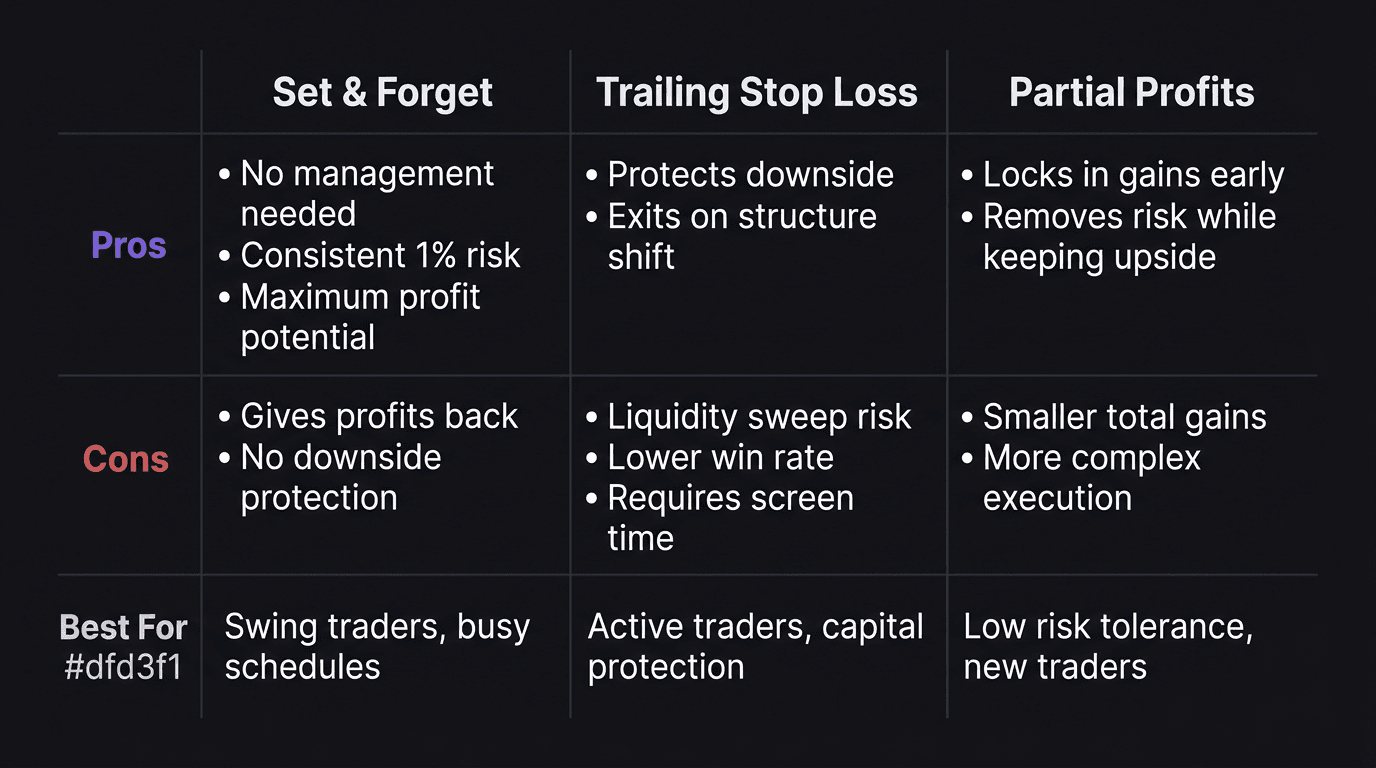
Set and forget gives maximum profit potential but zero downside protection once the trade is live.
Trailing stop loss protects your downside but exposes you to liquidity sweep stop-outs.
Partial profits let you pay yourself early while keeping upside open.
Pick one method, test it over 30+ trades, and stick with it.
Set and Forget Method
Set and forget is the most passive approach. You place your stop loss and take profit at entry, then walk away. No adjustments, no chart-watching, no second-guessing.
The trade either hits your take profit or your stop loss. That is it.
This method works well for swing traders who cannot monitor charts during the day. If you work a 9-to-5 or travel frequently, set and forget removes the temptation to micromanage. You enter, set your levels, and let the market do its thing.
The biggest advantage is consistent risk. If you risk 1% per trade, every loss is exactly 1%. No partial adjustments mean no variable losses of 0.5% here and 1.3% there. Your risk stays mechanical and predictable.
The downside? You are fully exposed to giving profits back. Price can run halfway to your take profit, reverse hard, and stop you out for a full loss.
Walkthrough: Set and Forget on GBP/USD
You spot a demand zone on GBP/USD 4H at 1.2640. You enter long at 1.2650 with a stop loss at 1.2610 (40 pips) and take profit at 1.2770 (120 pips, a 3R target). You risk 1% of a $10,000 account, so $100 on the line.
Price climbs to 1.2720, up 70 pips and nearly $175 in unrealized profit. Then it reverses. Price drops back through your entry and hits your stop loss at 1.2610. You lose $100.
With set and forget, you watched $175 in open profit become a $100 loss. But your risk was defined, consistent, and exactly what you planned.
Set and forget captures the full move when it works. But it gives everything back when it does not. If seeing unrealized profit evaporate makes you tilt, this method will test your discipline.
Trailing Stop Loss Method
Trailing your stop loss means moving it as price creates new market structure. In an uptrend, you move your stop loss to each new higher low. In a downtrend, you move it to each new lower high.
The goal is simple: reduce risk as the trade moves in your favor. First you move to break even. Then into profit. Even if the trade reverses and stops you out, you either lose nothing or exit with partial gains.
This protects your downside in a way set and forget cannot. When market structure shifts from an uptrend to a downtrend, your trailing stop catches the turn. You exit near the last valid higher low instead of riding the reversal all the way back to your original stop.
The catch is liquidity sweeps. Price does not always make clean higher lows. Sometimes it dips below a swing low to sweep the liquidity sitting there, then continues higher. If your stop loss is sitting at that swing low, you get stopped out right before the move continues without you.
You trade $500 in profit for a $2,000 missed opportunity. Your trade idea was right. Your stop placement was premature.
Walkthrough: Trailing Stop Gets Swept on EUR/USD
You enter long on EUR/USD at 1.0850 after a pullback to a demand zone. Stop loss at 1.0820 (30 pips), take profit at 1.0960 (110 pips).
Price pushes to 1.0900, pulls back, and forms a higher low at 1.0870. You trail your stop to 1.0870. Now you are in a risk-free trade with 20 pips of profit locked in.
Price pushes up to 1.0920, pulls back again, but this time it dips to 1.0865, sweeping your stop at 1.0870. You exit with 20 pips of profit ($60 on 0.2 lots at $10/pip).
Thirty minutes later, price rockets to 1.0950. Had you waited for the liquidity sweep before trailing, you could have captured 100 pips ($200). The trade idea was correct. The trailing decision was premature.
The solution is to wait for liquidity sweeps to happen before moving your stop. Do not trail to the first higher low. Wait for price to sweep below it, reject, and form a stronger low. Then trail.
This requires active management and screen time. If you cannot watch charts during the trading session, trailing stop loss may not suit your schedule.
Partial Profits Method
Partial profits mean closing a portion of your position at a predetermined level and letting the rest run. You pay yourself along the way instead of waiting for the full move.
The most common split is 50/50: close half at one target, let the other half run to your final take profit. But you can use any ratio. A 20/80 split at 4R means you close 20% of the position when price reaches 4R, and let the remaining 80% ride to your ultimate target.
The 20/80 split at 4R has an interesting property. If you risk 1R on the full position, closing 20% at +4R secures 0.8R in realized profit (20% of 4R). If the remaining 80% gets stopped out at your original stop for -0.8R (80% of 1R), you net zero. You break even on a trade that went against you.
That is the worst case. The best case is the remaining 80% hits your full target, and you collect both the partial profit and the runner.
Walkthrough: 50/50 Partial Profits on EUR/USD
You enter long on EUR/USD at 1.0850. Stop loss at 1.0820 (30 pips, 1R). Take profit at 1.0940 (90 pips, 3R). You open 0.2 lots, risking $60 (30 pips x $10/pip x 0.2 lots = $60).
Price hits 1.0895 (45 pips, 1.5R). You close 0.1 lots (half the position) for $45 profit.
Price then reverses and hits your original stop at 1.0820. The remaining 0.1 lots lose $30. Net result: $45 minus $30 = $15 profit on a trade that hit your stop loss.
Without partial profits, that same trade would be a $60 loss. Partial profits turned a losing trade into a small win.
The con is smaller overall gains. When the trade does hit your full target, you only have half a position riding at that point. You capture 100% of the first half's target and 100% of the second half's target, but the total is less than if you had kept the full position running.
Which Method Fits Your Style
There is no universally best method. The right trade management approach depends on your personality, schedule, risk tolerance, and trading plan.
If you want simplicity and cannot watch charts, set and forget is your method. Accept that you will give back some winners in exchange for zero management overhead and consistent 1% risk.
If you want downside protection and can dedicate screen time during your trading session, trailing stop loss fits. Learn to wait for liquidity sweeps before trailing, and accept a lower win rate in exchange for protected capital.
If you want to lock in gains along the way and you have a lower risk tolerance, partial profits make sense. Accept smaller total gains on full runners in exchange for the psychological relief of paying yourself.
The worst thing you can do is switch methods mid-trade or mix approaches without a plan. Pick one method. Backtest it over at least 30 trades. Track the average R gained. Then commit.
Consistency comes from repeating the same approach, not from finding the perfect exit. The market is unpredictable. Your actions do not have to be.
How EdgeFlo Supports Trade Management
EdgeFlo's auto risk calculator computes your position size before every entry, so you always know your exact dollar risk regardless of which management method you choose. No manual lot size math, no second-guessing whether your position is too big or too small.
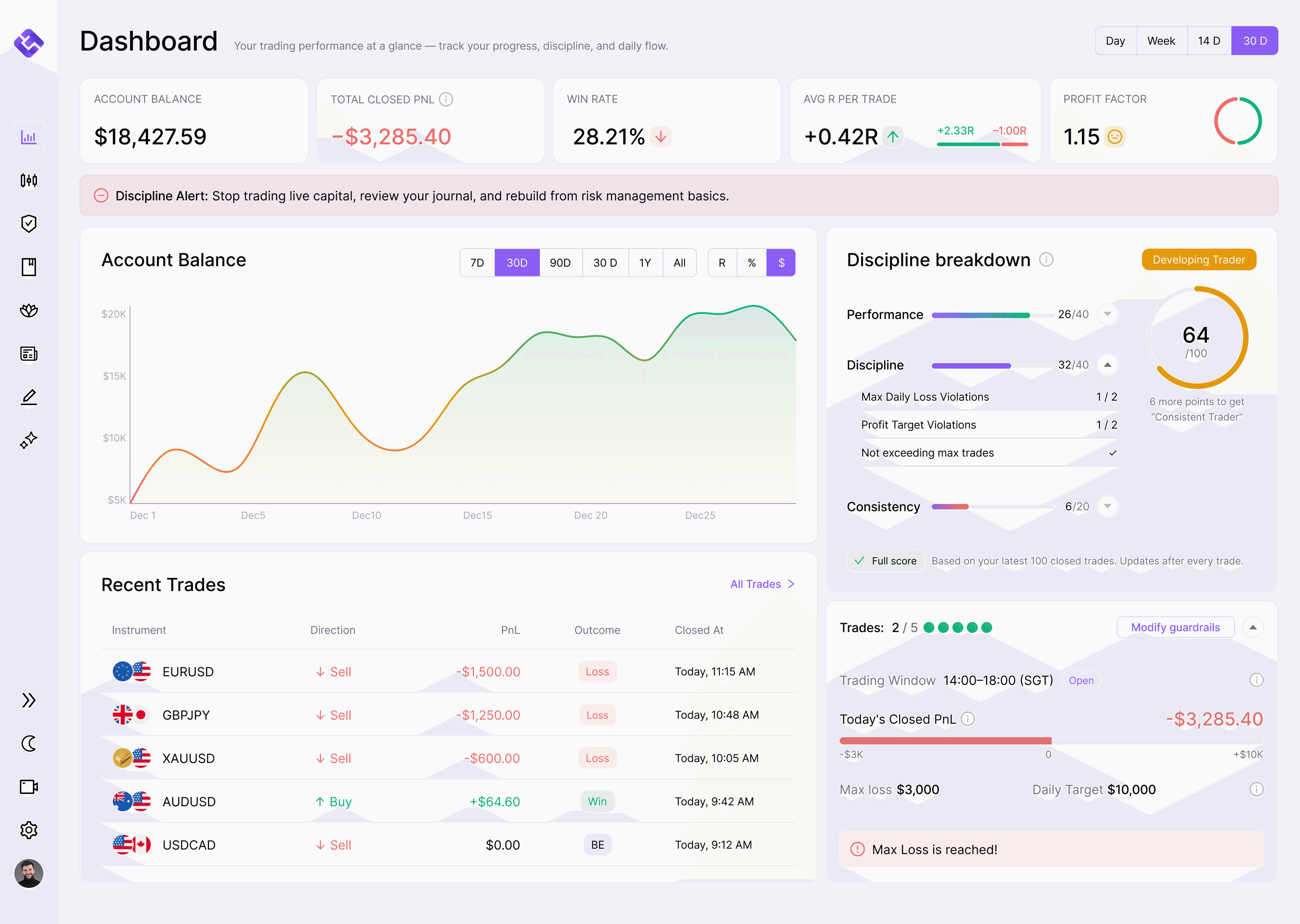
If you use a trailing stop loss or partial profit approach, EdgeFlo's guardrails help you stay disciplined. When you hit your daily loss limit, guardrails can restrict further trading to keep you from revenge-trading after a stopped-out position. You can override this if you have a valid setup, but the friction is intentional.
Your trading playbook inside EdgeFlo documents your chosen management method alongside your entry rules. When the trade is live and emotions start pushing you toward a decision that is not in your plan, your rules are right there on screen.
The Edge Brief
Receive Insights on trading psychology, discipline, and the behavioral patterns that create consistent traders from our Founder and the EdgeFlo team, delivered to your inbox.
Think different. Trade different.
What is trade management in forex?
Which trade management method is best for beginners?
Should I use partial profits or trailing stop loss?
How do I choose a trade management style?

Turn discipline on.
Every session.
EdgeFlo is the environment serious traders operate inside.
Start 7-Day Free Trial
Cancel anytime.
No long-term commitment.

Think Different, Trade Different.