

Trade Entry Criteria Checklist for Forex Traders
Build a trade entry criteria checklist with four filters: market structure, time frame, point of interest, and entry trigger. Stop taking random setups.
A trade entry criteria checklist is a short list of conditions that must all be true before you enter any trade. If the setup checks every box, you take it without hesitation. If even one box is empty, you skip it and wait. No exceptions. That binary decision process is what separates a planned trade from a gamble.
Most traders lose not because they cannot read charts, but because they enter trades that do not meet their own standards. A checklist fixes that by making the decision mechanical instead of emotional.
TL;DR
Your entry checklist should cover four core filters: market structure, time frame, point of interest, and entry trigger.
If all criteria are met, enter without hesitation. If any single criterion is missing, skip the trade.
The checklist eliminates "sort of" setups that feel right but do not match your plan.
Keep it to four to six items. More than that and you will never find a trade. Fewer and you are not filtering enough.
Use the same checklist for every pair. The structure is universal; only the price levels change.
Why You Need an Entry Checklist
Ever taken a trade and immediately known it was wrong? Not because the market moved against you, but because you never really had a reason to enter in the first place?
That is what happens without a checklist. You see price moving, feel the pull of opportunity, and click buy or sell before you have confirmed whether the setup actually matches your plan. Thirty seconds later, the doubt sets in.
A checklist solves this by forcing a pause between seeing a setup and executing it. During that pause, you run through your criteria one by one. Did I confirm the trend? Is price at my zone? Did I see my trigger? If the answer to any question is no, the trade does not happen.
This is not about being overly cautious. It is about being selective. The best traders take fewer trades, not more. They wait for setups where every filter aligns, and they skip everything else. That selectivity is what produces A-plus trade setups.
Without a checklist, you make every entry decision in real time, under pressure, with emotions running. With a checklist, the decision was made weeks ago when you wrote the rules. You are just verifying.
What Your Entry Criteria Should Include
A Forex-specific entry checklist needs four core filters. Each one serves a different purpose, and together they create a complete gate that only the highest-quality setups can pass.
1. Market Structure Direction
Before you look for a trade, you need to know which direction the market is trending. This is your directional filter.
Which time frame are you using to define market structure? The 4-hour? The daily?
Has there been a bullish or bearish break of structure?
Is price in a pullback phase (retracing to a zone) or a push phase (breaking new highs or lows)?
If the higher time frame structure is bearish, you are only looking for sell setups. No exceptions. This single filter eliminates half of the random trades most beginners take.
2. Time Frame Alignment
Your execution time frame should match your trading style:
Scalpers: 1-minute to 5-minute chart
Day traders: 5-minute to 15-minute chart
Swing traders: 1-hour to 4-hour chart
The entry time frame must be lower than the structure time frame. If you map structure on the 4-hour chart, you enter on the 15-minute. If you map on the daily, you enter on the 1-hour or 4-hour. This alignment ensures your entry is in the direction of the larger trend.
3. Point of Interest
You enter when price reaches a specific zone, not when it is floating in the middle of the chart. Your point of interest is the location filter.
Is price at a supply or demand zone?
Does the zone need to have swept liquidity first? If yes, has it happened?
Is the zone fresh (untested) or has it already been touched?
Write down exactly what qualifies as a valid zone. If your plan says you only trade demand zones that have swept sell-side liquidity, then an untested demand zone without a liquidity sweep is not your trade. Even if it looks good.
4. Entry Trigger
The trigger is the final confirmation before you place the order. It answers: "Price is at my zone, but is the reaction strong enough to enter?"
Are you entering at the edge of the zone (aggressive), the 50% equilibrium (standard), or waiting for a market structure shift on the lower time frame (conservative)?
What confirmation do you need? A shift in order flow? A break and retest? An inducement sweep?
Define the trigger precisely. "Price reached the zone and showed a reaction" is too vague. "Price reached the demand zone, swept the low by 3 pips, and printed a bullish market structure shift on the 5-minute chart" is mechanical.
Walkthrough: Running the Checklist on EUR/USD
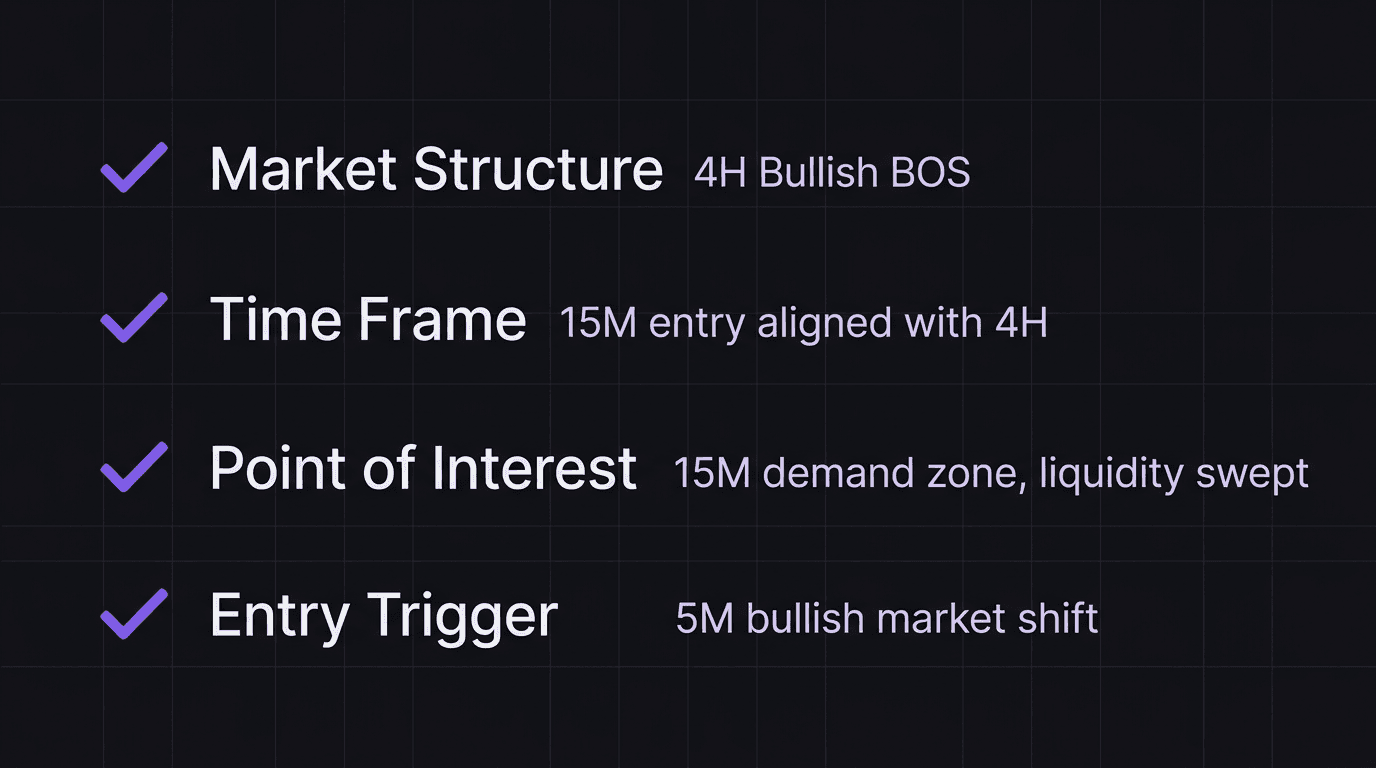
You are looking at EUR/USD. The 4-hour chart shows a bullish break of structure with a new higher high. Price is pulling back.
Checklist: 1. Market structure: Bullish (4H BOS confirmed). Check. 2. Time frame: You enter on the 15-minute chart, aligned with 4H direction. Check. 3. Point of interest: Price pulls into a 15-minute demand zone at 1.0840 that has swept sell-side liquidity at 1.0835. Check. 4. Entry trigger: 5-minute chart shows a bullish market structure shift from 1.0842. You enter at the 50% of the new 5-minute demand zone. Check.
All four criteria met. You enter a buy at 1.0844 with a stop loss at 1.0830 (14 pips) and a 3R target at 1.0886 (42 pips).
Math check: Entry 1.0844 to stop 1.0830 = 14 pips. Entry 1.0844 to target 1.0886 = 42 pips. 42 / 14 = 3R. Confirmed. At 0.5 lots (EUR/USD = $5/pip): $5 times 14 pips = $70 risk. $5 times 42 pips = $210 target.
How to Use the Checklist in Real Time
Having a checklist on paper is step one. Actually using it under pressure is step two.
Here is the real-time workflow:
Before the session starts, review the higher time frame structure for your pairs. Mark which direction you are looking to trade. If a pair has no clear structure, it is off the list for the day.
When price approaches a point of interest, pull out the checklist. Do not look at the entry trigger first. Start from the top. Structure? Check. Time frame? Check. Zone quality? Check. Only then look at the trigger.
If all four pass, set your entry, stop, and target. Execute. No second-guessing.
If any criterion fails, close the chart for that pair and move on. Do not sit there watching, hoping it will "set up better." That is how you end up forcing an entry.
The biggest mistake traders make with checklists is negotiating with them. "Well, the structure is kind of bullish." "The zone is not perfect, but it is close enough." Kind of and close enough are not on the checklist. They are the back door for emotion-based entries.
Your pre-trade checklist should take less than 60 seconds to run. If it takes longer, you have too many criteria or they are not specific enough.
Walkthrough: When the Checklist Saves You
Same EUR/USD session. After your first trade, you see another possible demand zone forming at 1.0860 on the 15-minute chart. It looks interesting.
Checklist: 1. Market structure: Still bullish. Check. 2. Time frame: 15-minute chart. Check. 3. Point of interest: The zone at 1.0860 is from a small consolidation, not from a strong swing low. It has not swept any liquidity. Fail.
Stop. Criterion three failed. You do not proceed to the trigger. The trade does not exist. You close the chart and wait.
Price drops through 1.0860 and hits 1.0835 before bouncing. If you had entered, your stop would have been hit. The checklist saved you $70.
When the Setup Does Not Check Every Box
This is the hardest part. A setup that checks three out of four boxes can look extremely tempting. The chart is moving, the zone is decent, and you feel the pull of FOMO.
Skip it anyway.
The entire point of a checklist is that it is binary. Pass or fail. Four out of four or zero out of four. There is no "three out of four is close enough" in mechanical trading.
Here is why partial setups are dangerous:
They have a lower probability of working because a missing criterion means a missing filter
They introduce inconsistency into your data (you cannot measure your edge if sometimes you follow the rules and sometimes you do not)
They reinforce the habit of negotiating with your trading rules, which eventually erodes the entire plan
If you consistently find that valid setups never appear, the problem is not the market. The problem is that your criteria might be too restrictive. Adjust the checklist during your weekly review, not during a live session. Change one criterion at a time, backtest the change, and then implement it.
The discipline to walk away when the setup is "almost there" is what separates traders who build consistent edge from traders who stay stuck in the cycle of random results.
How EdgeFlo Keeps Your Checklist Visible
Writing a checklist is simple. Remembering to use it when price is moving fast and your emotions are running is the challenge.
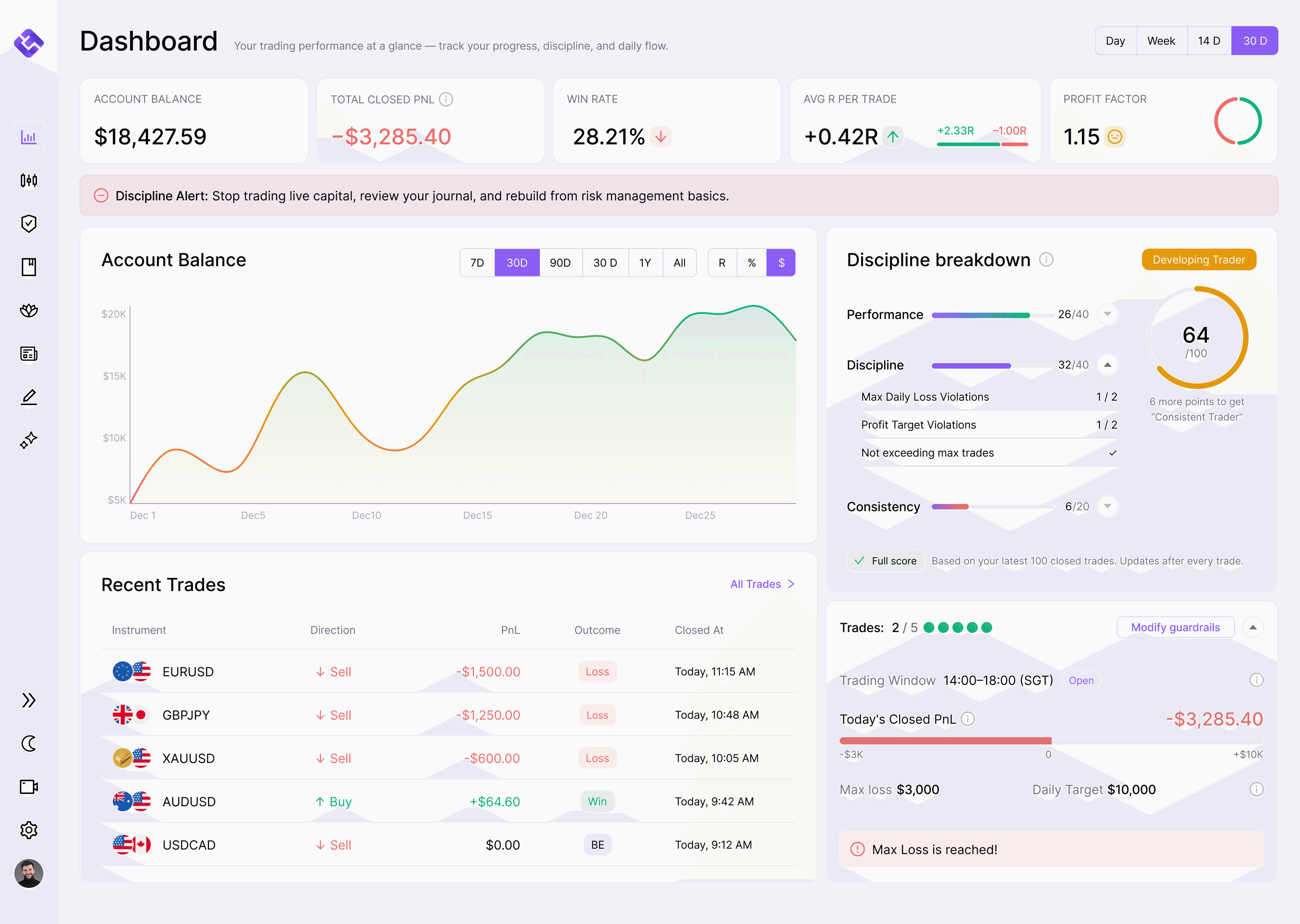
EdgeFlo's Edge feature lets you store your entry criteria checklist inside the platform, visible alongside your charts. Before each trade, you see the rules you set for yourself. After each trade, post-trade self-reporting captures whether you followed them. Over time, that data shows your plan adherence rate, which is often more predictive of profitability than win rate alone.
If your plan says you only take setups with all four criteria confirmed, EdgeFlo helps you document that commitment and hold yourself accountable to it. No hidden notebooks. No forgotten spreadsheets. The rules stay where you trade.
The Edge Brief
Receive Insights on trading psychology, discipline, and the behavioral patterns that create consistent traders from our Founder and the EdgeFlo team, delivered to your inbox.
Think different. Trade different.
What should an entry criteria checklist include?
How many criteria should be on the checklist?
What happens if a setup meets most but not all criteria?
Should I use the same checklist for every pair?

Turn discipline on.
Every session.
EdgeFlo is the environment serious traders operate inside.
Start 7-Day Free Trial
Cancel anytime.
No long-term commitment.

Think Different, Trade Different.