

Track Your Entry Quality: The Setup Review That Builds Edge
Learn to grade your trade entries by confluence count, zone accuracy, and timing. Use entry quality data in your journal to keep winning setups and cut losers.

Tracking entry quality means grading every trade on how well it matched your criteria, not just whether it made money. A winning trade with a bad entry teaches you nothing. A losing trade with a perfect entry is exactly what you want to see because it means your process works, and the outcome was just probability doing its thing.
Most traders review their P&L. Profitable traders review their entries. The difference between the two is that P&L only tells you what happened. Entry quality tells you why, and that "why" is the data you need to build a real trading edge.
TL;DR
Grade every entry on confluence count, zone accuracy, and timing, not just win/loss.
A-grade entries have 4 or more confluences aligned. B-grade entries have 2 to 3. C-grade entries have 1 or zero.
Over 30 or more trades, A-grade entries will show a higher win rate and better average R than B or C entries.
Use the data to cut bad setups from your plan and double down on what works.
Your journal should track entry grade as a mandatory field, not an afterthought.
Why Entry Quality Matters More Than Direction
You called the right direction. EUR/USD went up. But you entered 40 pips early, before the zone held, and your stop got hit on the pullback. By the time price actually reversed, you were already out with a loss.
Sound familiar?
Direction is only half the equation. The other half is where and when you entered. A trader who enters at the right zone with proper confirmation might risk 15 pips for 60 pips of profit. A trader who enters early, before confirmation, might risk 40 pips for the same 60 pips. Same direction. Completely different outcomes.
Entry quality is what separates a profitable strategy from a mediocre one. Your pre-trade checklist defines the conditions for a good entry. Your journal tracks whether you actually met those conditions. And the data shows whether meeting them leads to better results.
How to Grade Your Entries
Use a simple A/B/C grading system. Grade every trade immediately after closing it, while the details are fresh.
Higher timeframe trend confirmed
Price reached a valid, unmitigated zone
Lower timeframe market structure shift confirmed
Risk defined before entry (stop and target set)
Bonus: liquidity sweep before entry, or flip zone formation
Trend was clear but zone was partially mitigated
Or, zone was valid but the market structure shift was borderline
Or, entry was rushed (you entered before the shift completed)
No higher timeframe confirmation
Entry at a random level (no zone)
No structural shift, just "felt like it was going up"
No risk definition (stop added after entry or not at all)
C-grade entries are the ones draining your account. They are the impulse trades, the boredom trades, the revenge entries after a loss. When you see them in your data, you can trace them back to what your post-trade review missed.
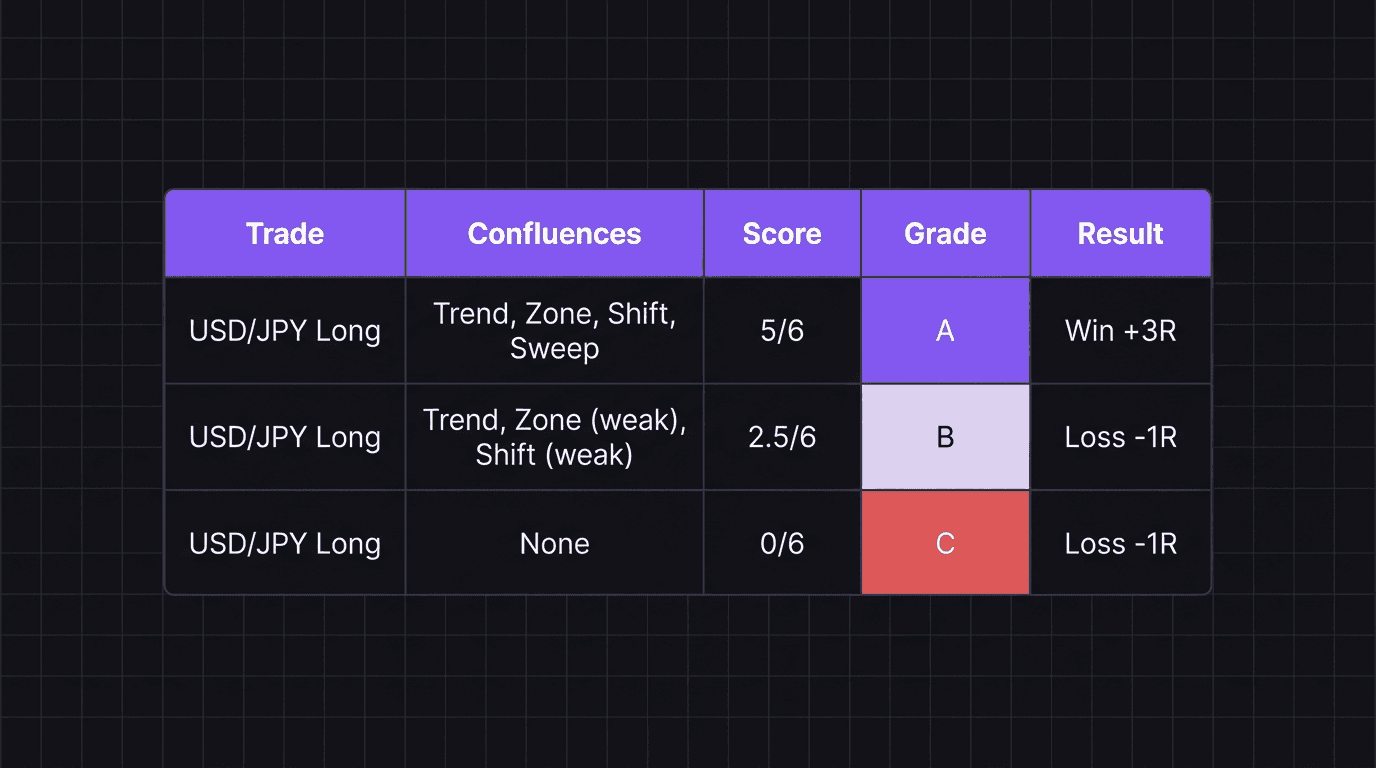
Walkthrough: Grading Three Trades on USD/JPY
Trade 1: 4-hour trend is bullish. Price reaches a 4-hour demand zone at 151.20 (unmitigated). On the 15-minute chart, price sweeps to 151.12, forms a higher low at 151.18, and shifts structure at 151.35. Entry at 151.38. Stop at 151.08 (30 pips). Target at the 4-hour supply zone at 152.30 (92 pips). Result: hit target.
Confluences: trend (yes), zone (yes, unmitigated), timeframe alignment (yes), structural shift (yes), sweep (yes). Grade: A.
Trade 2: 4-hour trend is bullish. Price is at a demand zone at 150.80, but the zone was already tested two sessions ago. On the 15-minute, price enters the zone and a shift forms, but the higher low is only 3 pips above the zone bottom. Entry at 150.95. Stop at 150.72 (23 pips). Target at 151.50 (55 pips). Result: stopped out.
Confluences: trend (yes), zone (partial, already tested), timeframe alignment (yes), structural shift (weak). Grade: B.
Trade 3: No clear trend on the 4-hour (choppy). No specific zone. Price just "looked like it was going to bounce." Entry at 151.60 based on a 5-minute candle pattern. No stop set initially, added after at 151.30 (30 pips). Target vague. Result: stopped out.
Confluences: trend (no), zone (no), shift (no). Grade: C.
After 30 trades, suppose your data shows: A-grade entries have a 58% win rate and average 2.8R. B-grade entries have a 41% win rate and average 1.5R. C-grade entries have a 22% win rate and average 0.9R. That data tells you exactly where your money comes from: A-grade setups. Everything else is noise.
The Confluence Score: Rating Your Setups
A confluence score is just a count of how many conditions aligned on a given trade. Keep it simple.
Trend confirmed (1 point)
Valid zone (1 point)
Timeframe alignment (1 point)
Market structure shift (1 point)
Liquidity sweep (1 point)
Flip zone formation (1 point)
Maximum score: 6. A-grade setups score 4 or higher. B-grade setups score 2 to 3. C-grade setups score 0 to 1.
The score is not a magic number. It is a proxy for how well the trade matched your ideal criteria. Over a large enough sample, higher scores will correlate with better results. That correlation is your edge, quantified.
Using Entry Data to Cut Bad Setups
After 30 or more graded trades, sort your journal by entry grade and look at the numbers.
If B-grade entries are breakeven or slightly negative over a large sample, you have a decision: either tighten your criteria so B-grade entries become A-grade, or stop taking them entirely.
If C-grade entries are deeply negative (and they almost always are), the answer is clear: stop taking them. Every C-grade trade you skip is money you keep.
This is how your trading review process feeds back into your plan. Your trading journal is not just a record. It is an input for plan refinement. The data tells you which setups to keep and which to remove.
The best traders do this quarterly. They export their entry quality data, calculate win rate and average R by grade, and update their plan accordingly. The worst traders never look back at their entries at all.
How EdgeFlo Surfaces Your Best Entry Patterns
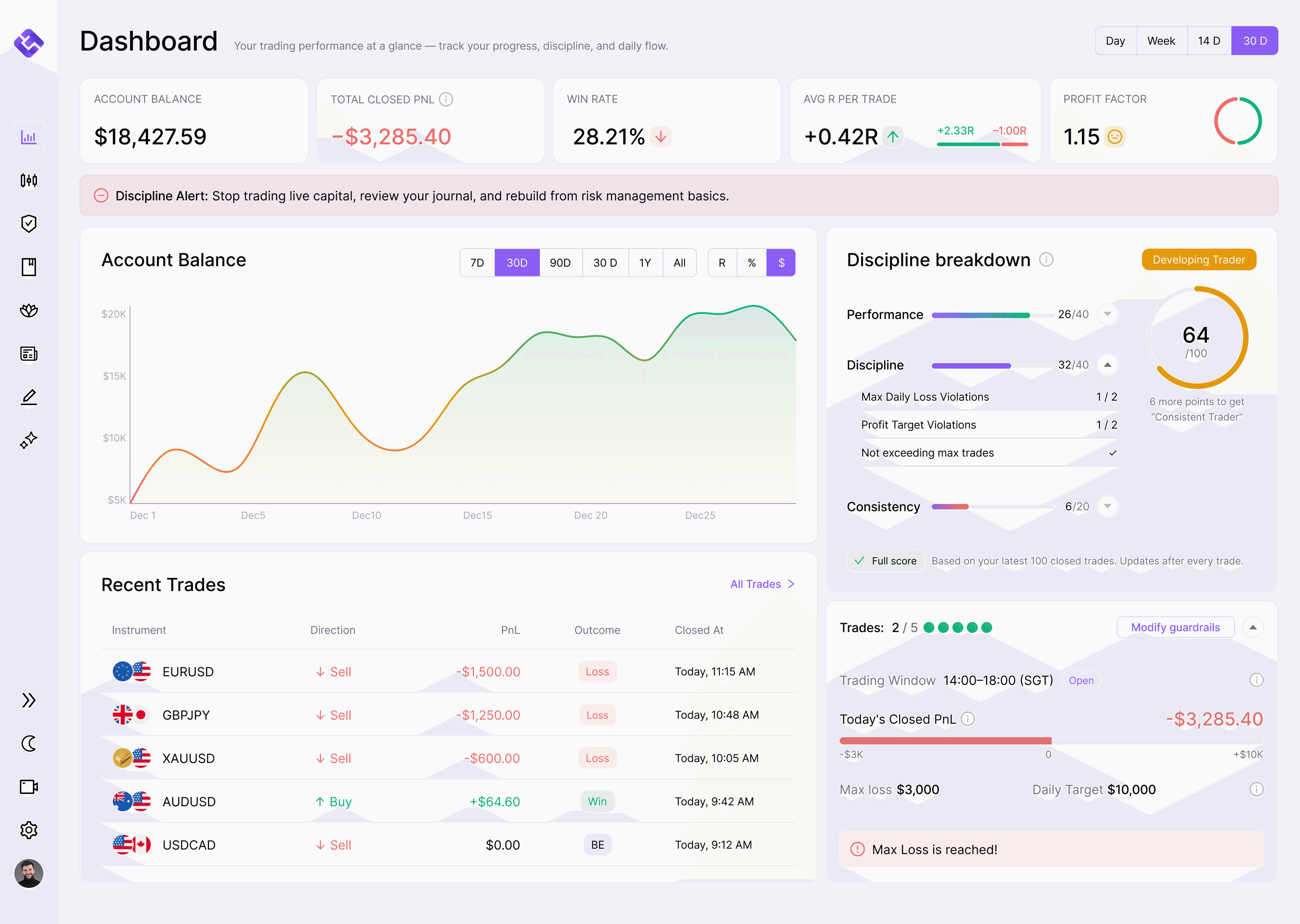
Grading entries manually works, but it is tedious. EdgeFlo's trading journal tracks setup type and confluence tags automatically. Tag each trade with its confluence factors, and the journal aggregates the data for you.
After enough trades, EdgeFlo surfaces which setup types and confluence combinations produce the best results. You can filter by entry grade, by pair, by session, by any combination of tags you track. The patterns emerge from the data, not from your memory or feelings about what "seems to work."
This is how you build conviction in your strategy. Not from a guru. Not from a course. From your own trade data showing that your edge is real and that A-grade entries are worth waiting for.
The Edge Brief
Receive Insights on trading psychology, discipline, and the behavioral patterns that create consistent traders from our Founder and the EdgeFlo team, delivered to your inbox.
Think different. Trade different.
How do I grade the quality of my trade entries?
Why does entry quality matter more than trade direction?
How many trades do I need to review before seeing entry quality patterns?
What should I do with low-quality entry data?
Turn discipline on.
Every session.
EdgeFlo is the environment serious traders operate inside.
Start 7-Day Free Trial
Cancel anytime.
No long-term commitment.

Think Different, Trade Different.