

How to Build a Confirmation Trading Strategy
Build a confirmation-based trading strategy using inducement, market shift, and liquidity. Stop guessing entries and start waiting for alignment.

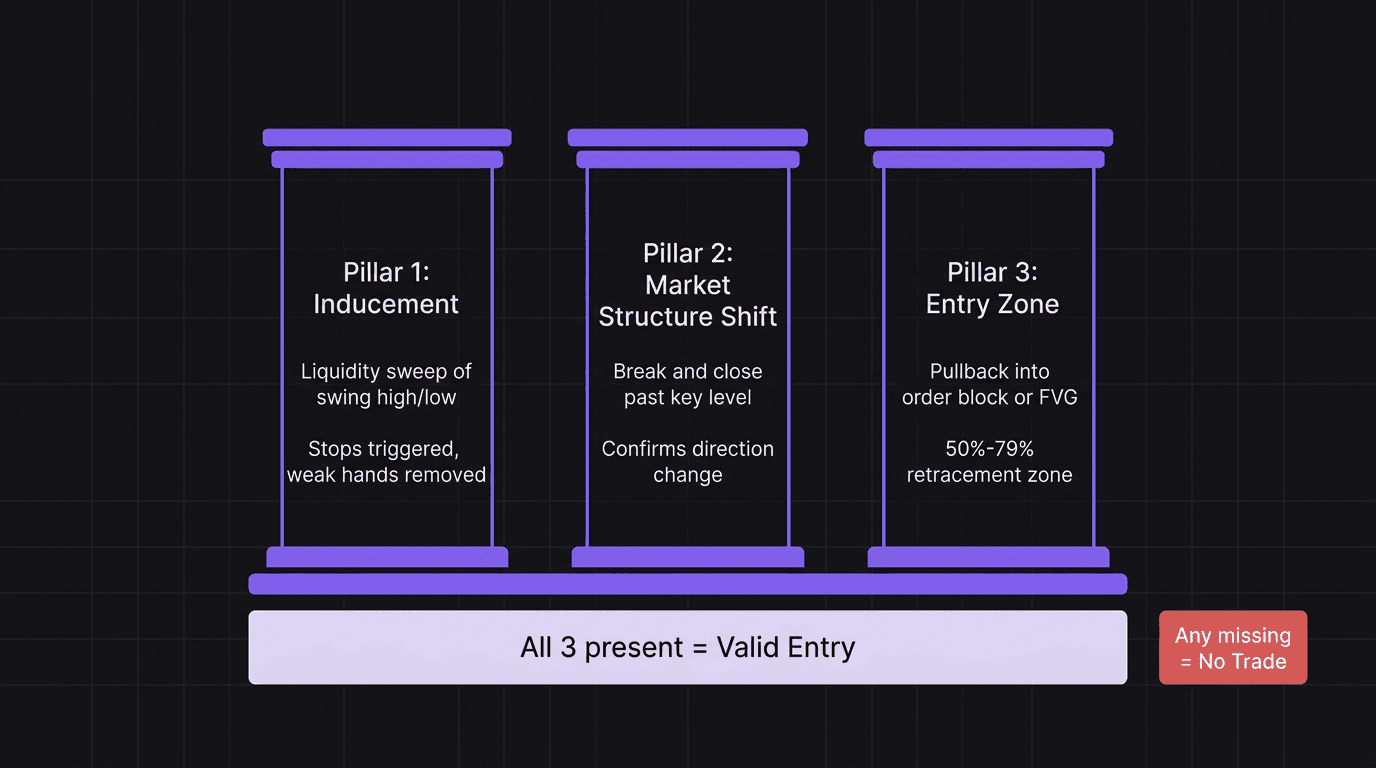
A confirmation trading strategy means you do not enter a trade until multiple conditions align at the same time. No single candle, no single indicator, and no gut feeling is enough to trigger an entry. You wait for inducement, a market structure shift, and a move into your entry zone. When all three are present, you take the trade. When any one is missing, you sit on your hands. This approach eliminates guessing and replaces it with a repeatable process that gives you a clear reason for every entry and every skip.
TL;DR
Confirmation trading requires three conditions to align before entry: inducement (liquidity sweep), market shift, and entry zone pullback.
Entering on one signal without the others is the most common execution mistake.
A mechanical trading plan built on confirmations removes guessing from your entries.
Skipping trades that lack confirmation is as important as taking trades that have it.
This framework works on any timeframe and any liquid market.
What Confirmation Trading Actually Means
Think of confirmation trading like buying a used car. You would not hand over money based on a nice paint job alone. You would check the mileage, run a vehicle history report, and take it to a mechanic. Each check confirms the others. If the paint is great but the engine is shot, you walk away.
Trading confirmation works the same way. A bullish candle at support is the nice paint job. It might be the start of a move, or it might be a trap. You need more evidence before committing capital.
The opposite of confirmation trading is impulse trading: entering because price is moving, because you "feel" the direction, or because you missed the last move and want to catch this one. That approach turns your trading playbook into a suggestion list rather than a rulebook.
The Core Principle
No single piece of evidence justifies an entry. Every entry requires multiple independent confirmations that price is likely to move in your direction. If one piece is missing, the trade does not meet your criteria, full stop.
Yousef, a trader who scaled from zero experience to $850,000 in funded accounts in under a year, summarized his entire strategy in three words: "Inducement, market shift, liquidity." He does not trade unless all three align. No exceptions.
The Three Confirmation Pillars
Every confirmation strategy is built on the same structural logic, even if the specific tools differ. Here are the three pillars.
Pillar 1: Inducement (The Liquidity Sweep)
Inducement is the market's way of grabbing stop losses before moving in the real direction. When price pushes past a key level (a swing high, swing low, or equal highs/lows) and then reverses, it is sweeping the liquidity sitting at that level.
Why this matters for confirmation: a liquidity sweep tells you that the weak hands have been shaken out. The stop losses that were clustered at that level have been triggered. Now the market has fuel to move in the opposite direction.
Price pushes past a clearly visible swing high or swing low
Wicks beyond equal highs or equal lows
A quick push into a level followed by immediate rejection
Without a sweep, you might be entering into a move that still has unfilled orders on the other side. Those orders become resistance to your trade.
Pillar 2: Market Structure Shift
After the sweep, you need evidence that the market has changed direction on your execution timeframe. This is the market structure shift, and it is your confirmation that the inducement was real and not just a continuation.
Price sweeps a swing low (Pillar 1)
Then breaks above the most recent lower high on your timeframe
A candle closes above that level (not just a wick)
Price sweeps a swing high (Pillar 1)
Then breaks below the most recent higher low on your timeframe
A candle closes below that level
The close is critical. A wick through a level is not a shift. Plenty of common trading mistakes come from treating wicks as confirmed breaks.
Pillar 3: Entry Zone (The Pullback)
Once you have a sweep and a shift, you wait for price to pull back into a high-probability zone before entering. This is where your risk-to-reward ratio gets built.
Order block: The last bearish candle before a bullish move (or vice versa). This zone often acts as support when price returns to it.
Fair value gap: An imbalance in price where a candle body skips over a range, leaving an "unfilled" zone.
50% to 79% retracement: The discount zone of the impulse move that created the shift.
You place your entry inside the zone, your stop loss below the zone (for longs) or above it (for shorts), and your target at the next liquidity pool.
How All Three Work Together
Walkthrough: EUR/USD, 15-minute chart, London session.
At 8:30 AM, EUR/USD sweeps the Asian session low at 1.0835. Wicks below and immediately rejects. That is your inducement (Pillar 1).
By 8:45 AM, a 15-minute candle closes above 1.0852, which was the most recent lower high. This is your market structure shift (Pillar 2).
Price pulls back between 9:00 and 9:15 AM, tapping the order block at 1.0843 that formed during the shift. You enter long at 1.0843, stop loss at 1.0830 (below the sweep), target at 1.0880 (the previous day's high where buy-side liquidity sits).
Risk: 13 pips. Reward: 37 pips. R:R = 2.85:1.
Price reaches 1.0880 by 10:20 AM. You close the trade for a 2.85R gain. All three pillars were present before you clicked buy.
Building Your Confirmation Checklist
Turn the three pillars into a written checklist that you run before every trade. Not mentally. Written down, visible on your desk or screen.
Pre-Entry Checklist
Before opening a position, each item must be checked:
Bias: Is my higher-timeframe bias bullish or bearish? (Check your pre-market markup.)
Inducement: Has a key level been swept on my execution timeframe?
Shift: Has market structure shifted in the direction of my bias? Did a candle close past the critical level?
Entry zone: Is price pulling back into an order block, fair value gap, or 50-79% retracement?
Risk defined: Is my stop loss placed below (or above) the entry zone with a clear R:R of at least 2:1?
Session valid: Am I within my designated trading session?
If any item is unchecked, you do not enter. This is what makes it a pre-trade checklist, not a pre-trade suggestion list.
Documenting Your Confirmations
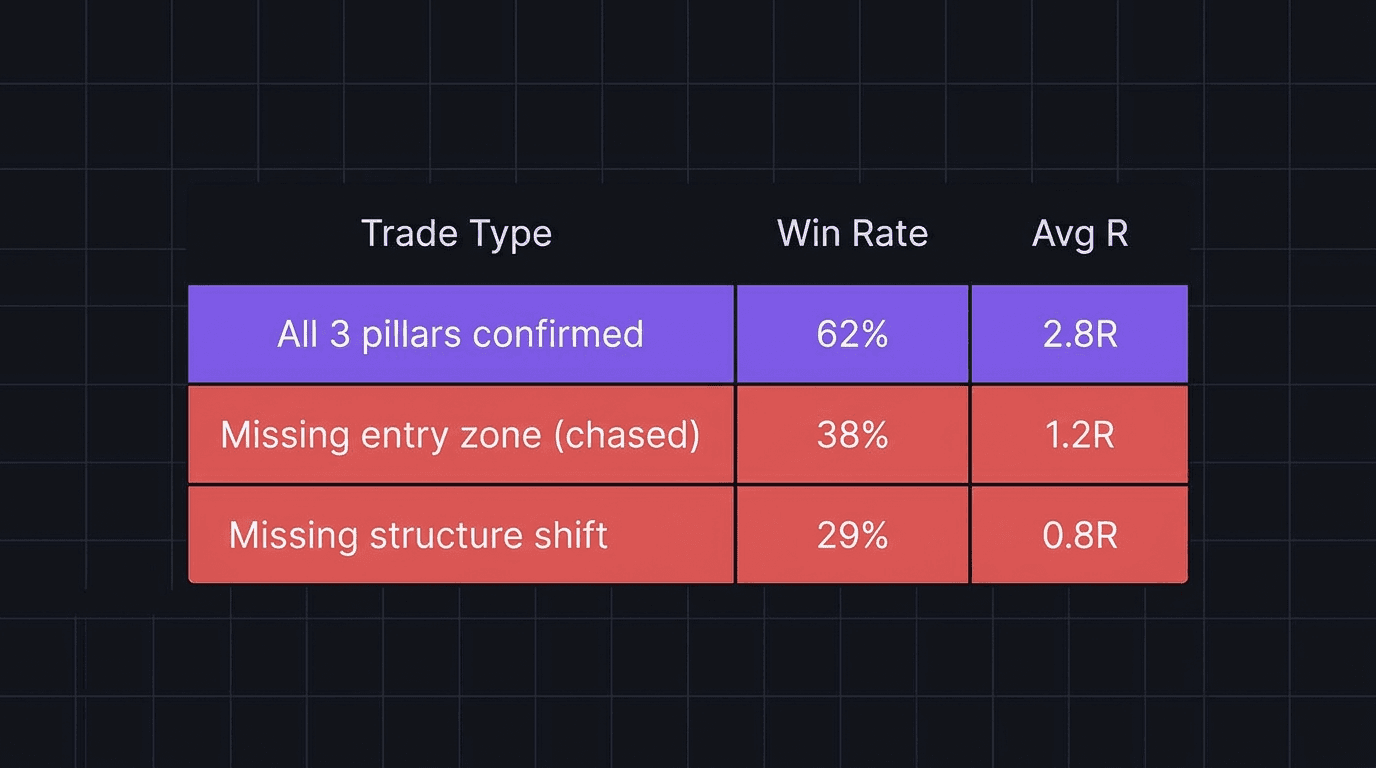
After each trade (win or loss), record which confirmations were present and which were marginal. Over time, you will see which pillar you tend to skip and which pillar most reliably predicts winners.
Trades with all three pillars: 62% win rate, 2.8 average R
Trades missing the entry zone pullback (chased entries): 38% win rate, 1.2 average R
Trades missing the structure shift: 29% win rate, 0.8 average R
That data turns your confirmation strategy from a theory into a mechanical trading plan backed by your own performance metrics.
When to Skip a Trade That Has No Confirmation
This is where most traders fail. Skipping a trade feels like missing an opportunity. But skipping a trade that lacks confirmation is the entire point of having a confirmation strategy.
The Wrong Trade Yousef Stopped Taking
What the old Yousef did: GBP/USD pushes through the London session high. He sees the breakout and enters long immediately, no pullback, no structure shift, just momentum. Price reverses 20 pips later. He adds to the position. Price drops further. He closes both for a combined 2.5R loss.
What the new Yousef does: GBP/USD pushes through the London session high. He marks it as a potential inducement (sell-side sweep if it reverses). He waits. If a 15-minute candle closes back below the session high, confirming a bearish shift, he looks for a pullback into the order block to enter short. If price just keeps running higher without reversing, he does nothing. No entry. No loss. No drama.
The difference is not strategy knowledge. Both versions of Yousef knew about liquidity and structure. The difference is whether he waited for all three confirmations or acted on one.
Common Scenarios to Skip
Sweep with no shift. Price sweeps a level but does not break structure in the opposite direction. This could be a legitimate breakout, not a trap. Wait.
Shift with no sweep. Structure breaks but no key level was swept first. The move might lack the fuel (triggered stops) to sustain itself. Wait.
Sweep and shift but no pullback. All the conditions are met except price never returns to your entry zone. It just runs. This is the hardest one to accept because the move is real and you are watching it happen. Let it go. The next setup will come.
Yousef put it simply: he focuses on "what price does NOW." Not what it might do, not what it did an hour ago. If the confirmation is not happening right now on his timeframe, there is no trade.
How EdgeFlo Supports Confirmation Trading
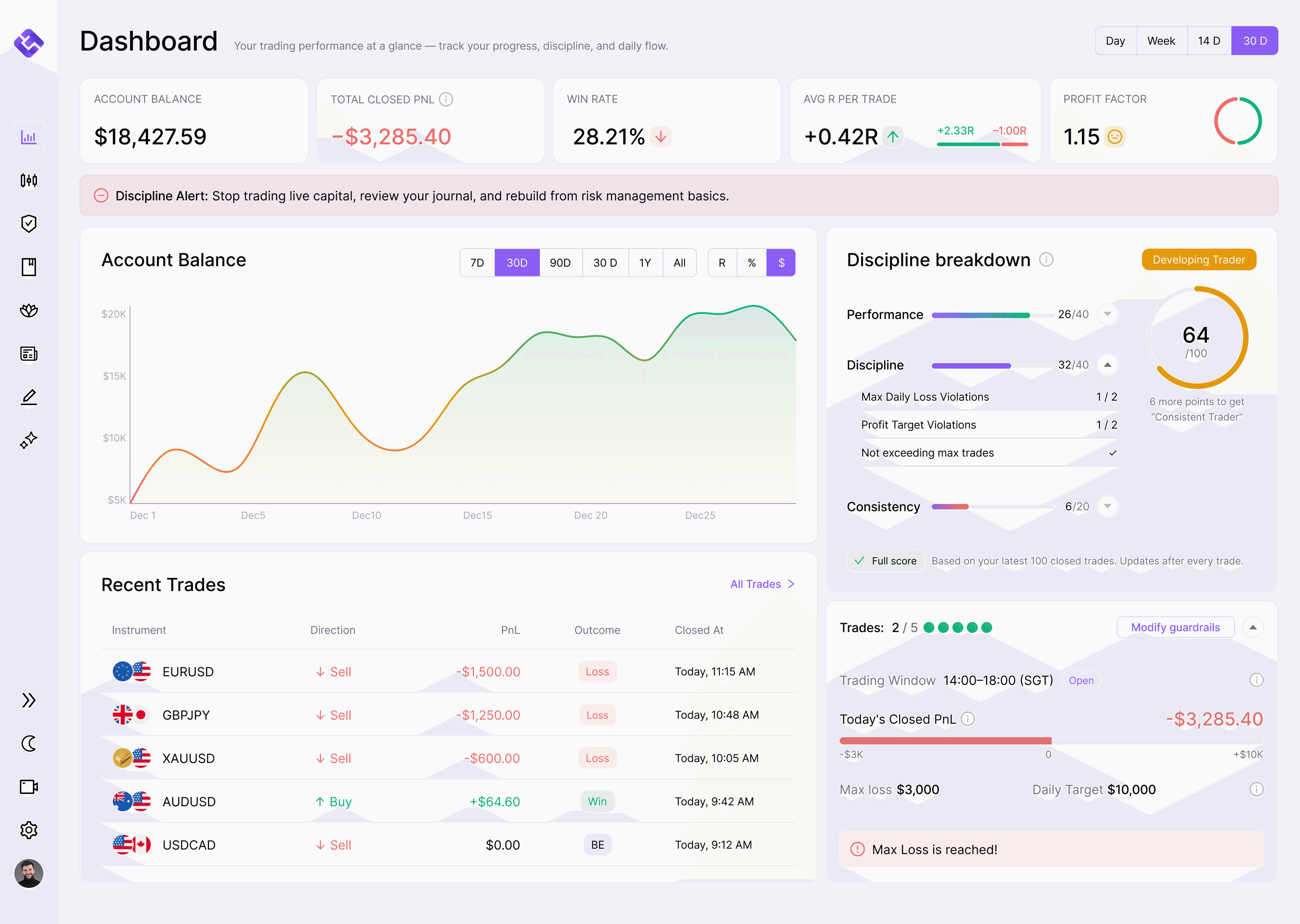
EdgeFlo's Edge trade plan builder lets you document your confirmation stack directly in your trading workspace. Your three pillars, your entry criteria, and your skip rules stay visible while you trade, not buried in a separate document. After each trade, you log whether all confirmations were present, giving you the data to refine your checklist over time.
The Guardrails feature adds a structural layer to your confirmation process. If you set a maximum of 3 trades per session and you have already taken 3, EdgeFlo flags the next trade attempt. This prevents the common failure mode where a trader follows confirmations for the first two trades and then starts improvising by trade four.
FloAI (Plus plan) can review your journal entries and highlight patterns: which confirmation pillar you skip most often, which sessions produce your most disciplined entries, and whether your win rate correlates with how many pillars were confirmed. That feedback loop is what turns a confirmation strategy from a concept into a habit.
The Edge Brief
Receive Insights on trading psychology, discipline, and the behavioral patterns that create consistent traders from our Founder and the EdgeFlo team, delivered to your inbox.
Think different. Trade different.
What is confirmation in trading?
How many confirmations should I wait for before entering?
Does confirmation trading work on all timeframes?
What is the biggest mistake traders make with confirmation strategies?

Turn discipline on.
Every session.
EdgeFlo is the environment serious traders operate inside.
Start 7-Day Free Trial
Cancel anytime.
No long-term commitment.

Think Different, Trade Different.