

Trade Exit Strategy: Pick One and Stick
Compare three trade exit strategies (set and forget, trailing SL, partial profits) and learn why consistency in exits matters more than the perfect method.
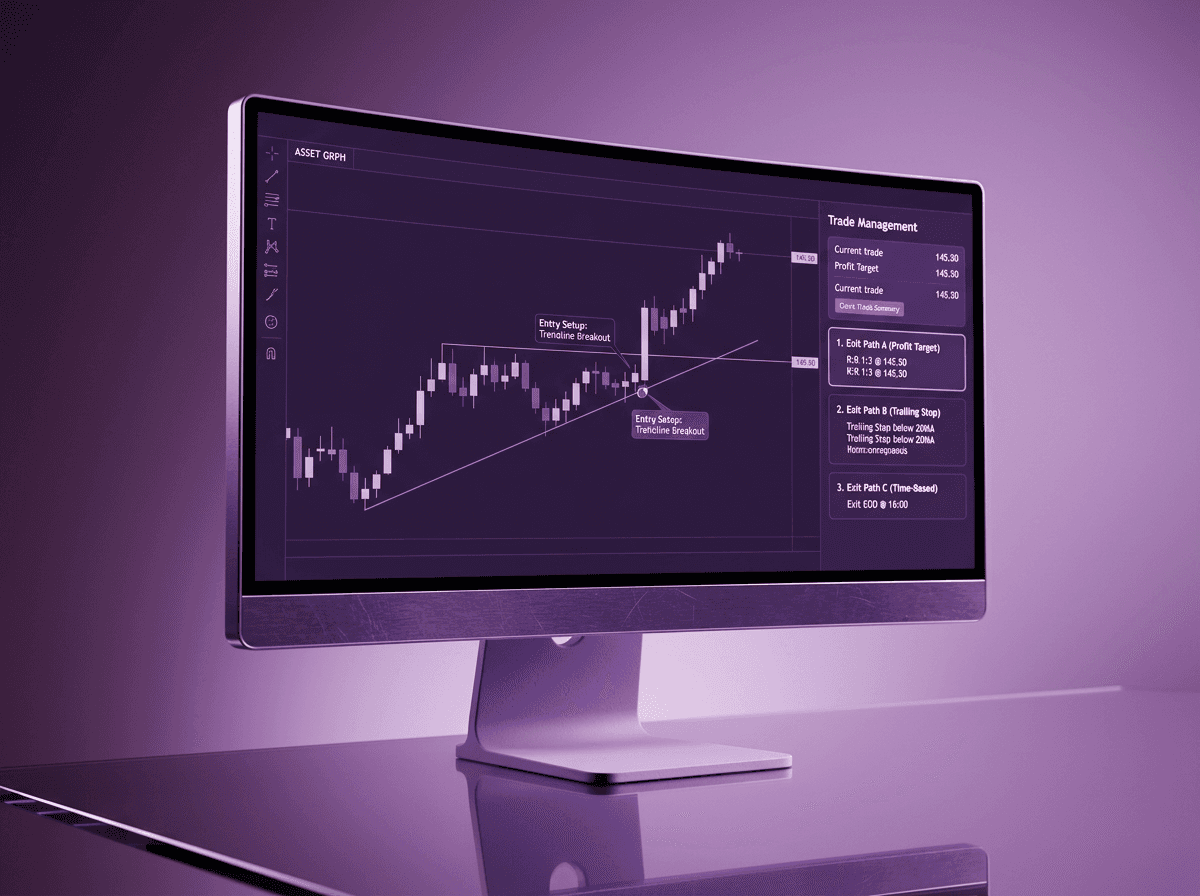
Most traders spend 90% of their energy finding the perfect entry. They study candlestick patterns, indicator setups, order flow, and market structure. Then, once they are inside a trade, they panic.
Your exit strategy determines what you actually keep from the market. A good entry with a bad exit is just a bad trade with extra steps. And the most common exit mistake is not choosing the wrong method. It is switching methods mid-trade based on emotions.
TL;DR
Three main exit methods exist: set and forget, trailing stop loss, and partial profits.
Each method has clear tradeoffs between simplicity, risk protection, and profit potential.
Switching between exit methods based on feelings destroys consistency.
Pick one approach, backtest it, and follow it mechanically for at least 30 trades before changing anything.
Consistent execution of an average exit strategy beats inconsistent execution of a perfect one.
Why Exits Matter More Than Entries
You can have a 40% win rate and still be profitable if your winners are significantly larger than your losers. That ratio is controlled entirely by how you exit, not how you enter.
Two traders take the exact same entry on EUR/USD at 1.0850. Same stop loss at 1.0820. Same analysis, same setup. Trader A uses set and forget with a take profit at 1.0940 (3R). Trader B panics when price pulls back from 1.0880 and closes manually at 1.0865 (0.5R).
Same entry. Completely different outcomes. The exit made the difference.
This is why your trading plan needs an exit section that is just as detailed as your entry criteria. "I will take profit when it feels right" is not a plan. That is hope wearing a disguise.
Three Exit Methods Compared
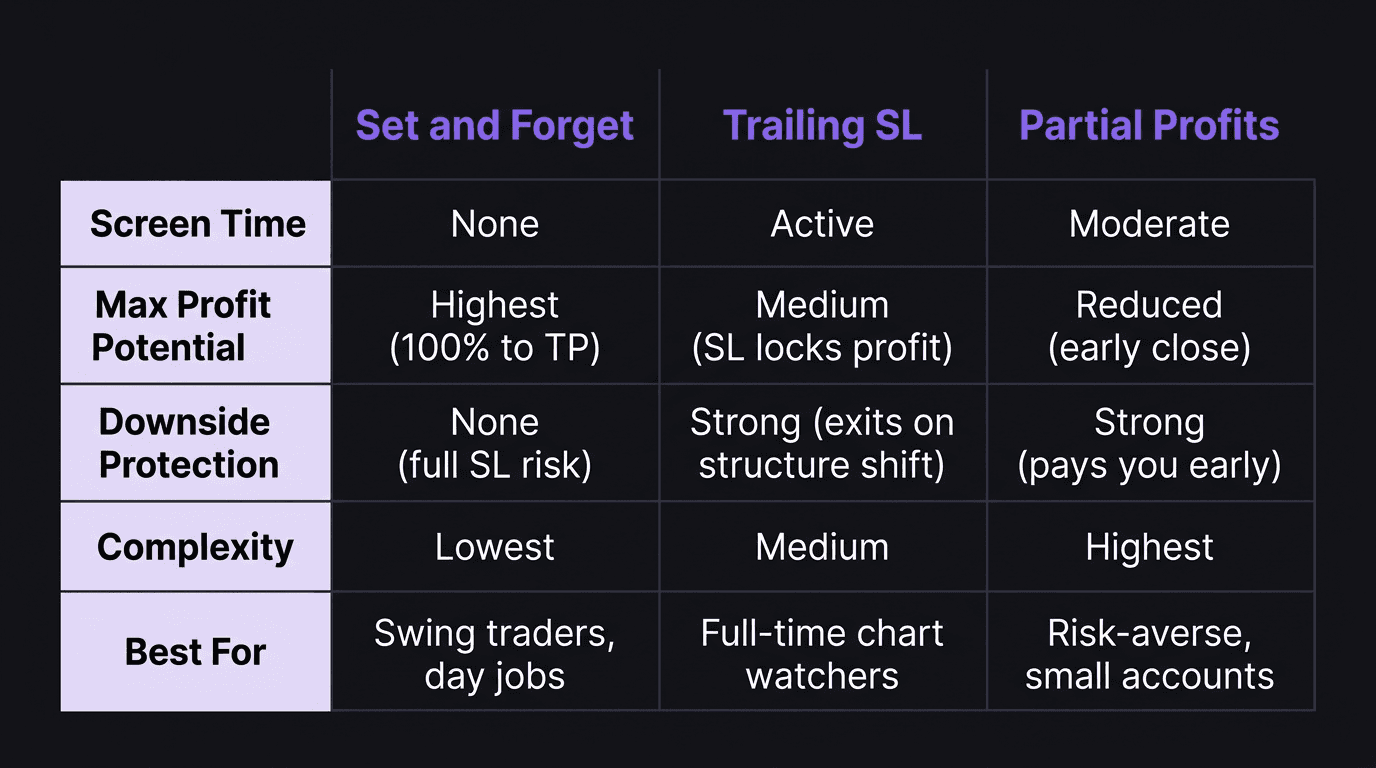
The source transcript covers three approaches to managing an open trade. Here is how each one works, with the tradeoffs you need to understand.
Set and Forget
You place your stop loss and take profit when you enter. Then you walk away. Price either hits TP or SL. You do not touch it.
Pros: zero screen time required, keeps risk at a fixed percentage (like 1%), maximizes profit when the trade works because 100% of your position reaches the target. Cons: you watch profits evaporate when price gets close to TP and reverses back through your stop.
This method suits swing traders with day jobs who cannot monitor charts for hours. It is simple, mechanical, and eliminates mid-trade decisions.
Trailing Stop Loss
As price moves in your favor and creates new market structure (higher lows in an uptrend, lower highs in a downtrend), you move your stop loss to the most recent structural point. First to break even, then into profit.
Pros: protects your downside, gets you out when market structure shifts. Cons: liquidity sweeps below structural lows can stop you out early for a small profit when the full trade would have paid 3x more. Also requires active management and chart monitoring.
Partial Profits
You close part of your position at a predetermined level and let the rest run to your ultimate target. Common splits: 50% at 3R and 50% at the supply zone, or 20% at 4R with 80% running.
Pros: you "pay yourself" immediately, and if you scale out at 4R with 20% of the position, the remaining 80% is essentially a free trade (even a full stop-out on the remainder still nets you break even). Cons: you capture less total profit than set and forget on winning trades because part of the position was closed early.
Pick One and Test It
The worst exit strategy is switching between all three based on how you feel in the moment. One day you set and forget because you are feeling confident. The next day you trail because you are nervous. The day after that you take partials because you saw someone on YouTube do it.
This is strategy hopping applied to exits. And it destroys your data.
If you change your exit method every few trades, you cannot know which method actually works for your strategy. You need at least 30 trades using the same exit rules to get any meaningful signal about whether the approach fits your edge.
Walkthrough: Testing Set and Forget on AUD/USD
You decide to test the set and forget method for one month. Your rule: every trade gets a 3R target. Stop loss placed at structure. Take profit at the next technical level that delivers at least 3R. No adjustments.
Trade 1: AUD/USD, long at 0.6520. Stop at 0.6490, TP at 0.6610 (3R). Price hits TP. Result: +3R.
Trade 2: AUD/USD, long at 0.6480. Stop at 0.6450, TP at 0.6570 (3R). Price goes to 0.6555, pulls back, stops you out at 0.6450. Result: -1R.
Trade 3: AUD/USD, short at 0.6600. Stop at 0.6630, TP at 0.6510 (3R). Price hits TP. Result: +3R.
After 12 trades, you have 5 wins and 7 losses. Win rate: 42%. Average win: +3R. Average loss: -1R. Total R gained: (5 x 3) - (7 x 1) = +8R. That is profitable with a sub-50% win rate.
Now you have data. You can see your trading expectancy and decide whether set and forget is the right fit. If the data says yes, keep it. If not, test trailing for the next 30 trades.
Backtesting accelerates this process. You can simulate 100 trades with each exit method in a few hours instead of waiting months for live data.
How Consistency Compounds Results
The power of sticking to one exit method is not that it captures the most R on any single trade. It is that it makes your results predictable and measurable.
When your exit rules are the same every time, you can isolate what is actually working in your strategy. Maybe your entries are strong but your 3R target is too ambitious. You would only know that if you ran 30+ trades with the same exit. If you varied exits across those trades, the data means nothing.
Consistency also reduces emotional interference. When exit decisions are pre-made, there is nothing to decide in the heat of the moment. Price is moving against you? The plan says hold. Price is near your target? The plan says hold. You do not need discipline if the decision was already made.
This is what separates traders who find their trading edge from those who keep searching forever. The edge was there the whole time. They just needed to stop changing the rules long enough to see it.
Your trading plan should contain one sentence about exits that you could recite from memory. "I use set and forget with a 3R target at the next supply zone." That is enough. Everything else is execution.
How EdgeFlo Supports Exit Discipline
EdgeFlo's Edge plan builder lets you document your exit strategy alongside your entry criteria, so your rules are visible every time you open a trade. Writing down "set and forget, 3R minimum" in your plan and seeing it before every session removes the temptation to improvise.
When your exit rules are written, visible, and tracked, switching methods requires a conscious decision instead of an emotional impulse. That is the difference between process and guessing.
The Edge Brief
Receive Insights on trading psychology, discipline, and the behavioral patterns that create consistent traders from our Founder and the EdgeFlo team, delivered to your inbox.
Think different. Trade different.
What is the best trade exit strategy?
Should I use trailing stop loss or set and forget?
How do I know if my exit strategy is working?
Can I mix different exit methods?

Turn discipline on.
Every session.
EdgeFlo is the environment serious traders operate inside.
Start 7-Day Free Trial
Cancel anytime.
No long-term commitment.

Think Different, Trade Different.