

FOMO Trading: Why Chasing Setups Costs More Than Waiting
FOMO trading destroys accounts faster than bad analysis. Learn why chasing setups fails and three rules to stay patient with your plan.
FOMO trading is entering a position because you watched price move without you and decided you could not afford to miss it. It costs more than waiting because it replaces your planned entry with an emotional one, giving you a worse price, wider risk, and no edge. Most traders do not blow up because their analysis is wrong. They blow up because they abandon their analysis the moment price starts moving.
You know a high-probability setup will only present itself when price gets to your desired point of interest. But meanwhile, you want to make money. So you take a low-quality trade, get frustrated when there is no real opportunity, and obviously lose money. Sound familiar?
TL;DR
FOMO trading means chasing entries after a move has started, replacing your planned setup with an emotional reaction.
The most dangerous window is between finishing your analysis and waiting for price to reach your level.
Every missed setup feels like the last one. It is not. High-probability patterns repeat.
Three rules kill FOMO: define your entry before the session, accept that no-trade days are profitable, and track plan adherence separately from PnL.
Structure and visibility beat willpower every time.
What FOMO Actually Looks Like on a Chart
FOMO does not announce itself. It disguises itself as opportunity.
Here is what it looks like in practice. You did your analysis the night before. You marked a demand zone on GBP/USD around 1.2640. You set an alert. Your plan is clear: wait for price to tap the zone, show a bullish reaction on the 15-minute chart, then enter long with a stop below the zone.
The London session opens. GBP/USD is sitting at 1.2680 and starts pushing higher. It hits 1.2710. Then 1.2730. Your zone at 1.2640 never got touched. Price left without you.
This is where FOMO starts whispering. "It is going. Get in now or you will miss the whole move."
So you enter long at 1.2730. No plan for this entry. No structure supporting it. You are 90 pips above your intended zone. Your stop loss is somewhere vague because you did not plan for an entry at this level. Price pulls back to 1.2700, takes your stop, and then rallies to 1.2780 without you.
You were right about the direction. You were wrong about the execution. And that is the entire problem with FOMO trading. It turns correct analysis into losing trades.
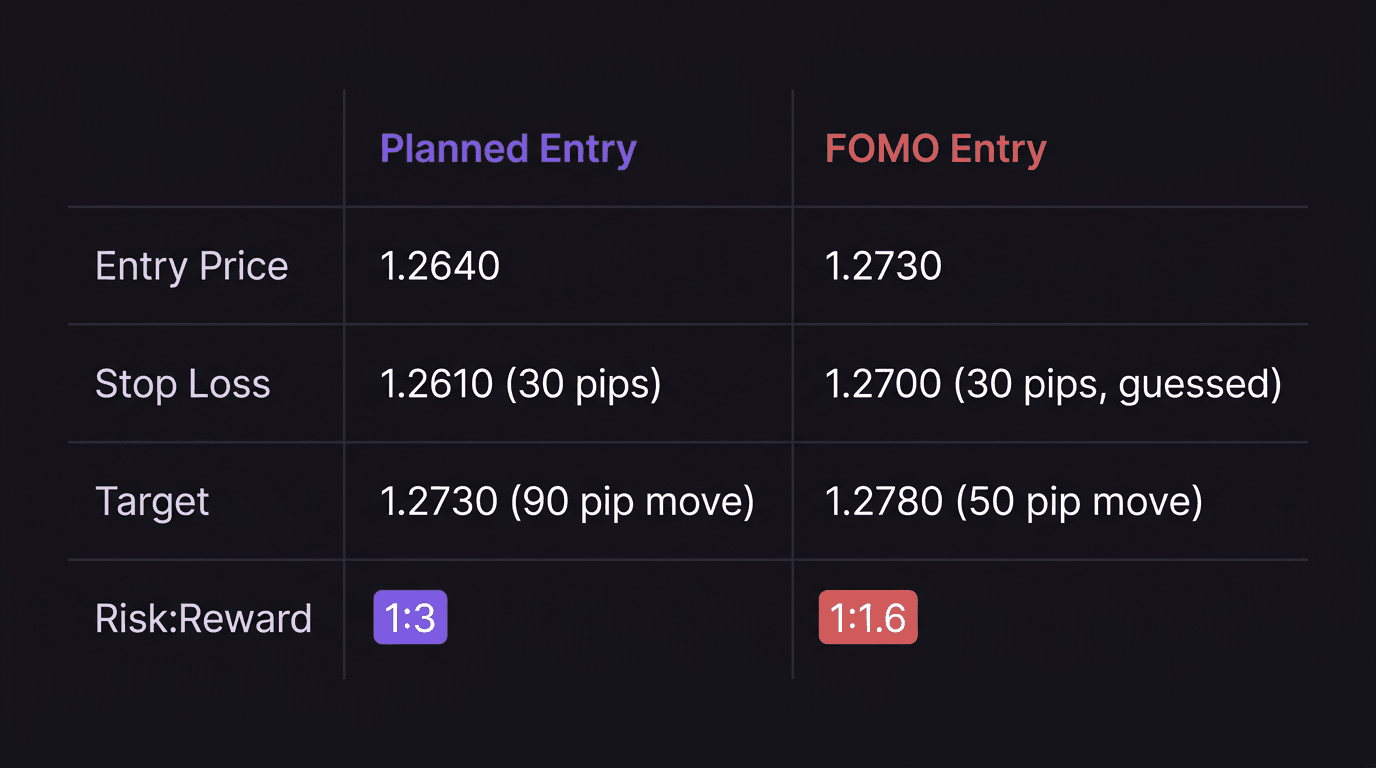
The numbers tell the story. Same pair. Same session. Same directional bias. But the FOMO entry cuts the reward in half and turns a 1:3 trade into a coin flip.
The Gap Between Analysis and Entry (Where FOMO Strikes)
Most traders mess up in the duration between analysis and entry. That gap is where discipline either holds or breaks.
You do your pre-market routine. You mark levels. You identify the pairs you want to trade and the conditions that need to appear. Your analysis is solid. And then you sit down to watch the charts and nothing happens for 45 minutes.
Meanwhile, EUR/JPY is ripping 80 pips in one direction. NZD/USD breaks a range you were not tracking. You see green candles on pairs you did not analyze. And you start thinking: "Maybe I should just take something."
This is the moment. Not the analysis. Not the execution. The waiting. That is where FOMO lives.
You are going against your own research, your own analysis, your own preparation, your own plan. You know this. But the discomfort of sitting still while price moves feels worse than the discomfort of losing money on a bad trade. At least a bad trade feels like doing something.
Traders jump into trades way too early because they are trading on impulse, chasing the market with no real plan. And the worst part is that it often works once or twice. That random win reinforces the behavior. Then it costs you three or four times what you made.
This pattern links directly to overtrading. FOMO and overtrading feed each other. FOMO gets you into a bad trade. The bad trade creates a loss. The loss creates urgency to recover. The urgency triggers more FOMO. It is a cycle, and the only way to break it is to interrupt it before the first bad entry.
Why the Missed Setup Isn't Your Last Chance
Every trader who has chased a trade has felt the same thing: "If I do not get in now, I will miss it."
But miss what, exactly? One trade. One setup. One occurrence of a pattern that has repeated thousands of times before and will repeat thousands of times after.
GBP/USD did not give you your entry at 1.2640 today. It will give you a similar setup within the next week. High-probability patterns are high-probability precisely because they recur. If they only happened once, there would be no edge in trading them.
Think about it this way. You probably eat lunch every day. If you missed lunch today, you would not panic and eat four dinners to make up for it. You would just eat lunch tomorrow. Trading setups work the same way. Missing one is not a crisis. It is Tuesday.
The traders who build trading consistency are not the ones who catch every move. They are the ones who only take trades that match their criteria. That means accepting that some days, your criteria are not met. And a day with zero trades and zero losses is a better day than one trade and one loss from chasing.
Track your missed setups for a month. Write down every time you wanted to enter but held back because the conditions were not right. At the end of the month, go back and check: how many of those "missed" setups actually would have hit your target? You will find that a good portion of them reversed or chopped. The fear of missing out is almost always bigger than the actual missed opportunity.
Three Rules to Kill FOMO Before It Kills Your Account
FOMO is not something you think your way out of. You build structures around it. These three rules work because they change your environment, not your emotions.
Rule 1: Write Your Entry Criteria Before the Session Starts
If your entry criteria are not written down before you open a chart, you do not have a plan. You have preferences. And preferences bend the second price starts moving.
Your trading rules need to include specific conditions: pair, timeframe, structure requirement, zone or level, and confirmation signal. If price does not meet all of these, you do not trade. Period.
Write it on paper. Put it next to your screen. Check each condition before every entry. This is not optional. This is the wall between planned trading and FOMO trading.
Rule 2: Accept That No-Trade Days Are Profitable
A day with zero trades and zero losses means you preserved your capital. That is a profitable day. Not in PnL terms, but in account-survival terms.
Most trading mistakes come from forcing activity when the market gives you nothing. The traders who survive long enough to compound are the ones who sit on their hands when there is no setup.
Reframe the no-trade day. It is not a failure. It is proof that your filter works.
Rule 3: Track Plan Adherence, Not Just PnL
Add one column to your trading journal: "Was this trade in my plan?" Yes or no. Nothing else.
After 30 trades, calculate your win rate on planned trades versus unplanned trades. Almost every trader who does this discovers the same thing: planned trades are profitable, unplanned trades are not. Once you see that data, FOMO loses its power because the numbers make the argument for you.
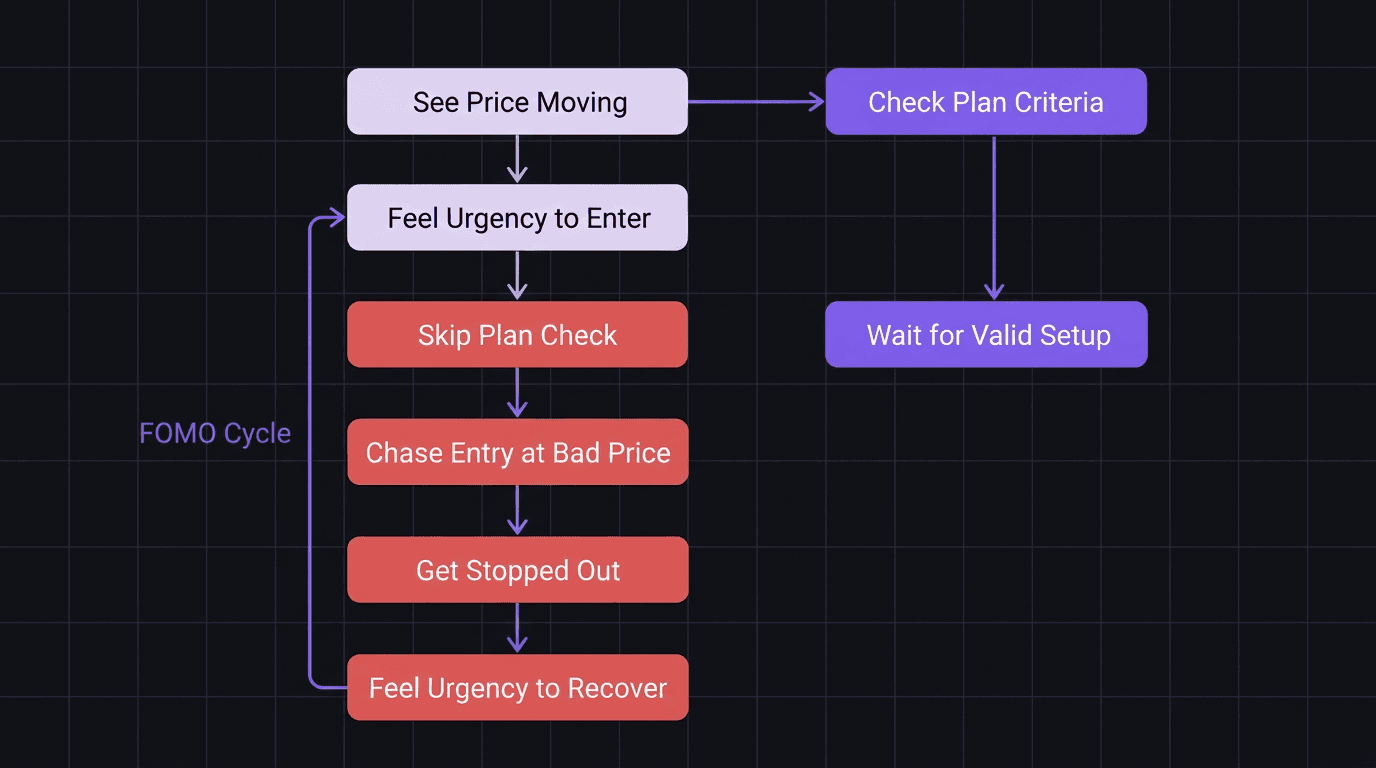
The flowchart makes the cycle visible. Once you can see it, you can break it.
How EdgeFlo Keeps You Anchored to Your Plan
FOMO is a gap between knowing your plan and executing your plan. EdgeFlo closes that gap by keeping your plan visible while you trade.
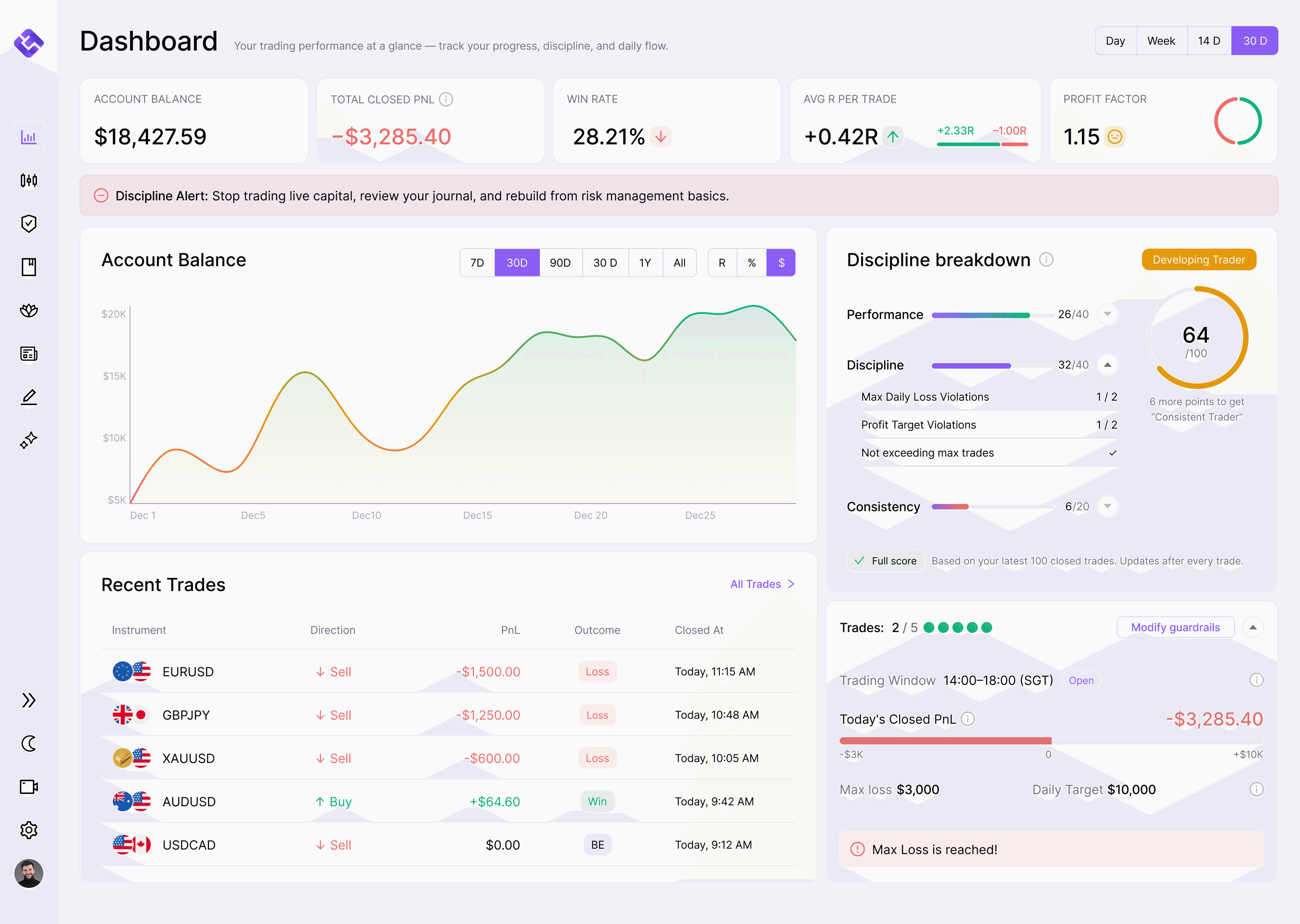
The Edge plan keeps your criteria on screen during execution. Your entry conditions, your invalidation levels, your risk parameters. They sit right next to your chart, not buried in a notebook or a screenshot from last night. When price starts moving and the urge to chase kicks in, your criteria are right there asking: "Does this meet your conditions?"
That visibility changes the decision. Instead of "Should I get in?" the question becomes "Does this match what I wrote down?" One is emotional. The other is mechanical.
EdgeFlo's guardrails can also restrict trading outside your defined conditions. If you have set specific session times or loss limits, the guardrails hold you to them. And if you genuinely need to override them for a valid reason, you can. The override exists so the guardrails support your discipline without removing your agency.
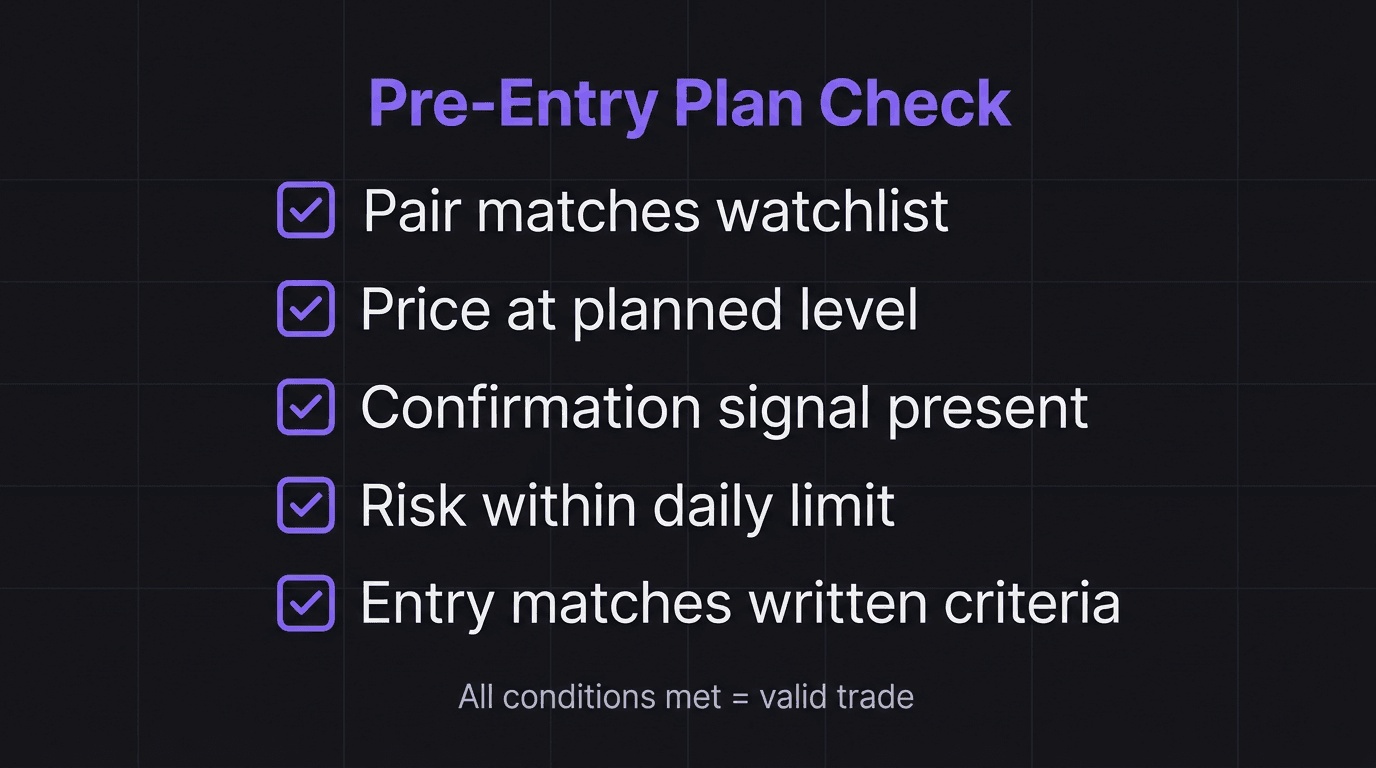
You do not need more willpower. You need more structure. FOMO loses most of its pull when your plan is visible, your criteria are specific, and your trading environment is designed to keep you honest.
The Edge Brief
Receive Insights on trading psychology, discipline, and the behavioral patterns that create consistent traders from our Founder and the EdgeFlo team, delivered to your inbox.
Think different. Trade different.
What is FOMO trading?
How do I know if I'm FOMO trading?
Can FOMO trading be fixed?
Why does FOMO trading cause more losses than bad analysis?

Turn discipline on.
Every session.
EdgeFlo is the environment serious traders operate inside.
Start 7-Day Free Trial
Cancel anytime.
No long-term commitment.

Think Different, Trade Different.