

Pre-Trade Checklist: 7 Questions Before Every Entry
Run these 7 questions before every trade entry. A simple pre-trade checklist that filters bad setups and keeps you on plan.
You have a setup on screen. Price is pulling back to a level you marked. The spread is tight. Volume is picking up. Everything looks right.
So you click buy.
Thirty seconds later you realize you never checked the trend on the higher timeframe. You sized the position based on feel, not math. And you have no idea where you are getting out if this goes wrong.
A pre-trade checklist fixes this. Not by adding complexity, but by forcing you to answer seven specific questions before every entry. If you cannot answer all seven, you do not take the trade. That single filter eliminates most of the trading mistakes that drain accounts slowly over weeks and months.
TL;DR
A pre-trade checklist is a fixed set of questions you answer before every entry to filter impulsive trades.
Seven questions cover trend, setup, risk, catalyst, invalidation, sizing, and plan alignment.
Running the checklist takes under 60 seconds once practiced. Skipping it costs far more.
The checklist works because it replaces confidence-based decisions with evidence-based ones.
Build it into your pre-market routine so it becomes automatic.
Why a Checklist Beats 'I Feel Good About This'
Feelings are terrible trade filters. You feel good about a trade when you are excited. You feel good when you just had a winner. You feel good when price is moving fast and you do not want to miss it. None of those feelings have anything to do with whether the setup meets your criteria.
A checklist replaces that feeling with evidence. Every question demands a concrete answer. "Is the trend aligned on the higher timeframe?" is a yes or no. "Where is my stop?" is a number. There is no room for "I think it looks bullish."
Pilots figured this out decades ago. A Boeing 737 has thousands of components and experienced captains who have flown for 20 years. They still run checklists before every flight. Not because they are bad pilots. Because human memory is unreliable under pressure, and the cost of missing one item is catastrophic.
Trading is the same dynamic at a smaller scale. You know your rules. You have written them in your mechanical trading plan. But in the moment, with price moving and money on the line, you skip steps. The checklist is the forcing function that stops that from happening.
Every trade you enter should reflect excellence, not excitement. That principle separates traders who compound from traders who churn. A checklist is how you operationalize it. You stop asking "do I feel good about this?" and start asking "does this pass every filter?"
The 7-Question Pre-Trade Filter
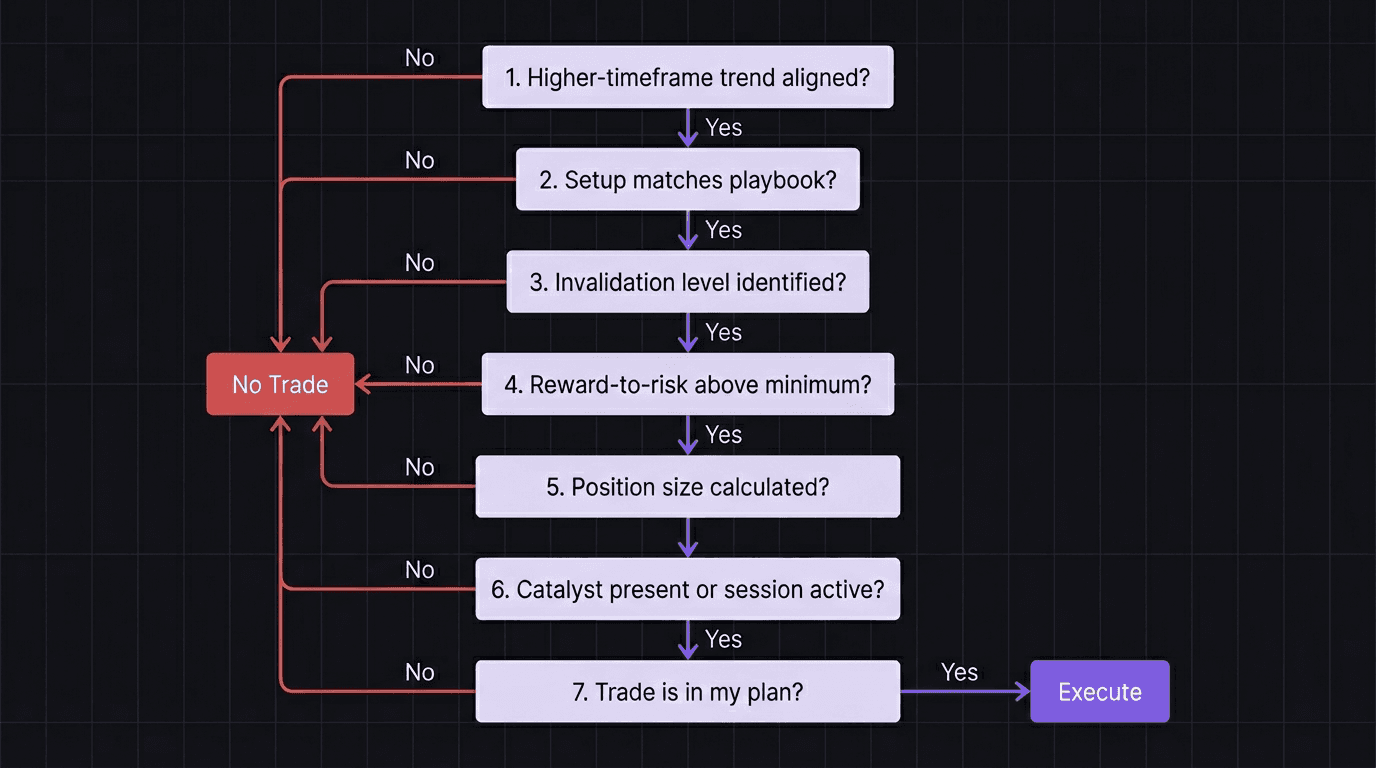
These seven questions are ordered deliberately. Trend first, plan alignment last. If the answer to any question is no or unclear, you stop.
1. Is the higher-timeframe trend aligned with my direction? Check one timeframe above your entry timeframe. If you trade the 15-minute chart, check the 1-hour. Trend alignment is the first filter because nothing else matters if you are trading against the dominant move.
2. Does this match a setup in my playbook? Your trading playbook documents the specific patterns you trade. Pullback to support. Break and retest. Range fade. If the setup on screen does not match one of your documented patterns, it is not your trade.
3. Where is my invalidation level? Before you enter, you need the exact price where you are wrong. Not a zone. A number. This is where your stop goes. If you cannot identify it cleanly on the chart, the setup is not clear enough to trade.
4. What is the reward-to-risk ratio? Measure the distance from entry to stop (risk) and entry to target (reward). If the ratio is below your minimum (most traders use 1.5:1 or 2:1), pass. Good entries are defined by favorable math, not good feelings.
5. Is my position size correct for this stop distance? Calculate the size based on your stop distance and your per-trade risk percentage. If you risk 1% per trade and your account is $10,000, you risk $100. Divide $100 by the pip distance to your stop to get the correct lot size. Do not eyeball this.
6. Is there a catalyst or is this a dead zone? Check if there is a news event, session open, or momentum shift supporting the move. A perfect setup in a dead zone (lunchtime in New York, pre-news consolidation) might sit there for hours doing nothing. Patience makes profits, and sometimes patience means waiting for the catalyst.
7. Is this trade in my plan? This is the final gate. Your if-then trading rules define what you trade, when, and how. Even if the setup looks perfect technically, if it falls outside your documented plan, it is a random trade. Random trades destroy consistency.
Walkthrough: Checklist on a Live Setup
Here is how the checklist works in practice on a real setup.
EUR/USD Pullback to Support, 15-Minute Chart
You are watching EUR/USD during the London session. Price has been trending up on the 1-hour chart, making higher highs and higher lows. On the 15-minute chart, price pulls back to the 1.0875 level, which was previous resistance now acting as support. A bullish engulfing candle forms right at that level.
This looks good. You want to buy. Run the checklist.
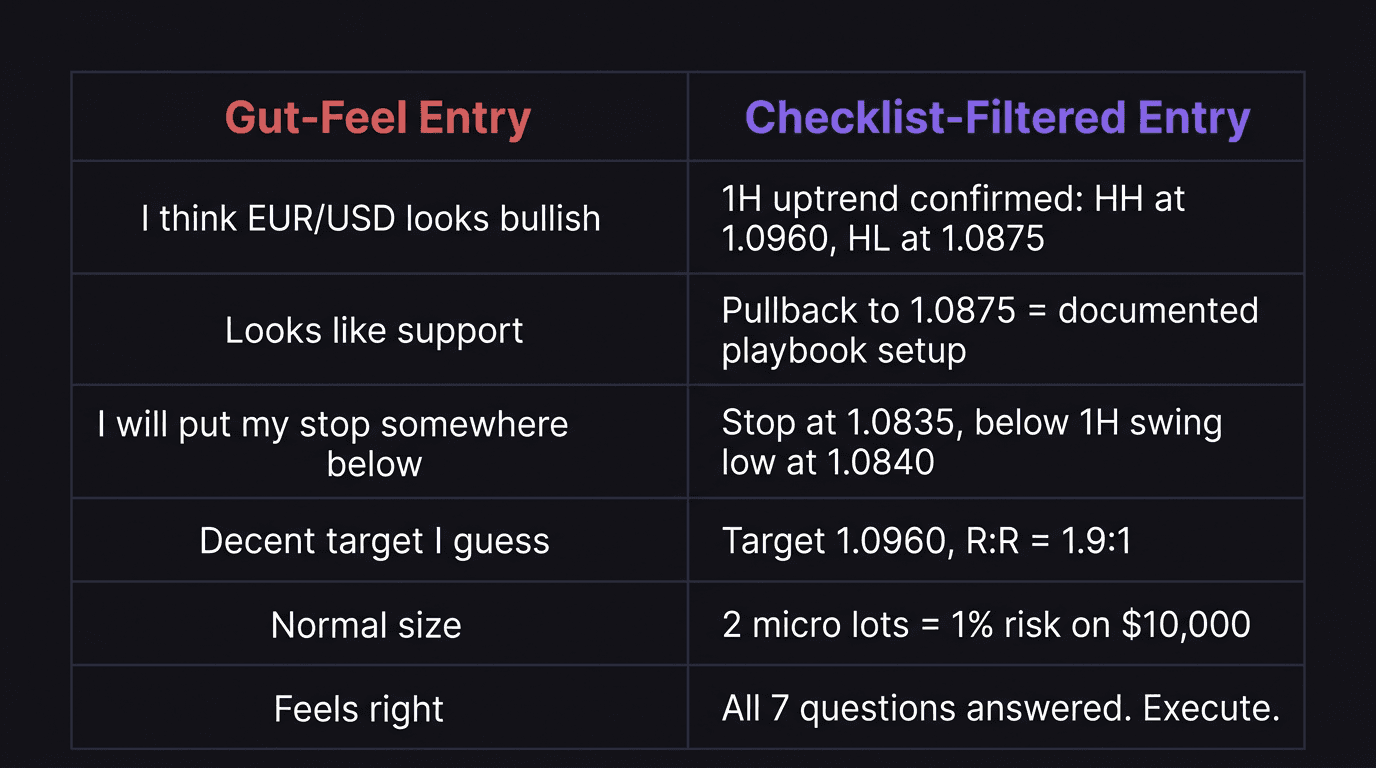
1. Higher-timeframe trend aligned? Yes. The 1-hour shows a clear uptrend with higher lows at 1.0840 and 1.0875. Direction is long.
2. Setup matches playbook? Yes. This is a pullback-to-support pattern. You trade this. It is documented in your playbook.
3. Invalidation level? Below the 1-hour swing low at 1.0840. If price breaks below 1.0840, the higher-low structure is broken and you are wrong. Stop goes at 1.0835 (5 pips below the level for spread buffer).
4. Reward-to-risk? Entry at 1.0878 (above the engulfing candle). Stop at 1.0835. Risk is 43 pips. Target is the previous 1-hour high at 1.0960. Reward is 82 pips. Ratio is 1.9:1. Above your 1.5:1 minimum. Pass.
5. Position size? Account is $10,000. Risk 1% = $100. At 43 pips risk, on EUR/USD where one standard lot = $10/pip, position size is $100 / (43 x $1) = 2.3 micro lots. You round down to 2 micro lots.
6. Catalyst? London session is active. Volume is above average. No high-impact news for the next two hours. Catalyst: session momentum. Pass.
7. In my plan? Your plan says: trade pullback-to-support long when 1-hour trend is up, during London or New York session, with minimum 1.5:1 R:R. Every condition met. This trade is in the plan.
Seven questions, seven clear answers. You take the trade.
Now contrast this with the same chart if the 1-hour was ranging instead of trending. Question 1 fails. You stop. No trade. That single filter just saved you from a low-probability entry in a choppy market.
What Happens When You Skip the Checklist
Every chart, every session, every trade carries a lesson. Here is the lesson that skipping teaches you: undisciplined entries compound into account damage.
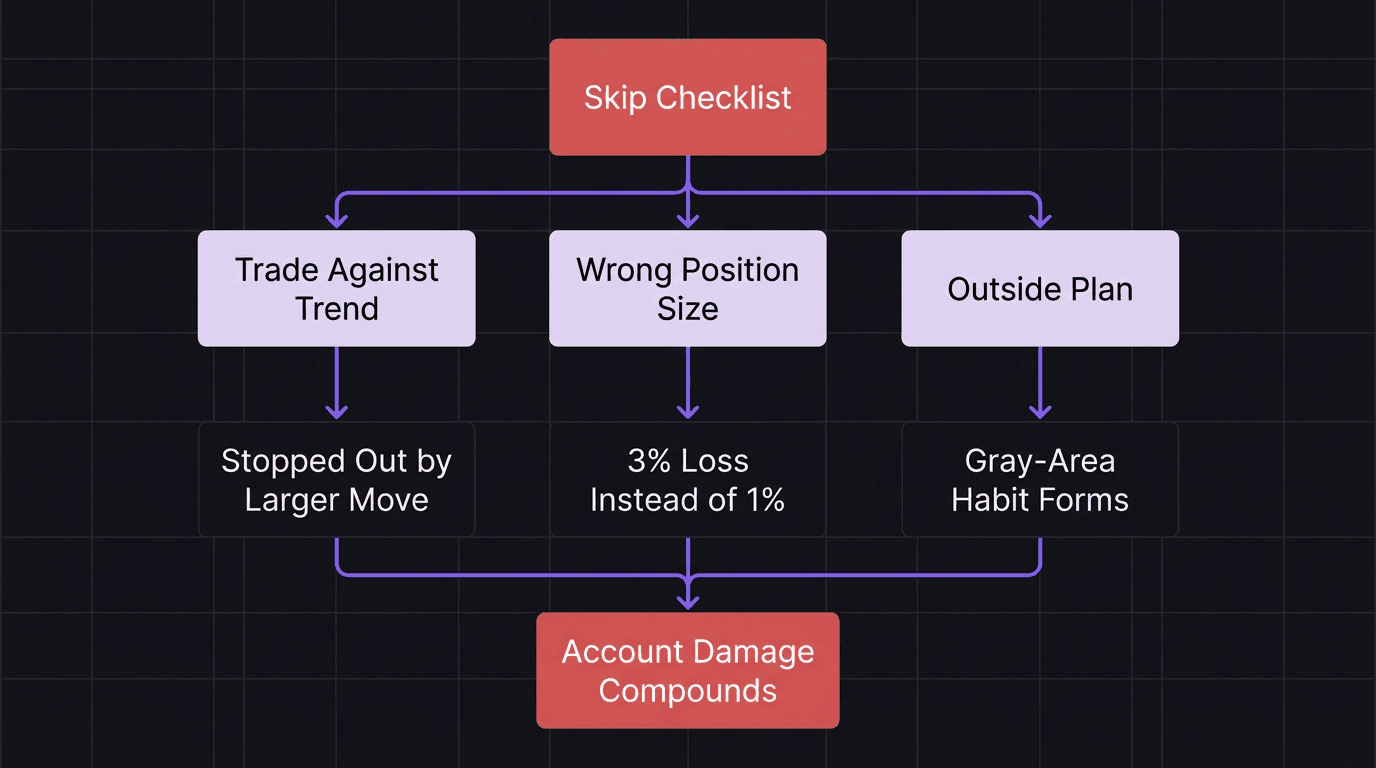
When you skip the checklist, three things tend to happen.
You trade against the trend. Without checking the higher timeframe, you take a long in a downtrend because the 5-minute chart looks bullish. The 5-minute chart is noise inside a larger move. You get stopped out and wonder what happened. This is the most common mistake beginners make, and question 1 eliminates it entirely.
You size wrong. Without calculating position size from your stop distance, you default to whatever you traded last time. Sometimes that is too small and your win barely matters. Sometimes it is too large and a normal stop-out takes 3% of your account instead of 1%. Over 50 trades, inconsistent sizing destroys your equity curve even if your win rate is solid.
You take trades outside your plan. This is the quiet killer. The setup looked interesting. It was not in your plan, but it was not not in your plan either. So you took it. These gray-area trades are where discipline erodes. One gray-area trade becomes five. Five becomes a habit. And now your plan is just a document you wrote once and never follow.
Discipline means following your plan even when it is boring or uncomfortable. A checklist is how you enforce that discipline on yourself. Not through willpower. Through structure. You do not need motivation to run seven questions. You just need the habit.
The fix is not complicated. Print the checklist. Tape it next to your screen. Do not click the buy or sell button until you have answered every question. After two weeks, it takes less than 60 seconds. After a month, it is automatic. The investment is tiny. The protection is enormous.
How EdgeFlo Makes the Checklist Part of Your Workflow
Building a checklist is one thing. Actually running it before every trade is another. The gap between knowing and doing is where most traders fail.
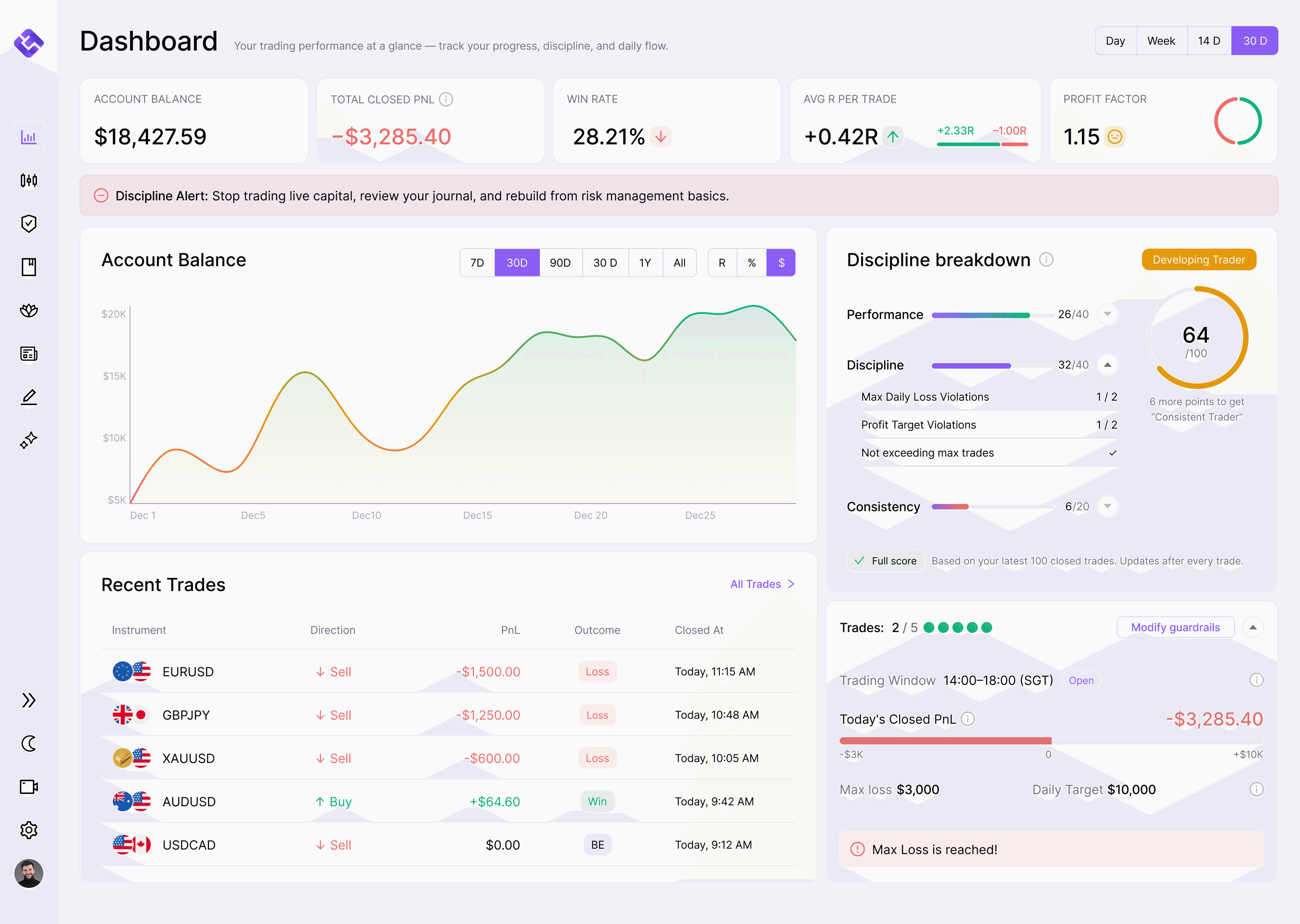
EdgeFlo's plan builder lets you document your strategy criteria in a structured format. Your entry rules, setup types, risk parameters, and invalidation logic all live inside your active plan. When you open EdgeFlo before a session, your plan is right there next to your chart. You do not have to remember the seven questions because they are written down in a format you built yourself.
The pre-market flow includes prompts and a checklist you can run before your session starts. This is not enforced. You can skip it and still trade. But the prompts are designed to walk you through the exact preparation that makes the seven questions easy to answer. Higher-timeframe trend? You checked it in pre-market. Playbook setups? You reviewed them. Session catalyst? You noted it. By the time you are looking at a live setup, most of the checklist is already done.
The discipline still comes from you. EdgeFlo does not block trades that fail the checklist. What it does is put the checklist where you cannot avoid seeing it, reduce the friction of running it, and make skipping it a conscious choice rather than an oversight.
The Edge Brief
Receive Insights on trading psychology, discipline, and the behavioral patterns that create consistent traders from our Founder and the EdgeFlo team, delivered to your inbox.
Think different. Trade different.
How many questions should a pre-trade checklist have?
Should I use a pre-trade checklist for every single trade?
What is the most important question on a pre-trade checklist?
Can a pre-trade checklist work for scalping or fast timeframes?

Turn discipline on.
Every session.
EdgeFlo is the environment serious traders operate inside.
Start 7-Day Free Trial
Cancel anytime.
No long-term commitment.

Think Different, Trade Different.