

Trading Rules: Why You Break Them and How to Stop
You wrote trading rules for a reason. Here is why you keep breaking them and how to build rules that actually stick under pressure.
You have trading rules. You wrote them down, maybe even printed them out. And you still break them.
Not because you forgot. Not because you lack knowledge. You break them because the rules you wrote were built for your calm, rational self. The version of you sitting at a desk on a Sunday afternoon. That version is not the one trading at 9:45 AM after watching a position blow through your stop.
Every time you follow your plan, even when it feels boring or uncomfortable, you are building mental armor. That is not a motivational quote. It is the mechanical truth of how discipline compounds. But you cannot follow a plan that falls apart the moment your emotions show up.
This article shows you why your rules break down and how to rebuild them so they hold.
TL;DR
Most trading rules fail because they are too vague to execute under stress.
Rules need to be specific if-then statements, not general principles.
Environmental design (removing temptation) beats willpower every time.
Tracking rule compliance separately from PnL shows you where discipline leaks.
The goal is not perfection. It is making rule-breaking harder than rule-following.
The Real Reason You Break Your Rules
The standard answer is "emotions." You got greedy, you got scared, you revenge traded. And that is true on the surface. But it does not explain why some rules hold and others collapse.
The real problem is ambiguity.
Most traders write rules that require a judgment call in the moment. "Only take A+ setups." "Manage risk properly." "Do not overtrade." These sound clear when you are calm. But at 2 AM, after three consecutive losers on GBP/JPY, what exactly qualifies as "A+ "? Your emotional brain fills in the blanks, and it fills them in the direction of taking the trade.
Most traders are ruled by emotions. They chase setups, skip journals, move stop losses. Not because they are weak, but because their rules have gaps. And emotions rush in to fill gaps.
Here is the distinction that matters: you do not have a discipline problem. You have a specificity problem. Discipline is just doing what needs to be done, no matter how you feel. Showing up every single day regardless of how you feel. But "what needs to be done" has to be crystal clear, or discipline has nothing to grab onto.
When your rules are vague, every trade becomes a negotiation with yourself. And you will lose that negotiation when you are tired, frustrated, or on tilt. This is one of the most common trading mistakes and it has nothing to do with chart reading.
Vague Rules vs Actionable Rules (Examples)
The difference between a rule you follow and a rule you break usually comes down to how it is written.
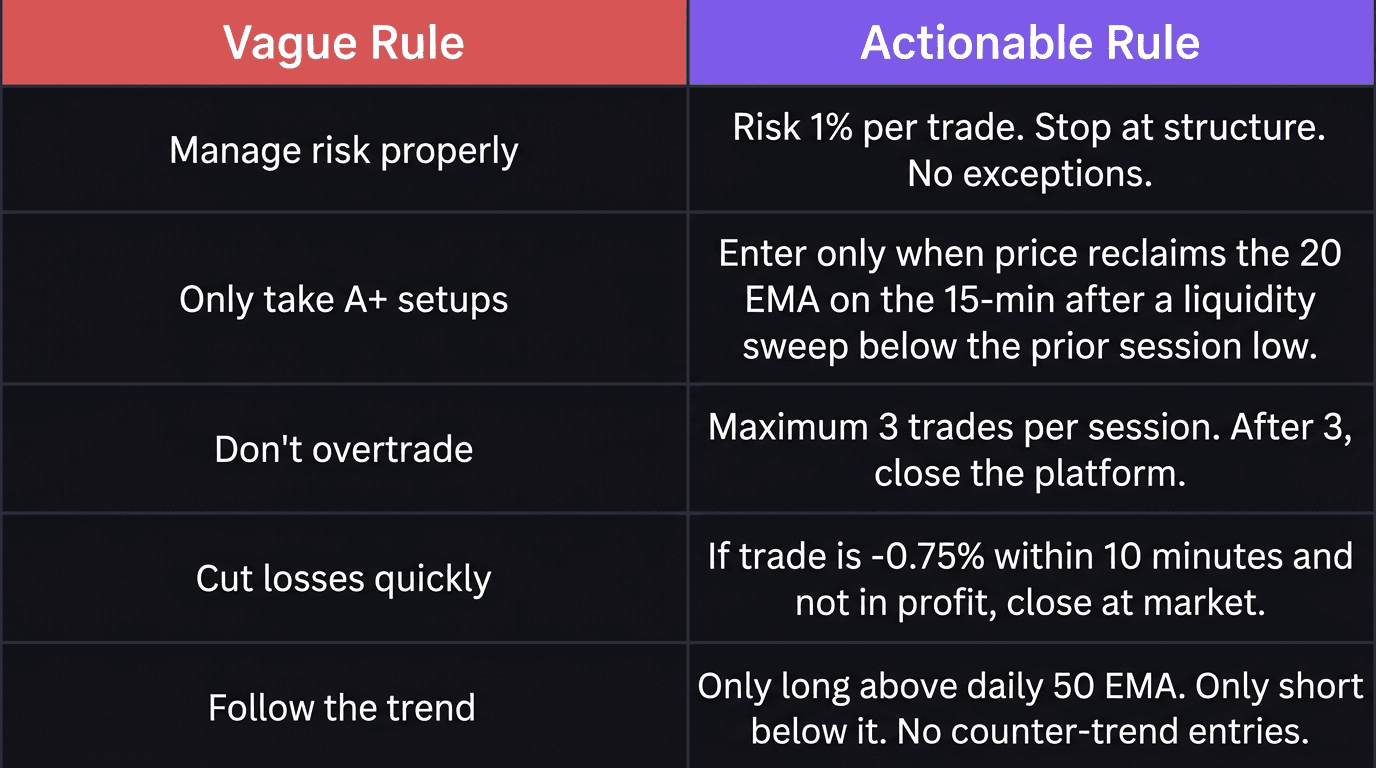
Look at the right column. Every rule has a number, a condition, and a clear action. There is nothing to interpret. You either did it or you did not.
Here is how to test your own rules: read each one and ask, "Could a stranger follow this without asking me a single question?" If the answer is no, the rule is too vague.
Three steps to rewrite any vague rule
Identify the decision point. What exactly are you deciding? Entry, exit, position size, session length?
Add a number. Every rule needs at least one specific number. Percentages, price levels, time limits, trade counts.
Define the action. Not "be careful" or "manage it." Actual verbs: close, skip, reduce, walk away.
"Manage risk properly" becomes "Risk 1% of account equity per trade. Calculate position size before entry. If the math does not work for the setup, skip the trade." No gaps. No room for your emotional brain to negotiate.
Write Rules You Can Follow at 2 AM
This is the real test. Not whether your rules look good on paper. Whether they hold up when you are exhausted, frustrated, and staring at a chart that just stopped you out for the third time.
Rules that survive pressure share three traits:
They are binary. Yes or no. Did you follow it or not. "I will try to be patient" is not binary. "I will not enter a trade in the first 15 minutes after market open" is binary.
They require zero calculation in the moment. If you need to think about whether you are following the rule, the rule is too complex. Pre-calculate everything during your pre-market routine so that execution is just following instructions.
They have a physical action attached. "Do not revenge trade" is a thought. "After two consecutive losses, close the platform and set a 30-minute timer" is a physical action. Your body can do physical actions even when your brain is on fire.
Walkthrough: The same setup, two different rule sets
Say you are trading EUR/USD on the London open. Price sweeps below 1.0840 and reclaims it on the 5-minute chart. Your bias is long based on your morning analysis.
Trader A's rules: "Take good setups in the direction of the trend. Manage risk. Do not get emotional."
Trader A enters long at 1.0845. Price pulls back to 1.0830. The rules say "manage risk" but do not say what that means right now. Trader A moves the stop from 1.0820 to 1.0810, then to 1.0800, because "it needs more room." Price hits 1.0795. Trader A is down 50 pips on what was supposed to be a 20-pip risk trade.
Trader B's rules: "Enter long only after a liquidity sweep below the prior session low with a reclaim on the 5-min. Stop at the sweep low minus 5 pips. Risk exactly 1% of account. Do not move the stop. Target is 2R."
Trader B enters long at 1.0845 with a stop at 1.0815. Price pulls back to 1.0830. The stop is at 1.0815. Nothing to decide. Price bounces and hits the 2R target at 1.0905. Trader B made 60 pips on 30 pips of risk.
Same setup. Same market. Different rules. The difference was not talent or experience. It was specificity.
That kind of rule clarity is the foundation of trading consistency. You do not rise to the level of your goals. You fall to the level of your rules.
Environmental Design: Make Rule-Breaking Harder
Willpower is a losing strategy. Research on self-control consistently shows that people who appear disciplined are not resisting temptation better. They are arranging their environment so temptation does not show up.
Apply this to trading.
Remove the tools of rule-breaking. If you overtrade, set a maximum order count on your broker platform. If your broker does not support it, use a trading habit tracker with a hard daily limit. After you hit it, close the charts.
Change the default. Instead of relying on yourself to remember your rules, make the rules the default state. Write your plan before the session starts. Set alerts at your levels. Put your position size calculation in a spreadsheet so you just plug in the stop distance.
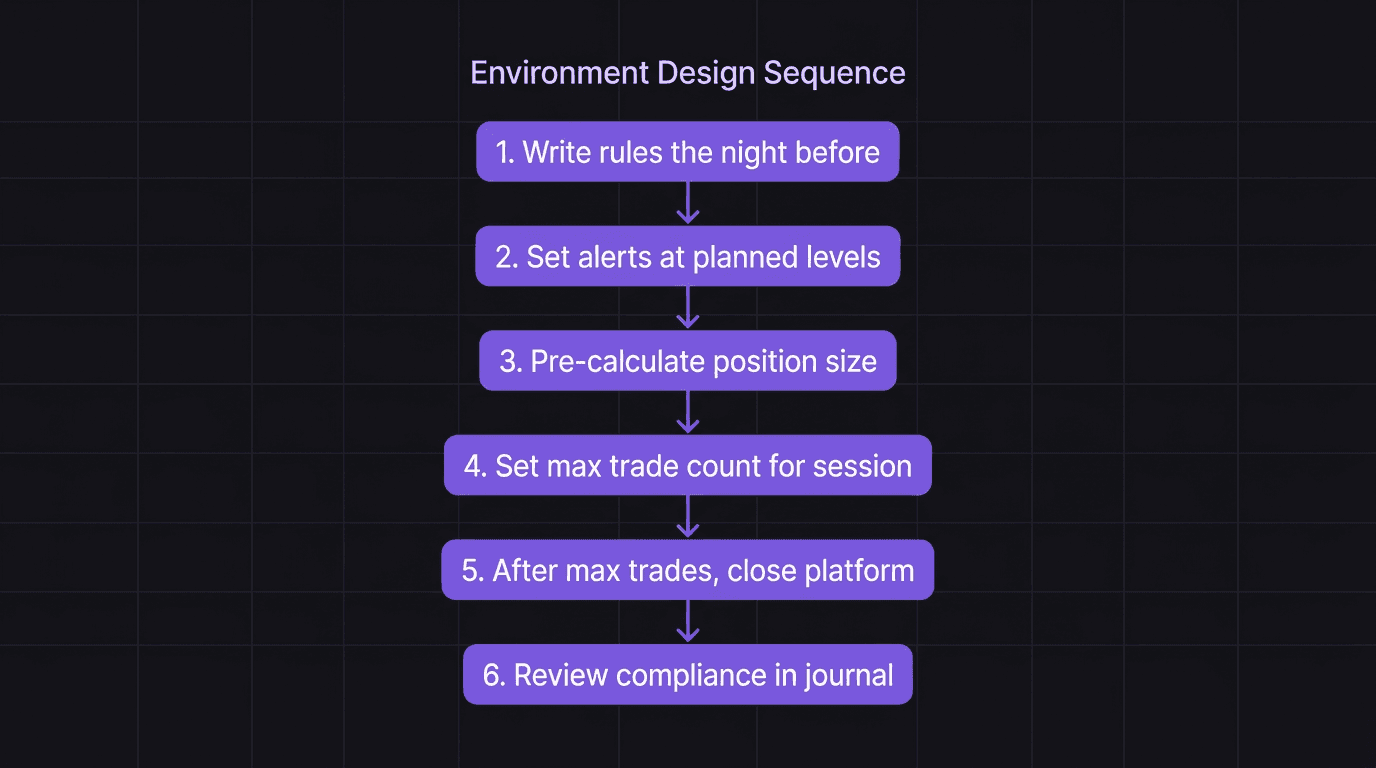
Add friction to bad behavior. Log out of your broker after each session. Require yourself to re-enter your password and re-open your chart layout. That 30-second delay is often enough to interrupt an impulsive trade.
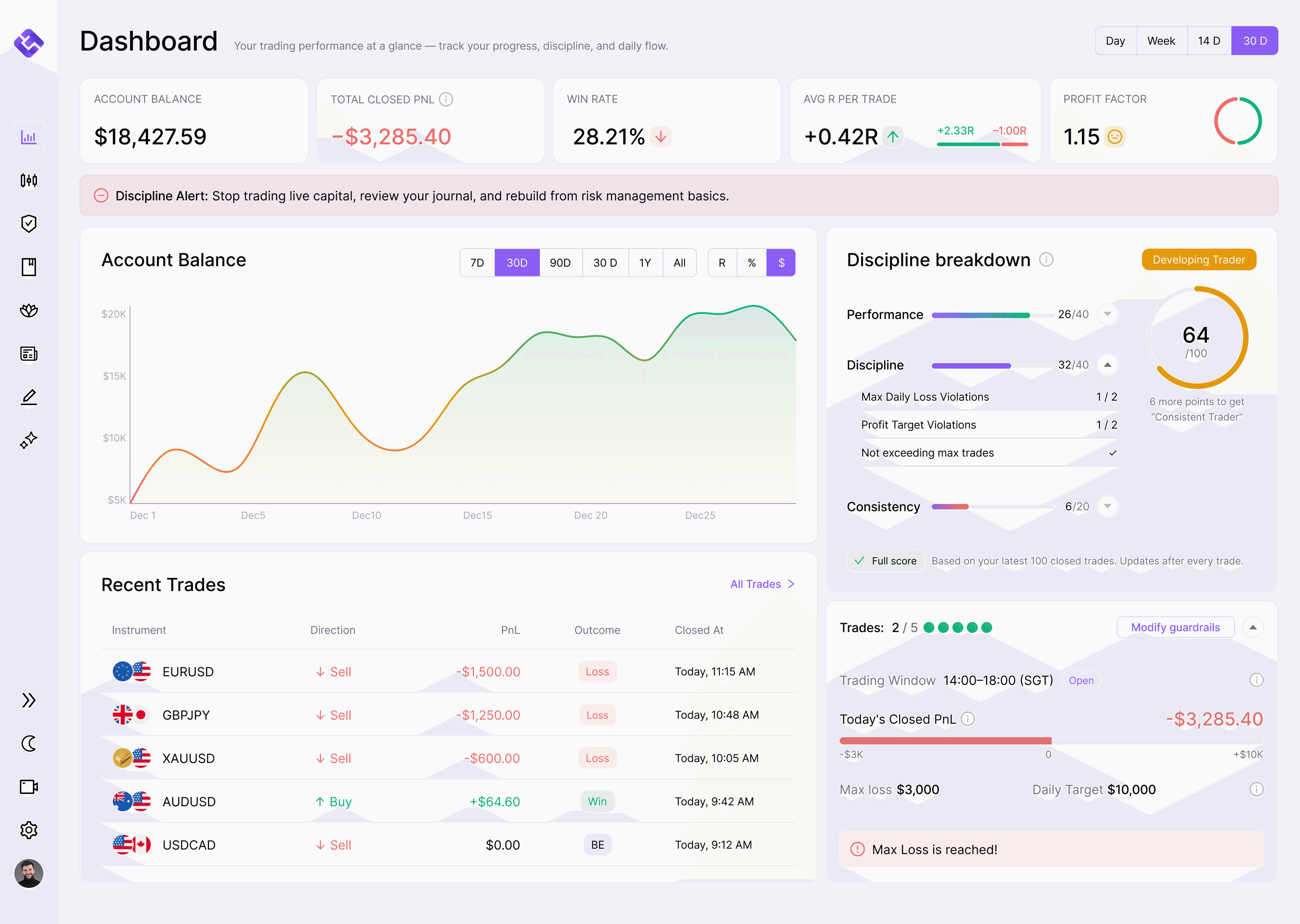
Use accountability. Track rule compliance as a separate metric from PnL. You can have a profitable day and still break rules. You can have a losing day with perfect compliance. Separating the two gives you real data on your process.
Build a mechanical trading plan that covers every decision point before the market opens. When the plan is complete, execution becomes mechanical. You are free from emotional trading. Free from overthinking. That is what discipline actually looks like in practice.
How EdgeFlo Keeps Your Rules Visible
EdgeFlo's edge plan builder lets you store your trading rules right next to your chart. Not in a separate notebook. Not in a PDF you forgot about. Next to the chart, where you are making decisions.
You document your strategy, set your active plan, and it stays visible during your session. When you are about to take a trade, your rules are there. No switching tabs. No relying on memory.
Guardrails add another layer. You can set restrictions that flag when you are about to break your own parameters. Hit your daily loss limit or max trade count, and the platform intervenes. You can override it, but you have to actively choose to. That moment of friction is often enough to stop the impulse.
The point is not that you need software to follow rules. Plenty of traders do it with a sticky note on their monitor. The point is that rules work when they are in your field of vision, not buried in a document you opened once. EdgeFlo is built around that principle: make the rules impossible to ignore so you spend less energy remembering them and more energy executing.
The Edge Brief
Receive Insights on trading psychology, discipline, and the behavioral patterns that create consistent traders from our Founder and the EdgeFlo team, delivered to your inbox.
Think different. Trade different.
Why do I keep breaking my trading rules?
How many trading rules should I have?
What is the best way to write trading rules?
How do I stop moving my stop loss?

Turn discipline on.
Every session.
EdgeFlo is the environment serious traders operate inside.
Start 7-Day Free Trial
Cancel anytime.
No long-term commitment.

Think Different, Trade Different.