

When to Stop Trading for the Day (3-Loss Rule)
The 3-loss rule tells you exactly when to stop trading for the day. Learn why mechanical stop rules protect your capital better than willpower ever will.
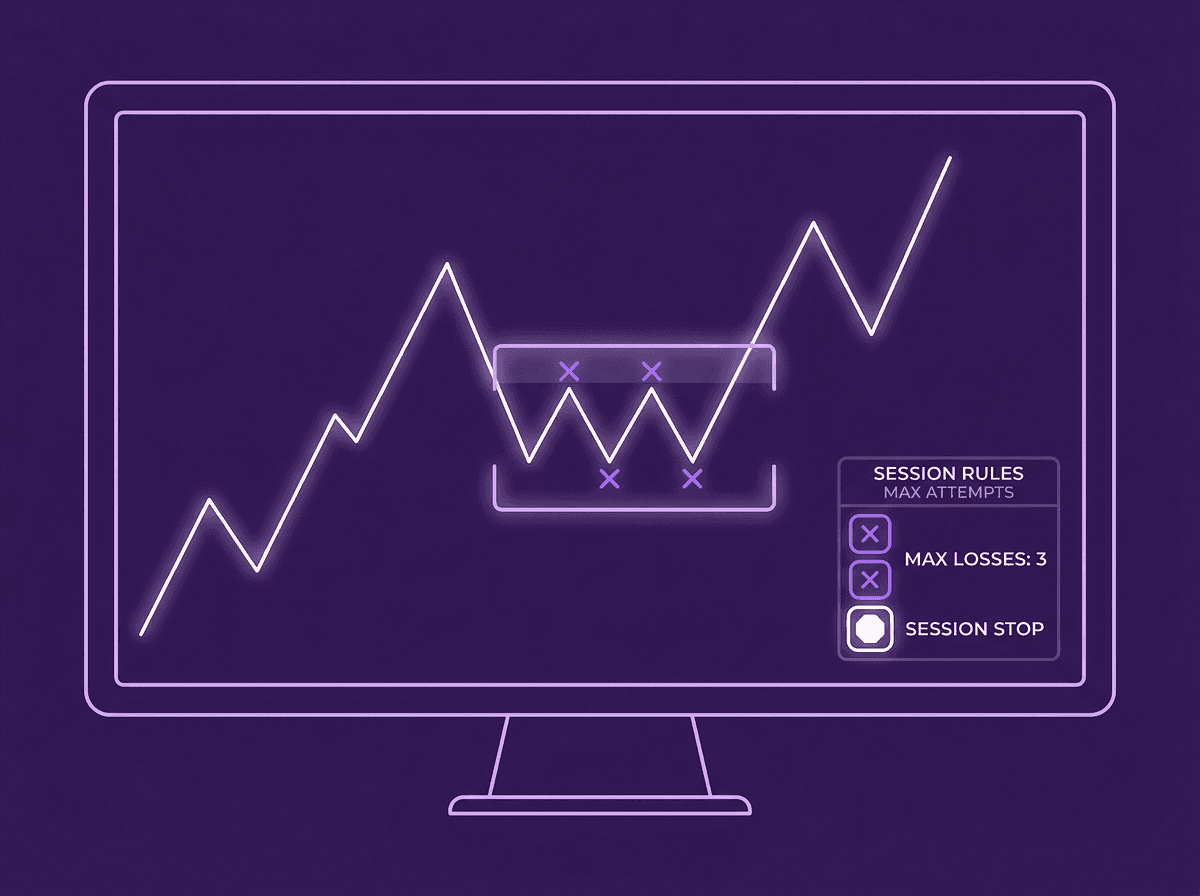
You just lost your third trade. Your finger is hovering over the buy button because you can see another setup forming. You know you should stop. But the market is right there, and you just need one win to get back to even.
Stop. Close the laptop. That impulse is exactly how accounts die.
Knowing when to stop trading for the day is the single most underrated skill in trading. Not entries. Not indicators. Knowing when to walk away. A mechanical rule, like stopping after 3 losses, removes the decision from your emotional brain and hands it to a system that actually works when you are tilted. Simulation data backs this up: traders who cap risk per session with hard stops show dramatically lower account blow-up rates than those who rely on "feeling it out."
TL;DR
Stop trading after 3 losses in a single day. No exceptions, no negotiations with yourself.
Willpower fails when you are emotional. A pre-set rule is the only thing that fires reliably after consecutive losses.
Counting wins as a buffer sounds logical but adds complexity that your tilted brain will exploit.
Not every trading day deserves a trade. Sitting out choppy sessions is a skill, not a weakness.
Your capital is your ammunition. Run out, and you cannot take the next high-quality setup.
The 3-Loss Rule: Close the Laptop
The rule is dead simple: if you lose 3 trades in one day, you are done. Close your charts, shut your platform, and come back tomorrow.
Why three? Because three consecutive losses is the point where most traders start abandoning their plan. The first loss stings. The second one makes you question your strategy. By the third, the emotional part of your brain has taken the steering wheel from the logical part. You are no longer trading setups, you are trading feelings.
Think about it like ammunition. If you risk 0.5% per trade, three losses cost you 1.5% of your account. That is recoverable in a single good session. But traders who push past three losses routinely turn a 1.5% drawdown into a 5% or 8% hole, because the fourth, fifth, and sixth trades are not coming from a plan. They are coming from anger.
What the Simulation Data Shows
Monte Carlo simulations using a 30% win rate and 5:1 reward-to-risk ratio show that at 0.5% risk per trade, the probability of blowing your account drops to 0.1% over 30 trades. But that 0.1% assumes you are still following your plan on every trade. The moment you start forcing trades after a losing streak, taking setups you would never take with a clear head, your effective win rate craters and your blow-up risk spikes.
The 3-loss rule works because it removes you from the screen before that collapse begins.
Example: The GBP/USD Spiral: A trader opens the London session with a short on GBP/USD at a supply zone. Stopped out for -0.5%. Tries the same zone again. Stopped out for -0.5%. Now down 1% on the day. Instead of walking away, they flip to EUR/USD, a pair not even in their plan, and take a long based on "it looks like it's going up." Stopped out. Down 1.5%. Then they double their position size on the next trade to "make it back faster." That is no longer trading. That is an overtrading spiral, and it ends one way: a blown account or a blown week.
Had this trader followed a 3-loss rule, they would have closed after the third trade. Down 1.5%. Uncomfortable, but survivable. Instead, they finished the day down 4.3%.
Should Wins Count as a Buffer?
This is a real question that comes up constantly. There are two schools of thought, and both have logic behind them.
Option A: Wins do not count. Three losses means you are done, period.
You win 5 trades in a row, then lose 3. You stop. This feels brutal, you had a great day going. But the rule is clean, and a clean rule is one you will actually follow when your brain is screaming at you to keep trading.
Option B: Wins create a buffer. Each win gives you an extra loss before the cutoff.
You win 3 trades, so you can lose 6 before stopping (3 base + 3 buffer). The math makes sense. The problem is that it gives your emotional brain a loophole to exploit. After 5 wins and 4 losses, you are sitting there thinking, "I still have one more loss left," and you take a garbage setup just to use it.
The recommendation? Start with Option A. It is simpler, harder to game, and builds the habit faster. You can always add complexity later once the walk-away reflex is automatic.
Why You Cannot Stop When Emotional
Ever told yourself "just one more trade" after a loss? Probably more than once. And that one trade turned into three more, and by the end of the session you had given back everything.
This is not a willpower problem. It is a brain architecture problem.
When you take consecutive losses, your amygdala, the part of your brain that processes threat, starts firing. Your body floods with cortisol. Your prefrontal cortex, the part responsible for rational planning and self-control, gets hijacked. You literally cannot think straight. The desire to "get it back" is not a character flaw. It is your fight-or-flight response treating a $50 loss like a physical threat.
This is why revenge trading is so destructive. It is not that traders do not know they should stop. They know. But knowing and doing are completely different things when your stress response is activated.
A pre-set rule works because you made the decision before the emotion showed up. When you write "3 losses = done for the day" in your trading rules, you are using your calm, rational self to protect your future emotional self. The rule does not care how you feel. It does not negotiate. It just fires.
Example: The "Just One More" Trap: A trader is short EUR/JPY during the New York session. First trade: stopped out at -0.5%. Second trade on the same pair: stopped out at -0.5%. Third trade, this time a long because "it clearly reversed": stopped out at -0.5%. Now down 1.5%. Without a daily stop rule, the trader scans three more pairs, finds a "setup" on EUR/USD that they would never take on a normal day, and sizes up to 1% risk because "I need to recover." That single trade moves against them 30 pips. At 0.1 lots on a $10,000 account, that is $30 (0.1 lots x $1/pip x 30 pips), but at 1% risk (the increased size), the loss is $100. The day ends at -2.5% instead of -1.5%. One extra trade, nearly double the damage. The daily loss limit exists for exactly this reason.
Less Is More: Not Every Day Is a Trading Day
Here is a truth that most beginners resist: the market is open every weekday, but that does not mean you should trade every weekday.
Some days the market is choppy. Price chops through your levels, fakes breakouts, and reverses without follow-through. On those days, even perfect execution produces losses. Not because your strategy is broken, because the conditions do not match your edge.
Profitable traders spend most of their time doing nothing. They wait for price to reach their key level. They wait for their confirmation pattern. Then they execute. If the setup does not appear during their trading session, they close the charts and go do something else.
This is the opposite of FOMO trading. FOMO says, "The market is moving and I am missing it." Discipline says, "The market will be here tomorrow, and so will my capital."
A practical framework:
Before the session: Review your plan. Identify 1-3 levels where you will look for trades. If you do not have at least one clear level, do not trade.
During the session: If price never reaches your level, that is your answer. No trade today.
After the session: Journal what happened. Did you follow your plan? Did you sit out when you should have? That review is more valuable than the trade itself.
Trading consistency does not mean trading every day. It means executing the same process every day, even when that process tells you to sit on your hands.
How EdgeFlo Enforces Your Daily Limits
Knowing you should stop and actually stopping are different problems. EdgeFlo solves the second one.
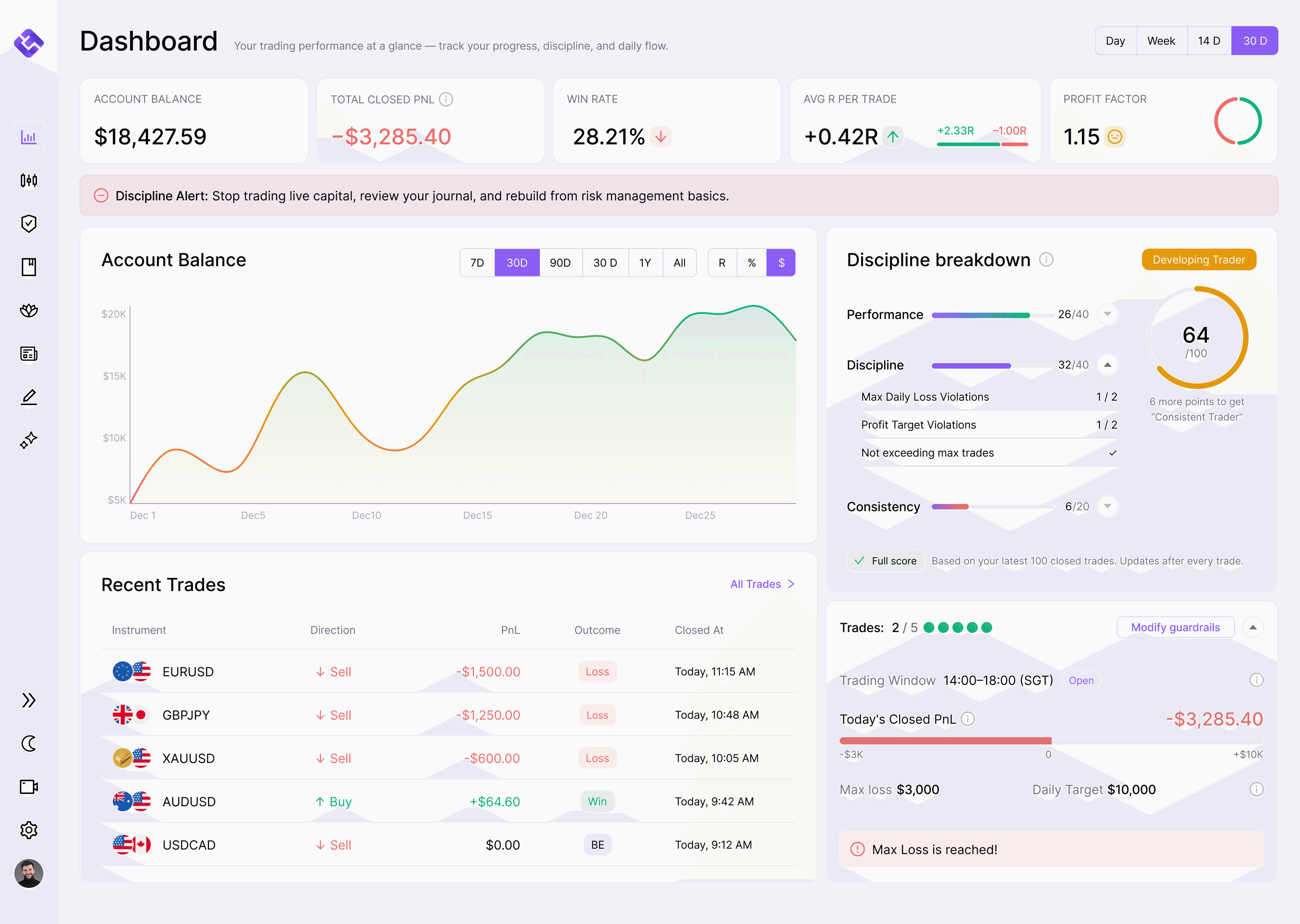
When you set a daily loss limit or a maximum number of trades in EdgeFlo, the platform grays out the buy and sell buttons once you hit that threshold. You physically cannot place a trade until the next session. The override is there if you need it, EdgeFlo is a guardrail, not a cage, but you have to consciously choose to push past your own rule. That friction is the point. It turns "just one more trade" from a one-click impulse into a deliberate decision.
Most traders do not need better strategies. They need an environment that makes following their existing rules the path of least resistance. EdgeFlo builds that environment around your daily loss limit so that your 3-loss rule fires even on the days when your discipline would not.
The Edge Brief
Receive Insights on trading psychology, discipline, and the behavioral patterns that create consistent traders from our Founder and the EdgeFlo team, delivered to your inbox.
Think different. Trade different.
How many losses should I take before stopping for the day?
Should I count wins as a buffer before my loss limit kicks in?
What if I see a perfect setup after hitting my daily loss limit?
Does the 3-loss rule apply to demo trading too?

Turn discipline on.
Every session.
EdgeFlo is the environment serious traders operate inside.
Start 7-Day Free Trial
Cancel anytime.
No long-term commitment.

Think Different, Trade Different.