

Revenge Trading: The Cycle That Blows Accounts
Revenge trading follows a predictable three-stage cycle. Learn why willpower fails and four rules that break the pattern before it blows your account.
Revenge trading is the fastest way to turn a small loss into an account-ending disaster. It happens when you take a loss, feel the sting, and immediately jump back in with a bigger position or a sloppy setup to "win it back." The problem is that those recovery trades almost never have an edge. They are emotional reactions disguised as market decisions. And they follow a pattern so predictable you can map it in three stages.
Most traders who blow accounts do not blow them on a single bad trade. They blow them on the five or six trades that come after the bad one. The initial loss is survivable. The revenge spiral is not.
TL;DR
Revenge trading follows a three-stage cycle: trigger (a loss), escalation (bigger size, worse setups), and blowup (catastrophic drawdown).
Willpower fails because the emotional brain hijacks decision-making within seconds of a loss.
Four structural rules break the cycle: daily loss limits, cooldown timers, setup checklists, and session caps.
Environment design beats self-control. Change what is possible, not what you feel.
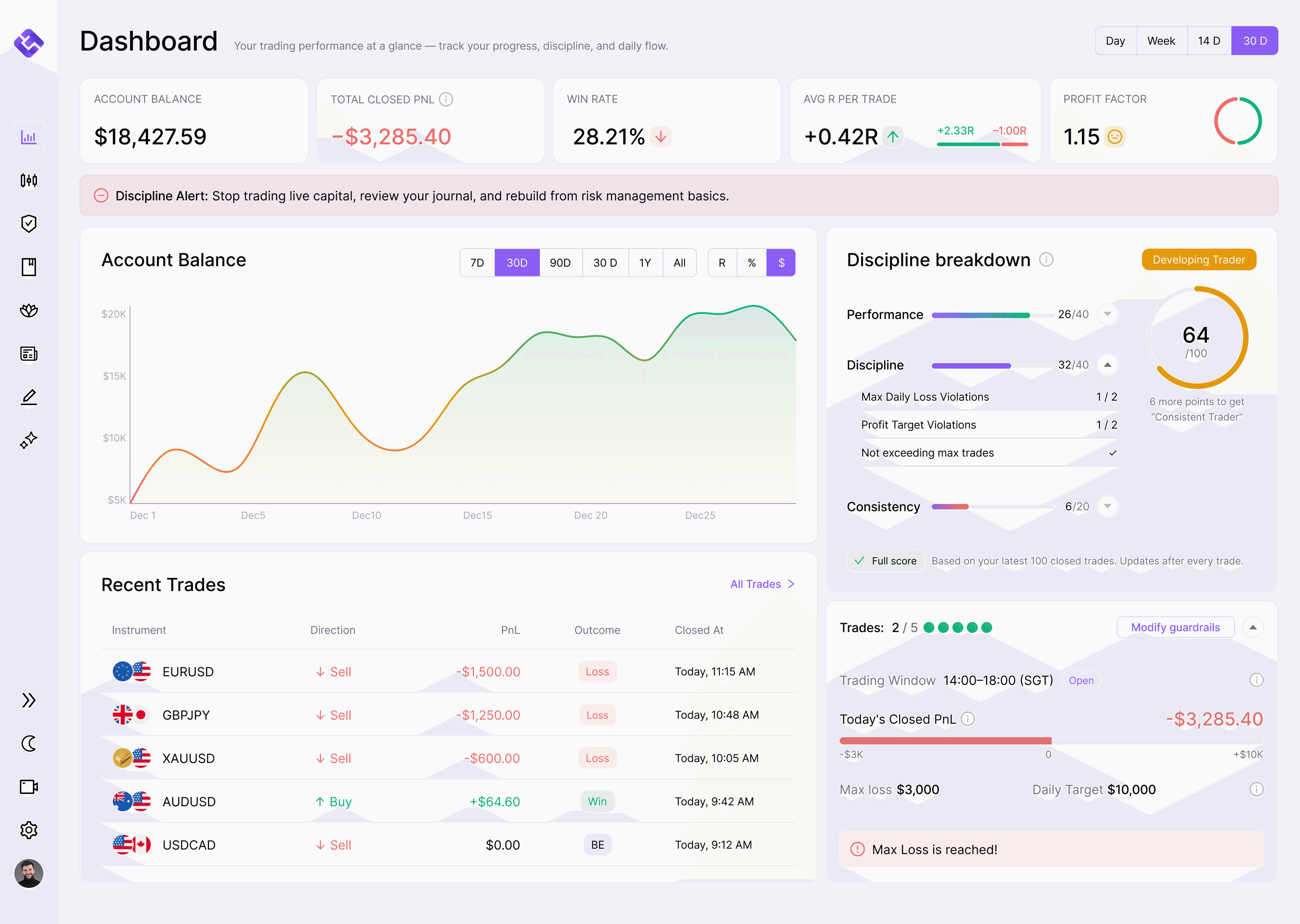
EdgeFlo's Guardrails can block trading after loss limits hit (with override), giving you a circuit breaker when you need it most.
What Revenge Trading Actually Looks Like
You probably already know what revenge trading feels like. But knowing and recognizing it in the moment are two different things.
Picture this. You take a clean EUR/USD short at London open based on your plan. Price hits your stop. Down 1%. That is fine. Normal. Within your trading rules.
But instead of walking away or waiting for the next A-grade setup, you open another chart. GBP/JPY looks like it might move. You did not analyze it this morning. You have no plan for this pair. But it "feels" like it is about to drop, and a quick win would erase that 1%.
You enter with double your normal size because you need to recover faster. Price moves against you. Now you are down 3%. Your chest tightens. You take one more trade, this time on a 5-minute chart you never use. Down 5% by noon.
That sequence is revenge trading. Not one bad decision. A chain of them, each one powered by the last loss.
The tell is always the same: your reason for entering the trade is not about the setup. It is about the money you just lost. Every revenge trade is backwards-looking. It is trying to fix the past instead of trading the present.
The Three-Stage Cycle (Trigger, Escalation, Blowup)
Revenge trading is not random. It runs on a loop, and it follows the same three stages almost every time.
Stage 1: The Trigger
A loss happens. Sometimes a legitimate stop-out. Sometimes a mistake, like the trading mistakes that catch everyone early on. Either way, you feel it. The frustration. The sense of unfairness. The urge to act immediately.
The trigger is not really the loss. It is the emotional charge the loss creates. A trader who expects losses, plans for them, and sizes around them barely flinches. A trader who ties their identity to each trade outcome gets triggered by a $50 stop-out.
Stage 2: The Escalation
This is where the damage multiplies. The trader re-enters the market without a clear setup. Position size goes up. Timeframe often drops (from the 1-hour they planned to a 5-minute chart). They switch pairs. They skip their checklist.
Each losing trade adds fuel. The emotional brain gets louder. Rational process gets quieter. "Just one more" becomes the mantra.
Sound familiar? This is also the stage where overtrading and revenge trading overlap. Overtrading is too many trades. Revenge trading is too many trades driven by anger. They feed each other.
Stage 3: The Blowup
The account takes a hit that would have been impossible with normal risk. A trader who risks 1% per trade suddenly finds themselves down 8% in a single session. Funded challenge failed. Confidence destroyed. And the worst part: they knew better the entire time.
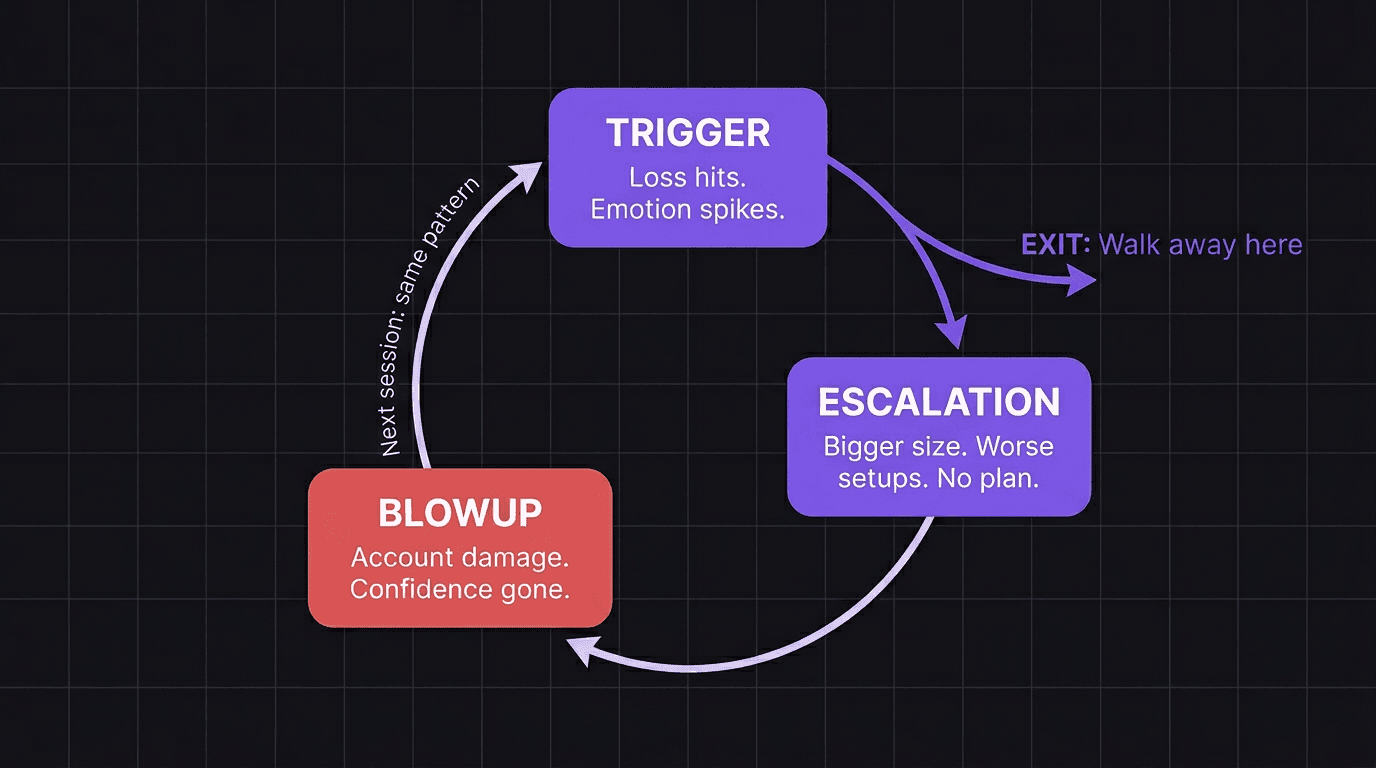
This cycle does not care how smart you are. It does not care how many books you have read about trading psychology. It runs on emotion, and emotion is faster than logic.
As the 1% Club puts it: "Those who rush fall. Those who wait rise." Patience makes profits. Traders who rush into recovery trades after a loss are doing the opposite of what profitable traders do.
Why Willpower Fails Against Revenge Trades
Here is what most traders try first: they tell themselves to stop. "Next time I will just walk away." "Next time I will not let it get to me."
It never works. Not because you are weak, but because willpower is the wrong tool for this problem.
When you take a loss, your brain floods with cortisol and adrenaline. The emotional brain (the amygdala) takes over decision-making from the prefrontal cortex, the part that handles planning, rules, and risk assessment. This is not a character flaw. It is biology.
Think of it like trying to do math while someone is honking a car horn in your face. Your brain is technically capable of the calculation, but the alarm signal drowns everything else out. The loss creates a neurological alarm, and your brain's priority shifts from "follow the plan" to "fix this immediately."
That is why traders who blame themselves after a revenge spiral are missing the point. The problem is not willpower. The problem is that they are fighting biology with good intentions.
Losers blame the market, get emotional, and play the victim. But winners do not win by being tougher. They win by building systems that remove the decision from the emotional moment entirely.
Walkthrough: Revenge Spiral on GBP/USD
Pair: GBP/USD | Timeframe: 15-minute | Session: New York open
A trader enters long at 1.2640 based on a support bounce. Stop at 1.2620. Risk: 1% of a $10,000 account ($100).
Price drops to 1.2618 and stops them out. Down $100. The trader sees a "hammer candle" forming on the 5-minute chart at 1.2615 and enters long again. No plan for 5-minute trades. Position size: 2% this time because "it is a better entry."
Price drops to 1.2595. Stopped out again. Down $300 total. The trader switches to USD/JPY. No analysis. Enters short because "the dollar is strong today." Full 2% risk. Price chops sideways, then spikes against the position. Stopped out. Down $500 in 45 minutes.
Three trades. None of them were in the plan. The first loss was $100 and completely normal. The revenge spiral cost $400 extra and came from trading fear dressed up as confidence.
This is what the cycle looks like with real numbers. The first loss was fine. Everything after it was revenge.
Four Rules That Break the Cycle
You cannot think your way out of revenge trading in the moment. You need rules set before the session starts, when your prefrontal cortex is still running the show.
Rule 1: Set a Daily Loss Limit (and Obey It)
Pick a number before the session. Two percent. Three percent. Whatever your plan says. When you hit it, you are done for the day. Not "done unless a great setup appears." Done.
A daily loss limit is the single most effective tool against revenge trading because it removes the option entirely. You cannot spiral if you cannot trade.
Rule 2: Mandatory Cooldown After Any Loss
After every losing trade, step away from the screen for a minimum of 15 minutes. Walk. Get water. Do anything that is not looking at charts.
This is not about calming down. It is about letting the cortisol clear enough for rational thought to resume. Fifteen minutes is the minimum neurological reset window. You do not need to meditate. You just need to not be staring at a chart while your brain is in alarm mode.
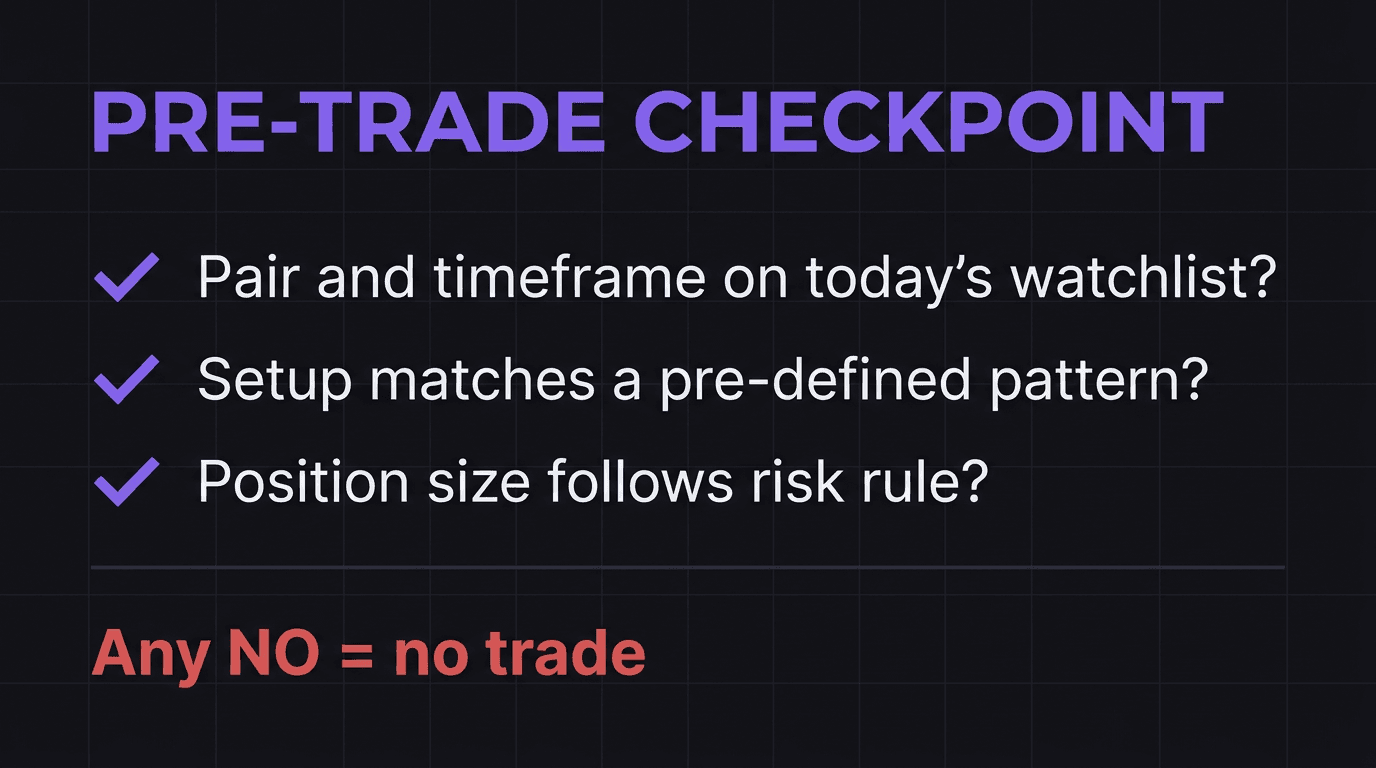
Rule 3: No Trade Without a Checklist Pass
Before every entry, confirm three things from your written plan:
This pair and timeframe are in your watchlist.
The setup matches one of your pre-defined patterns.
Your position size follows your risk rule.
If any answer is no, you do not enter. This forces a pause between impulse and execution.
Rule 4: Cap Total Trades Per Session
Set a maximum number of trades before the day starts. Three trades. Five trades. The number depends on your strategy, but having a cap prevents the "just one more" escalation that defines Stage 2 of the cycle.
When you hit your cap, review what you took instead of looking for the next entry. Did those trades follow your plan? That review session is worth more than a sixth trade.
How EdgeFlo Flags Revenge Patterns
The four rules above work. But they only work if you follow them, and the hardest moment to follow a rule is exactly the moment revenge trading hits.
EdgeFlo's Guardrails let you set a daily loss limit that blocks new trades once you hit it. You can still override it if you deliberately choose to, but the default is a hard stop. That friction matters. It forces a conscious decision instead of an automatic spiral.
The difference between "I decided to keep trading" and "I kept trading because nothing stopped me" is the difference between a controlled override and an emotional blowup.
EdgeFlo's Sanctuary feature supports your reset process between trades. When you are tilted after a loss, Sanctuary guides you through a structured cooldown with guided exercises. It does not force you to stop. It gives you a path back to clear thinking before your next decision.
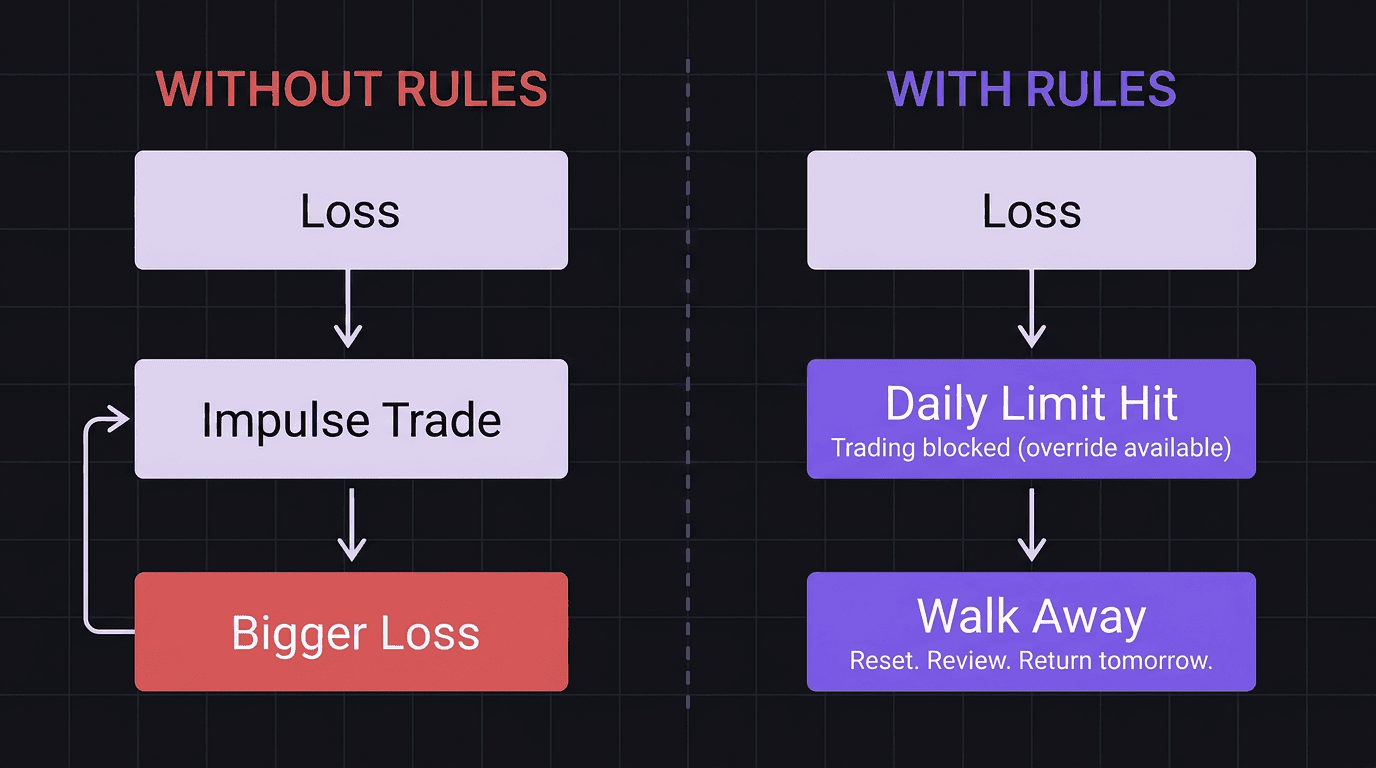
That combination (loss limit with override plus guided reset) addresses both stages of the revenge cycle. The guardrail interrupts the escalation. The reset routine supports the emotional recovery. Neither one relies on willpower alone.
The Edge Brief
Receive Insights on trading psychology, discipline, and the behavioral patterns that create consistent traders from our Founder and the EdgeFlo team, delivered to your inbox.
Think different. Trade different.
What is revenge trading?
How do I know if I am revenge trading?
Can you stop revenge trading with willpower alone?
What is the best way to prevent revenge trading?

Turn discipline on.
Every session.
EdgeFlo is the environment serious traders operate inside.
Start 7-Day Free Trial
Cancel anytime.
No long-term commitment.

Think Different, Trade Different.