

When to Stop Trading (Before You Spiral)
A 7-day trading pause turned a $30K loss into a $27K profit month. Learn 3 triggers that mean stop now and what to do during the break.
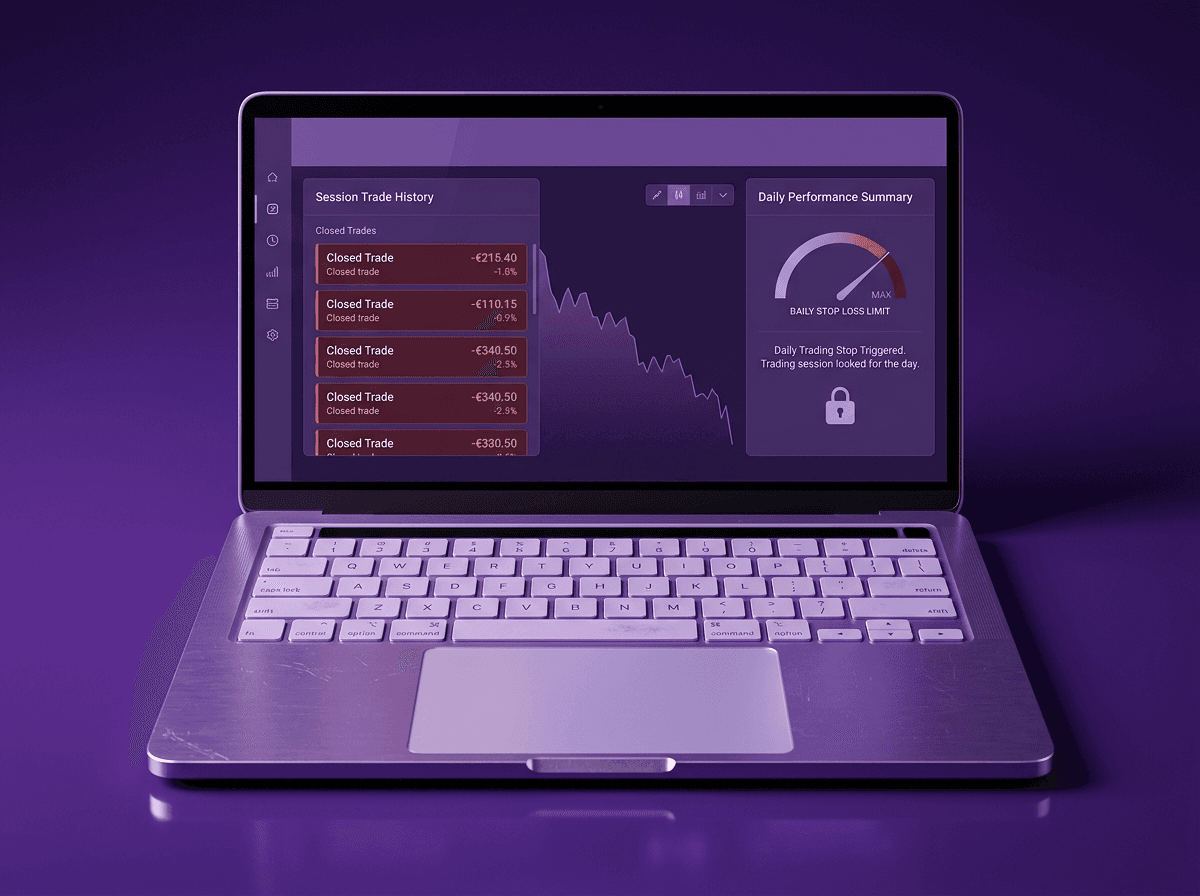
The hardest skill in trading is knowing when to stop. Not stop permanently. Stop today. Stop this week. Step away from the screen before a bad day becomes a bad month.
A trader lost $30,000 in the first week of June across three trades. Instead of taking a fourth trade, he shut everything down for seven full days. When he came back, he took two trades and made $58,000. The month ended at $27,000 net profit. The pause was worth more than any setup he could have found.
TL;DR
Pressing pause after a losing streak prevents the spiral from compounding losses.
Three clear triggers mean stop now: hitting your daily loss limit, two consecutive rule-breaking losses, or inability to articulate your next trade's plan.
A 7-day break turned a $30,000 loss week into a $27,000 profit month.
During a pause, review every loss in your journal and categorize each as a good loss or a bad loss.
Coming back with a strict A+ only filter produced $58,000 in two trades.
When Pressing Pause Beats Pressing On
Most traders treat pausing as quitting. It feels like giving up, admitting defeat, or leaving money on the table. But the math tells a different story.
After three consecutive losses ($10,000 each), the emotional state of the trader was compromised. He described feeling "filled with constant self-doubt" and questioning whether his plan even worked. In that mental state, every new trade carries extra baggage. You are not just trading the chart. You are trading the need to prove you are still competent.
This is where the losing streak spiral starts. You take a fourth trade not because the setup is A+ but because you need a win. The entry criteria gets looser. The stop loss gets wider (or nonexistent). The lot size creeps up because you need a bigger win to offset the losses. Each bad decision feeds the next one.
Pausing interrupts that cycle. It is not passive. It is the most active risk management decision you can make.
The 7-Day Reset That Saved the Month
Here is exactly what happened during the seven-day pause that turned a $30,000 drawdown into a profitable month.
Walkthrough: From $30K Down to $27K Profit
Week 1 (June 1-7, GBP/JPY): Three trades, three losses, $30,000 down. Trade 1: entered long before the entry model confirmed, driven by impulse after skipping plan review. Trade 2: entered short while ignoring bullish signals, driven by ego and the need to prove himself after a public loss. Trade 3: followed the plan correctly, lost to choppy market conditions (good loss). After the third stop out, the trader decided to stop trading for the remainder of the week and the following week.
During the break, he did three things:
1. Reviewed every loss in his journal. He went through each trade and asked: Did I follow my plan? What was my emotional state at entry? What would I do differently? The first two trades failed the plan test. The third passed.
2. Identified the emotional patterns. Complacency from the previous month's profits caused him to skip his plan review on day one. After the first loss, ego and revenge impulses drove the second trade. He was trading to prove something, not to execute a plan.
3. Set a re-entry rule. He would only come back to the charts when he felt calm, and he would only take A+ setups with full confluence. No B-grade setups. No "it looks good enough" entries.
Week 3 (GBP/JPY, 4H/1H timeframe): Found a long setup at a higher low after price swept a strong low and printed a fractal market shift. All confluence items checked: higher timeframe bullish, internal order flow bullish, liquidity swept, demand zone mitigated. Entered the trade and it hit 2.2R. Profit: approximately $22,000.
Week 4 (GBP/JPY, 4H/1H timeframe): Found a short setup after price mitigated a supply zone that had swept previous highs. Waited for liquidity to be taken above equal highs before entering. Closed manually at 2.4R because he did not want to hold overnight. Profit: approximately $36,000.
The month: 5 trades total, 40% win rate, +1.5R net, roughly $27,000 profit after fees. Two weeks of not trading produced a better result than a month of constant activity would have.
Three Triggers That Mean Stop Now
You do not need to wait for a $30,000 drawdown to know when to pause. Build these triggers into your rules.
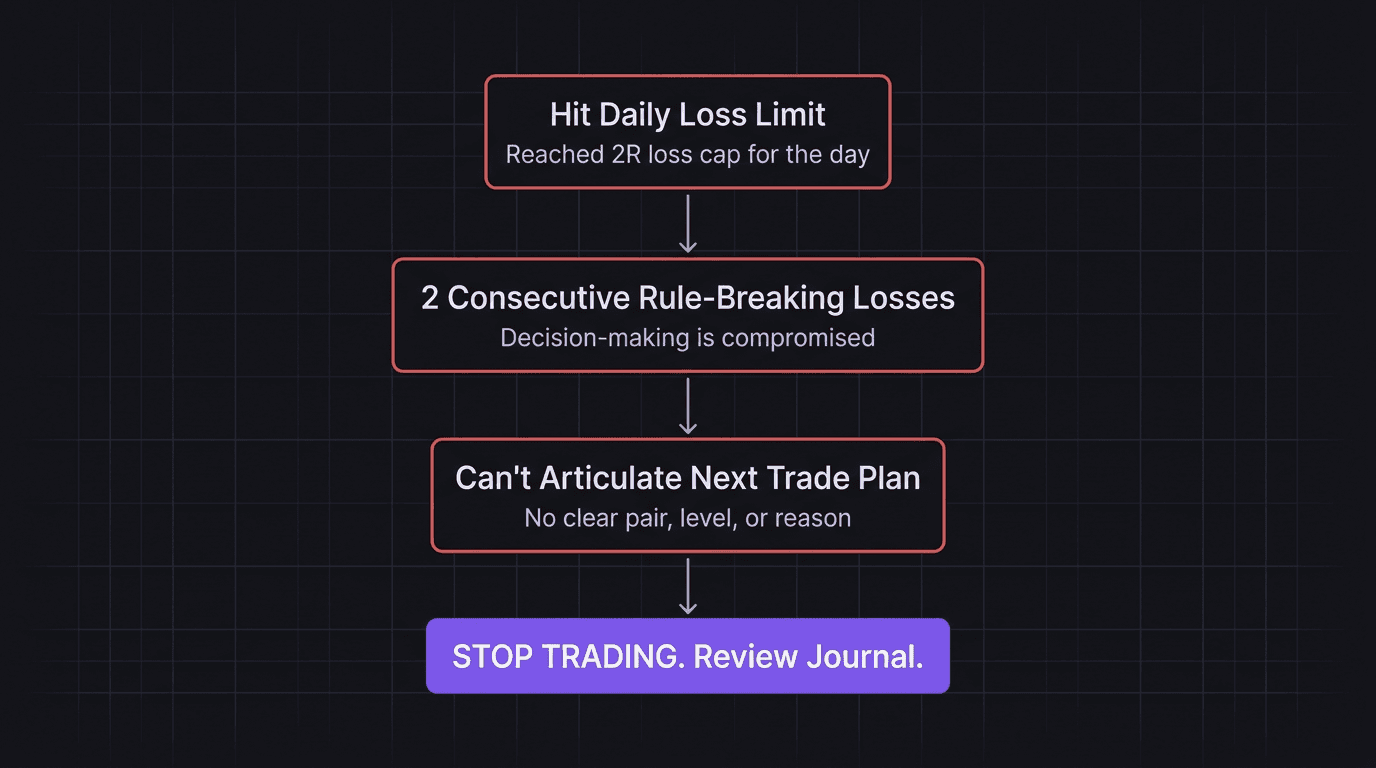
Trigger 1: You hit your daily loss limit. If your rule is "stop after 2R of losses in one day," stop at 2R. Not 2.5R. Not "one more trade to see." The limit exists to protect your capital and your mental state. Respect it like a stop loss.
Trigger 2: Two consecutive losses where you broke your rules. One bad loss can happen. Two in a row means your decision-making process is compromised. The issue is not the market. The issue is you. Step away and figure out why you are not following your plan.
Trigger 3: You cannot clearly articulate the plan for your next trade. Before every entry, you should be able to say: "I am looking for [specific setup] on [pair] at [level] because [reason], with stop loss at [level] and take profit at [level]." If you cannot say that clearly, you are about to trade on impulse. Close the platform.
What to Do During a Trading Pause
Pausing does not mean doing nothing. A pause without review is just procrastination. Here is what a productive trading break looks like.
Day 1: Full journal review. Go through every trade from the losing streak. Categorize each loss as plan-following (good loss from variance) or rule-breaking (bad loss from discipline failure). If you do not have a journal, that is the first problem to fix. A structured review turns raw losses into data. Having clear trading rules makes it easy to identify which losses followed the plan and which ones did not.
Days 2-3: Root cause analysis. Look for the emotional pattern behind the bad losses. Was it revenge? Ego? FOMO? Complacency from a winning streak? The trader in the case study traced his first loss to complacency (he skipped plan review after a profitable month) and his second to ego (he needed to prove himself publicly). Those are two different triggers with two different fixes.
Days 4-5: Rule adjustment. Based on what you found, add or tighten one rule. Not five rules. One. The trader's adjustment was simple: return to charts only for A+ setups. That single filter eliminated the low-quality entries that caused the first two losses.
Days 6-7: Paper trade or review setups without entering. Before risking real money, practice spotting setups and articulating your plan for each one. This rebuilds the connection between your eyes and your process without the emotional weight of real capital.
The length of your pause depends on the severity. Hit your daily loss limit once? Take the rest of the day off. Three consecutive losses with two rule breaks? A full week is reasonable. The point is to come back ready, not just rested. Recovery is a process, not a calendar event. Consistency comes from trusting the process after a setback, not from forcing the next win.
How EdgeFlo Helps You Reset
EdgeFlo's Sanctuary feature guides you through a reset routine when you are in a reactive emotional state. It does not force you to stop trading (you can always override), but it walks you through a structured pause before your next trade.
The journal's emotion tagging tracks your mental state alongside every trade, so when you review a losing streak, you can see exactly which trades were calm executions and which ones were driven by frustration, ego, or fear. That separation between good losses and bad losses is what turns a painful week into actionable data.
After a break, the pre-market routine prompts bring your plan back into focus before you re-enter the market. Not enforced, but present. A reminder that the process comes first, especially when you are itching to trade again.
The Edge Brief
Receive Insights on trading psychology, discipline, and the behavioral patterns that create consistent traders from our Founder and the EdgeFlo team, delivered to your inbox.
Think different. Trade different.
When should I stop trading for the day?
How long should a trading break last?
What should I do during a trading pause?
Can taking a break from trading improve results?

Turn discipline on.
Every session.
EdgeFlo is the environment serious traders operate inside.
Start 7-Day Free Trial
Cancel anytime.
No long-term commitment.

Think Different, Trade Different.