

Daily Loss Limit: The 5% Rule That Keeps You in the Game
The 5% daily loss limit protects your funded or live account from blowouts. Learn how it is calculated, why floating losses count, and how to stay well under it.
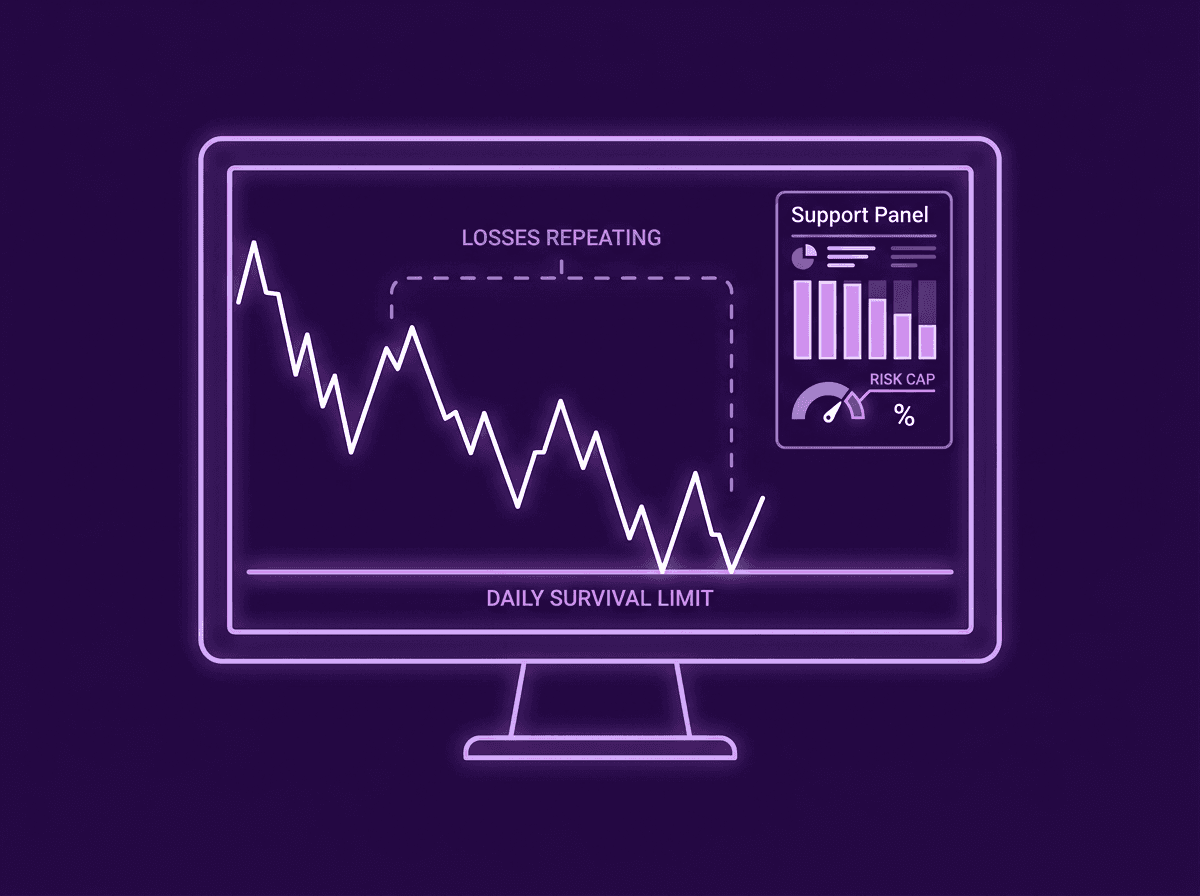
A daily loss limit caps how much you can lose in a single trading day, usually at 5% of your account balance. On a $100,000 funded account, that means $5,000. Hit that number and trading stops. On prop firm accounts, breaching it kills the account entirely. On personal accounts, it should trigger a hard stop where you walk away from the screen.
The daily loss limit exists because most blown accounts do not die from bad strategies. They die from one catastrophic day where a trader kept going after losses piled up.
TL;DR
The 5% daily loss limit includes closed trades, floating open losses, commissions, and swaps.
Most prop firms terminate your account instantly if you breach the daily limit, no warnings.
Risk 0.5% to 1% per trade so a losing streak cannot push you anywhere near 5%.
Set a personal 2% daily stop rule as a buffer well inside the hard limit.
Stop trading after two consecutive losses and reassess before taking a third.
What a Daily Loss Limit Actually Protects
The daily loss limit is not punishment. It is a circuit breaker.
Think about the electrical panel in your house. When too much current flows through a circuit, the breaker trips and cuts power before something catches fire. You do not remove the breaker because it is inconvenient. You fix the problem that caused the overload.
A daily loss limit works the same way. When losses start compounding, the limit forces a stop before you lose more than you can recover from in a reasonable timeframe.
Without one, here is what happens. You lose $2,000 in the morning. You take another trade to "make it back." You lose $1,500 more. Now you are emotional, the screen is red, and your position sizes start creeping up because smaller trades "will not recover fast enough."
Ever watched a $3,000 loss turn into $8,000 by end of day? That is a day without a loss limit. And it can take weeks of disciplined trading to recover.
How Prop Firms Calculate Daily Loss (Open + Closed Trades)
This calculation is where most funded traders get caught. It is not as simple as "how much did I lose on closed trades today."
The daily loss formula for most prop firms:
Daily Loss = Closed P&L + Open Floating P&L + Commissions + Swaps
Every component counts. In real time. All day.
Breaking Down Each Component
Closed P&L: The sum of all finalized trades for the day. Two winners at +$500 and one loser at -$2,000 gives you a closed P&L of -$1,000.
Open floating P&L: Any unrealized gains or losses on positions you are still holding. That trade you are "letting run" while it floats at -$3,000 counts against you right now.
Commissions and swaps: Broker fees and overnight holding costs. These are small individually but add up, especially if you are a high-frequency trader or holding positions across sessions.
Walkthrough: How $3,000 in Losses Becomes a Breach
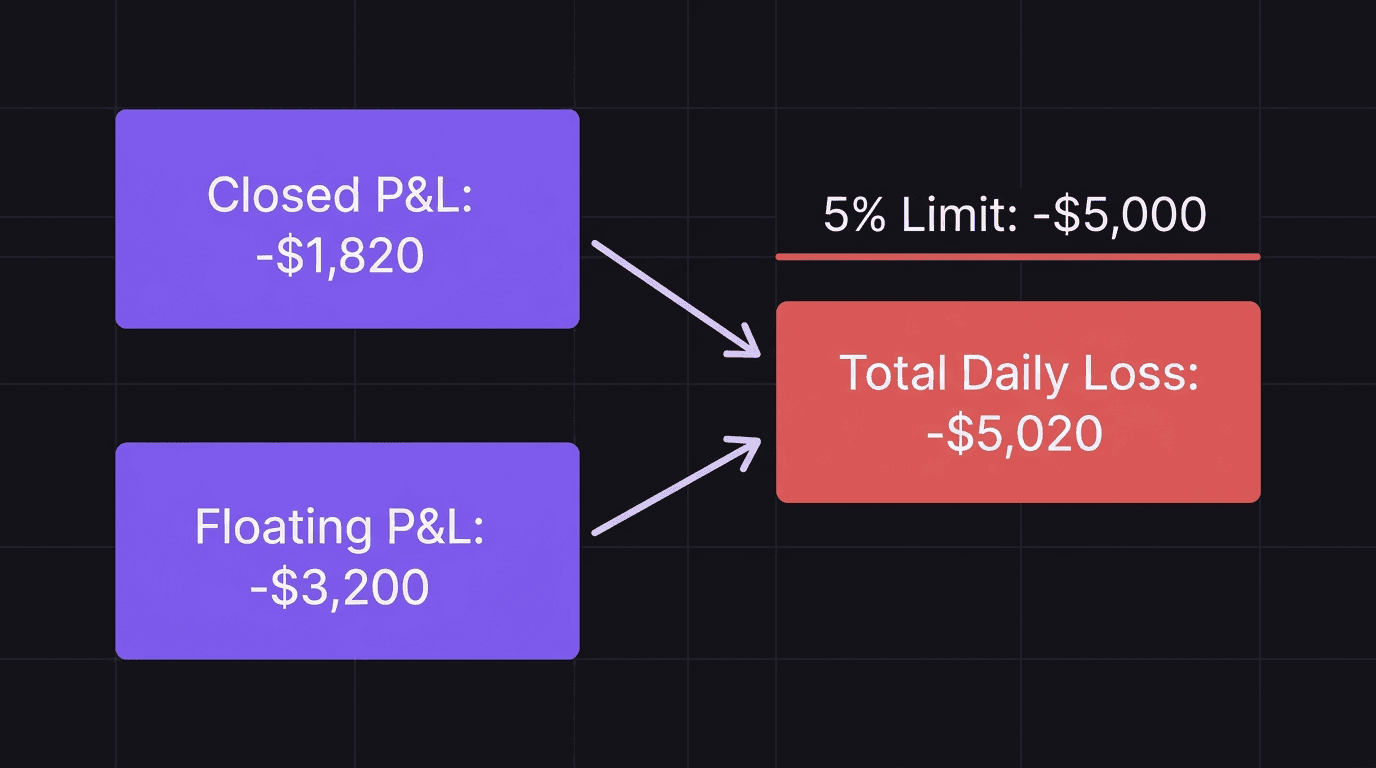
You start the day on a $100,000 funded account. Your 5% daily limit means $5,000 max loss.
9:00 AM: You short EUR/USD at 1.0850 with a 30-pip stop. Price moves against you and hits your stop. Loss: -$900 (including commissions). Running daily loss: -$900.
10:15 AM: You short GBP/USD at 1.2740, also 30-pip stop. Stopped out. Loss: -$920. Running daily loss: -$1,820.
11:00 AM: Frustrated, you take a larger position on USD/JPY. You buy at 154.20 with a wider stop. The trade goes -45 pips against you but you hold, thinking it will reverse. Floating loss: -$3,200.
Your daily loss right now: -$1,820 (closed) + -$3,200 (floating) = -$5,020.
You just breached the 5% daily limit. The account is terminated. Not when you close the trade. Right now, with the position still open.
The two closed losses were painful but manageable. The third trade, taken from frustration and held without a plan, ended the account. That pattern of escalation is exactly what the daily loss limit is designed to prevent.
The Hidden Trap: Floating Losses Count
This is the single most common way funded traders lose their accounts.
You close the day with $1,000 in realized losses. Manageable. But you are holding an open position that is floating at -$4,200. You think: "I have not closed it, so it does not count."
It counts. In real time. The moment your closed losses plus floating losses cross 5%, the account is done. Some firms check this on a minute-by-minute basis.
Why This Catches People Off Guard
Most retail traders on personal accounts have never had a hard daily loss limit. They are used to holding losing trades overnight, hoping for a reversal. "It is not a loss until you close it" is a common saying. On a funded account, it is dead wrong.
The fix is structural, not emotional. You cannot simply promise yourself you will not let floaters get too big. You need rules:
Never hold a position without a stop loss. If your stop is placed at 1% risk, your maximum floating loss on that single trade is capped.
Check your daily P&L after every trade. Closed losses plus current floating losses. Know the number.
If your combined daily loss reaches -2%, stop trading. Not -4.5%. Not -3%. Two percent. That leaves a 3% buffer before the hard limit.
The traders who survive funded accounts long-term are not the ones with the best win rates. They are the ones who never let a single day get out of control.
How 0.5% Risk Per Trade Gives You Breathing Room
The math here is simple but powerful.
At 1% risk per trade on a $100,000 account, each loss costs $1,000. Five consecutive losses (which happens) puts you at -$5,000. That is exactly the 5% daily limit. One bad session, account gone.
At 0.5% risk per trade, each loss costs $500. Five consecutive losses: -$2,500. You are only halfway to the limit. You still have room to trade. You still have room to recover.
Risk Per Trade | Loss Per Trade ($100k) | 5 Consecutive Losses | Distance to 5% Limit |
|---|---|---|---|
2% | $2,000 | $10,000 (BREACH) | Already past |
1% | $1,000 | $5,000 (BREACH) | At the limit |
0.5% | $500 | $2,500 | $2,500 buffer remaining |
0.25% | $250 | $1,250 | $3,750 buffer remaining |
At 0.5% risk, you can take ten consecutive losses before hitting the daily limit. Ten. In a row. That almost never happens with a tested strategy.
And here is the part that makes 0.5% risk worth it: one winning trade at 1:3 risk-to-reward gives you +1.5%. That single trade recovers three losing trades at the same risk level. You are always one good setup away from turning a bad day around.
The position sizing discipline to trade at 0.5% when you want to trade at 2% is the difference between keeping your account for years versus losing it in a week.
What to Do When You Hit 2% Down
Two percent is your personal circuit breaker. Not the firm's 5%. Yours.
When your daily P&L reaches -2%, you have a decision to make. And the right decision almost every time is to stop trading for the day.
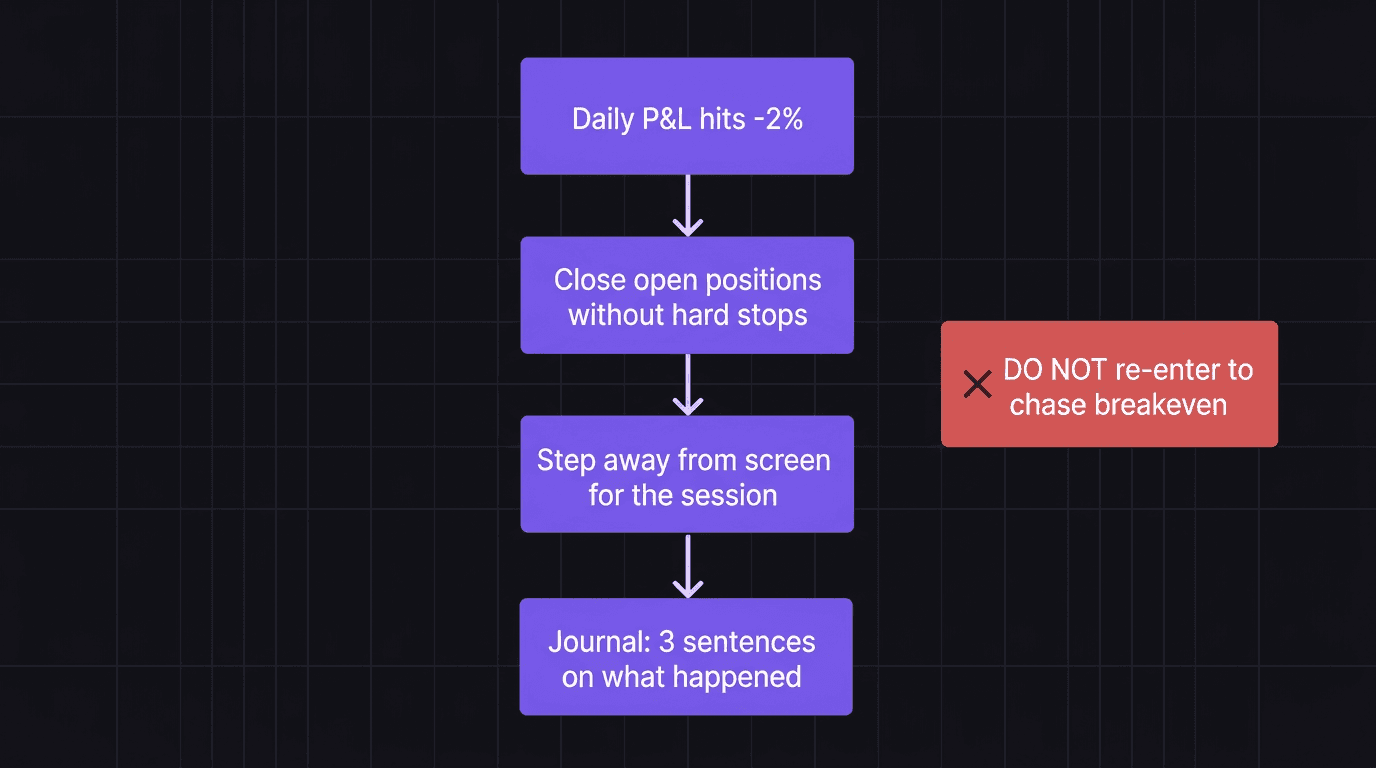
The 2% Protocol
Close any open positions that do not have hard stops already in place.
Step away from the screen. Not for five minutes. For the session.
Write down what happened. Not a novel. Three sentences: what you traded, what went wrong, and what you will adjust tomorrow.
Do not re-enter the same day to "get back to breakeven."
That last point is where most daily blowups originate. The desire to end the day flat is one of the most destructive impulses in trading. It leads to oversizing, chasing setups that are not there, and revenge trading that turns a -2% day into a -5% day.
Walkthrough: A 2% Stop That Saved the Account
You are trading a $100,000 funded account on a Wednesday. London open is choppy. You short EUR/USD at 1.0920 with a 20-pip stop. Stopped out: -$600. You long GBP/USD at 1.2680 with a 25-pip stop. Stopped out: -$750. You short USD/CHF at 0.8820. Stopped out: -$650.
Three trades, three losses. Daily P&L: -$2,000. That is -2%.
You follow the protocol. Close the platform. Walk away. Write in your trade journal: "Three losses in London session. Choppy price action, no clear direction. No trades for the rest of the day."
Thursday, the market trends cleanly. You take two trades at 0.5% risk. Both hit 1:2 targets. Daily P&L: +$2,000. The week is back to breakeven.
If you had kept trading on Wednesday, those three losses could have become six. -$2,000 could have become -$4,500. One more trade gone wrong and the account would be over. Instead, you lost one day and saved 30 days of future profits.
Common Traps After a Losing Morning
"I will just take one more trade." This is the sentence that ends funded accounts. One more trade becomes two becomes five. If the morning was not working, the afternoon probably will not either. The market conditions that caused three stops have not changed.
"I will increase size to recover faster." Doubling your risk after losses is the mathematical opposite of good risk management. Your account is smaller now. Your risk should stay the same or decrease, not increase.
"The market owes me." The market owes you nothing. That feeling is tilt, and tilt has destroyed more accounts than bad strategies ever have. If you recognize trading fear or anger influencing your next click, that is your signal to stop.
How to Build Daily Loss Limits Into Your Routine
A daily loss limit only works if it is set before the session starts, not decided in the moment when you are already losing.
Pre-Session Checklist
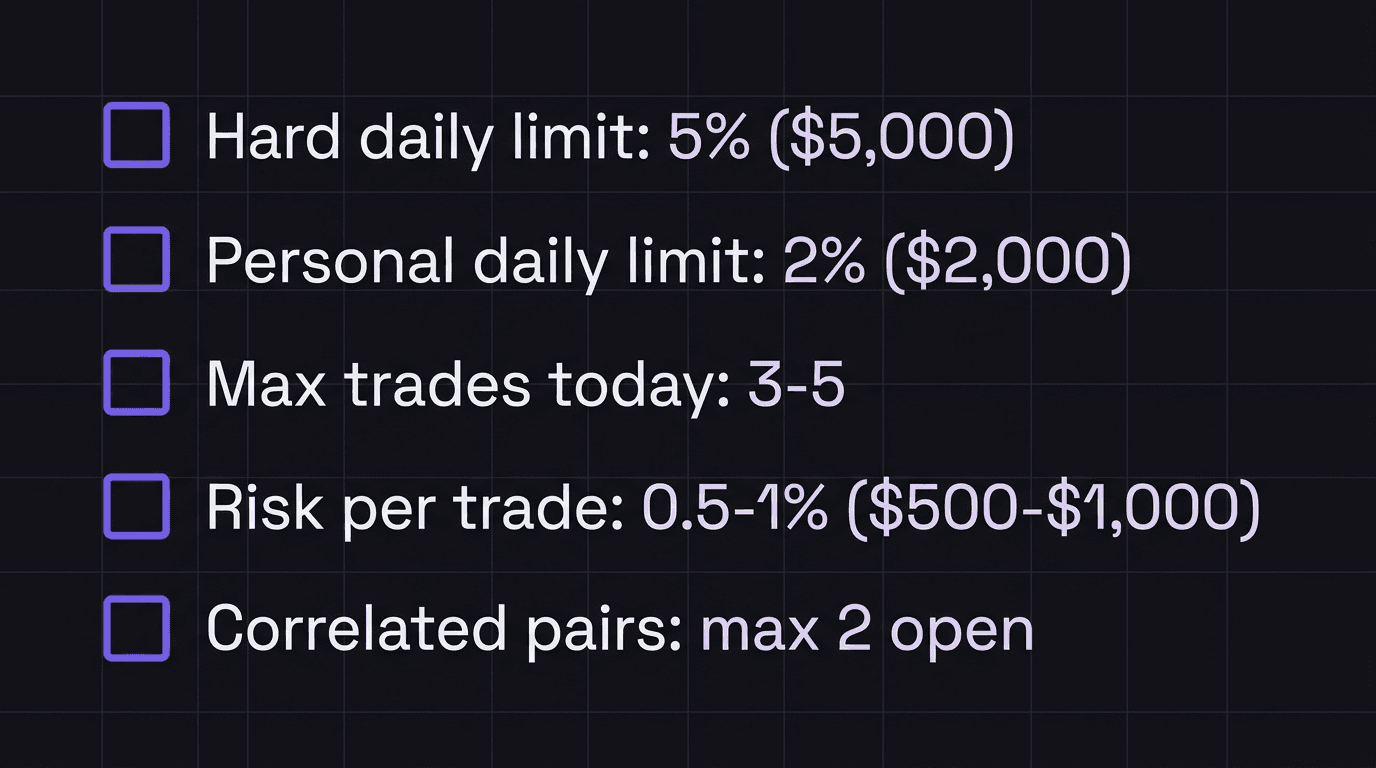
Before your first trade of the day, write down:
Hard limit: 5% (or whatever your firm sets)
Personal limit: 2%
Max trades for the day: 3-5 (prevents overtrading)
Max risk per trade: 0.5% to 1%
Correlated position rule: No more than two open positions on similar pairs (EUR/USD and GBP/USD move together)
This takes 30 seconds. Write it on a sticky note. Put it next to your monitor. When the losses start stacking, you do not want to rely on willpower. You want to look at a rule you wrote when you were calm and rational.
One of the most common trading mistakes is setting rules but only following them on good days. The rules matter most on bad days. That is the entire point.
How EdgeFlo Enforces Daily Loss Limits
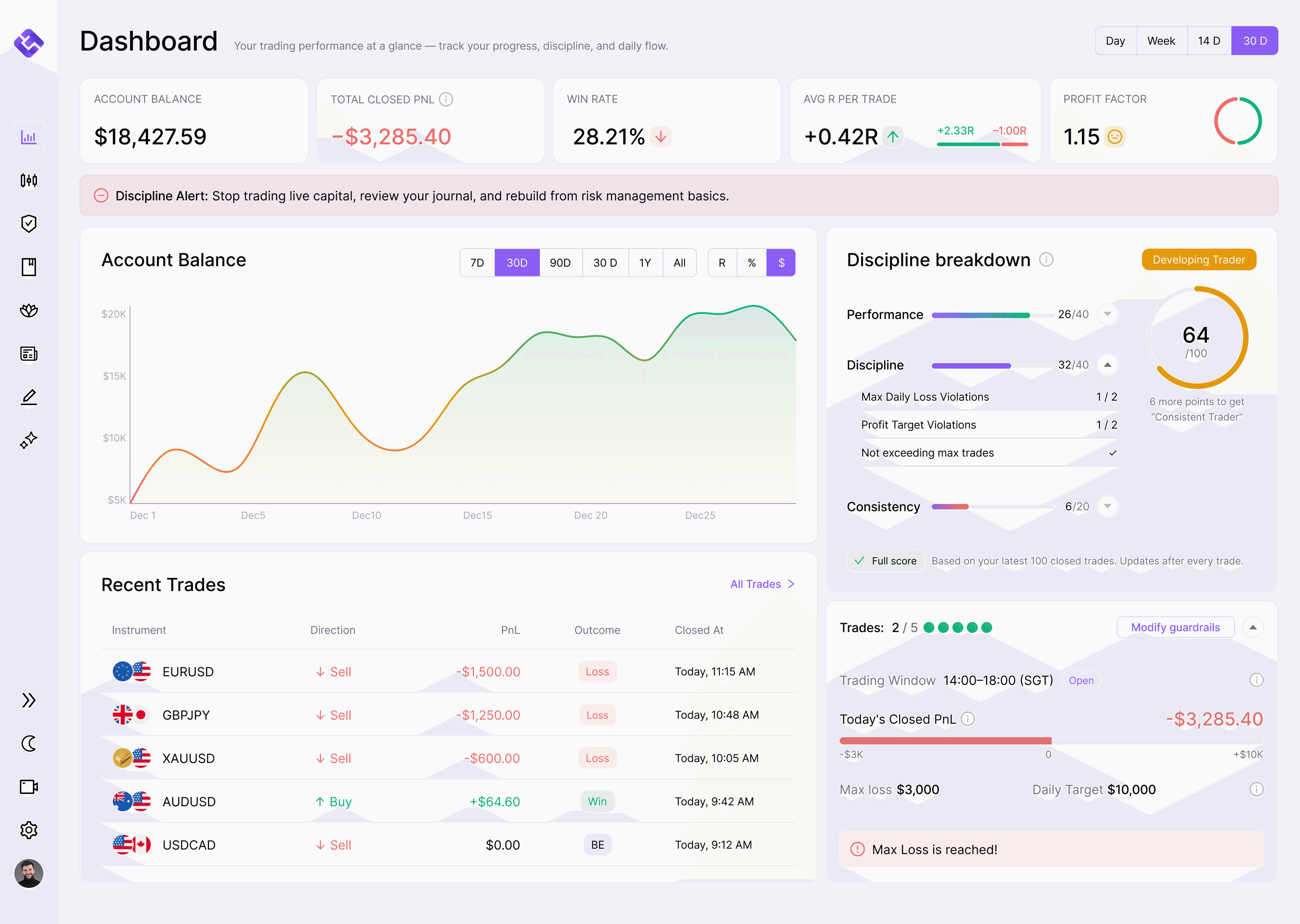
EdgeFlo has a built-in max daily loss guardrail that disables the Trade button when your losses hit the threshold you set. You pick the percentage. When you reach it, the button grays out.
There is an override option. You can choose to keep trading. But you have to actively decide to break your own rule, which is very different from passively letting losses accumulate while you are in the zone. That friction, that one extra step, is often enough to snap you out of tilt and walk away.
Combined with the journal that auto-imports every trade, you can review exactly which days you hit your limit, which days you overrode it, and what happened afterward. That data tells you more about your discipline than any win rate ever could.
The Edge Brief
Receive Insights on trading psychology, discipline, and the behavioral patterns that create consistent traders from our Founder and the EdgeFlo team, delivered to your inbox.
Think different. Trade different.
What is a daily loss limit in trading?
Do floating losses count toward the daily loss limit?
What happens if you breach the daily loss limit?
How do you stay under the daily loss limit?

Turn discipline on.
Every session.
EdgeFlo is the environment serious traders operate inside.
Start 7-Day Free Trial
Cancel anytime.
No long-term commitment.

Think Different, Trade Different.