

Overtrading: Why Doing Less Makes More Money
Overtrading drains accounts faster than bad setups. Learn the real cost, the boredom trap, and three rules to cap your trades for better results.
Overtrading is the most expensive habit in trading, and it has nothing to do with picking the wrong direction. It is the act of taking trades that do not belong in your plan, driven by boredom, impulse, or the need to feel productive. Most blown accounts do not die from one catastrophic loss. They bleed out from dozens of mediocre trades that never should have happened. If your win rate drops the more you trade in a day, overtrading is already costing you money.
TL;DR
Overtrading increases commission drag, spreads your focus thin, and turns winners into breakeven noise.
Boredom is the number one trigger. If you are trading to feel busy, you are trading without an edge.
Three high-quality trades will almost always outperform ten average ones when you account for fees and slippage.
A daily trade cap, written into your trading rules, is the simplest fix.
Tracking trade count alongside P&L reveals the pattern most traders miss.
What Overtrading Actually Costs You
The obvious cost is commissions. But commissions are just the surface. The real damage runs deeper.
Say you trade EUR/USD on the 15-minute chart. Your average spread cost is 1.1 pips per round trip. On a day where you take 3 trades, that is 3.3 pips in friction. On a day where you take 12 trades, that is 13.2 pips. If your average winner is 15 pips, those 12 trades just ate almost a full winner in spread alone.
Now add slippage. Fast entries during London session volatility might cost an extra 0.3 pips per trade on a busy day. That is another 3.6 pips gone on a 12-trade day versus 0.9 pips on a 3-trade day.
But the hidden cost is worse than the math. Every extra trade dilutes your attention. By trade number eight, you are not reading the chart the same way you read it at trade number two. Your pattern recognition gets sloppy. Your entries get impulsive. You start seeing setups that are not there because you have already decided you want to be in a trade.
This is one of the most common trading mistakes, and it compounds. A trader who overtrades does not just lose on the bad trades. They also degrade the quality of their good ones.
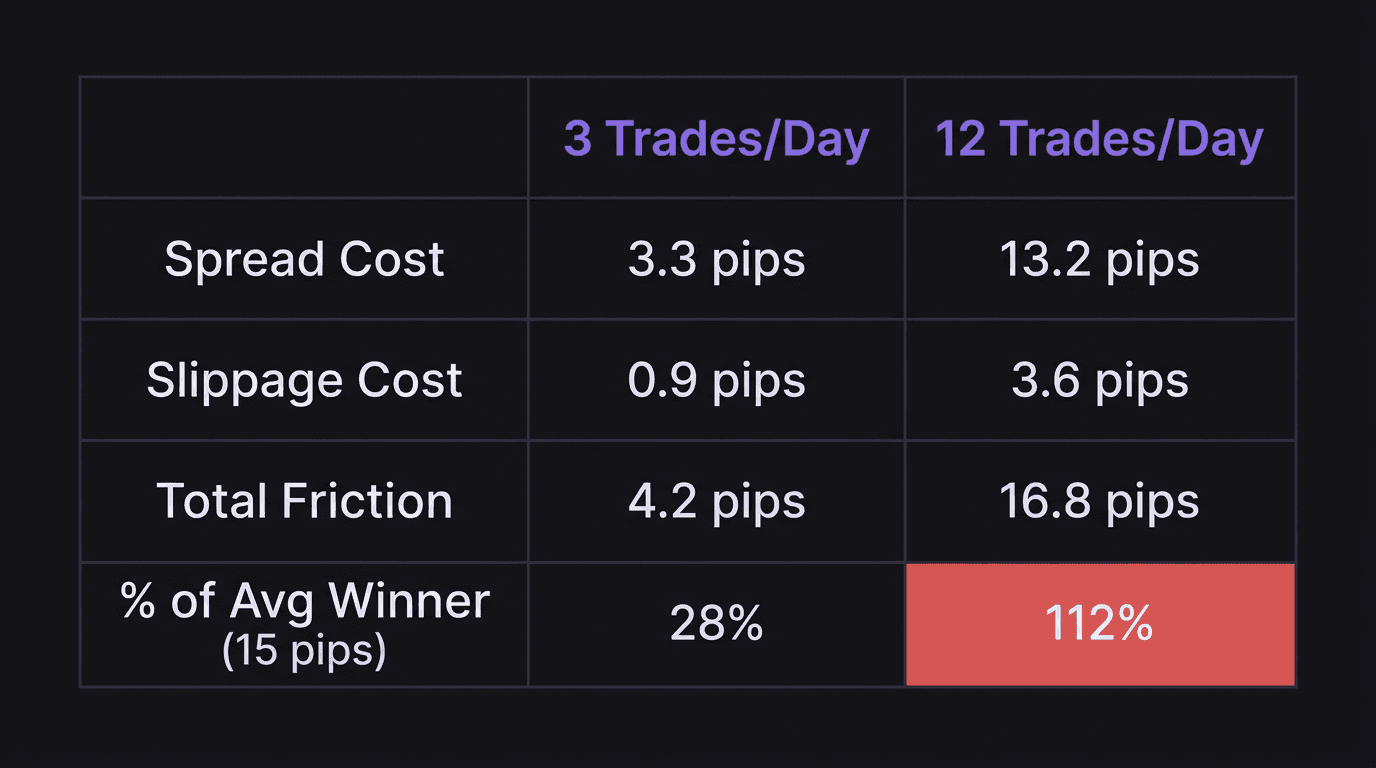
Look at that. On a 12-trade day, your friction costs exceed your average winner. You are paying more in overhead than you make on a typical winning trade. That is not a strategy. That is a hamster wheel.
The Boredom Trap: Trading for Action, Not Edge
Here is the uncomfortable truth. Most overtrading is not caused by greed. It is caused by boredom.
You sit down at your desk. You have done your pre-market analysis. And then the market does nothing. It chops sideways for two hours. No setup forms. No clean structure. Just noise.
So you start looking harder. You drop to a lower timeframe. You find something that almost looks like a setup. You convince yourself it is close enough. You enter.
Sound familiar?
The GBP/USD Boredom Trade
A trader is watching GBP/USD on the 1-hour chart during early New York session. Their plan says to look for a pullback to the 1.2640 support zone after the morning push higher to 1.2695. The pullback never comes. Price consolidates between 1.2670 and 1.2690 for three hours.
Out of boredom, the trader drops to the 5-minute chart and takes a long at 1.2678 on a "micro pullback" that was never part of their plan. Price immediately fades to 1.2665, hitting their stop. They take a second entry at 1.2671 on the same logic. Another stop. Two losses, 24 pips gone, and neither trade was in their system.
The setup they were waiting for (the pullback to 1.2640) never triggered that day. The correct action was zero trades. Instead, boredom cost them money and confidence.
This is what one source nails perfectly: "Traders who lose are the ones who rush." Those two boredom trades were not bad analysis. They were impatience dressed up as analysis.
Every delayed entry, every avoided FOMO trade, every moment you choose quality over quantity, you are building capital and character. That is not a motivational slogan. It is observable in the numbers. Go look at your journal. Compare your P&L on 1-2 trade days versus 5+ trade days. Most traders find the answer uncomfortable.
The boredom trap also feeds into revenge trading. You take a boredom trade, it loses, and now you are down on a day where you should have been flat. So you trade again to get it back. The spiral starts from a single trade that had no business existing.
Quality Over Quantity (The Math)
The math on this is not close. It is not even a debate once you see it.
Consider two traders over 20 trading days. Both have a 55% win rate and a 2:1 reward-to-risk ratio. Both risk $100 per trade.
Wins: 33 trades at $200 = $6,600
Losses: 27 trades at $100 = $2,700
Commissions (round trip $4/trade): $240
Net: $3,660
Same 55% win rate? Not likely. But assume it holds.
Wins: 88 trades at $200 = $17,600
Losses: 72 trades at $100 = $7,200
Commissions (round trip $4/trade): $640
Net: $9,760
Looks like Trader B wins, right? Here is the problem. The 55% win rate does not hold at 8 trades per day. No strategy produces 8 equally valid setups per day on a single pair and timeframe. By trade 5 or 6, Trader B is forcing entries. A more realistic win rate at that volume is 42-45%.
Wins: 69 trades at $200 = $13,800
Losses: 91 trades at $100 = $9,100
Commissions: $640
Net: $4,060
Now Trader A, taking 60% fewer trades, makes almost the same money with far less screen time and emotional wear. And that 43% is generous. Many traders who overtrade see their win rate drop below 40%, at which point the math flips entirely and they lose money over the period.
Slow is smooth. Smooth is fast. That is not just a saying for snipers. It is the operating principle of every profitable trader who has been at this for more than a year.
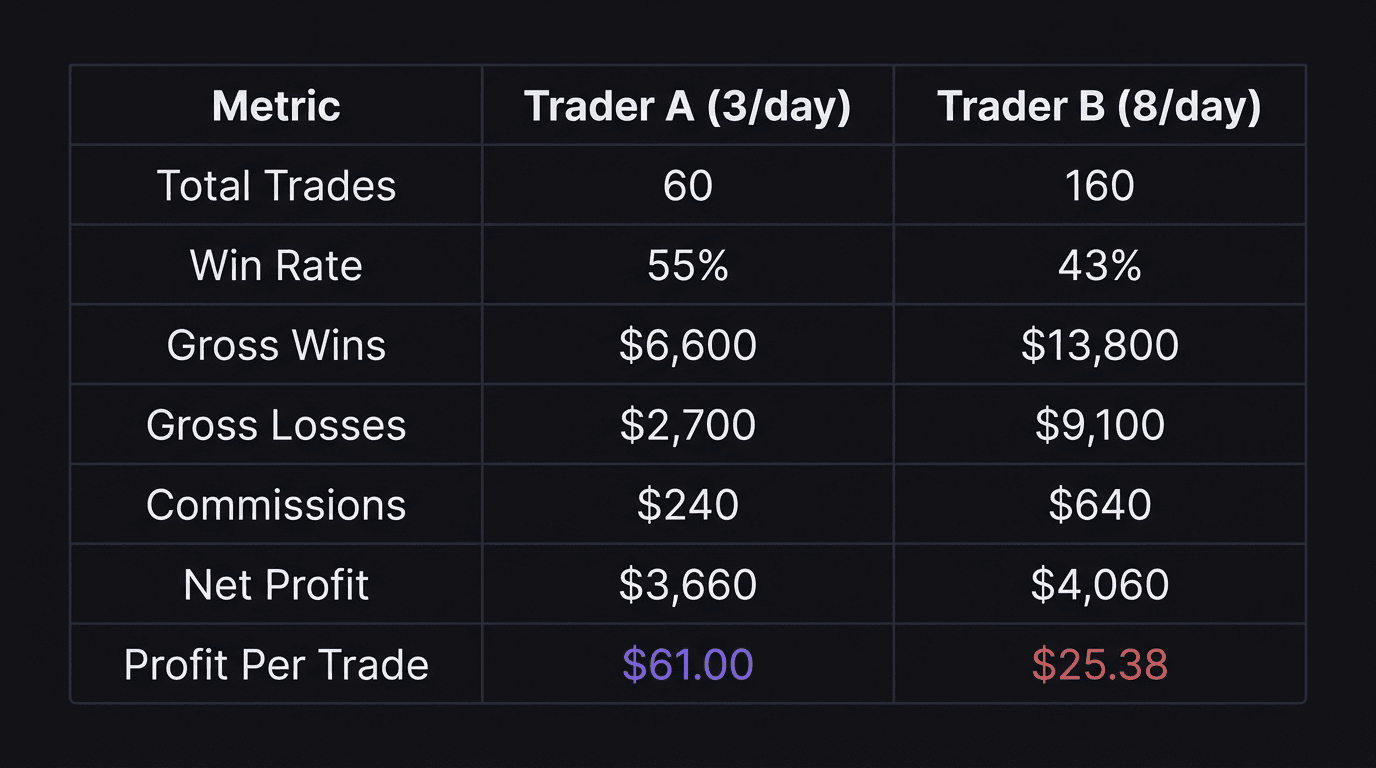
Profit per trade is the number that matters. Trader A makes $61 per trade. Trader B makes $25.38. Trader A is building a sustainable business. Trader B is grinding for scraps and will eventually burn out or blow up when the win rate slips another few points.
Three Rules That Cap Your Trades
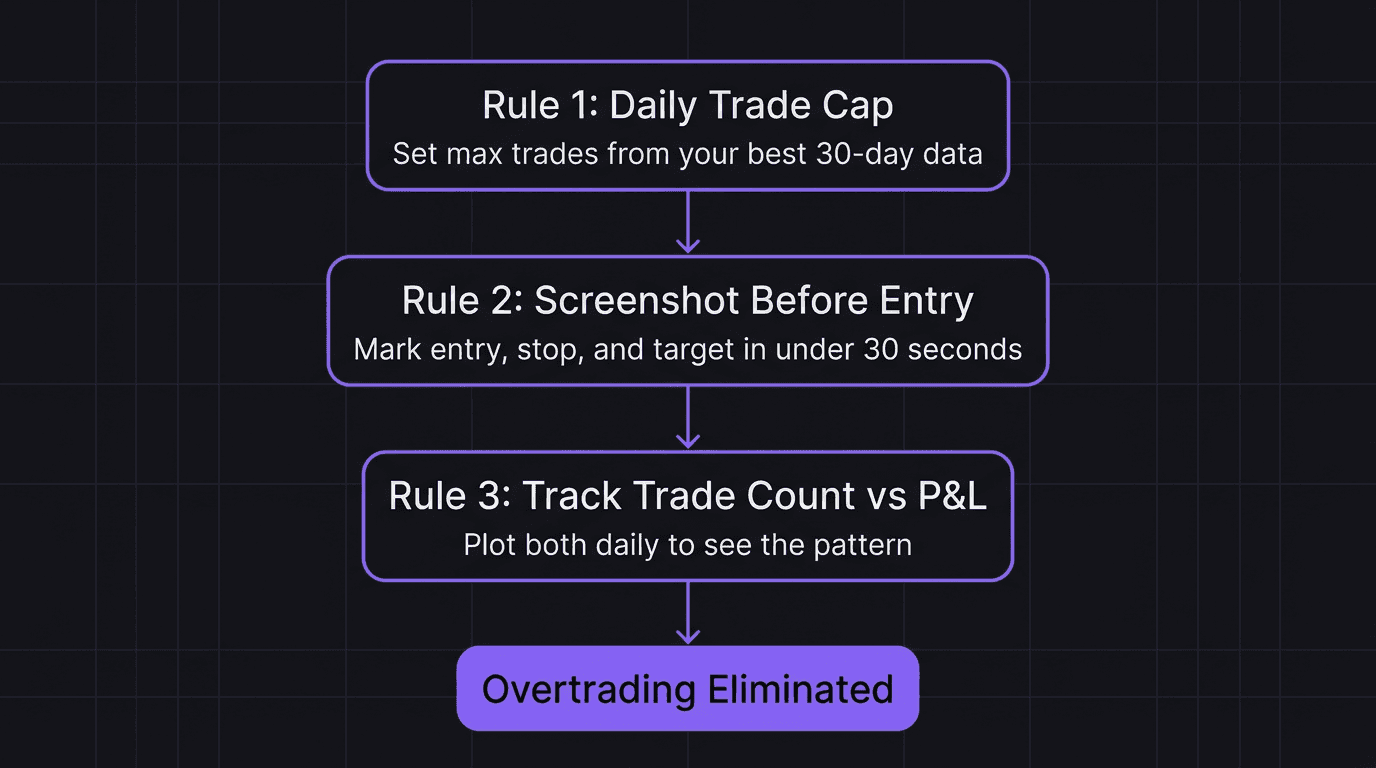
You do not fix overtrading with willpower. You fix it with structure. Here are three rules that work.
Rule 1: Set a Hard Daily Trade Cap
Pick a number based on your historical data, not your feelings. Look at your last 30 trading days. On the days you were profitable, how many trades did you take on average? That number (or one below it) becomes your cap.
For most swing traders on the 1-hour or 4-hour chart, that cap is 2-3 trades. For scalpers on the 5-minute chart, it might be 5-6. The number matters less than the commitment to stopping when you hit it.
Write it into your trading rules. Not as a suggestion. As a hard stop.
Rule 2: Require a Setup Screenshot Before Entry
Before you click buy or sell, screenshot the chart with your setup marked. Draw the entry, stop, and target. If you cannot clearly mark all three in under 30 seconds, the setup is not clean enough. Skip it.
This forces a pause between impulse and action. That pause is where overtrading dies. Most boredom trades cannot survive a 30-second screenshot test because the setup is not really there.
Rule 3: Track Trade Count Separately From P&L
Most traders only track whether they made or lost money. Start tracking how many trades you took each day as its own metric. Plot it alongside your daily P&L on a simple spreadsheet.
You will see the pattern within two weeks. The days with the most trades are rarely the most profitable. Often, they are your worst. This data turns an abstract problem ("I think I might overtrade") into a concrete one ("I lose money every time I take more than 4 trades").
Combine this with a daily loss limit and you have two structural guards against your worst impulses. The trade cap stops you from overtrading when you are winning. The loss limit stops you when you are losing. Together, they keep you in the zone where your strategy actually works.
How EdgeFlo Limits Trade Frequency
EdgeFlo's Guardrails feature lets you set a maximum number of trades per day. You pick the number that matches your plan, and the app flags you when you hit it. You can override the limit if a genuine setup appears late in the session, but the override is deliberate. You have to acknowledge you are going past your own rule. That friction is the point.
The trading journal tracks your trade count automatically alongside your P&L. Over time, it builds a clear picture of which days had too many trades and what that cost you. Pattern recognition across weeks of data is where the real insight lives. You stop guessing whether you overtrade and start seeing exactly when and how much it costs.
Those who wait rise. Those who rush fall. Structure makes waiting possible. When your environment reminds you of your own rules, patience stops being a personality trait and becomes a built-in part of your process.
Trading fear keeps some traders from entering at all. Overtrading is the opposite problem, but it comes from the same root: trading based on emotion instead of a plan. Both are solved the same way. Write the rules. Build the environment. Trust the process.
The Edge Brief
Receive Insights on trading psychology, discipline, and the behavioral patterns that create consistent traders from our Founder and the EdgeFlo team, delivered to your inbox.
Think different. Trade different.
How many trades per day is considered overtrading?
Can overtrading happen on a demo account?
What is the difference between overtrading and active trading?
How do I stop overtrading?

Turn discipline on.
Every session.
EdgeFlo is the environment serious traders operate inside.
Start 7-Day Free Trial
Cancel anytime.
No long-term commitment.


Think Different, Trade Different.