

When You Lose a Trade, You Become the Liquidity
When your stop loss triggers, your buy becomes a sell that feeds institutional buying. Understanding this mechanic changes how you think about losses and stop placement.
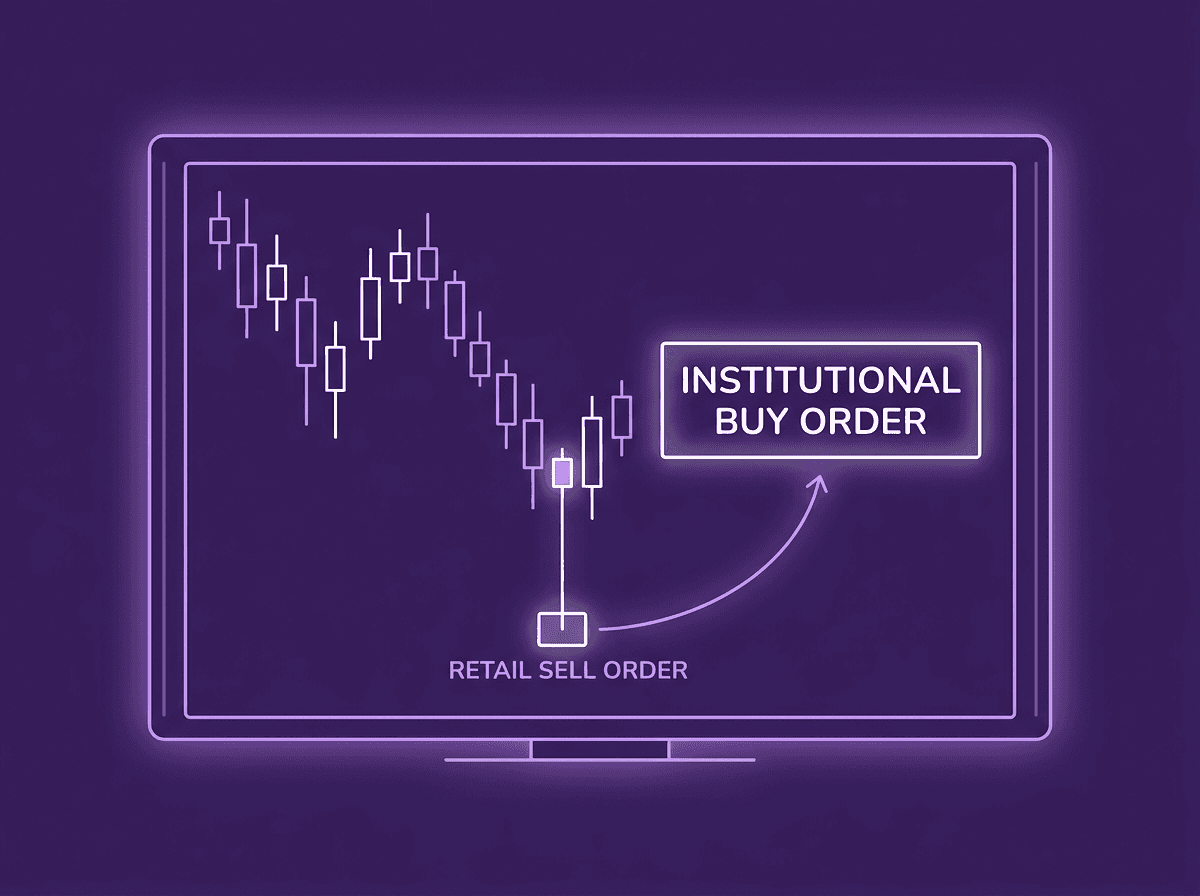
When your buy trade stop loss triggers, you are not just exiting a position. You are creating a sell order that feeds institutional buying. Your loss becomes their entry. Understanding this mechanic does not eliminate losses (every trader has them), but it fundamentally changes where you place your stops and how you think about being on the wrong side of a trade. If you have ever been stopped out at the exact low before a major reversal, you were the liquidity.
Closing a buy position means executing a sell order. Your stop loss creates the sell liquidity institutions need.
Thousands of retail stops clustered at the same level create a massive pool of opposing orders.
Institutions push price into these pools to fill their positions, then price reverses.
The "stopped out at the exact bottom" experience is not bad luck. It is a mechanical feature.
Moving stops beyond the obvious cluster is the most practical fix.
What Happens When Your Stop Loss Triggers
Most traders think about a stop loss as an exit. "I am leaving the trade." But mechanically, a stop loss is a new order entering the market.
If you have a buy position on EUR/USD and your stop loss triggers, your broker sends a sell order to close that position. That sell order goes into the order book and gets matched with a buyer. That buyer might be an institution accumulating a long position at discount prices.
This is not a theory. It is how order matching works. Every closed buy creates a sell. Every closed sell creates a buy. Your exit is always someone else's entry.
Now multiply that by thousands. When price reaches a swing low where hundreds of retail traders have placed their stops, hundreds of sell orders hit the market simultaneously. That flood of selling creates exactly the kind of concentrated liquidity that institutions need to fill their massive buy orders without slippage.
Your Buy Becomes Their Sell
Walk through the mechanics step by step.
You buy EUR/USD at 1.0860. You place your stop loss at 1.0818, just below the swing low at 1.0820. You are following the rule you learned: "place your stop below the recent swing low."
Price drops. It reaches 1.0820 and keeps going. Your stop at 1.0818 triggers. Your broker immediately executes a sell order at market price. You are now out of the trade with a 42-pip loss.
But that sell order did not vanish. It went into the market and was absorbed by a buyer. An institutional buyer sitting at 1.0815, accumulating a massive long position with all the sell orders flooding in from triggered stops.
The institution just got what it needed: hundreds of sell orders at a discount price. Now there are no more sellers (all the stops have been triggered). No more selling pressure. Price reverses and rockets to 1.0920.
Walkthrough: The donation you did not know you made. Trader buys GBP/USD at 1.2700 with a 30-pip stop at 1.2670, right below the swing low at 1.2675. Price drops to 1.2665, triggering the stop. The broker sells at 1.2665. The trade is closed with a $150 loss (0.5 lots at $10/pip times 30 pips). At the same moment, hundreds of other retail stops trigger between 1.2670 and 1.2660. That cluster of sell orders totals thousands of lots, which institutional buyers absorb to fill their positions. Price reverses from 1.2660 and climbs to 1.2780. The trader donated $150 and 30 pips of liquidity. The institution bought at the exact bottom and rode 120 pips.
The Emotional Trap of Obvious Stop Placement
The worst part is not the loss itself. It is the psychological damage of watching price reverse immediately after stopping you out. That experience does two harmful things.
First, it breeds paranoia. "The market is out to get me." It is not personal. But it is mechanical. Your stop was at the same level as thousands of other traders. The pool was large enough to attract institutional activity. It would have happened regardless of whether your specific order was there.
Second, it leads to revenge trading. You just watched price move exactly where you predicted, without you on board. The impulse to re-enter immediately, at a worse price, without waiting for setup confirmation, is overwhelming. This is where one manageable loss turns into two or three, all because the first stop was placed where the liquidity cluster sat.
The fix is not removing stops (that creates a worse problem). The fix is placing stops where the cluster is not.
Walkthrough: Two stop placements, same trade. Trader A buys EUR/USD at 1.0860 and places a stop at 1.0818 (2 pips below the swing low). The stop gets swept and Trader A loses 42 pips. Trader B buys the same pair at the same price but places the stop at 1.0790 (below a deeper structural level). The sweep takes out Trader A but does not reach Trader B. Price reverses from 1.0810 and pushes to 1.0940. Trader B rides 80 pips of profit. Trader A is already re-entering emotionally and about to take another loss.
How This Knowledge Changes Your Trading
Understanding the liquidity donation mechanic does not make you immune to losses. You will still get stopped out. The goal is to get stopped out for the right reasons (the trade was genuinely wrong) instead of the wrong reasons (your stop sat in the liquidity cluster and got swept before the move you expected).
Practical changes you can make today:
1. Adjust stop placement. Place your stop beyond the liquidity zone, not at the obvious level. If the swing low is at 1.0820, the cluster sits between 1.0810 and 1.0820. Your stop goes at 1.0795 or lower.
2. Reduce size to accommodate wider stops. A wider stop means larger potential loss per pip. Reduce your lot size to keep dollar risk the same. The wider stop is worth it because you survive the sweep.
3. Wait for the sweep before entering. Instead of buying at the zone and placing a tight stop below it, wait for price to sweep the level first. Enter after the sweep, with your stop below the swept wick. Your entry is better, your stop is below a drained pool (less likely to get hit again), and your risk-to-reward improves.
4. Track your stop quality. Use your trading journal to record whether each stop was inside or outside the liquidity cluster. After 20 trades, the data shows you exactly how much the placement adjustment is worth.
How EdgeFlo Helps You Review Stop Placement
Stop placement quality is invisible without a feedback system. You might think your stops are fine until the data shows that 60% of your losing trades were stopped out within 5 pips of the reversal point.
EdgeFlo's journal auto-imports your trades and shows exactly where your stop was relative to the price action. In the post-trade review, you can annotate whether the stop was inside or outside the liquidity zone. The weekly AI report (Plus) surfaces patterns like "most stops this week were within the liquidity cluster" so you catch the habit before it drains your account.
This is not about eliminating losses. It is about ensuring your losses are from trades that were genuinely wrong, not from trades that were right except for a stop that was 10 pips too tight.
The Edge Brief
Receive Insights on trading psychology, discipline, and the behavioral patterns that create consistent traders from our Founder and the EdgeFlo team, delivered to your inbox.
Think different. Trade different.
How does losing a trade add liquidity to the market?
Is it bad that my stop loss adds liquidity?
How do I stop being the liquidity?
Why does price reverse right after I get stopped out?

Turn discipline on.
Every session.
EdgeFlo is the environment serious traders operate inside.
Start 7-Day Free Trial
Cancel anytime.
No long-term commitment.

Think Different, Trade Different.