

Trading Consistency: Process Over Willpower
Trading consistency comes from systems, not discipline. Build a repeatable process that removes willpower from the equation and tracks what matters.

Trading consistency is not about gritting your teeth harder. It is about building a process so clear and repeatable that following it becomes the path of least resistance. Willpower is a depletable resource. Systems are not. The traders who show up and execute the same way every session are not more disciplined than you. They just removed more decisions from their day.
TL;DR
Willpower is finite and burns out fast during live trading. Relying on it for consistency is a losing strategy.
Systems (checklists, routines, fixed rules) make consistency automatic by reducing real-time decisions.
A daily process with the same steps every session builds "mental armor" that compounds over months.
Track process adherence, not just PnL. Consistency percentage is the leading indicator of long-term results.
EdgeFlo's EdgeScore tracks your discipline metrics so you can measure consistency without manual logging.
Why Willpower Runs Out by Trade Three
You sit down for the trading session with a plan. You are calm, focused, ready. Trade one goes by the book. You follow your trading rules, wait for confirmation, enter clean.
Trade two gets messier. The setup is almost there but not quite. You take it anyway because you feel sharp and the first trade went well. That is willpower cracking.
Trade three? By now you have been staring at charts for an hour, made two decisions under pressure, and your brain is looking for shortcuts. The third trade is where most traders abandon their process entirely.
This is not a character flaw. It is how the brain works. Every decision you make during a session draws from the same limited pool. Psychologists call it decision fatigue. Traders call it "going on tilt." Same thing, different label.
Think about it like a phone battery. You start the day at 100%. Every decision, every moment of restraint, every time you override an impulse, you drain a few percent. By mid-session, you are running on 15% and wondering why you just revenge traded a setup that was not even on your watchlist.
The fix is not "try harder." The fix is to stop relying on willpower at all.
The Willpower Trap in Action
EUR/USD, 15-minute chart, London session. A trader has a rule: only take longs above the Asian session high. Session opens, price consolidates below the level. Forty-five minutes of waiting. The trader watches three clean moves happen on GBP/USD that were not on the plan. By the time EUR/USD finally breaks the Asian high, the trader has already jumped into an unplanned GBP/USD short "just to get something going." EUR/USD runs 40 pips without them. The GBP/USD short stops out for -1R. Two trading mistakes from one session, both caused by depleted patience, not bad analysis.
That scenario plays out in thousands of accounts every day. The analysis was fine. The willpower was not.
Systems That Make Consistency Automatic
Discipline is not about being robotic. It is about being in control. And the easiest way to stay in control is to remove as many live decisions as possible before the session starts.
Here is the principle: every decision you can make before the market opens is one less decision that can go wrong during the session.
A mechanical trading plan does this by turning your strategy into a set of if/then rules. If price reaches this level, then you enter. If your stop is hit, then you exit. No interpretation required.
But consistency goes beyond the trade plan. It covers your entire session:
Pre-session: What pairs are you watching? What levels matter? What is the daily bias?
During session: What is your entry trigger? What disqualifies a setup? When do you stop trading?
Post-session: Did you journal? Did you screenshot? Did you score your process?
When all three phases are scripted, you stop relying on in-the-moment judgment for the routine parts. Your willpower is reserved for the one thing that actually needs it: executing the plan when the trade feels uncomfortable.
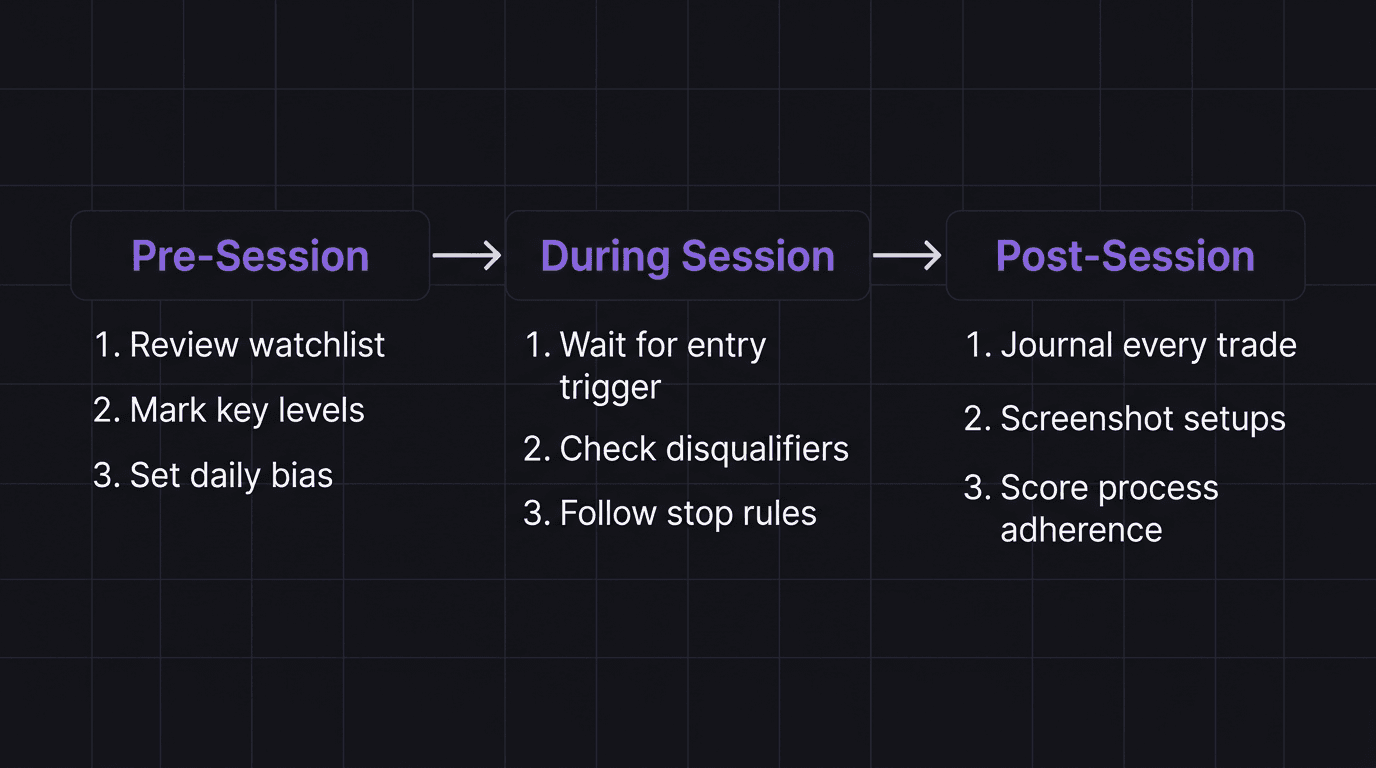
Every single time you follow your plan, even when it feels boring or uncomfortable, you are building mental armor. That is not motivational fluff. Repetition literally rewires how your brain responds to market stress. The hundredth time you sit through a losing trade without moving your stop is easier than the tenth time. Not because you got tougher. Because the process became automatic.
The Daily Process: Same Steps, Every Session
Excellence is not a one-time thing. It is a lifestyle. And in trading, that lifestyle looks boring from the outside. Same steps. Same order. Same checklist. Every single session.
Here is what a repeatable daily process looks like in practice:
Before the Open
Complete your pre-market routine. Check the economic calendar. Review overnight price action on your pairs. Mark support, resistance, and any levels where your setup could trigger.
Write down your bias for each pair. Not a prediction. A conditional statement: "Bullish above 1.0850, bearish below 1.0820."
Set your maximum loss for the session. Know the number before the chart moves.
During the Session
Wait for your setup. If it does not appear, do not trade. "No trade" is a valid outcome.
When the setup triggers, execute the plan. Entry, stop, target. All predefined.
After entry, do not touch the trade unless your plan says to manage it at a specific level.
After the Close
Journal every trade. Include the screenshot, the setup name, and whether you followed the rules.
Score yourself on process, not outcome. A losing trade executed perfectly is a 10/10 session.
That is it. No complexity. No secret sauce. The hard part is doing it when you do not feel like it.
Show up every day regardless of how you feel. That is the dividing line between traders who plateau and traders who compound. The sessions where you feel flat, distracted, or frustrated are the ones that matter most. Anyone can follow the process on a green day.
Walkthrough: What "Same Steps" Looks Like
NZD/USD, 4-hour chart, New York session. A swing trader runs the same pre-session checklist every morning at 8:00 AM. Today, there is nothing. NZD/USD is mid-range, no level nearby, no catalyst on the calendar. The old version of this trader would have dropped to the 15-minute chart and hunted for something. Instead, the process says: "If no setup on the 4-hour, close the platform." Session score: 10/10. Zero trades. Zero risk. Full consistency. Two days later, NZD/USD reaches the marked level at 0.6140, the setup triggers, and the trader enters a long at the exact price they marked 48 hours earlier. Target hit at 0.6195 for +2.2R. That trade only happened because the process kept the trader out on the boring day.
Measure Consistency, Not Just Profits
Most traders track their PnL religiously and their process barely at all. That is backwards.
PnL is a lagging indicator. It tells you what already happened. Process adherence is a leading indicator. It tells you what is going to happen if you keep showing up.
Here is a simple framework. Track these five binary metrics after every session using a trading habit tracker:
Metric | Score |
|---|---|
Completed pre-market routine | Yes/No |
Only took planned setups | Yes/No |
Followed stop loss rules | Yes/No |
Respected session loss limit | Yes/No |
Journaled all trades | Yes/No |
Five questions. Each one is yes or no. Your daily consistency score is the percentage of "yes" answers. Track it weekly.
A trader who scores 80-100% consistently will outperform a trader who scores 40-60% over any meaningful time period, regardless of strategy. The strategy almost does not matter if you cannot execute it the same way twice.
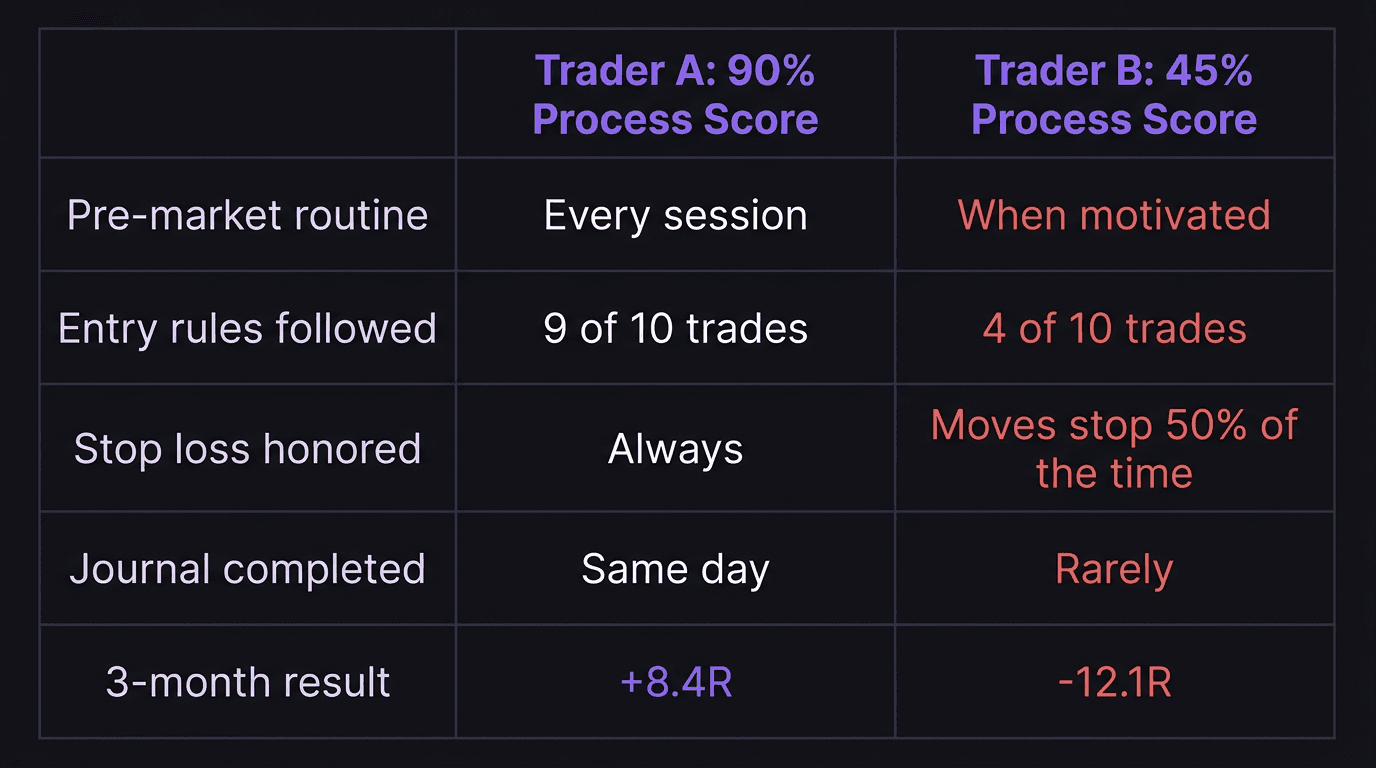
Notice something about that table? Trader A's strategy could be mediocre. A 1:1.5 reward-to-risk ratio with a 45% win rate. Nothing fancy. But consistent execution of a decent plan beats inconsistent execution of a great one, every time.
The 30-Session Benchmark
Do not evaluate your consistency after one week. Give it 30 sessions. That is roughly six weeks for a day trader or three months for a swing trader.
After 30 sessions, look at the trend in your process score, not the individual days. A trader who starts at 60% and trends to 85% over 30 sessions is building something durable. A trader who bounces between 40% and 90% with no trend is still running on willpower.
How EdgeFlo Tracks Your Process Adherence
This is where most traders hit a wall. Tracking process manually works, but it is one more thing to remember at the end of the session. And on the days when your process breaks down (the days you need the data most), you are least likely to log it honestly.
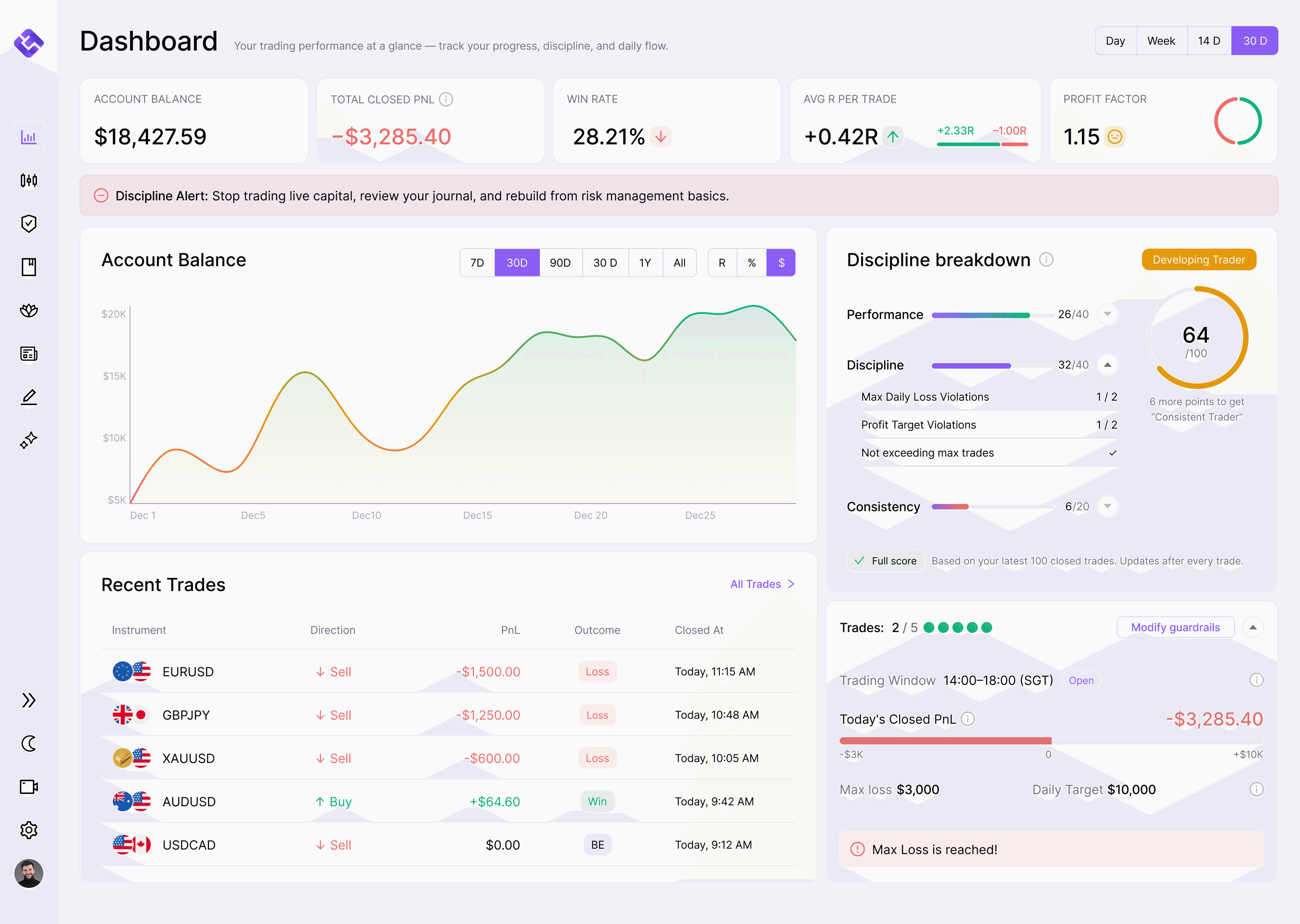
EdgeFlo's EdgeScore tracks discipline and consistency metrics automatically. Instead of grading yourself on a spreadsheet after the session, EdgeScore pulls from your actual trading behavior: did you follow your pre-set rules, did you respect your stop levels, did you trade within your defined session window.
EdgeFlo also provides pre-market routine prompts to help you start each session with the same steps. These are not enforced. You can skip them. But the prompt itself is a nudge that reduces the willpower cost of starting your process. You do not have to remember to do the routine. You just have to respond to the prompt.
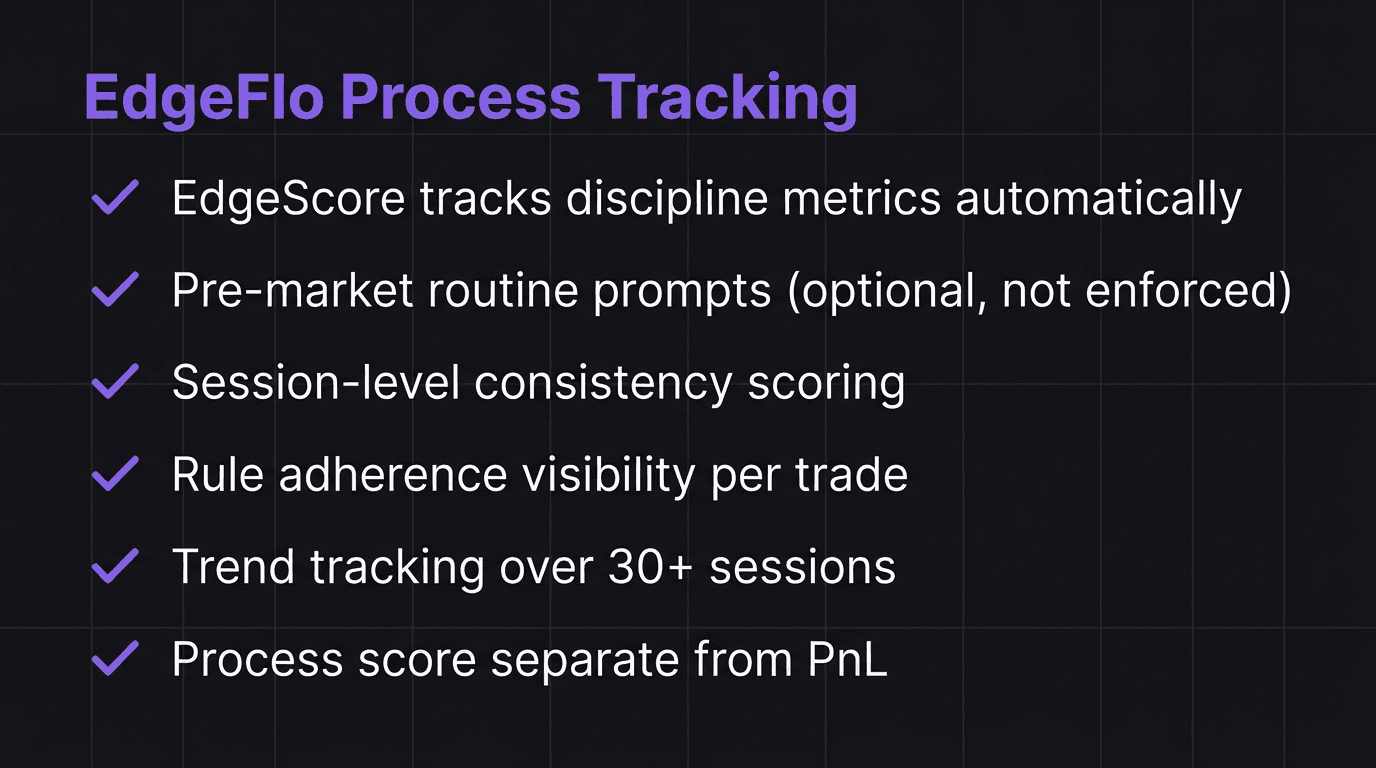
The goal is to make consistency visible. When you can see your process adherence as a number that trends over weeks, it stops being an abstract concept and becomes something you can actually improve. You would not try to get stronger without tracking your reps. Trading consistency works the same way.
The Edge Brief
Receive Insights on trading psychology, discipline, and the behavioral patterns that create consistent traders from our Founder and the EdgeFlo team, delivered to your inbox.
Think different. Trade different.
How long does it take to build trading consistency?
Can you be consistent and still lose money?
What is the difference between trading discipline and trading consistency?
How do I track trading consistency?

Turn discipline on.
Every session.
EdgeFlo is the environment serious traders operate inside.
Start 7-Day Free Trial
Cancel anytime.
No long-term commitment.

Think Different, Trade Different.