

Valid vs Invalid Trades: The Tag That Fixes Your Review
A valid trade follows your plan, win or lose. An invalid trade breaks it, even if profitable. Learn how to classify trades in your journal for real improvement.
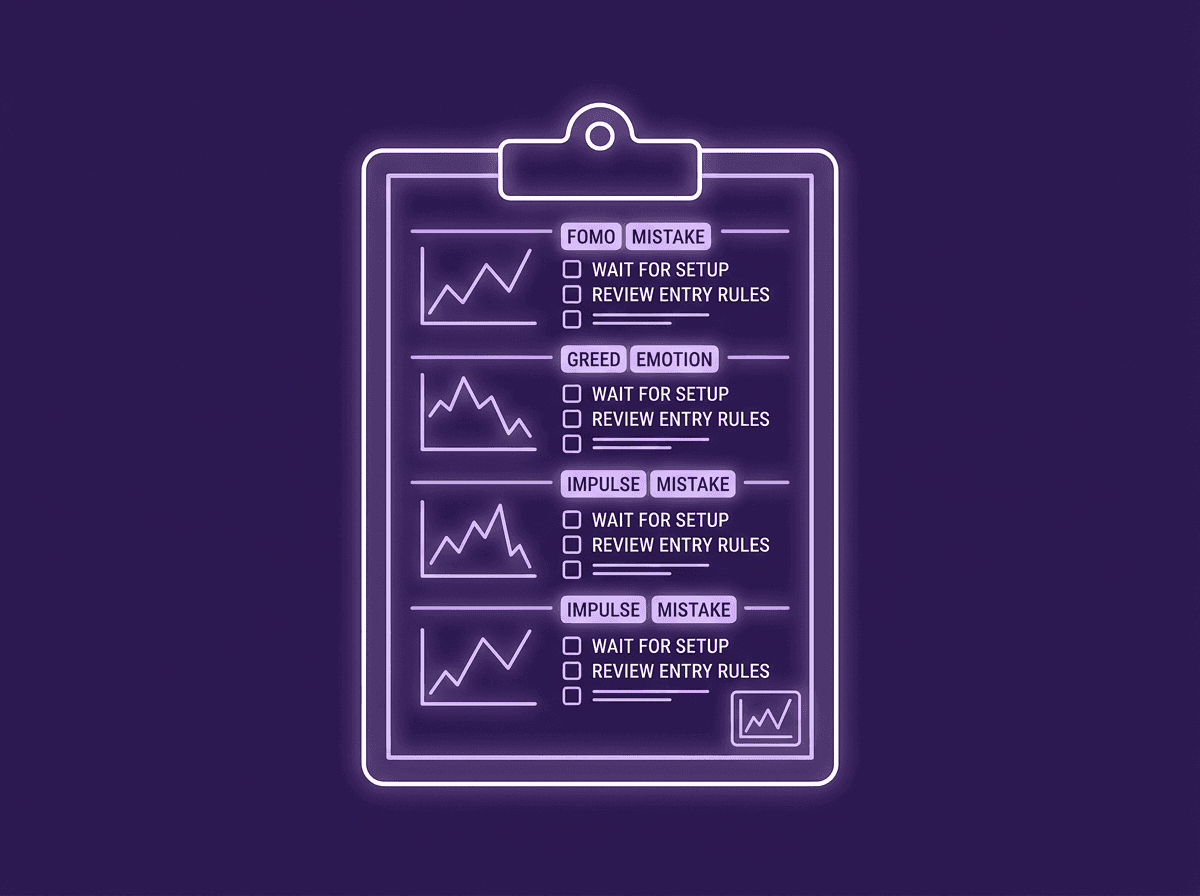
A valid trade is any trade that followed your plan, win or lose. An invalid trade is any trade that broke your rules, even if it made money. Most traders never make this distinction. They sort their journal by profit and loss, celebrate the green days, and bury the red ones. But that approach hides the one thing that actually determines whether you improve: whether you executed your process.
This classification system, tagging every trade as valid or invalid based on plan adherence, is the single most useful change you can make to your trading journal. It separates execution quality from market randomness, and it gives your review sessions something concrete to work with instead of "I need to be more disciplined."
TL;DR
A valid trade follows your plan, regardless of outcome. A valid loss is a good trade.
An invalid trade breaks your rules, regardless of outcome. An invalid win is a bad trade.
Tag every journal entry with a trade classification before analyzing the P&L.
Review invalid trades to find the pattern behind your rule-breaking, not just the dollar cost.
This system shifts your journal from a scorecard into a feedback loop that targets execution quality.
What Makes a Trade Valid
A trade is valid when it meets every condition in your trading playbook before you click the button. That means the setup matched your criteria, the entry model confirmed, the stop-loss and target were placed according to your rules, and the position size followed your risk parameters.
The outcome does not factor in. A valid trade that hits your stop-loss at -0.5% is still a good trade. You executed the process. The market did what the market does.
Here is a simple test: could you show this trade to another trader, walk them through your plan, and point to every rule you followed? If yes, the trade is valid. If you have to start explaining why you "felt" the setup was good enough, or why you skipped one of your entry conditions, it is not.
The Four-Box Classification
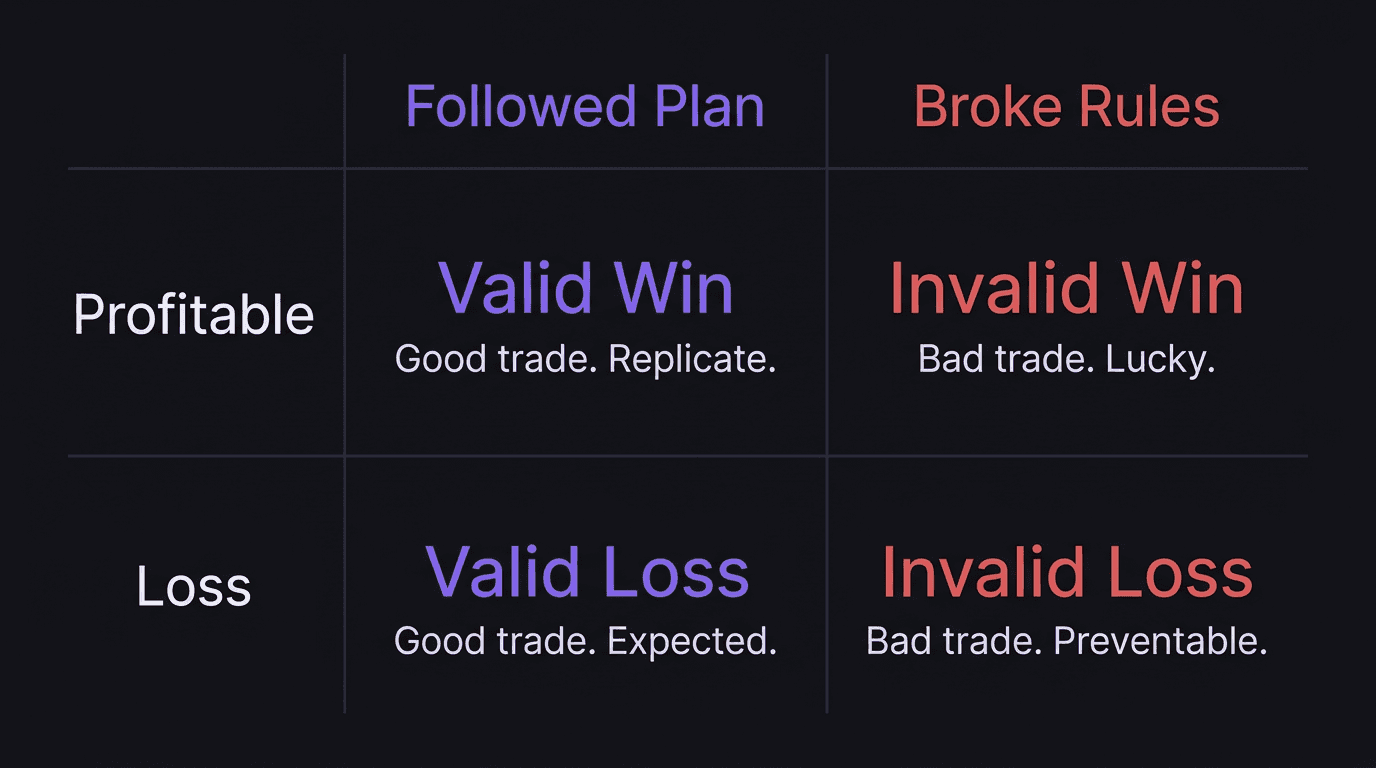
Every trade you take falls into one of four categories:
Valid win: followed the plan, trade was profitable. This is the goal. Learn what went right and look for ways to replicate it.
Valid loss: followed the plan, trade lost money. This is fine. Your edge plays out over many trades, not one.
Invalid win: broke the rules, trade was profitable. This is dangerous. The profit masks the process failure and reinforces the habit of improvising.
Invalid loss: broke the rules, trade lost money. This is the most common source of account damage. No plan, no edge, no reason to expect a different result.
The key insight: boxes 1 and 2 are both good trades. Boxes 3 and 4 are both bad trades. The profit column is irrelevant to the classification.
A Winning Trade Can Still Be Bad
This is where most traders push back. You made money, how can that be a bad trade?
Think about it like this. You are trading EUR/USD during London open. Your plan says: wait for price to tap your supply zone, confirm with a bearish engulfing on the 15-minute, then enter short with a stop above the zone high. Risk: 0.5% of your account.
But today, price is falling fast and you are watching it drop. You skip the supply zone tap, skip the confirmation candle, and market-sell because it "looks like it's going down." You size up to 1.5% because you are confident. Price drops another 40 pips in your favor. You close for a nice profit.
Sound familiar?
That trade is invalid. Every part of it violated the plan, the entry, the confirmation, and the position size. The profit came from luck, not from process. And here is the problem: if you log this as a win and move on, your brain files it under "things that work." Next time the market moves fast, you will do the same thing. Eventually, that impulse trade catches you on the wrong side and the loss is 3x your normal risk because you sized up.
Walkthrough: the invisible damage of an invalid win: You short GBP/USD at 1.2650 without confirmation, risking 1.2% instead of your planned 0.5%. Price drops to 1.2610 and you close for +40 pips. At 0.3 lots, that is $120 profit. Feels great. But the next day, you do the same thing, short without confirmation at 1.2580, same oversized position. Price reverses to 1.2640. That is 60 pips against you at 0.3 lots: a $180 loss. You gave back the profit plus an extra $60, and both trades were invalid. The win trained you to repeat the mistake.
Math check: 0.3 lots on GBP/USD = roughly $3/pip. 40 pips x $3 = $120. 60 pips x $3 = $180. Those numbers hold.
This is exactly why tracking your mistakes matters more than tracking your wins. Invalid wins create a false sense of skill. They hide the process failures that will eventually catch up to you.
How to Tag Trades in Your Journal
Tagging trades takes about 10 seconds per entry. The payoff shows up during your weekly review, when you can filter by tag and spot patterns you would never see in a flat P&L list.
Step 1: Define Your Classification Criteria
Before you tag anything, write down what "valid" means for your specific plan. Pull these straight from your trading rules:
Setup present: Did price reach your zone/level/pattern?
Confirmation received: Did your entry model trigger?
Correct position size: Was risk within your per-trade limit?
Stop and target placed correctly: Were they at plan-defined levels, not squeezed for a better R:R?
If all four answers are "yes," the trade is valid. If any answer is "no," the trade is invalid. No gray area.
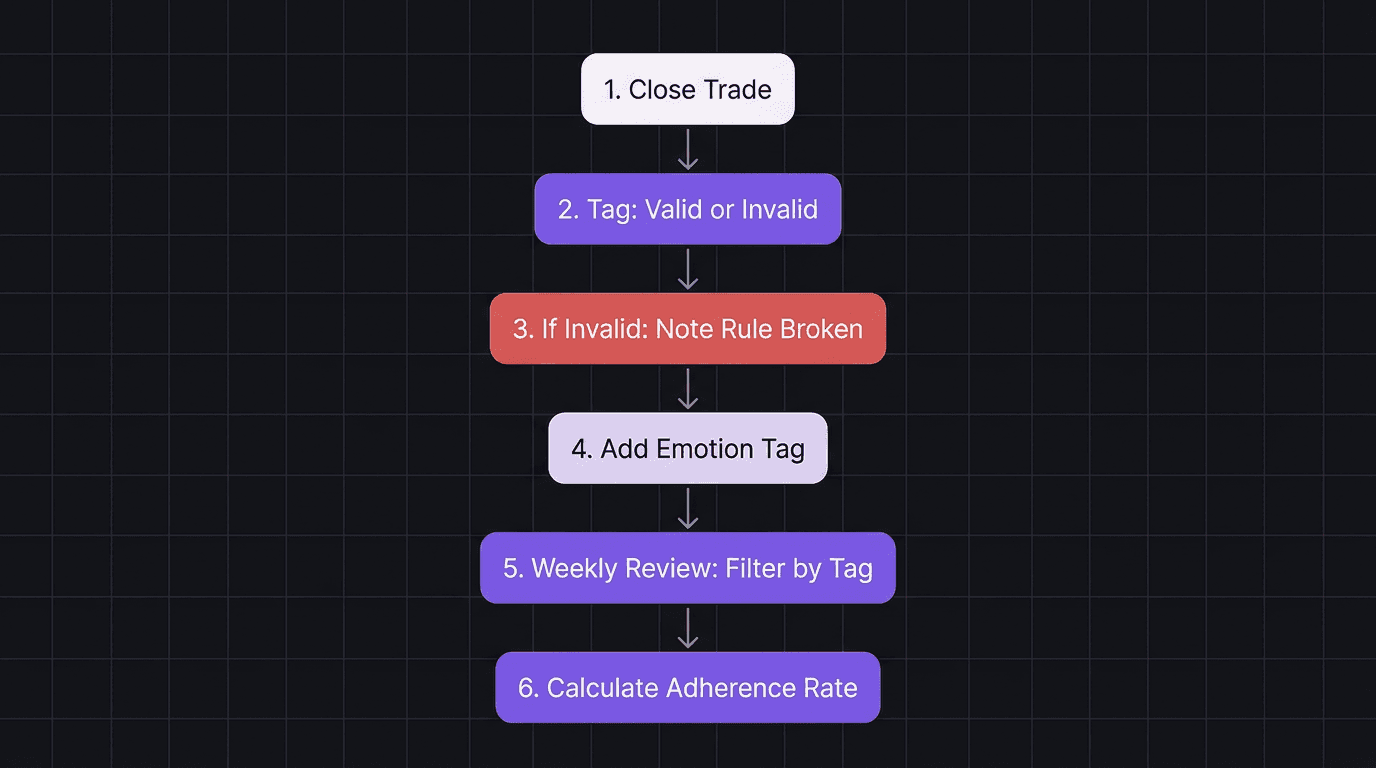
Step 2: Tag Immediately After Closing
Do not wait until your weekly review. Tag the trade right after you close it, while the context is still fresh. You need two tags per trade:
Classification: Valid or Invalid
If invalid, the specific rule broken: "Entered without confirmation," "Oversized position," "Traded outside session window," etc.
The second tag is critical. "Invalid" alone is not useful in review. You need to know which rule you broke so you can track whether it is the same rule every time.
Step 3: Add Emotion Context
This is optional but powerful. After the classification tag, note your emotional state during the trade:
Calm and focused
Anxious or hesitant
Frustrated (after a loss)
Overconfident (after a win streak)
Bored (no setup, traded anyway)
Over 20-30 trades, patterns emerge. You might discover that 80% of your invalid trades happen when you are frustrated after a loss. That is actionable. Now you know the trigger, and you can build a rule around it, like stopping after two consecutive losses.
Walkthrough: tagging in practice: You go long on EUR/USD at 1.0920 during New York session. Your plan called for a demand zone tap at 1.0915, but price only reached 1.0920 before bouncing. You enter anyway. Stop at 1.0890, target at 1.1020. Risk is 0.5%, correct size. Price hits your stop at 1.0890 for a 30-pip loss. At 0.1 lots, that is $30 (0.1 lots x $10/pip x 30 pips).
Classification: Invalid loss. Rule broken: Entered above the demand zone, price did not tap 1.0915. Emotion: Impatient, afraid of missing the move.
Without the tag, this looks like a normal loss. With the tag, it joins a growing pile of "entered too early" trades that your review can now address.
Why This Classification Changes Your Review Process
Most trade reviews start with the P&L column. Green trades get a glance. Red trades get analyzed. But this approach is backwards, it treats outcomes as the signal, when execution quality is the actual signal.
When you classify trades by plan adherence first, your review changes in three concrete ways.
You Stop Fixing the Wrong Problem
Without classification, a losing week looks like a strategy problem. "My setup does not work." "I need a better indicator." So you change your approach, start over, and repeat the cycle.
With classification, a losing week might reveal that 6 of your 8 losses were invalid, trades taken outside your plan. Your strategy was not the problem. Your execution was. That is a completely different fix: discipline rules, session limits, or a pre-trade checklist instead of a strategy overhaul.
You Catch Hidden Leaks
Invalid wins do not show up in a P&L review because they are green. But when you filter your journal for "invalid" tags, suddenly you see three off-plan winners last month, all oversized, all without confirmation. That is a leak. Those same habits are producing invalid losses that are costing more than the invalid wins earned.
You Build an Execution Score
Once you have a month of tagged trades, you can calculate a simple metric: valid trades divided by total trades. That is your plan adherence rate. A trader with a 90% adherence rate and a 35% win rate will outperform a trader with a 60% adherence rate and a 50% win rate over time, because the first trader is capturing their actual edge, while the second is mixing edge with noise.
Track this number monthly in your post-trade review. It is the clearest measure of whether your discipline is improving, independent of what the market is doing.
How EdgeFlo Helps You Classify Every Trade
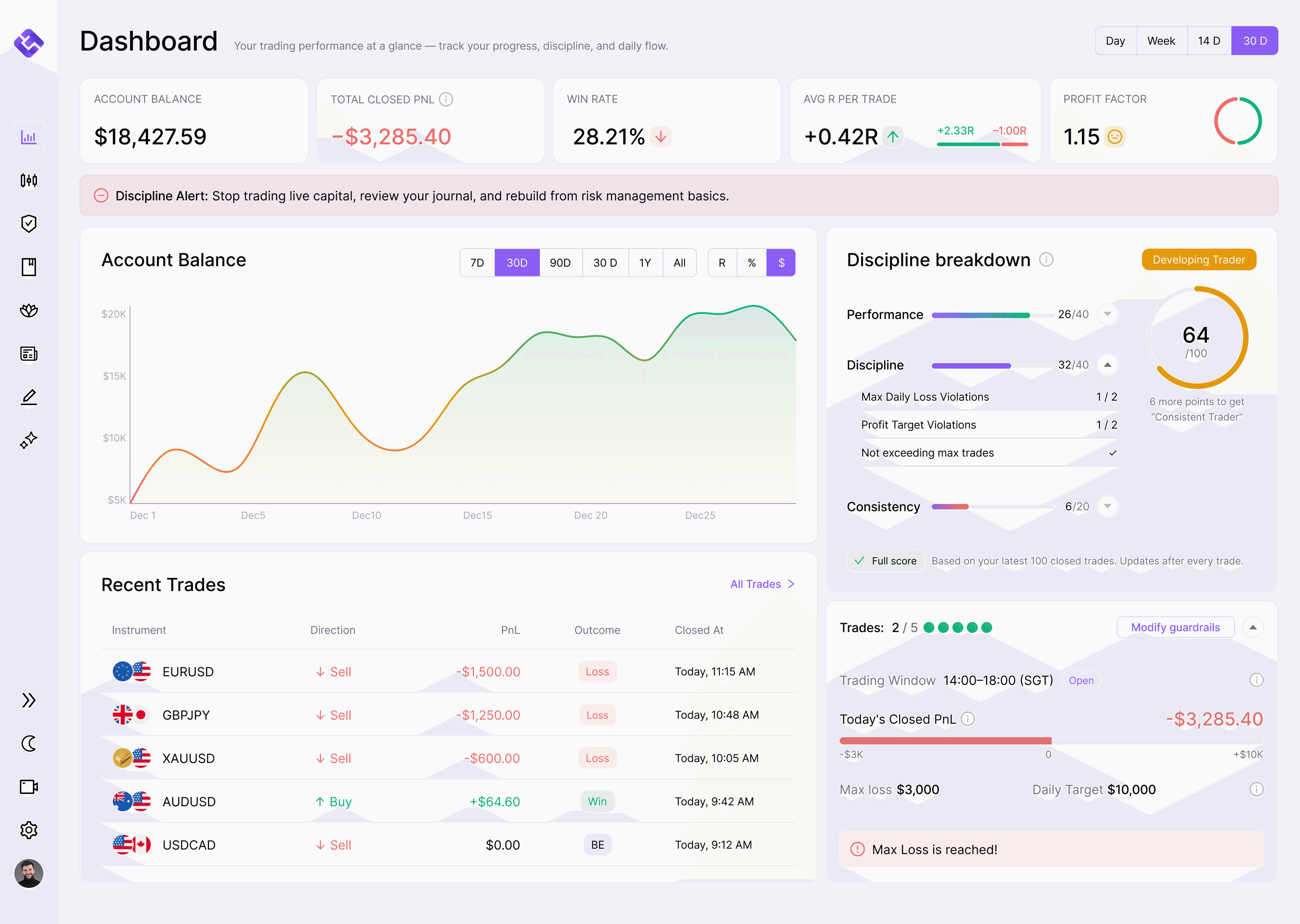
EdgeFlo's trading journal auto-imports your trades from your broker, so the raw data is already there, entry, exit, pair, size, P&L. You do not have to manually log the basics, which means your only job after each trade is adding the classification tag and the emotion tag.
The emotion tagging system is built into the journal workflow. After each trade closes, you tag your emotional state directly in the journal entry. Over time, EdgeFlo surfaces patterns between your emotional states and your trade outcomes, making it easier to spot the specific triggers behind your invalid trades.
When review day comes, you can filter your journal by classification tags and emotion tags together. Instead of scrolling through a spreadsheet and trying to remember what you were thinking three weeks ago, you have structured data that shows exactly where your execution broke down and why.
The Edge Brief
Receive Insights on trading psychology, discipline, and the behavioral patterns that create consistent traders from our Founder and the EdgeFlo team, delivered to your inbox.
Think different. Trade different.
Can a losing trade be considered a good trade?
What is an invalid trade in a trading journal?
How many trade classification tags should I use in my journal?
Why would I tag a winning trade as invalid?

Turn discipline on.
Every session.
EdgeFlo is the environment serious traders operate inside.
Start 7-Day Free Trial
Cancel anytime.
No long-term commitment.

Think Different, Trade Different.