

Trading Playbook: The One-Page Reference That Stops Improvising
Build a one-page trading playbook with entry models, minimum criteria, and screenshot examples so you stop improvising and start executing.
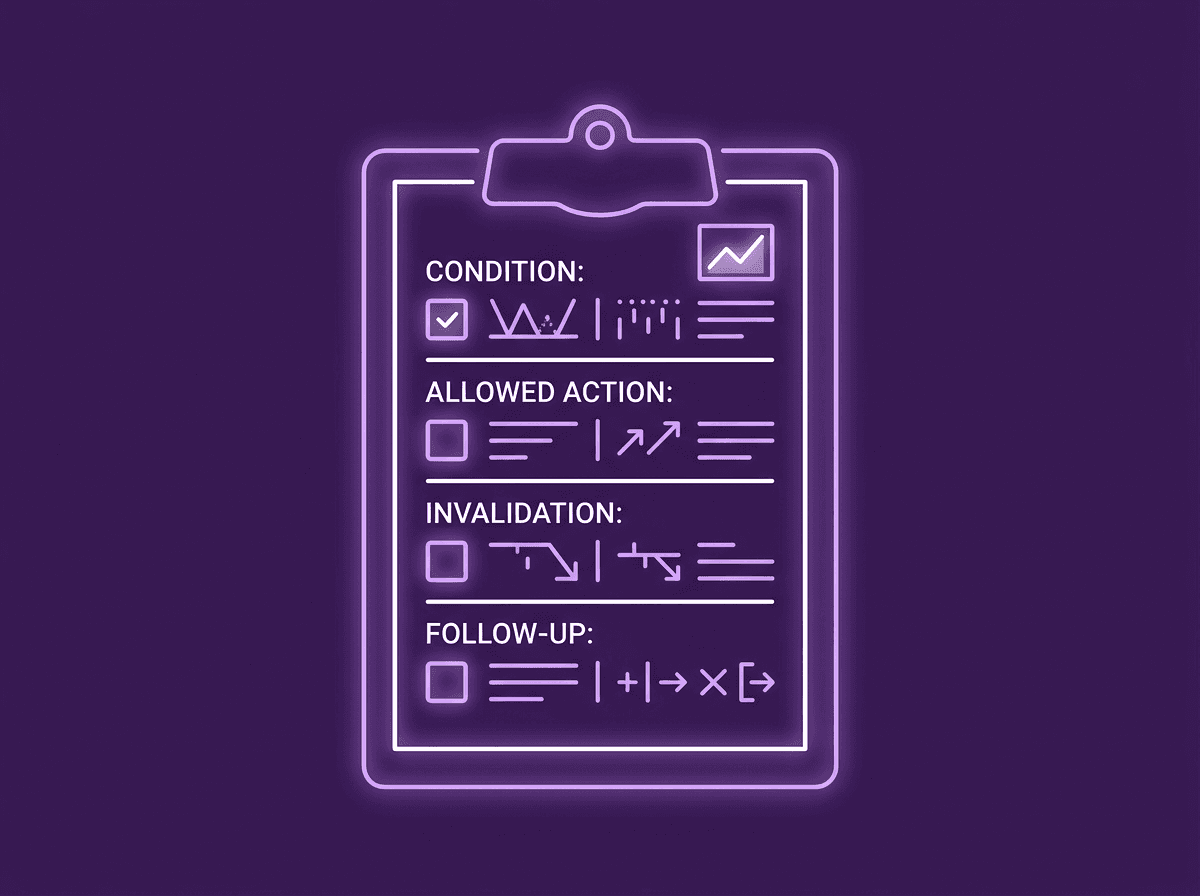
A trading playbook is a condensed, one-page reference that tells you exactly which setups to trade, what criteria must be present before entry, and how to manage each trade. It sits next to your chart. You check it before clicking buy or sell. No second-guessing, no improvising.
Most traders have a "plan" somewhere in a Google doc they haven't opened in weeks. A playbook is different. It is the operational layer, the part that actually prevents you from taking random trades on a Tuesday morning because the chart "looks good."
TL;DR
A trading playbook condenses your strategy into specific entry models with screenshots, minimum criteria, and trade management rules on one page.
Your full playbook holds everything (rules, confluences, A+ setup definitions). Your simplified playbook is the one-page version you check before every trade.
Entry models need screenshot examples, not text descriptions. You should be able to match what you see on the chart to a picture in your playbook.
Minimum criteria act as a filter that blocks low-quality setups before you ever reach the entry decision.
Update the playbook weekly during your trading review, replacing weaker examples with cleaner ones.
What a Trading Playbook Does (That a Plan Alone Doesn't)
A trading plan says things like "I trade with the trend using supply and demand zones." Fine. But when you're staring at GBP/USD during London session and price is pulling back into a zone, the plan doesn't tell you whether this specific setup qualifies.
That is the playbook's job. It answers: does this setup match one of my entry models? Are all minimum criteria present? What does an A+ version of this trade look like, and what does a B-grade version look like?
Think of it like a pilot's pre-flight checklist. The pilot already knows how to fly. The checklist makes sure nothing gets skipped when the pressure is on. Your playbook does the same thing for trade execution.
The plan owns the "why." The playbook owns the "what, exactly."
Why Text-Only Plans Fail Under Pressure
When you are watching price move and you feel the pull to enter, your brain starts rationalizing. "Close enough to the zone." "The trend is strong enough." A paragraph you wrote three weeks ago won't stop that.
A screenshot will. When your playbook shows you what an A+ setup looks like and the chart in front of you clearly doesn't match, the decision is obvious. You skip the trade.
This is why the best playbooks are visual, not just written. Rules are easy to bend. Pictures are hard to argue with.
Full Playbook vs Simplified Playbook
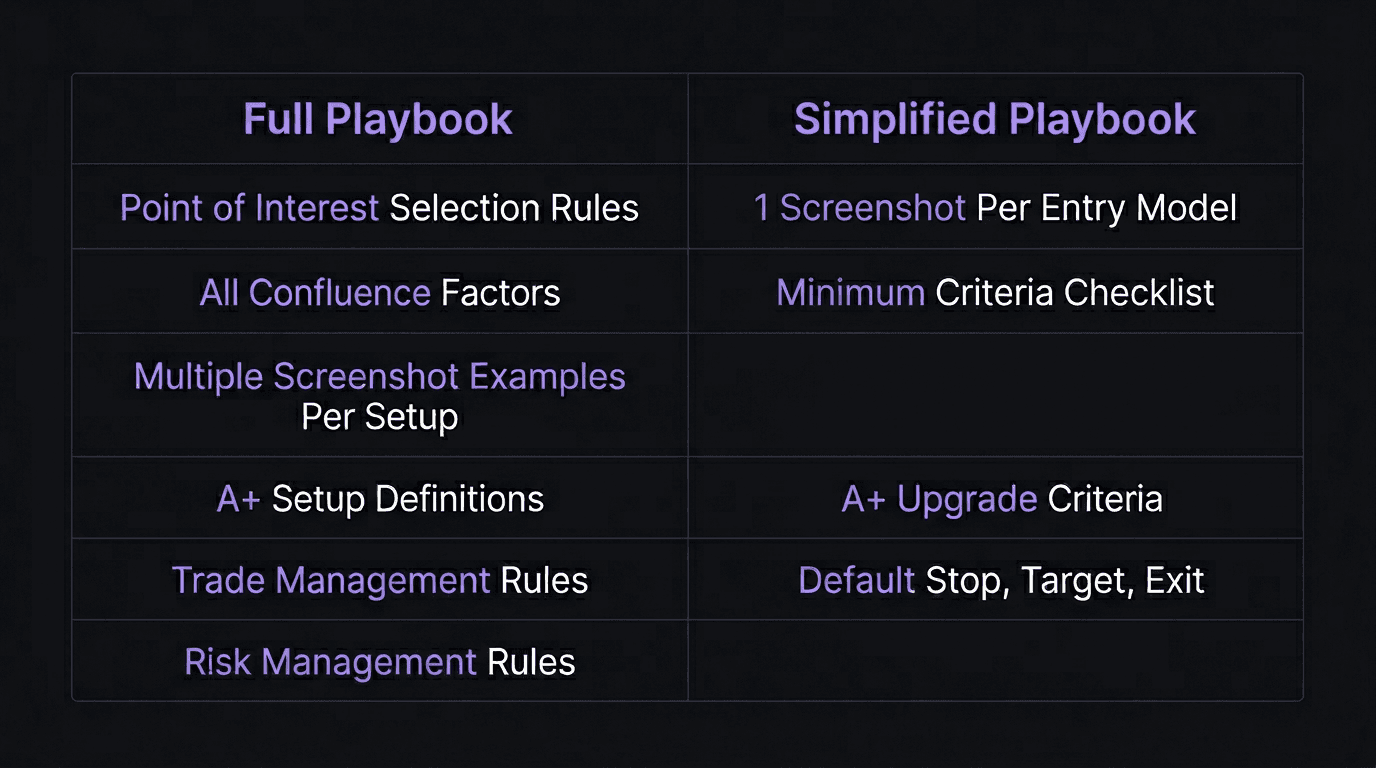
You actually need two versions of your playbook.
The full playbook is your complete reference. It includes:
Point of interest selection rules (which zones qualify, which don't)
All confluence factors you check (trend alignment, session timing, structure breaks)
Every entry model with multiple screenshot examples
A+ setup criteria (what makes a trade worth maximum risk)
Trade management rules (partial targets, trailing, when to move stop to breakeven)
Risk management rules tied to each setup type
The simplified playbook is one page. Maybe two. It's a distilled version you can scan in under 60 seconds. It contains:
Section | Content |
|---|---|
Entry models | Name + one screenshot each |
Minimum criteria | Bullet list of must-haves |
A+ criteria | What upgrades a trade from valid to high-conviction |
Management | Default stop, target, and exit rules |
The full playbook is your training manual. The simplified playbook is your field guide.
Ever gone through a losing streak and started taking trades that weren't in your plan? That's the moment the simplified playbook earns its place. Tape it to your desk if you have to.
Building Your Entry Model Library
An entry model is a repeatable pattern you trade. Not "I buy at support." An entry model is specific: the structure, the confirmation, the trigger, and the invalidation.
Here is an example of a properly defined entry model:
Walkthrough: The Breaker Block Retest (EUR/USD, 1H)
> Pair: EUR/USD, 1-hour chart > Setup: Price broke above a key swing high at 1.0920, creating a bullish market structure shift. The candle body that broke structure (the breaker block) sat between 1.0895 and 1.0910. > Entry trigger: Price retraced back into the breaker block zone during London session. A 15-minute bullish engulfing candle formed at 1.0900. > Stop loss: Below the breaker block at 1.0888 (12 pips). > Target: Previous swing high at 1.0960 (60 pips). Risk-to-reward: 5:1. > Outcome: Price hit target within 8 hours. The trade met all minimum criteria (trend-aligned, session-active, structure-confirmed).
That walkthrough becomes a screenshot in your playbook. You annotate the chart: mark the structure break, the zone, the entry candle, the stop, and the target. Now you have a visual reference you can compare against live charts.
Most traders need two to three entry models. Not ten. Not fifteen. Two or three that you have backtested across 30+ examples each. When you know your models that well, recognition becomes fast and confidence follows.
What Makes an A+ Setup?
Not every valid trade is worth the same conviction. Your playbook should define what separates a standard valid setup from an A+ setup.
A+ criteria might include:
Multiple confluences (trend, zone, session, liquidity sweep all aligned)
Clean price action at the point of interest (no choppy wicks, clear displacement)
Session timing matches your best historical performance window
No upcoming high-impact news within the next 2 hours
The A+ label matters because it affects how you size and manage the trade. A standard setup gets your default risk. An A+ setup might get slightly larger size or tighter management.
Minimum Criteria: The Filter Before Execution
Minimum criteria are your "must-have" list. If even one item is missing, you don't take the trade. Period.
This is the most powerful part of a trading playbook because it turns a judgment call into a checklist. Sound familiar? You see a setup that looks "pretty good" and you enter, only to realize later it failed two of your own rules.
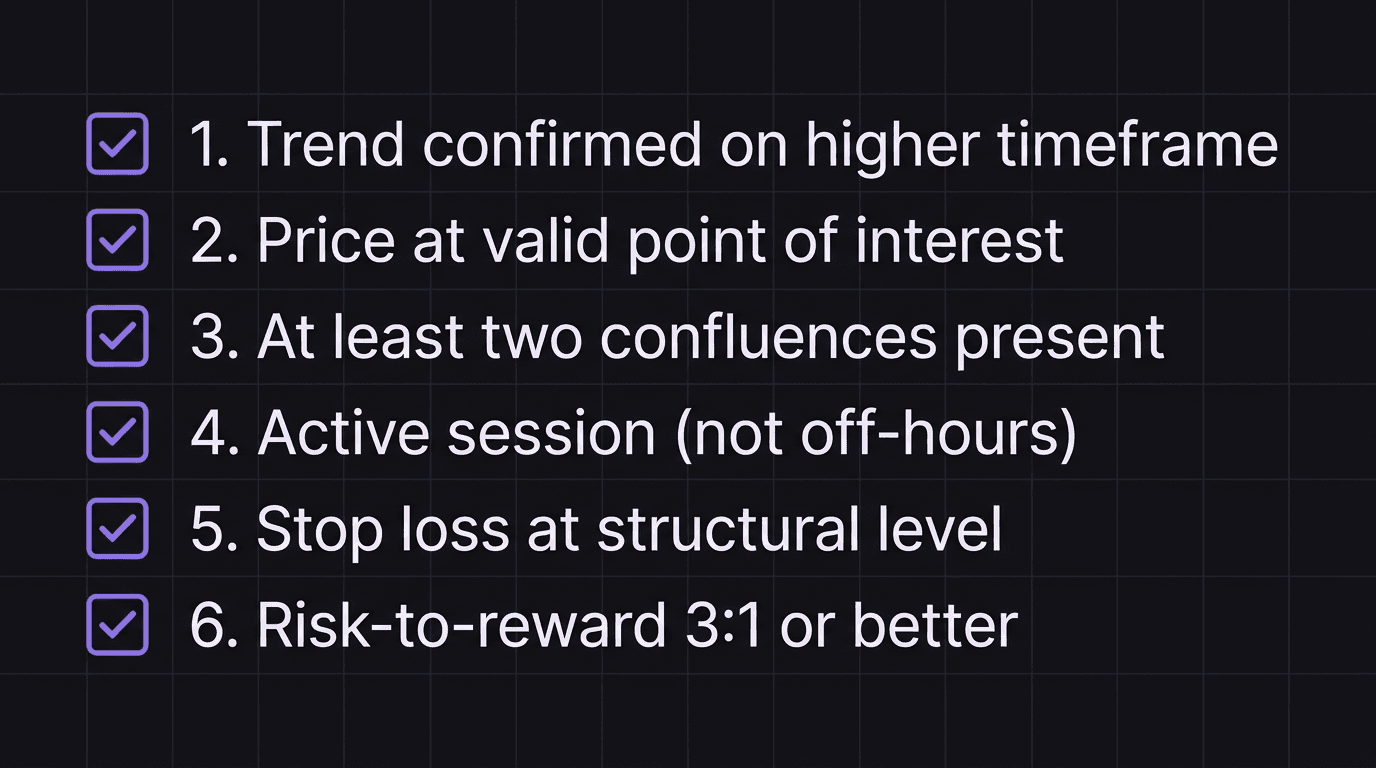
Here is an example minimum criteria list:
[ ] Trend direction confirmed on higher timeframe
[ ] Price is at a valid point of interest (supply/demand zone, breaker, order block)
[ ] At least two confluences present
[ ] Current session is active (not Asian session for a London model)
[ ] Stop loss is placed at a structural level, not an arbitrary pip count
[ ] Risk-to-reward is 3:1 or better before entry
If the trade checks all six boxes, it qualifies. If it misses even one, it doesn't. No exceptions. No "well, five out of six is close enough."
The discipline isn't in knowing the rules. It is in following the checklist when you're excited about a trade.
Walkthrough: Skipping a "Close Enough" Trade (GBP/JPY, 4H)
> Pair: GBP/JPY, 4-hour chart > Situation: Price pulled back to a demand zone at 190.80 during late New York session. The zone was valid, trend was bullish on the daily, and the entry candle looked strong. > Minimum criteria check: Five of six criteria met. The missing one: session timing. The trader's entry model performed poorly during late New York, and the pre-market routine had flagged low volatility conditions. > Decision: No trade. > What happened: Price wicked below the zone overnight, hitting where the stop would have been, then rallied to the target by London open. The trade would have been a loss despite looking "good enough." > Lesson: The minimum criteria filter blocked a losing trade. One missing checkbox was enough.
Screenshot Examples That Keep You Honest
Written rules are easy to reinterpret. Screenshots are not.
Every entry model in your playbook needs at least two screenshot examples: one A+ setup and one B-grade setup that still met minimum criteria. Ideally, include a third screenshot of a setup that looked valid but failed, with annotations showing what was different.
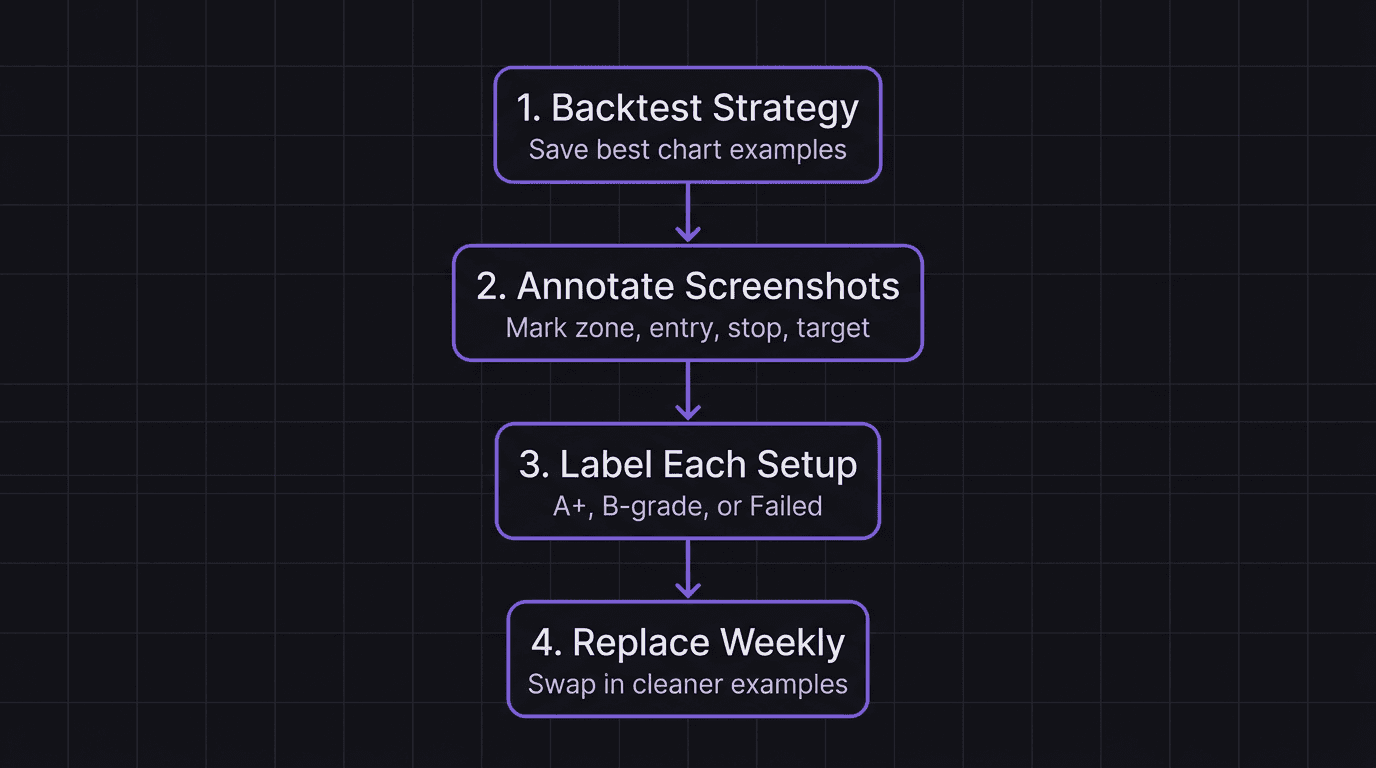
How to build your screenshot library:
Start with backtesting. As you backtest your strategy, save screenshots of the best examples.
Annotate clearly. Mark the zone, entry, stop, target, and any confluence markers. Use consistent colors.
Label the grade. Write "A+" or "B" on each screenshot so you can compare at a glance.
Replace weak examples over time. During your weekly journal review, swap in cleaner examples when you find them.
The goal is pattern recognition. After looking at 30 screenshots of your breaker block retest model, you start recognizing the pattern in live markets without thinking about it. That is what repetition builds.
Why screenshots over descriptions? Because your brain processes images faster than text. When you are in the middle of a session and price is moving, you don't have time to re-read a paragraph about what constitutes a valid retest. But you can glance at a screenshot and instantly see whether the current chart matches.
How EdgeFlo Stores Your Playbook
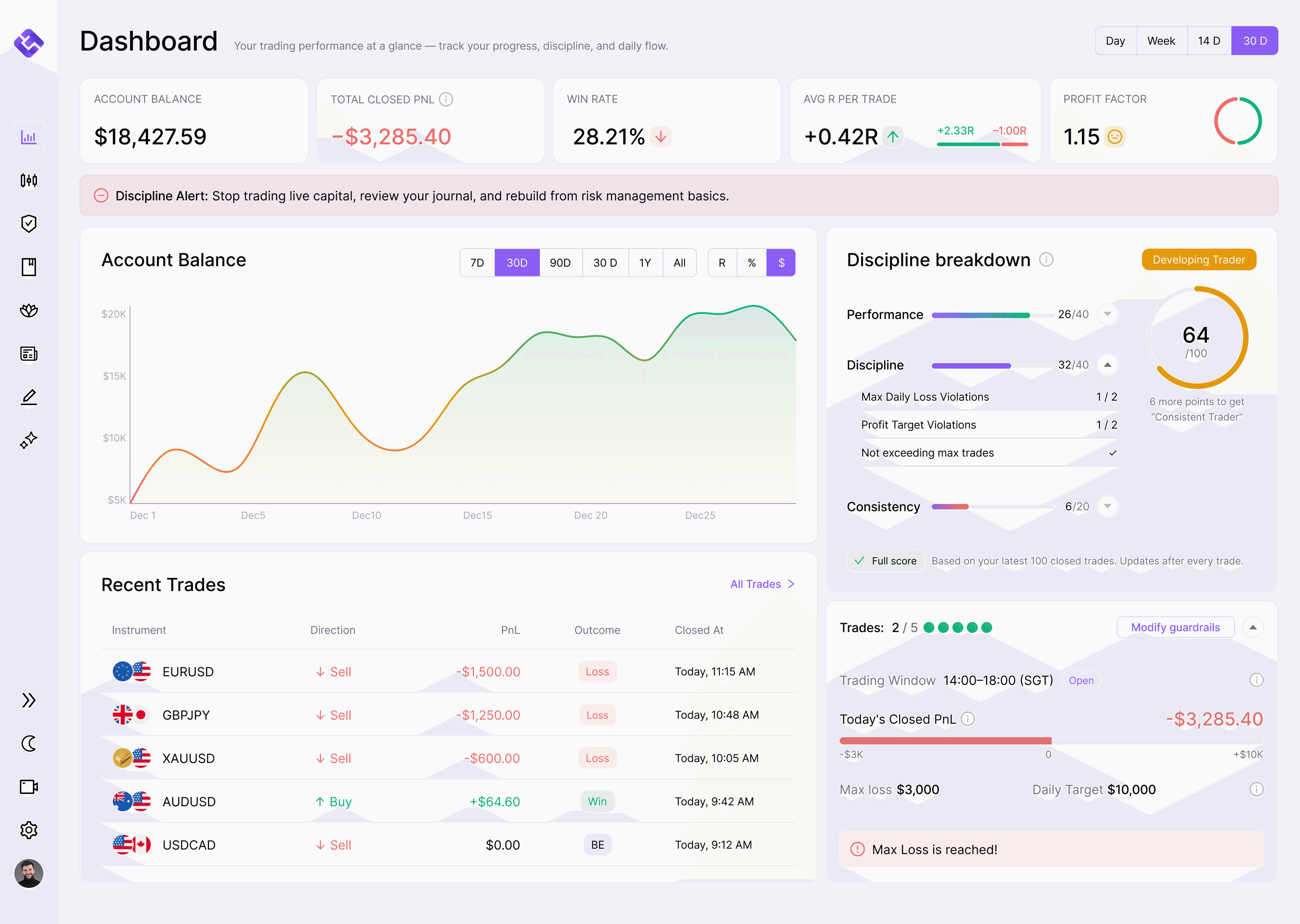
EdgeFlo includes an Entry Models section where you add screenshots and examples of valid setups directly inside the platform. Instead of keeping playbook images scattered across folders or pinned in a Discord channel, every entry model lives next to your chart, your journal, and your risk settings.
You add a screenshot, label it with the setup name and grade, and it becomes part of your pre-trade reference. Before entering a position, you can pull up your entry model library and compare. Does this chart match your A+ breaker block retest? Or are you forcing a trade that isn't there?
The playbook stays current because it connects to your trade journal. When you log a trade, you can reference which entry model it came from. Over time, you build data on which models perform best, which ones to retire, and which ones deserve more attention.
The Edge Brief
Receive Insights on trading psychology, discipline, and the behavioral patterns that create consistent traders from our Founder and the EdgeFlo team, delivered to your inbox.
Think different. Trade different.
What is a trading playbook?
How many setups should a trading playbook have?
What is the difference between a trading plan and a trading playbook?
How often should I update my trading playbook?

Turn discipline on.
Every session.
EdgeFlo is the environment serious traders operate inside.
Start 7-Day Free Trial
Cancel anytime.
No long-term commitment.

Think Different, Trade Different.