

Trading Journal Template: What to Write After Every Trade
Use this 6-field trading journal template to record what matters after every trade. Includes walkthrough, common mistakes, and automation tips.
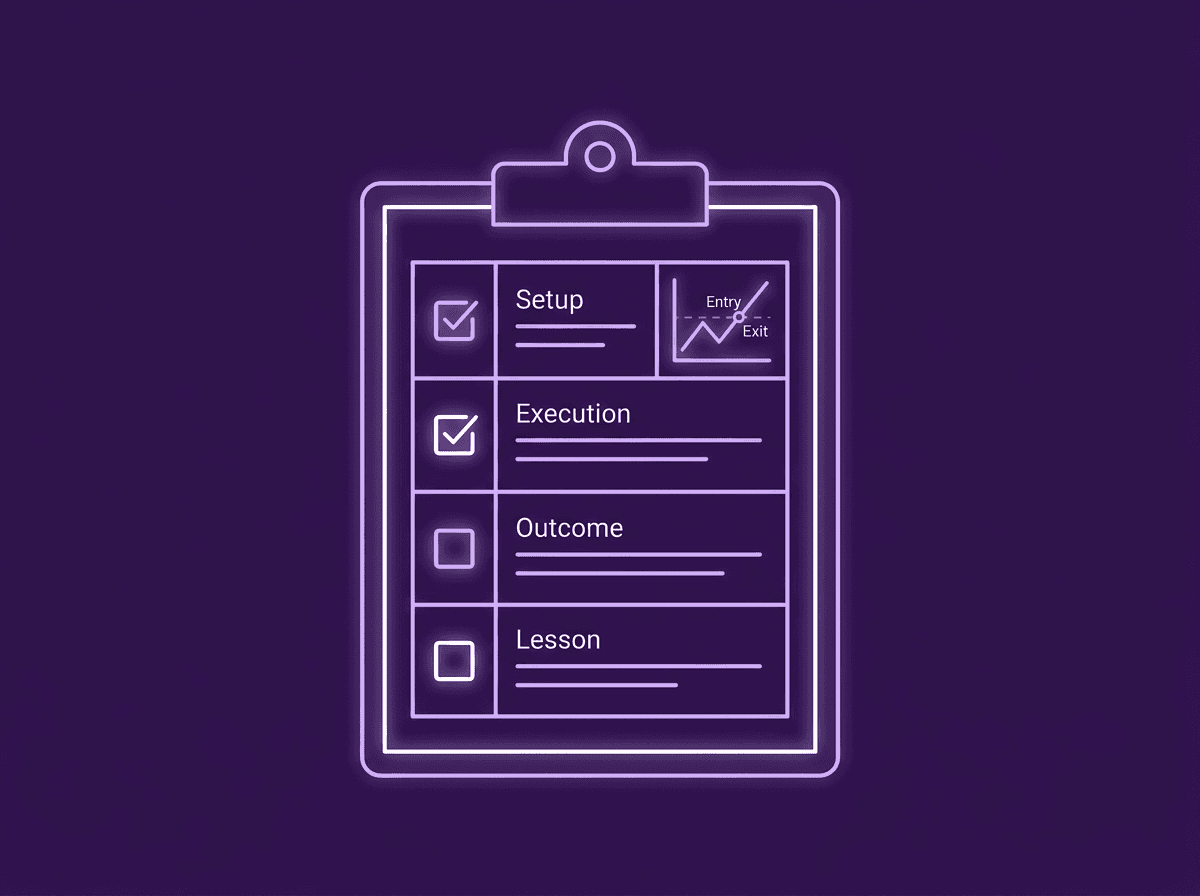
## Trading Journal Template: What to Write After Every Trade
You closed a trade. Maybe it hit your target. Maybe it stopped out. Either way, you move on to the next setup and forget about it within an hour.
That is how most traders operate. And it is exactly why most traders keep making the same mistakes for years.
The fix is not complicated. You need a trading journal template that tells you what to write down, keeps each entry short, and actually produces data you can review later. Not a diary. Not a novel. A structured record that takes less than five minutes per trade.
TL;DR
Most journals fail because they are either too detailed (you stop filling them in) or too vague (the data is useless).
A 6-field template covers everything you need: setup, plan, emotion, outcome, and lesson.
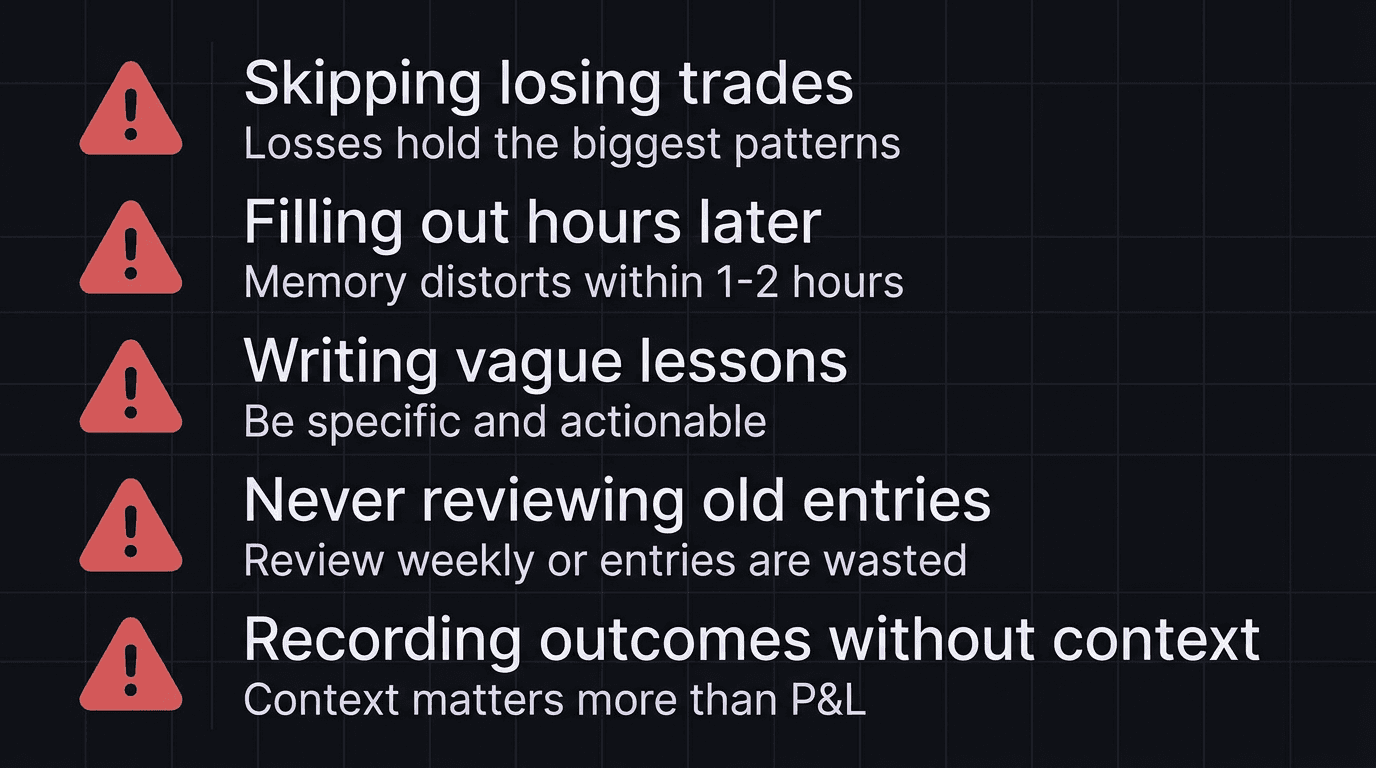
Fill it out within 30 minutes of closing, while the trade is still fresh.
The biggest mistake is skipping losing trades. Those entries are the most valuable ones.
Automation tools can handle the mechanical parts (importing fills, timestamps, P&L) so you can focus on the thinking parts.
Why Most Trading Journals Fail
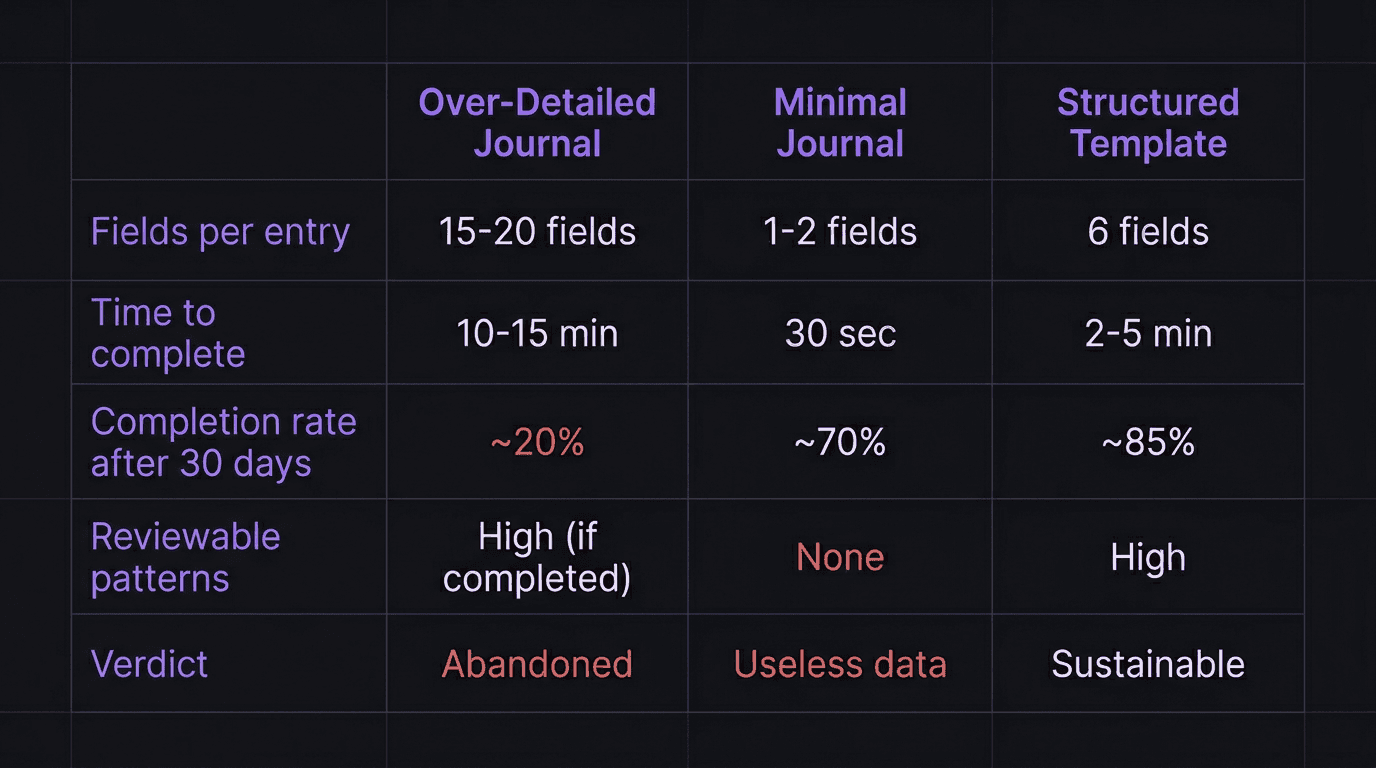
Traders quit journaling for one of two reasons. The journal asks for too much, or it asks for too little.
The "too much" version looks like this: a 20-field spreadsheet that wants your macro thesis, correlation analysis, volume profile notes, and three screenshots per trade. You fill it out diligently for a week. By week two, you are writing half the fields. By week three, you stop entirely. The friction killed the habit.
The "too little" version is just as common. A notebook where you scribble "bought EUR/USD, lost 30 pips." No entry reason. No exit plan. No emotional context. Three months later you read through it and learn nothing because there is nothing to learn from.
Both approaches share the same problem. They were not built to produce reviewable data. A journal is not a record of what happened. It is a tool that helps you spot patterns in your trading mistakes before they compound.
Winners track their trades. They journal their trades. They execute without guesswork. That is a principle that separates the top performers from everyone else. But the tracking only works when the template is specific enough to capture patterns and simple enough to sustain daily.
The 6-Field Template That Actually Works
Here is the template. Six fields. Nothing more.
Field 1: Date, Pair, and Timeframe What you traded and when. Example: "2026-03-04, GBP/USD, 1H chart." This is just metadata so you can filter and sort later.
Field 2: Entry Reason Why you entered. Not "it looked good." Be specific. Was it a break of structure? A retest of a demand zone? A moving average crossover on the 4H? Write one to two sentences that describe the setup in terms someone else could understand.
Field 3: Planned Exit (Target and Stop) Where were you planning to take profit, and where was your stop? This field locks in your plan before the outcome biases your memory. If you did not have a planned exit, write "no plan" and that alone tells you something important.
Field 4: Emotional State How did you feel before clicking the button? Confident, anxious, bored, revenge-minded, FOMO-driven? This is the field most traders skip. It is also the field that produces the most surprising patterns during your trading review process. After 50 entries, you might discover that every trade you took while feeling "bored" was a loser.
Field 5: Outcome What actually happened? Did you hit target, get stopped out, or close early? Include your P&L in pips or dollars. If you moved your stop or target during the trade, note that here too.
Field 6: One Lesson What did this trade teach you? Force yourself to write one sentence. Not "I need to be more patient." That is too vague. Try: "I moved my stop to breakeven too early and got wicked out before the move played out. Next time, give the 1H candle room to close."
That is the entire template. Every screenshot you take, every journal entry you write is you pursuing excellence as a student of the market. The key is making each entry specific enough to be useful during your weekly review.
How to Fill It Out (Walkthrough)
Here is a real example of what a completed entry looks like.
Say you just closed a trade on EUR/USD. You were watching the 4H chart and noticed price pulled back to the 1.0850 level, which had acted as support twice in the past week. The 1H chart showed a bullish engulfing candle right at that level. You entered long at 1.0855 with a stop at 1.0820 and a target at 1.0920.
The trade ran in your favor for about 16 hours, then pulled back. You got nervous and closed at 1.0890 for +35 pips instead of the planned +65.
Here is how you fill out the template:
Field | Entry |
|---|---|
Date/Pair/TF | 2026-03-03, EUR/USD, 4H + 1H |
Entry Reason | Pullback to 1.0850 support (tested 2x prior week). Bullish engulfing on 1H at level. |
Planned Exit | TP: 1.0920 (+65 pips). SL: 1.0820 (-35 pips). R:R = 1.86 |
Emotional State | Confident at entry. Became anxious during pullback around hour 12. |
Outcome | Closed early at 1.0890 (+35 pips). Price later hit 1.0915. Missed 25 pips. |
Lesson | Pullback was normal. Anxiety made me cut the winner short. Next time, set alert at TP and walk away. |
The whole entry took about four minutes. And look at what it captured: a pattern of anxiety-driven early exits. If this shows up in three or four more entries during your weekly review, you have found a concrete behavior to fix.
This is the kind of insight that feeds directly into your post-trade review. Without the emotional state field, you would just see "+35 pips" and think the trade went fine.
Common Mistakes That Make Journals Useless
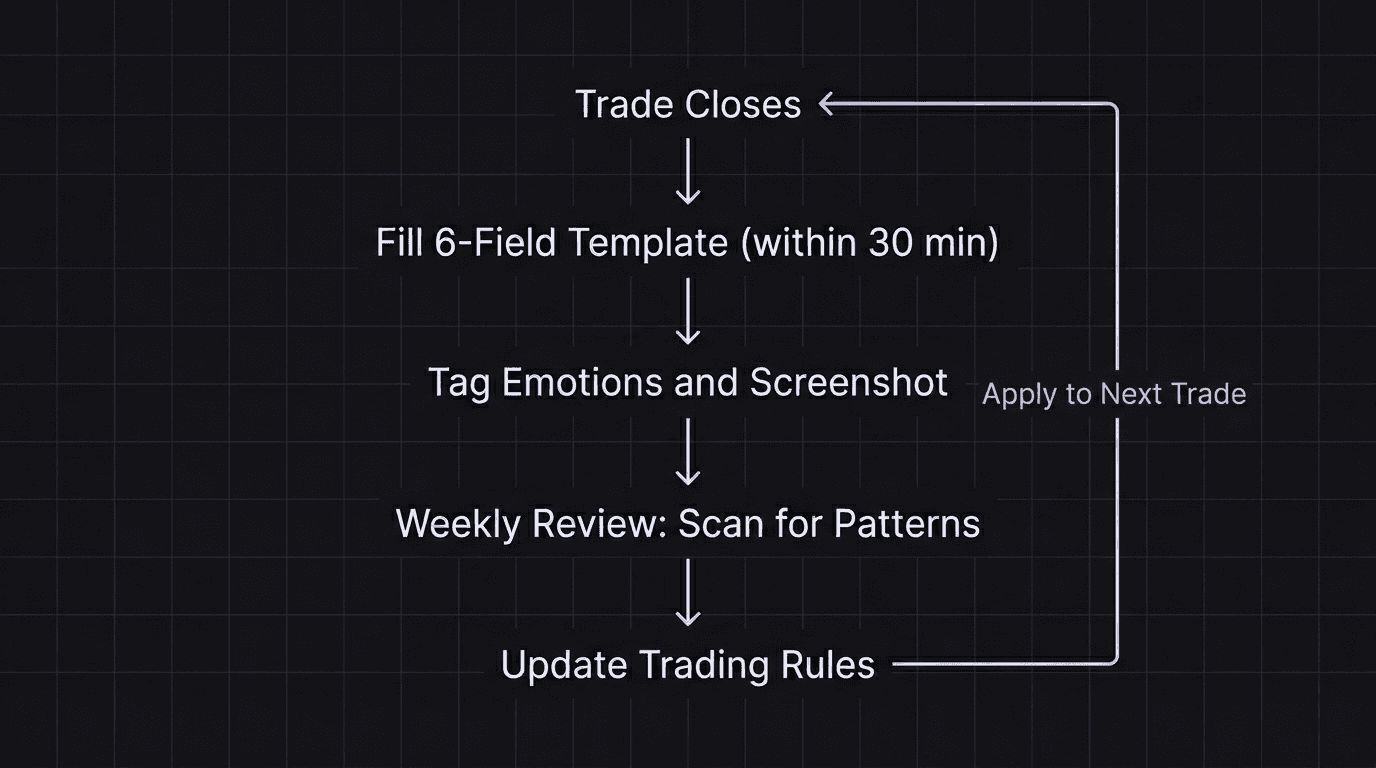
You can have the best template in the world and still get nothing from it. Here are the mistakes that kill journal value.
Skipping losing trades. This is the single biggest mistake. Losses are where the lessons are. If you only journal winners, you are documenting what you already know while ignoring what you need to fix. Your losing trades hold the patterns that are costing you money. Write them down.
Filling it out hours later. Memory distorts fast. By evening, you have already rewritten the story in your head. "I knew it was going to reverse" or "I was planning to exit there anyway." Fill out the template within 30 minutes of closing the trade while the emotions and reasoning are still raw.
Writing vague lessons. "I need to stick to my plan" is not a lesson. You already know that. A real lesson is specific and actionable: "I entered 15 minutes before NFP because I was afraid of missing the move. Rule: no new entries within 30 minutes of high-impact news." That second version gives you something to actually check against next time.
Never reviewing old entries. A journal you write but never read is just a diary. The value is in the review. Set a weekly slot (even 20 minutes works) to scan the past week's entries and look for patterns. Your journal habit only pays off when review is part of the routine.
Recording outcomes without context. Writing "+50 pips" or "-20 pips" tells you nothing about the quality of the trade. A trade that hit your target but violated three of your rules is not a good trade. A trade that stopped out but followed your plan perfectly is not a bad one. Record the context, not just the number.
How EdgeFlo Automates the Boring Parts
Half the work in journaling is mechanical. Copying fill prices, timestamps, calculating P&L, attaching screenshots. That is time you spend on data entry instead of analysis.
EdgeFlo auto-imports your trades directly into your journal. The pair, entry price, exit price, P&L, and timestamps populate automatically. You open the entry and the numbers are already there. All you do is fill in the thinking parts: your entry reason, emotional state, and the lesson. That cuts a five-minute entry down to about two minutes. Emotion tagging is built into every entry, so you can filter your entire history by how you felt and spot those anxiety or FOMO patterns fast.
If you are on the Plus plan, you also get a weekly AI report that analyzes your journal entries for recurring patterns. It is like having a trading dashboard that reads your journal for you and flags the behaviors you might miss on your own. The backtesting tools, journals, and trade templates work together to give you a complete picture of your performance over time.
The Edge Brief
Receive Insights on trading psychology, discipline, and the behavioral patterns that create consistent traders from our Founder and the EdgeFlo team, delivered to your inbox.
Think different. Trade different.
What should I write in my trading journal after every trade?
How long should a trading journal entry take?
Do I need to journal every single trade?
Can I use a spreadsheet as a trading journal?

Turn discipline on.
Every session.
EdgeFlo is the environment serious traders operate inside.
Start 7-Day Free Trial
Cancel anytime.
No long-term commitment.


Think Different, Trade Different.