

Trading Review Process: Catch Mistakes Before They Compound
A weekly trading review catches patterns your daily journal misses. Use this checklist to review trades, spot mistake loops, and fix them before they drain your account.
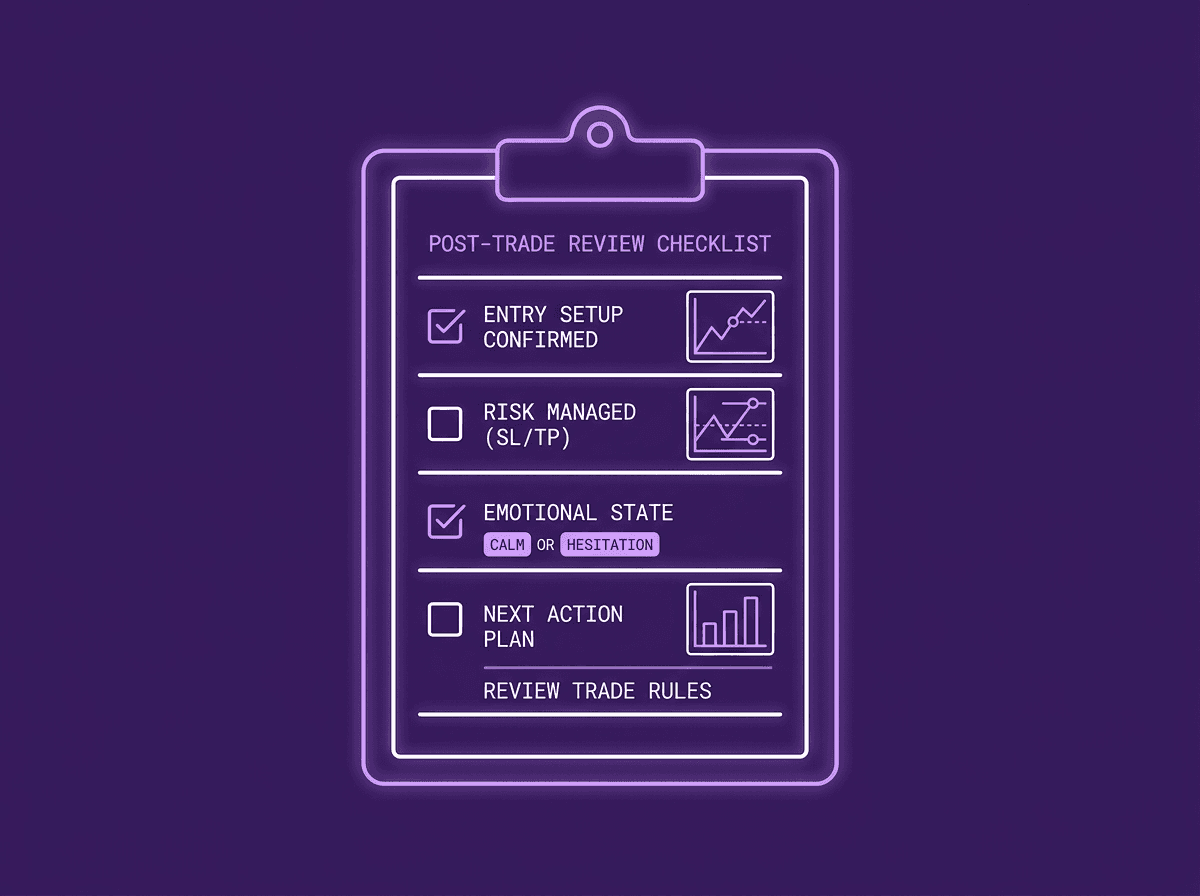
A trading review process is a structured weekly session where you look back at your trades, find repeated mistakes, and adjust before those mistakes compound into real account damage. Most traders journal daily but never zoom out. The daily entry tells you what happened on one trade. The weekly review tells you what keeps happening across ten or twenty trades. That pattern-level view is where the fixes live.
Without a review loop, the same errors repeat week after week. You take the same revenge trade on Friday that you took last Friday. You hold the same loser past your stop. The journal captured it both times, but nothing changed because you never sat down and connected the dots.
TL;DR
Weekly reviews catch mistake patterns your daily journal entries miss individually.
Focus on three metrics: win rate by setup, average R:R, and repeated errors.
Monthly and quarterly reviews add a strategy-level layer on top of weekly habit checks.
A 30-minute checklist beats a 2-hour unstructured data dive every time.
The goal is not perfection. It is improving one percent every single day.
Why Weekly Reviews Beat Daily Journaling Alone
Daily journaling is non-negotiable. You already know that (and if you don't, here is how to journal trades properly). But daily entries have a blind spot: they capture individual trades in isolation.
Your trading journal might show that you lost on EUR/USD Tuesday, won on GBP/USD Wednesday, and broke even Thursday. Each entry makes sense on its own. But the weekly review is where you notice that every Tuesday loss came from the same setup taken during low-volume hours. That is not visible from any single entry.
Think of it like a doctor reading one blood pressure reading versus tracking it over a month. One reading tells you almost nothing. A month of readings tells you everything.
The weekly review forces you to ask questions your daily journal never will: What is my win rate this week compared to last week? Did I follow my rules more or less? Am I taking the same bad trade repeatedly?
Sound familiar? Most traders skip this step. They journal religiously but never review the journal. The data sits there, untouched, while the same trading mistakes keep compounding.
What to Review Each Week (Checklist)
Keep your weekly review to 30-45 minutes. Longer than that and you are either tracking too many metrics or going in without structure.
Here is the checklist, question by question:
How many trades did I take? Compare to your plan. If you planned 5-8 and took 14, that is your first red flag.
What was my win rate this week? Break it down by setup type, not just overall. You might be 60% on breakout entries and 20% on counter-trend plays.
What was my average R:R on winners vs. losers? If your winners average 1.5R but your losers average 2.3R, you are holding losers too long.
Did I follow my entry rules on every trade? Count the rule-break trades. Even if they won.
What was my biggest mistake this week? Not the biggest loss. The biggest rule violation.
Did the same mistake appear more than once? If yes, this becomes next week's single focus.
What is one thing I will do differently next week? Just one. Not five.
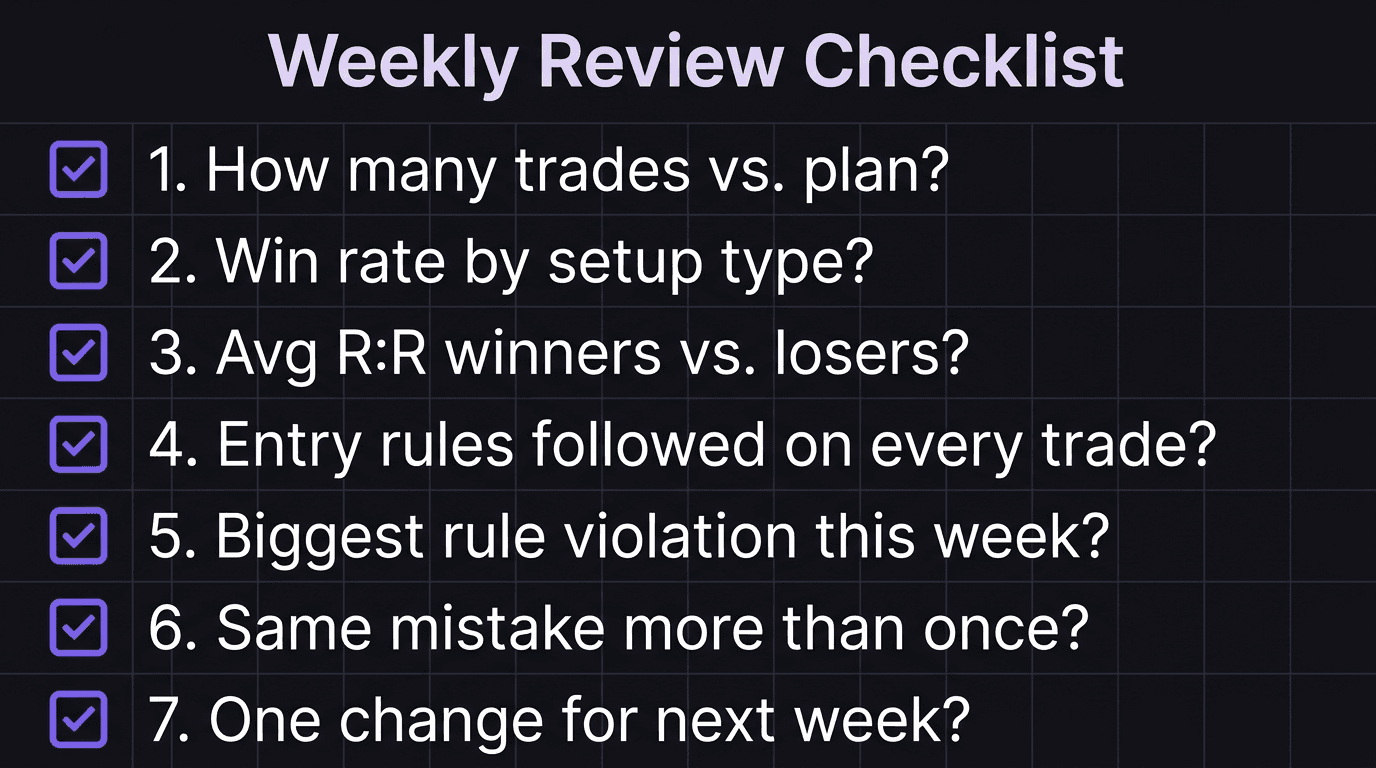
That last question is the most important one. One focus per week. Not a list of ten improvements. One.
Walkthrough: A Real Weekly Review
> You trade GBP/USD and EUR/USD on the 15-minute chart during London session. This week you took 11 trades. Your plan said 6-8. Win rate: 45% overall, but 60% on your A+ setup (liquidity sweep into demand) and 17% on your B setup (break-and-retest during New York overlap). Average winner: 2.1R. Average loser: 1.8R. > > The review reveals two things: (1) you overtrade by 3-4 trades per week, and (2) your B setup is bleeding money. The fix for next week is simple: drop the B setup entirely for one week. Only take the A+ setup. If your win rate jumps and your trade count drops, you have your answer. > > That is a 20-minute review that saves you a month of slow account bleed.
How to Read Your Trading Data Without Overthinking
Data paralysis is real. You open your journal, see fifty columns, and close it. The solution is not more data. It is less.
Track three numbers. That is it.
Win rate by setup type. Not overall win rate. By setup. This tells you which entries are working and which are dead weight.
Average R:R. Winners should be larger than losers. If they are not, you are either cutting winners short or holding losers too long.
Rule adherence rate. What percentage of trades followed your plan? This is the only metric that measures discipline directly.
Everything else is noise until these three are healthy. Once they are stable for a month, add one more metric. Not before.
Ever spent an hour analyzing your trades and walked away more confused than when you started? That is a sign you are looking at too much, not too little.
The Monthly and Quarterly Layer
Weekly reviews catch tactical mistakes. Monthly and quarterly reviews catch strategic ones.
Monthly review (60-90 minutes):
Look at your three weekly metrics over four weeks. Are they trending up, down, or flat?
Identify your best and worst week. What was different?
Check if your backtesting results still match your live performance. Divergence means something changed.
Decide whether to keep, adjust, or drop each setup you traded.
Quarterly review (2-3 hours):
Zoom out. Is your overall strategy working in the current market?
Review total account growth (or drawdown) over 12 weeks.
Compare your performance across different market conditions (trending vs. ranging, high volatility vs. low).
Set or adjust your goals for the next quarter.
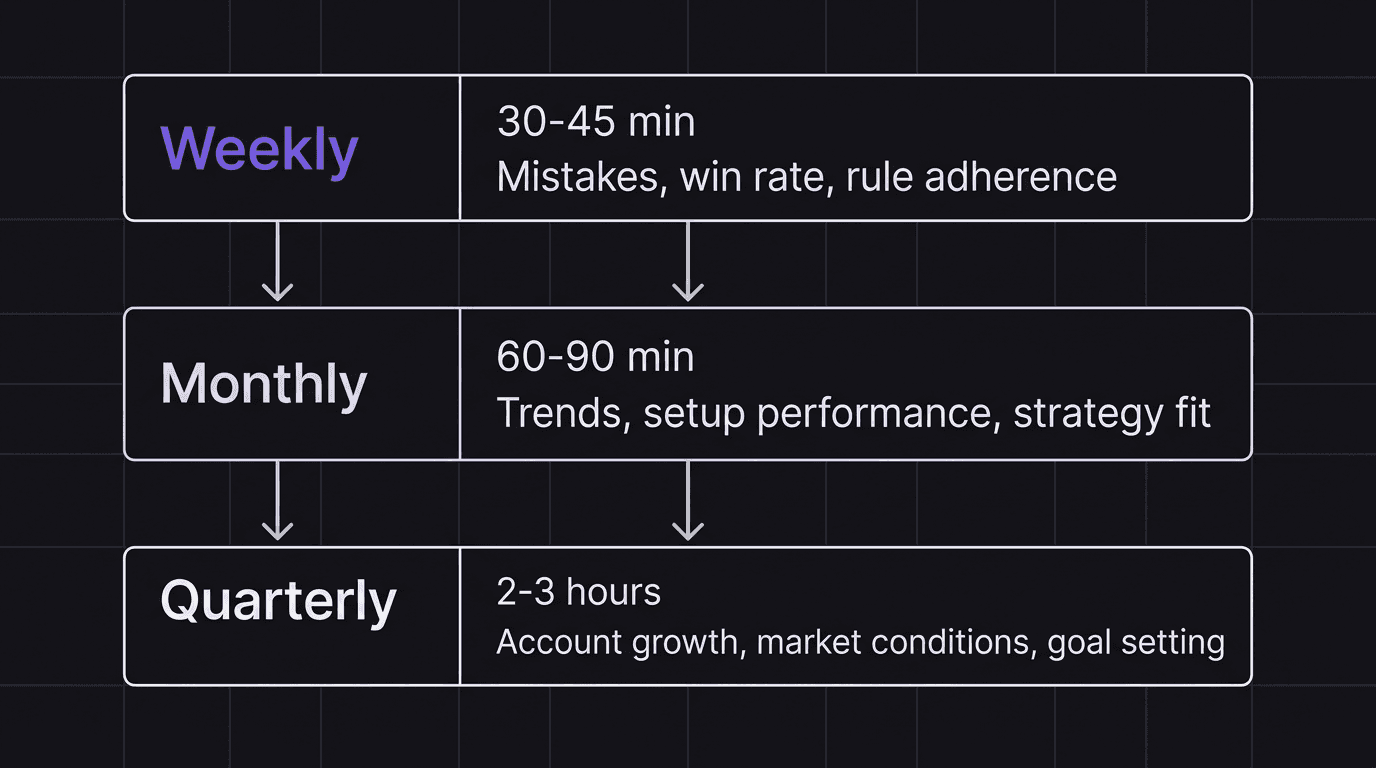
The source of this framework is simple: wins tracking and asking yourself "how can I improve" daily, then rolling those answers up into weekly, monthly, and quarterly layers. The goal is to improve one percent every single day. Not transform overnight.
Common Review Mistakes That Waste Time
Reviewing only losses. Wins carry data too. A winning trade that broke your rules teaches you nothing good. A winning trade that followed your plan perfectly tells you what your edge looks like.
Changing everything at once. You find three problems in your review. So you overhaul your entire plan on Sunday night. By Wednesday you have no idea what is working because you changed too many variables. Fix one thing per week.
Skipping the review after a good week. Good weeks are the most important ones to review. They tell you what you did right. If you only review bad weeks, you only know what to avoid, never what to repeat.
Tracking vanity metrics. Total P&L is the least useful number in your review. A trader who made $500 this week on 20 trades with a 30% win rate is in worse shape than someone who made $200 on 6 trades with a 67% win rate. Process metrics beat outcome metrics.
Does this sound like revenge trading in disguise? Sometimes it is. The urge to "fix everything now" after a bad review comes from the same emotional place as revenge trading: frustration turning into impulsive action.
How EdgeFlo Automates the Review Loop
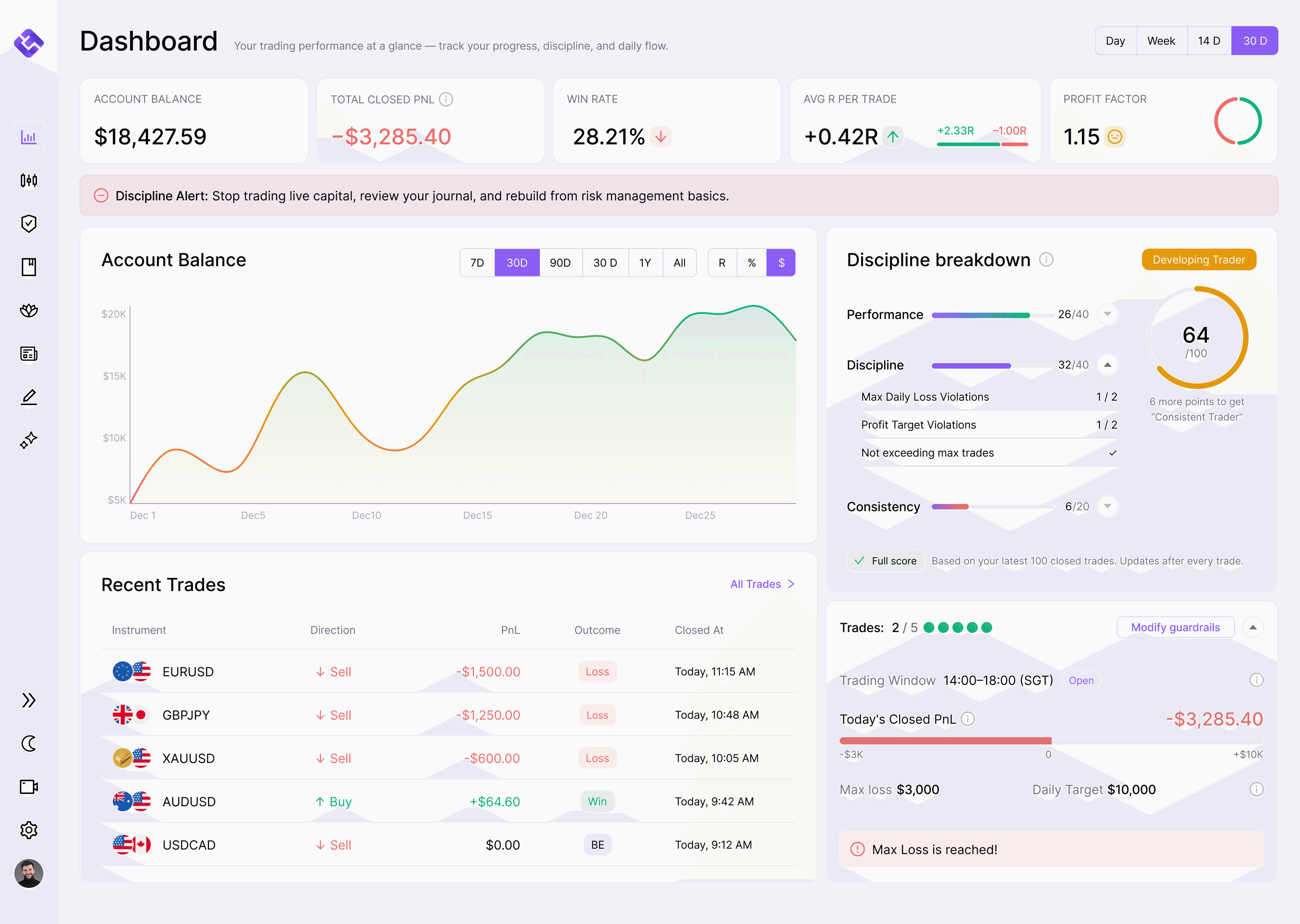
EdgeFlo's journal auto-imports your trades with metrics, chart markups, entry logic, trade management notes, mistakes, and lessons. You do not have to manually log each trade. The data is already there when you sit down for your weekly review.
The Weekly AI Report (Plus plan) summarizes what worked, what didn't, any discipline issues, and gives you one focus for the following week. That single-focus recommendation mirrors the checklist approach above: fix one thing, then move on.
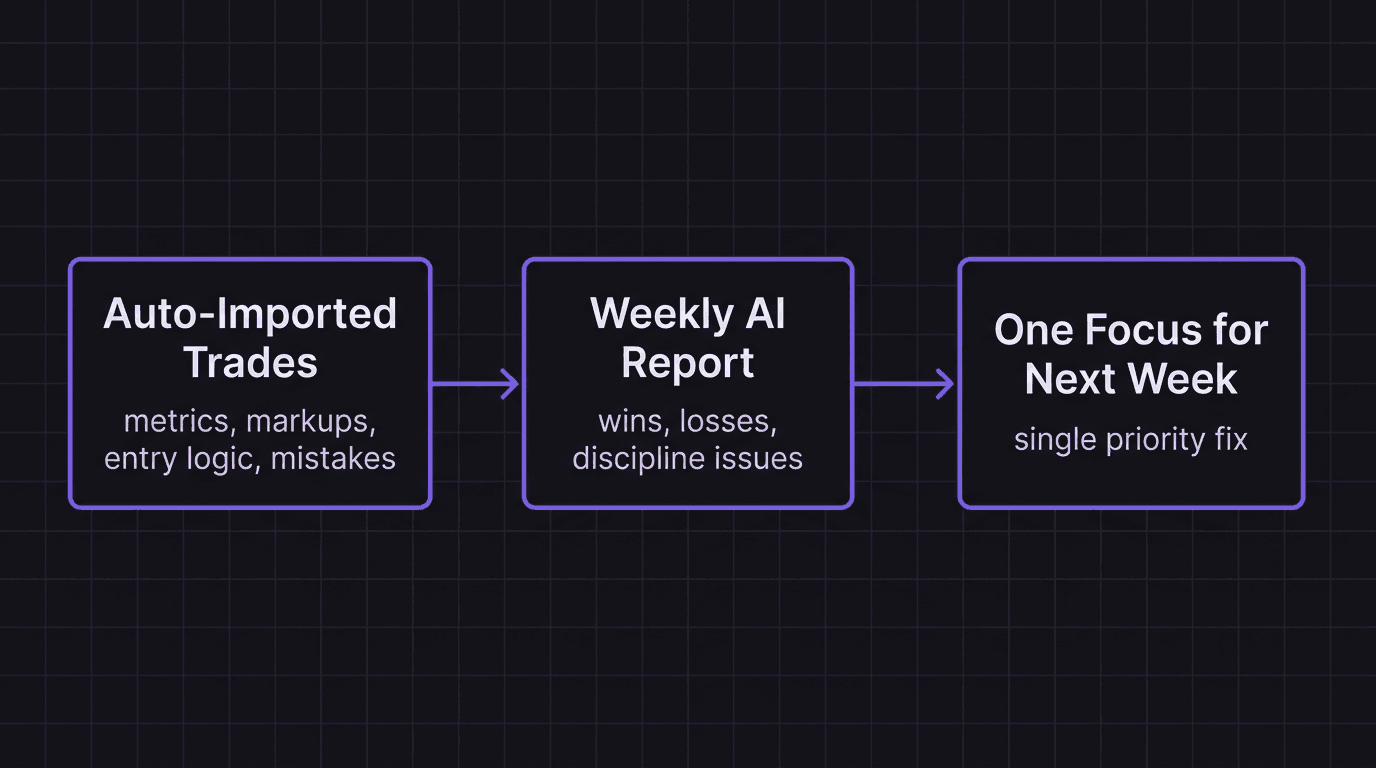
Instead of spending 20 minutes gathering data before your review even starts, the data is organized and waiting. Your 30-minute review stays 30 minutes, and you spend that time thinking about patterns instead of copying numbers from screenshots.
The Edge Brief
Receive Insights on trading psychology, discipline, and the behavioral patterns that create consistent traders from our Founder and the EdgeFlo team, delivered to your inbox.
Think different. Trade different.
How often should I review my trades?
What should I look for in a trading review?
How long should a weekly trading review take?
Can I just review my trades daily instead of weekly?

Turn discipline on.
Every session.
EdgeFlo is the environment serious traders operate inside.
Start 7-Day Free Trial
Cancel anytime.
No long-term commitment.

Think Different, Trade Different.