

Why Being Early Is Just as Bad as Being Wrong in Trading
Entering too early costs you just as much as being wrong. Learn the three timing mistakes that drain accounts and why reacting beats anticipating every time.
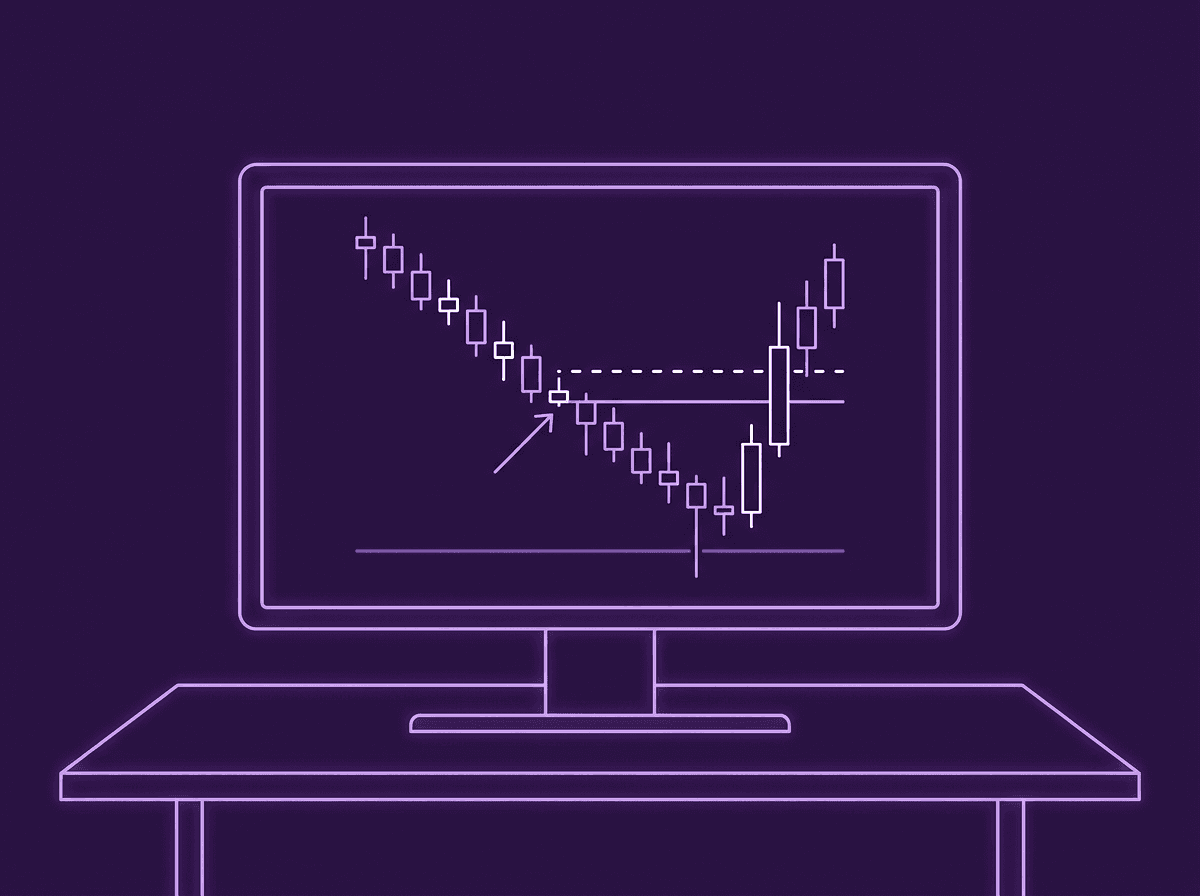
Being early on a trade is functionally identical to being wrong. You read the direction correctly, you identify the right zone, and you enter before the setup actually confirms. Price moves against you, stops you out, and then goes exactly where you expected. The trade idea was right. The timing killed it. There is an old Wall Street saying that captures this perfectly: being early is just as bad as being wrong. For retail traders, it might be worse, because a wrong trade teaches you to change your analysis, but an early trade tricks you into thinking your analysis failed when it did not.
TL;DR
Entering before the liquidity sweep means your stop loss becomes the fuel for the move you wanted to trade.
Trading during the Asian session or before your kill zone opens produces low-probability entries with maximum frustration.
Front-running confirmations (entering before the break of structure) is the most common timing error for intermediate traders.
Anticipation loses to reaction. Wait for price to show you the sweep, the V-shape, and the structural break before clicking.
Fewer trades at the right time consistently outperform more trades at random times.
The Cost of Being Early
Early entries are expensive in a way that does not show up on your P&L as a category. Your journal says "loss" and you might label it a bad setup. But the setup was fine. The timing was not.
Here is what an early entry actually costs you:
First, the immediate loss. You entered before confirmation, price moved against you, and your stop got hit. That is a real dollar amount subtracted from your account.
Second, the missed opportunity. After stopping you out, price goes where you predicted. But you are already out of the trade, and now you are emotionally compromised. Do you re-enter? Most traders either do not (they are shell-shocked from the loss) or they re-enter impulsively without waiting for a new confirmation, compounding the problem.
Third, the psychological damage. You were right about the direction. You feel cheated. That feeling breeds revenge trading, FOMO, and the dangerous belief that you need to "get your money back." One early entry can spiral into three or four bad trades in a single session.
The fix is not better analysis. Your analysis was correct. The fix is better timing.
Three Timing Mistakes That Drain Accounts
Mistake 1: Entering Before the Sweep
You see price approaching a demand zone. Your analysis says buy. You enter immediately when price touches the zone, placing your stop just below it. Price then sweeps through the zone, takes your stop, grabs the liquidity from your stop loss and dozens of others, and reverses.
The correct play: wait for price to sweep through the zone. Let it take the liquidity below. Then watch for the V-shaped reaction and structural confirmation. Enter after the sweep, not before it.
Walkthrough: Before vs After the Sweep
GBP/USD is in an uptrend. Demand zone sits at 1.2720 to 1.2735. Equal lows at 1.2715 create a liquidity pool below.
Early entry (the mistake): You enter long at 1.2730 with a stop at 1.2710. Price drops to 1.2698, sweeping below the equal lows and your stop. Loss: 20 pips. Price then reverses from 1.2698 and rallies to 1.2810.
Patient entry (the fix): You wait. Price drops to 1.2698, sweeping the equal lows. A strong bullish candle closes back above 1.2720 at 1.2725. You enter long at 1.2728 with a stop at 1.2693. Price rallies to 1.2810.
Same pair. Same zone. Same direction. The early entry lost 20 pips. The patient entry captured 82 pips at 2.34R. The difference was 15 minutes of waiting.
Mistake 2: Trading During the Asian Session
Your analysis is done at 10:00 PM EST. You see a clean setup. You enter. Price moves 5 pips in your direction, then chops sideways for 4 hours. You fall asleep. When London opens, price sweeps the opposite direction, hits your stop, then goes where you originally expected.
The Asian session has low volume and no institutional participation. Your setup might be correct, but executing it 5 hours before the ignition arrives means your stop gets eaten by noise before the real move starts.
The solution is simple: do your analysis during Asia, but do not execute until your kill zone opens. Mark your levels, set your alerts, and close the platform. Come back when London or New York starts.
Mistake 3: Front-Running Confirmations
This is the intermediate trader's version of being early. You know you need a break of structure to confirm the entry. You see price approaching the area where the break should happen. Instead of waiting for the candle to close below the level, you enter "early" to get a better price.
Price pulls back, the break does not happen, and you are stuck in a trade with no confirmation. Sometimes the break comes later and you luck out. Other times, the pullback continues and you take a full loss on a trade that never confirmed.
Waiting for the confirmation candle to close is not optional. It is the difference between a confirmed trade and a gamble. The slightly worse entry price from waiting is the cost of certainty.
Why Anticipation Loses to Reaction
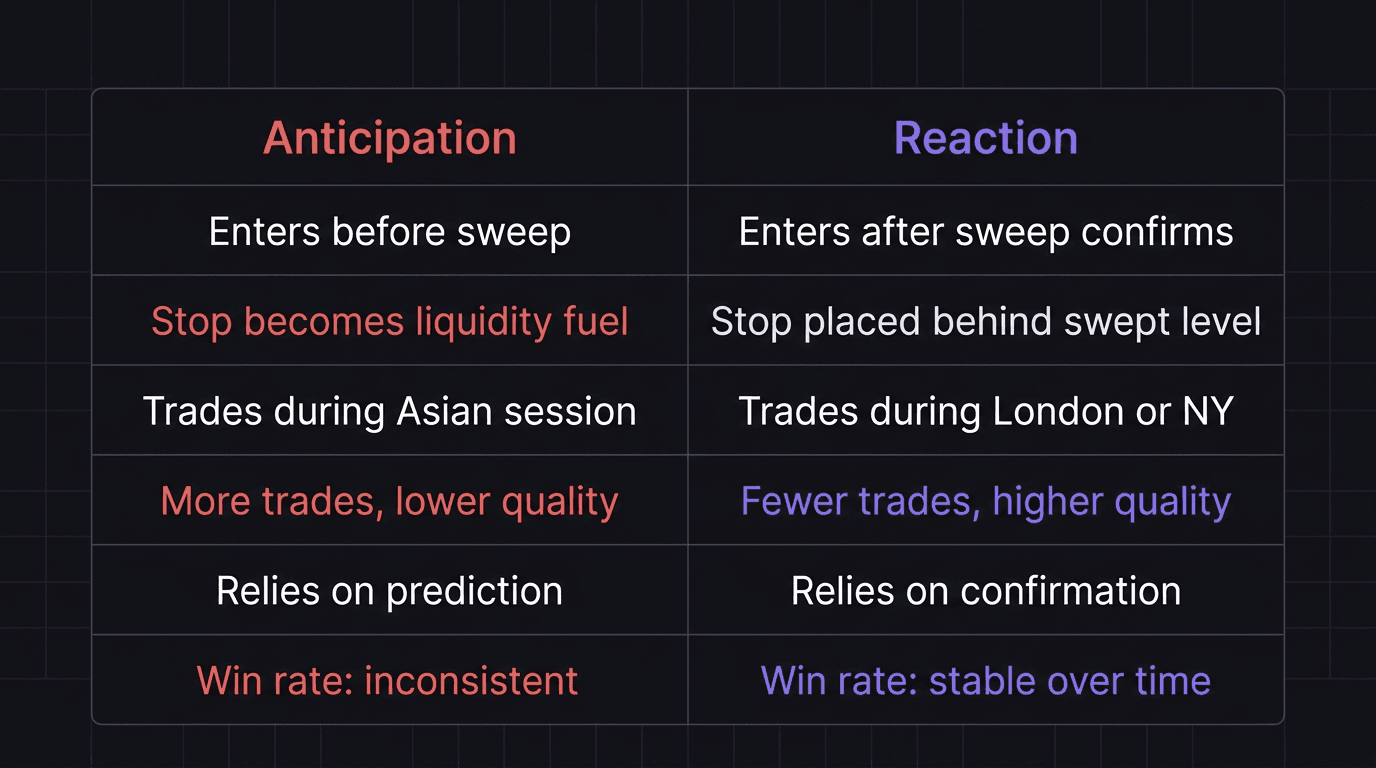
Anticipation feels smart. You predicted where price would go and you got in early. But trading rewards reaction, not prediction. The market does not care about your forecast. It cares about order flow.
When you anticipate, you are guessing that the sweep will happen at your level. Maybe it does. Maybe price sweeps one level below yours first. Maybe the sweep happens during a different session than you expected. Every "maybe" is a scenario where your early entry gets destroyed.
When you react, you wait for the evidence. Price swept the liquidity. You see the V-shape. You see the break of structure. Now you enter. You traded what happened, not what you thought would happen.
Reaction-based entries have worse entry prices (you enter after the turn, not at the bottom). But they have dramatically higher success rates because you only enter confirmed setups. The math overwhelmingly favors reaction: a slightly worse entry on a high-probability trade beats a perfect entry on a coin flip.
The Patience Equation: Fewer Trades, Bigger Wins
95% of retail traders lose. A major reason is that they trade too much, too early, and in the wrong sessions. They enter 5 trades a day instead of 1. They front-run confirmations. They trade during Asia because they are bored.
The patience equation is straightforward: fewer trades at the right time, at the right location, with full confirmation, compound into consistent profitability. More trades at random times, with partial confirmation, compound into a dying equity curve.
This is not a personality trait. It is a skill you build through structure. A pre-trade checklist forces you to verify timing before every entry. A maximum trade count (say, 2 per session) caps the damage from overtrading. Session restrictions remove the temptation to trade during dead hours.
The traders who make money are not the ones with the best chart reading. They are the ones who can sit quietly while the market consolidates and only act when all conditions align. The boring part pays.
How EdgeFlo Prevents Premature Entries
Trading patience is the skill. Environment design is the shortcut.
EdgeFlo's trading windows feature greys out the trade button outside your chosen session. If your window is 3:00 to 6:00 AM EST and it is currently 11:00 PM, you cannot place a trade without overriding the constraint. That override exists (you are always in control), but it forces a conscious decision instead of a reflexive one.
Combined with daily trade limits, the windows feature cuts early entries at the source. If you set a max of 2 trades per session and your session is London Open, you physically cannot burn through 5 impulse trades during Asia. The constraint does the work that willpower cannot.
Over time, your journal data shows the pattern. Trades taken inside your window with full confirmation return positive R. Trades taken outside the window or before confirmation return negative R. When the data is clear, the discipline follows. You stop fighting the constraint and start appreciating it because every trade it blocks was going to lose money anyway.
The Edge Brief
Receive Insights on trading psychology, discipline, and the behavioral patterns that create consistent traders from our Founder and the EdgeFlo team, delivered to your inbox.
Think different. Trade different.
Why is being early just as bad as being wrong in trading?
How do I stop entering trades too early?
What is the difference between anticipation and reaction in trading?
Does trading fewer times really make more money?

Turn discipline on.
Every session.
EdgeFlo is the environment serious traders operate inside.
Start 7-Day Free Trial
Cancel anytime.
No long-term commitment.


Think Different, Trade Different.