

Why 99% of Traders Fail Funded Challenges
Most traders fail funded challenges for five reasons that have nothing to do with strategy. Fix these and passing becomes a matter of time.
Most traders fail funded challenges for reasons that have nothing to do with their chart analysis. The five real killers are chasing dopamine instead of freedom, copying someone else's edge without proof it works, self-sabotaging after making money, obsessing over the payout instead of the process, and lacking the patience to let the challenge play out. Fix these five problems and passing becomes a matter of time, not luck. Your strategy is probably fine. Your behavior is the bottleneck.
TL;DR
Failing funded challenges is almost always a behavior problem, not a strategy problem.
Traders who chase excitement instead of consistency blow through drawdown limits.
Copying a strategy without backtesting it yourself means you will quit after three losses.
Self-sabotage after profits is an identity problem, not a discipline problem.
Patience is the single trait that solves overtrading, revenge trading, and forced entries.
The Real Reasons Challenges Fail (Not Strategy)
Here is something most funded challenge advice gets wrong: it focuses on strategy optimization. Better entries, tighter stops, higher win rates. But the traders who fail six challenges in a row (and plenty do) rarely have a strategy problem. They have a behavior problem.
Think about it like a gym membership. You know how to do a push-up. You know how to run on a treadmill. The equipment is not the issue. The reason most people quit after January is that they wanted the body, not the routine. Same thing with funded challenges.
The five reasons below come from the pattern that repeats across almost every failed challenge. They are not theoretical. They are the five walls that separate the 99% from the 1% of traders who actually get funded and keep the account.
Reason 1: You Want Excitement, Not Freedom
Most traders say they want to quit their job and trade full time. But what they really want is the rush of a winning trade after a losing streak. The dopamine hit. The adrenaline.
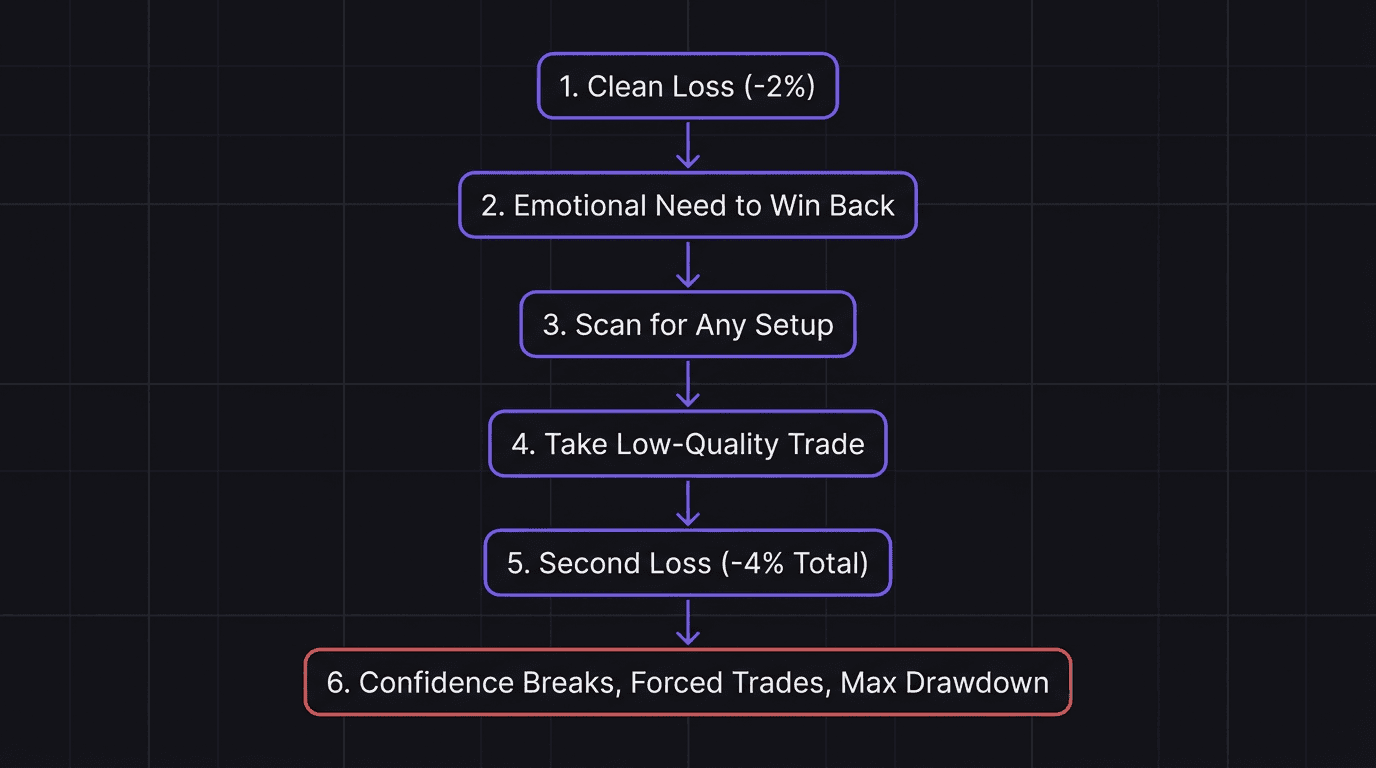
Sound familiar? You take a clean loss, and instead of walking away, you start scanning for another setup. Not because your plan says to, but because you need to feel something. You need to win one back. That is not trading. That is gambling with extra steps.
The top 1% of funded traders are boring. Their execution is repetitive. They wait for one setup that checks every box in their plan, enter the trade, and walk away. If there is no setup, they do nothing. No urgency. No excitement. Just process.
When you chase dopamine instead of consistency, you take low-quality setups to fill the emotional gap. On a prop firm challenge, those low-quality trades eat into your drawdown allowance fast. Two bad trades at 2% risk each and you are already down 4%. Now your confidence cracks. Now you start forcing trades to recover. And the spiral has begun.
Reason 2: You Copied an Edge You Cannot Trust
Copying a strategy from YouTube or a Discord group feels efficient. Someone already did the work, right? Just plug in their entry model and start trading.
The problem is trust. You did not backtest that strategy. You have no data showing it works across 50 or 100 trades. So when you hit three losses in a row (which happens to every strategy), you have zero reason to keep going. You think the strategy is broken. You switch to a new one. You blow the challenge.
Confidence comes from two things: data and kept promises. Data means you backtested the strategy yourself and saw the results. Kept promises means you followed the plan even when it felt wrong, and the edge proved itself over time. Without either of those, you are flying blind on someone else's map.
This is why building real trading confidence starts with owning your edge. Build it. Test it. Journal the trades. When you have 100 tracked trades proving a 40% win rate with a 3:1 reward-to-risk ratio produces positive expectancy, three losses in a row will not break you. You will know they are just variance.
Walkthrough: The Borrowed Strategy That Broke in Week Two
A beginner trader copies an ICT entry model from a YouTube course. He does not backtest it. He buys a $50,000 funded challenge and starts trading GBP/USD during London session. The first two trades win: +1.2% and +0.8%. He feels validated. Trade three is a loss at 1%. Trade four, another smaller loss at 0.5%. Now he is barely positive on the account.
By trade five, doubt has taken over. He does not trust the entry model anymore because he never built the proof that it works beyond a few screenshots. He widens his stop loss on trade six to "give it more room," turning a planned 1.5% risk into a 3% risk. The trade loses. He is now down 2.5% overall.
He switches to a completely different setup on trade seven, a supply-and-demand approach he saw in a different video. That trade also loses because he has no experience reading those zones. He hits the daily drawdown limit and stops trading for the day. Within ten days he fails the challenge. The strategy was not the problem. His lack of data was.
Reason 3: You Cannot Handle Success
This one is uncomfortable because it has nothing to do with charts. Some traders build up a 3% or 4% profit on their challenge account, and then they give it all back. Not because the market turned against them. Because they started overleveraging, breaking rules, or taking trades outside their plan.
It works the same way as lottery winners who go broke within five years. The money arrived, but the habits did not change. If you were undisciplined at $0 profit, you will be undisciplined at $4,000 profit. Success amplifies existing habits. It does not replace them.
In funded challenges, this shows up as increasing lot sizes after a winning streak, skipping pre-market preparation because "things are going well," or taking revenge trades after the first loss because you feel like you have a cushion to burn.
Your personality dictates your results. What you think, how you act, and what you believe all shape your decisions. If your identity is still "the trader who gets lucky sometimes," you will self-sabotage every time you get ahead. The fix is not a better strategy. It is actively building new habits while you are winning, not just when you are losing.
Reason 4: You Want the Payout, Not the Process
Everyone wants the $10,000 payout. The financial freedom, the laptop-on-the-beach lifestyle, the ability to set your own schedule. But when you fixate on the monetary goal, your attention shifts away from the process that actually gets you there.
Here is what happens when you trade with a payout target in mind: you crank up your lot size to hit the profit target faster. You overtrade because sitting out feels like wasting time. You skip backtesting and go straight to live trading because demo feels too slow. You are rushing the process to reach the outcome.
The process is the boring stuff: journaling every trade, following your plan, doing your pre-market routine, checking economic news before entering, making sure every trade aligns with your criteria. That is the work that eventually produces the payout. But it does not feel productive because nothing exciting is happening.
Think about it this way. If you focus on passing the challenge in two weeks, every losing day feels like a failure. If you focus on executing your plan correctly for 30 trading days, a losing day is just data. The emotional weight is completely different.
The traders who consistently pass challenges and eventually become funded traders are process-obsessed. They do not care whether they pass in week three or week eight. They care about whether today's trades followed the rules.
Reason 5: You Lack Patience
Every single trading problem can be solved with patience. Not overthinking. Not meditation. Not a new indicator. Patience.
With patience, you do not overtrade because you do not feel the need to force a setup. With patience, you do not revenge trade because you accept that one loss is not an emergency. With patience, you do not widen your stop loss because you trust your analysis enough to let the trade play out. With patience, you do not set a two-week deadline for a challenge that has no time pressure.
Patience means three things during a funded challenge:
Before the trade: You wait for a setup that checks every box in your plan. No A-minus setups. No "close enough" entries.
During the trade: You let it run. No micromanaging, no moving your stop loss, no adjusting your take profit unless your rules specifically call for it.
After the trade: You journal the result, review what happened, and accept the outcome without chasing the next trade to compensate.
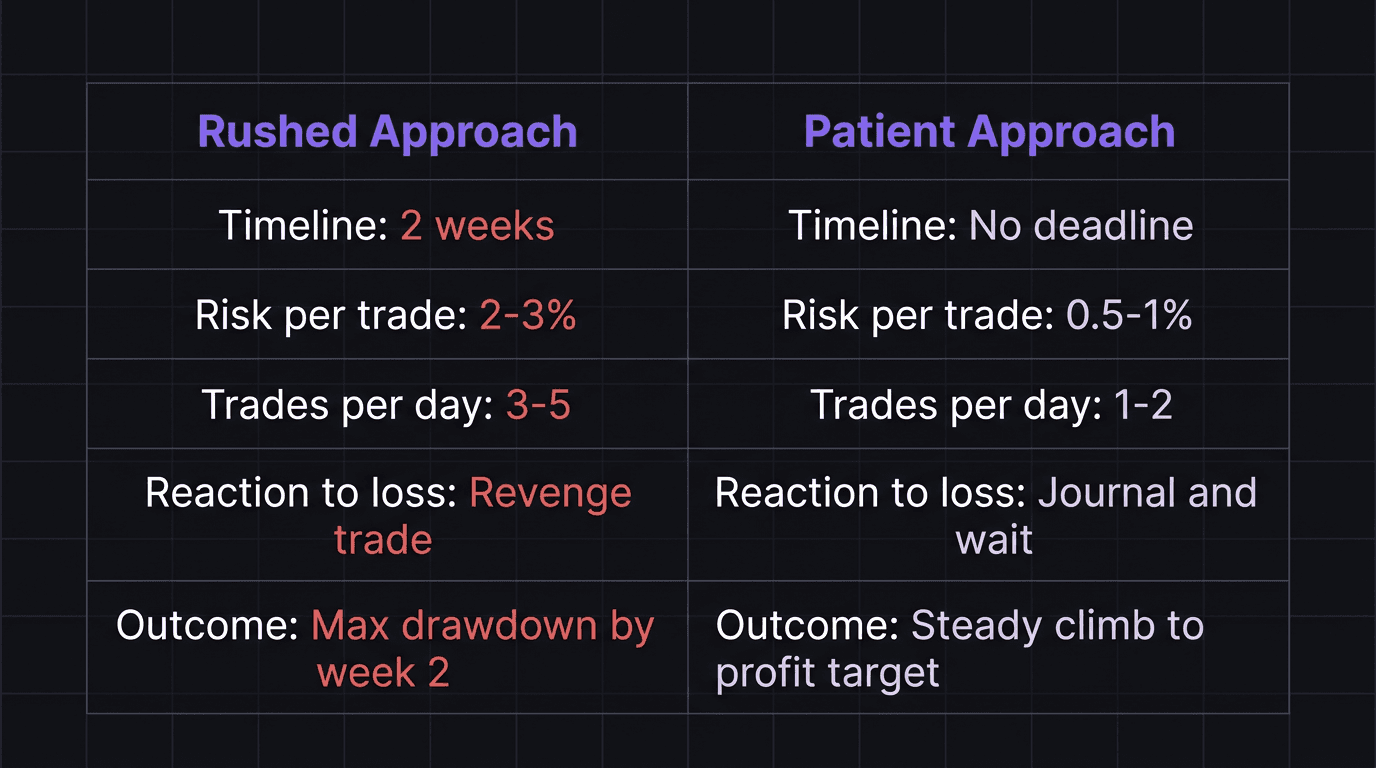
Most traders set timelines that are too aggressive. They want to pass in two weeks, so they force trades, break rules, and blow the drawdown. The irony is that the bigger the goal, the longer the timeline needs to be. Stretching your timeline does not slow you down. It removes the pressure that causes you to trade stupidly.
How EdgeFlo Keeps You Challenge-Ready
These five failures are all behavior problems, not strategy problems. That is exactly why EdgeFlo focuses on the trading environment instead of giving you another strategy to copy.
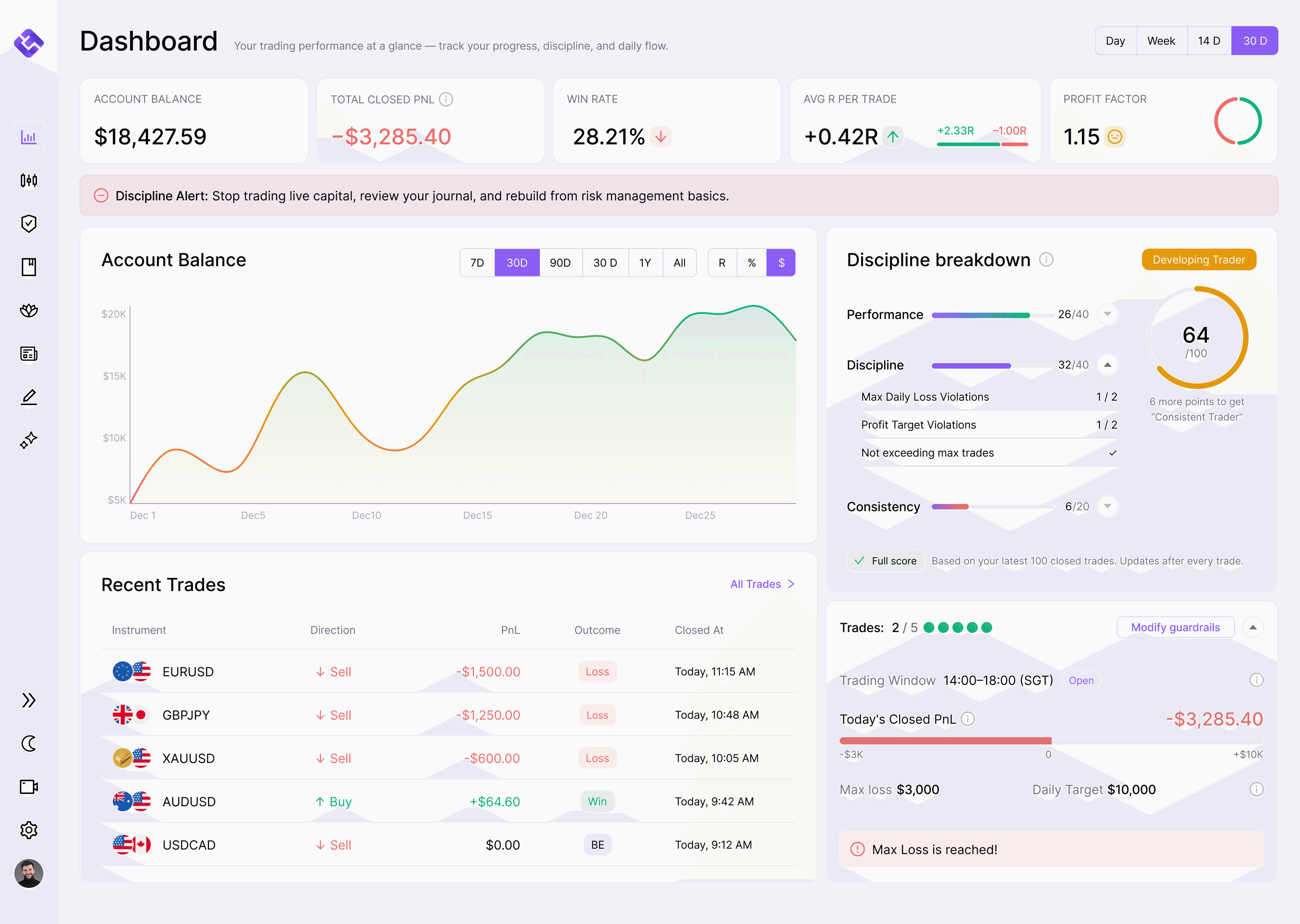
EdgeFlo's guardrails restrict overtrading and revenge trading by making rule-breaking a conscious choice (you can override, but you have to deliberately choose to). During a funded challenge, that friction is the difference between a 4% drawdown and a blown account. Your Edge plan stays visible while you trade, so your criteria and risk parameters are right next to your chart instead of buried in a notebook.
The journal tracks whether you actually followed your process, not just whether you won or lost. After each trade, you log whether you followed entry criteria, respected your stop, and stuck to your lot size. Over time, that data shows you exactly where your discipline breaks down. That is the kind of proof that builds real confidence, the same confidence that keeps you calm when a funded challenge hits three losses in a row.
The Edge Brief
Receive Insights on trading psychology, discipline, and the behavioral patterns that create consistent traders from our Founder and the EdgeFlo team, delivered to your inbox.
Think different. Trade different.
What is the main reason traders fail funded challenges?
How long should it take to pass a funded challenge?
Can you pass a funded challenge with a copied strategy?
Why do traders self-sabotage after making profits?

Turn discipline on.
Every session.
EdgeFlo is the environment serious traders operate inside.
Start 7-Day Free Trial
Cancel anytime.
No long-term commitment.

Think Different, Trade Different.