

Why Belief Shapes Your Trading Results (And How to Fix It)
Your belief about trading drives your actions and your results. Learn the belief-action-reality loop and how to shift from negative to positive using evidence.
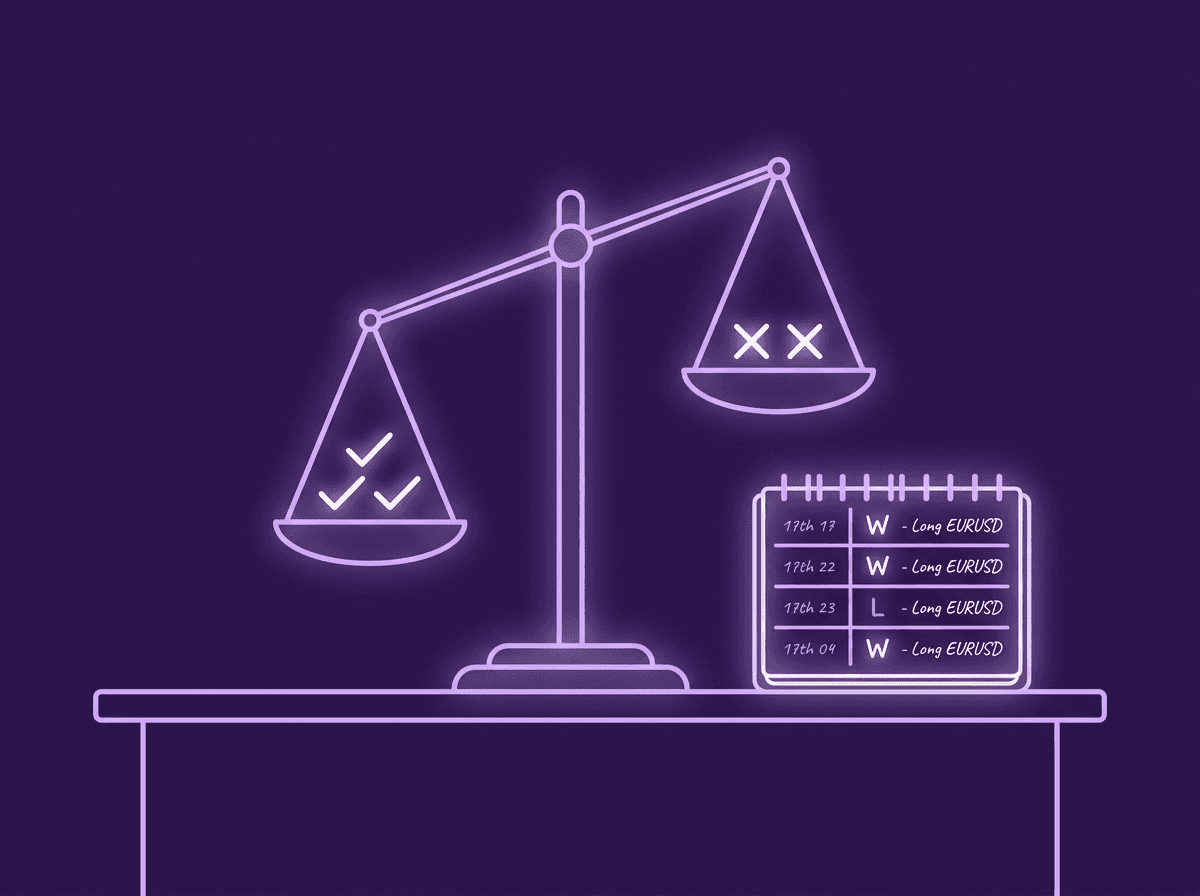
Your belief about trading determines what you do, and what you do determines your results. If you believe trading is rigged against you, you will half-commit to studying, skip your backtesting, and quit after a losing streak. Those actions produce exactly the results that confirm your belief. The loop is airtight: belief leads to action, action leads to reality, and reality reinforces the belief.
Breaking that loop is not about affirmations or positive thinking. It is about stacking real evidence on the positive side of the scale until your belief shifts on its own.
TL;DR
The belief-action-reality loop means your beliefs directly control your trading behavior and your results.
Negative experiences (losses, criticism, past failures) add weight to negative beliefs, creating a self-fulfilling downward spiral.
You shift the loop by adding positive evidence: backtested results, followed rules, logged wins, proven competence.
Visualization can accelerate the shift because your brain cannot distinguish vividly imagined experiences from real ones.
But visualization without action is useless. Data from real testing is what gives the shift permanent weight.
How Belief Drives Your Trading Actions
Think about the last time you hesitated on a trade entry. The setup was there. It met your criteria. But something in the back of your mind said, "This probably will not work." So you waited. Price moved. You missed it. Then you watched it hit your target without you.
That hesitation was not a technical problem. It was a belief problem. Somewhere in your experience, you collected enough evidence (or what felt like evidence) that your trades do not work. That evidence created a belief. That belief created hesitation. And hesitation created a missed trade, which added more negative evidence to the pile.
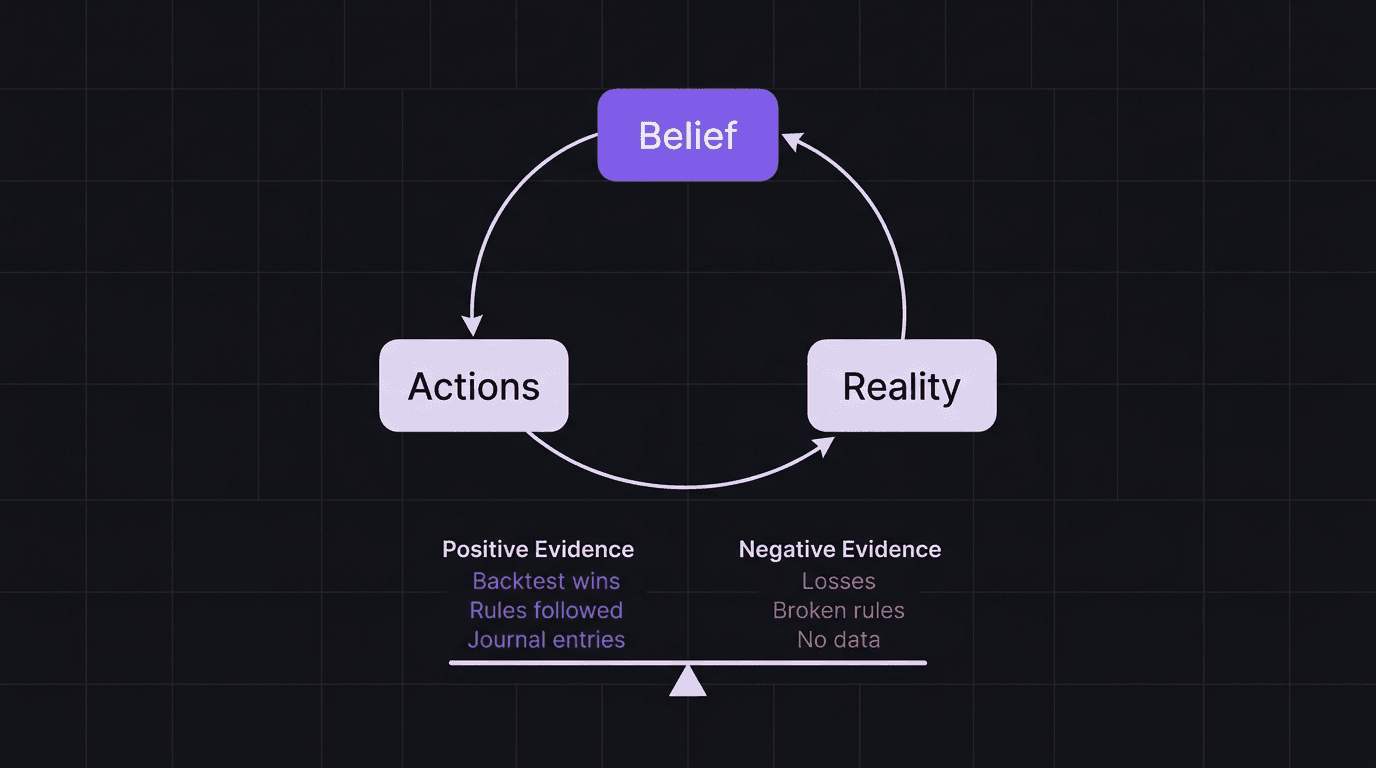
The loop works in three steps:
Belief shapes what actions you are willing to take.
Actions produce results (wins, losses, missed trades, broken rules).
Results become experiences that reinforce or challenge the belief.
If you believe risk management is pointless, you will not use a position size calculator. You will take oversized positions, blow through your stop levels, and lose more than you should. Those losses become evidence that "trading does not work," which strengthens the original belief that risk management is pointless. See the trap?
This is not abstract psychology. It is the mechanical process behind strategy hopping, account blowups, and the frustrating feeling that you know what to do but cannot make yourself do it.
The Negative Belief Cycle
Imagine a set of scales. On one side is a bucket of positive experiences. On the other, a bucket of negative experiences. Every experience you have with trading adds weight to one side or the other.
Here is how the negative cycle typically starts.
A friend tells you trading is a scam. Your coworker says 99% of traders lose money. You read a Reddit thread full of people who blew their accounts. Before you have even opened a chart, the negative bucket is already heavy. The scale is already tilted.
Then you start trading. You find a strategy, skip the testing, and jump into a live account because you want results fast. Your first trade loses. That is one more drop in the negative bucket. Second trade loses. Another drop. Now the scale is firmly tilted toward "trading is difficult, I probably cannot do this."
Here is the insidious part: once the scale tips, your brain actively seeks evidence to confirm it. You notice the losses more than the wins. You remember the blown stop but forget the setup that worked perfectly last week. You start interpreting neutral events (a trade that hit breakeven) as further proof that your strategy is broken.
This is not weakness. It is how human brains work. Confirmation bias is a survival mechanism. But in trading, it creates a downward spiral that feeds on itself.
Walkthrough: The Negative Loop in Action
You open a $5,000 account after watching a few strategy videos. No backtesting, no forward testing, no plan. First week, you take seven trades. Four lose, three win, but the losses are bigger because you moved your stop on two of them.
Net result: down $380. The belief that was already forming ("this is harder than they said") gets stronger. Next week, you trade more aggressively to make it back. You take 12 trades, ignoring your criteria on half of them. You end the week down another $520.
Now you are down $900 in two weeks. The belief is no longer forming. It is locked: "I cannot do this." You stop studying. You stop journaling. You either quit or start strategy hopping, looking for the "right" system that will finally work.
But the strategy was never the problem. The belief created the actions (no testing, no discipline, oversized losses), and the actions created the reality (lost money). The reality confirmed the belief. Loop closed.
Shifting the Scale With Positive Evidence
Breaking the negative loop is not about willpower. It is about evidence. You need to physically add positive experiences to the other side of the scale until it tips.
The fastest way to do this: backtesting.
When you sit down and backtest 50 trades, and 17 of them win at 3:1, and your expectancy is positive, that is tangible evidence that your strategy works. Each winning trade in your backtest log is a drop in the positive bucket. Each time you follow your rules and record the result, the scale shifts a little.
Forward testing adds heavier drops. When you mark up a chart in the morning, predict where price will go, and it actually goes there, that is not luck. That is competence creating confidence. Your brain registers it as a real positive experience because it happened in real time, not in replay.
Journaling adds steady drops. Every time you review a trade and write down what you did right, you are telling your brain, "I am someone who follows a plan." Over weeks, those journal entries accumulate. They become your feedback loop: evidence that you are improving, recorded in your own words.
The scale does not flip overnight. But it does not need to. It tips gradually, trade by trade, entry by entry, until one day you realize you are not hesitating on entries anymore. You are not second-guessing your stop placement. You just execute.
That is the moment the belief has shifted.
Why Data Beats Visualization Alone
Your mind cannot tell the difference between a vividly imagined experience and a real one. When you close your eyes and visualize yourself calmly executing a trade, seeing the profit on your screen, marking up your charts with confidence, your brain registers that as a real positive experience. It adds weight to the positive bucket.
This is why athletes visualize their performance before competition. It works. It literally changes the neural pathways that fire during execution.
But here is where traders get it wrong. They treat visualization as a substitute for action. They sit in a chair, visualize winning trades, and expect their account to grow. Obviously, that does not happen. Visualization creates belief. But belief without action produces nothing.
The formula requires both:
Visualization + Action = Shifted belief + Real results.
Visualization alone gets you a positive belief with an empty account. Action alone (trading without any belief work) gets you a trader who knows what to do but freezes under pressure. You need both sides.
The Practical Protocol
Here is how to combine them.
Morning (5 minutes). Before you open your charts, close your eyes and visualize your trading session. See yourself marking up the chart calmly. See yourself identifying a setup, checking it against your plan, and entering without hesitation. See the trade result (win or loss) and see yourself logging it in your journal without emotion. This is not fantasy. You are rehearsing the process, not imagining profits.
During your session. Trade your plan. Execute your backtested strategy. Follow your rules. Log every trade.
Evening (5 minutes). Review what happened. If you followed your rules, that is a positive experience. Log it. If you did not, identify why and plan the correction. Do not beat yourself up. Just record it.
Over four weeks, you accumulate 20 visualization sessions and 20 real trading sessions, each one adding a drop to the positive bucket. Combined with a growing sample size of logged trades, the scale starts to shift.
The traders who struggle with self-doubt are almost always missing one side or the other. They either visualize without trading, or they trade without ever building the mental evidence that they can succeed.
How EdgeFlo Supports Your Belief Shift
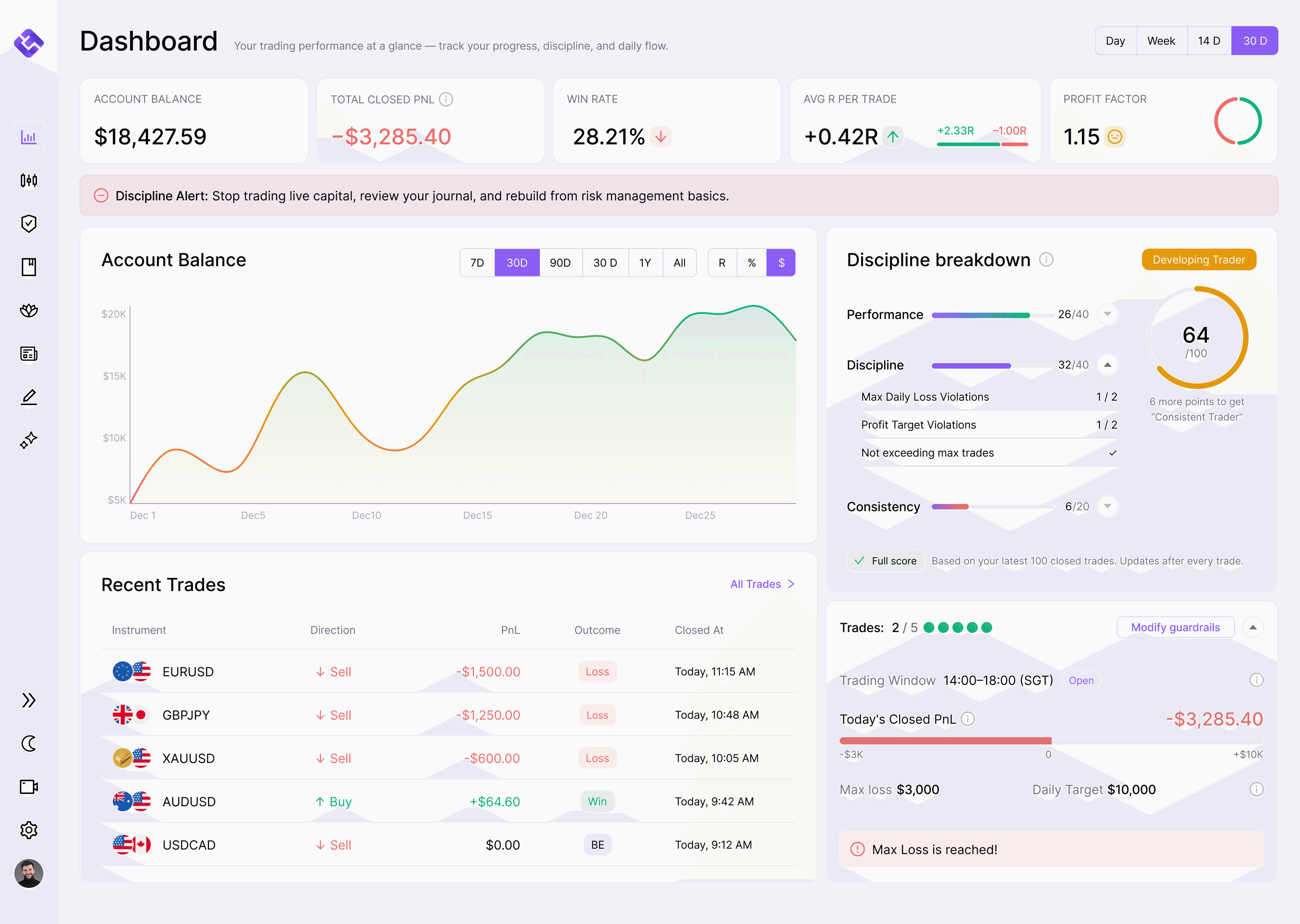
EdgeFlo is built around the idea that confidence comes from competence, not from motivational quotes. The trading journal logs your daily data automatically. The dashboard shows your win rate, expectancy, and discipline score over time. Every time you open the app and see a rising equity curve or an improving discipline percentage, that is a real positive experience being added to your scale.
The Edge plan builder lets you document your strategy and keep it visible during trading, which removes the "did I follow my rules?" uncertainty that erodes belief. After each trade, the self-reporting feature asks whether you followed the plan. Over time, that self-report data becomes proof of your own consistency.
You cannot fake the data. And that is exactly why it works. When your belief in your strategy is backed by 50 logged trades and a positive expectancy number staring back at you from the dashboard, hesitation fades. The scale tips. And you trade.
The Edge Brief
Receive Insights on trading psychology, discipline, and the behavioral patterns that create consistent traders from our Founder and the EdgeFlo team, delivered to your inbox.
Think different. Trade different.
How does belief affect trading performance?
Can visualization alone make me a better trader?
How long does it take to shift a negative trading belief?
What if I believe in my strategy but still lose money?

Turn discipline on.
Every session.
EdgeFlo is the environment serious traders operate inside.
Start 7-Day Free Trial
Cancel anytime.
No long-term commitment.

Think Different, Trade Different.