

How to Invest Trading Profits for Long-Term Wealth
Trading generates cash flow. Investing builds wealth. Learn how to allocate your trading profits into long-term investments for passive income.
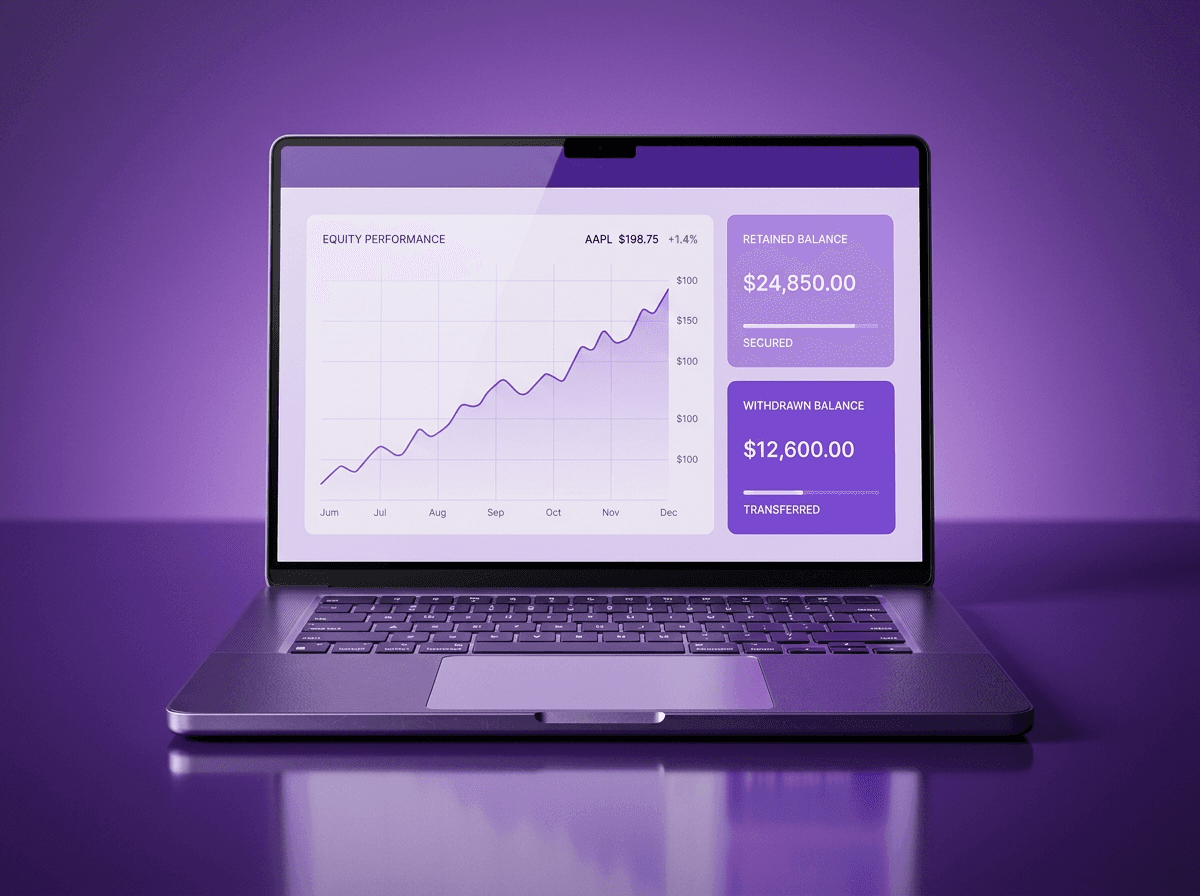
Investing your trading profits means taking your active cash flow from trades and deploying it into long-term assets like index funds, ETFs, or real estate that compound without you. Trading generates income, but it stops the moment you step away from the charts. The traders who build real wealth funnel a portion of every payout into investments that grow while they sleep.
Most traders skip this step. The number goes up, it feels good, and then it sits in a brokerage account doing nothing. That is a missed opportunity. Trading is one of the best short-term cash flow vehicles available to a retail trader, but it is still you exchanging time for money. The fix is a simple allocation framework that converts active income into passive wealth.
TL;DR
Trading is a cash flow vehicle, not a retirement plan. Use it to generate deployable capital.
Allocate profits using a simple split: living expenses, cash buffer, long-term investments.
Start investing once you have three consecutive profitable months and a three-month expense reserve.
Passive income from dividends and appreciation is what eventually replaces the need to trade every day.
Track your payout history so you can see exactly how much capital is available for deployment.
Trading Is a Vehicle, Not the Destination
Here is the uncomfortable truth about trading: no matter how good you get, you are still exchanging time for money.
You have to sit at the charts. You have to analyze. You have to press the buy or sell button. And if you stop doing those things, the income stops. Trading is active income in its purest form.
That does not make it bad. It makes it a vehicle. A very powerful one, actually. Funded traders pulling consistent payouts from prop firms can generate cash flow that most salaried jobs cannot match. But the money only flows while you are working.
The real question is: what do you do with that cash flow once it hits your account?
Most traders do one of two things. They leave it sitting in their trading account, where it does nothing productive. Or they spend it, which means they are perpetually dependent on tomorrow's trades to pay tomorrow's bills.
The third option is the one that builds wealth. You take your trading profits and funnel them into assets that appreciate over time and generate passive income. Dividends. Capital gains. Compounding returns. These work for you even on days you do not trade.
Think of it like this. Trading is the engine. Investing is the fuel tank. The engine generates power, but the fuel tank stores energy for the long haul. Without the tank, you run out of gas the moment you stop driving.
Example: The Funded Trader Who Stayed Broke
A trader passes a $200,000 funded account challenge and starts pulling $4,000 to $6,000 per month in payouts. Not bad. But he spends every dollar. New car payment, lifestyle upgrades, eating out every night. Two years later, he has earned over $100,000 in trading profits and has zero invested. When he hits a rough patch and loses the account for a drawdown violation, he has no runway. No savings. No investments. He is back to square one, looking for another challenge to pass. The income was real. The wealth never materialized because he never converted active cash flow into long-term assets.
That scenario plays out more often than you would think. The fix is not earning more. It is allocating what you earn.
How to Allocate Trading Profits
You do not need a financial advisor or a complicated spreadsheet to allocate trading profits. You need a simple framework you actually follow.
Here is one that works for most active traders pulling consistent payouts:
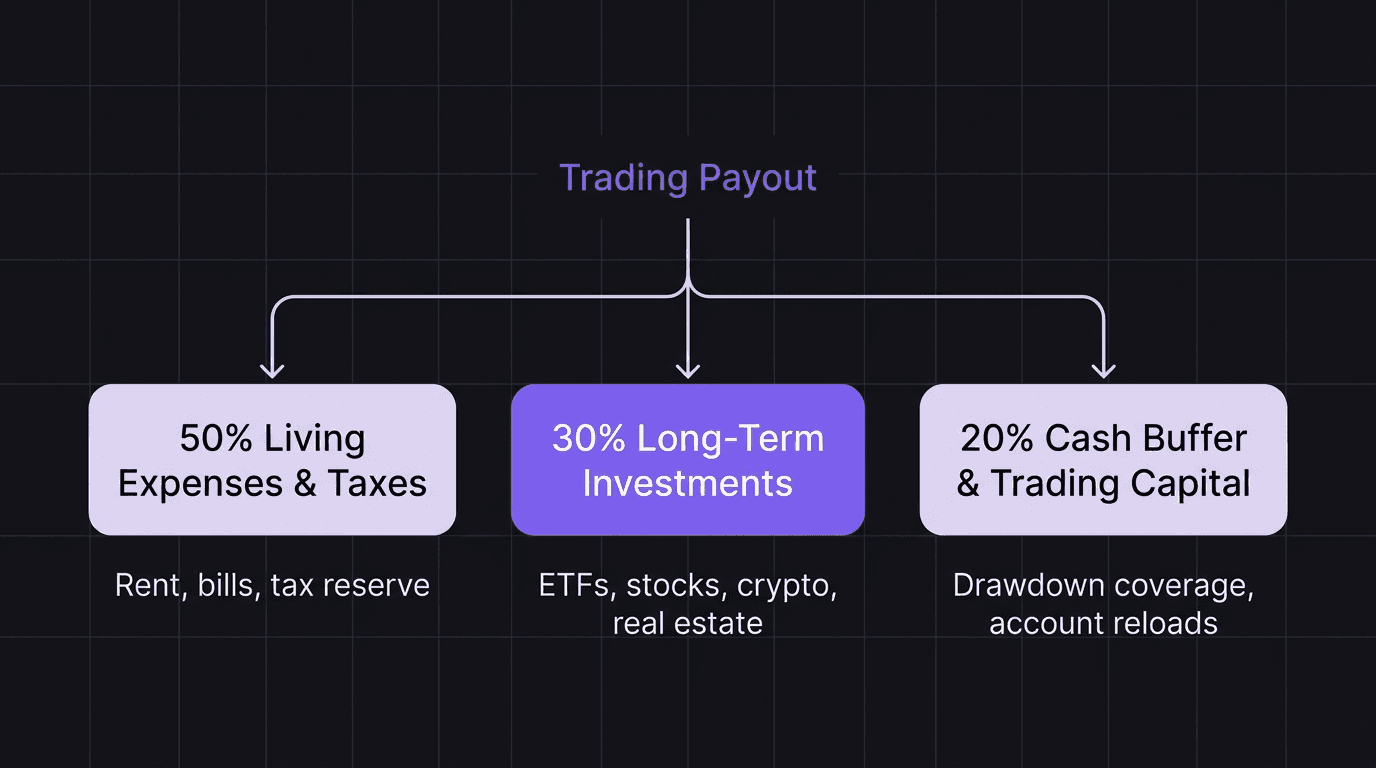
The 50/30/20 Trading Profit Split
Take every payout or profit withdrawal and divide it into three buckets:
50% Living Expenses and Taxes. Pay yourself first. Cover rent, food, bills, and set aside your estimated tax liability. If you are trading through a prop firm, remember that payout amounts are pre-tax.
30% Long-Term Investments. This is the wealth-building bucket. Index funds, ETFs, individual stocks, crypto, real estate. Whatever matches your risk tolerance and investment thesis.
20% Cash Buffer and Trading Capital. Keep this liquid. It covers drawdown periods, account reloads, and unexpected expenses. This is what keeps you from panic-selling investments during a bad trading month.
These percentages are not sacred. If your living expenses are lower, push more into investments. If you are still building your trading capital base, shift more toward the buffer. The point is that every dollar has a job before it arrives.
What About the Profit You Leave in Your Trading Account?
Good question. If you are trading a personal live account rather than a funded account, you do not have to withdraw everything. But you should still mentally allocate.
Set a threshold. Once your account exceeds the balance you need for your strategy (say, $25,000 for your position sizes), withdraw the excess and run it through the same split. Letting profits pile up in a trading account is not investing. It is just increasing your risk exposure.
Funded traders have it easier here. Your prop firm payout forces a withdrawal event, which naturally creates the allocation trigger. Use it.
Short-Term Cash Flow Into Long-Term Wealth
The magic of this approach is compounding. Your trading profits do not compound inside your brokerage account. They sit flat, waiting for you to trade them. But once you move them into investments, compounding takes over.
Here is what that looks like in practice.
Example: $2,000/Month Into Index Funds
A trader allocates $2,000 per month from trading profits into a broad market index fund averaging 10% annual returns. After 5 years, that is $120,000 contributed. But with compounding, the portfolio is worth roughly $155,000. After 10 years, $240,000 contributed grows to approximately $410,000. After 20 years, $480,000 contributed becomes roughly $1,530,000. The trader never changed anything about their trading. They just consistently moved 30% of profits into a single investment vehicle and let time do the work.
The numbers shift depending on what you invest in and when. But the principle holds. Active income plus passive compounding creates a wealth curve that trading alone cannot produce.
Diversification for Traders
You already take concentrated risk in your trading. Your investment portfolio should do the opposite.
Spread across asset classes:
Index funds and ETFs for broad market exposure and dividends
Individual stocks only if you have a genuine thesis (not a hot tip)
Crypto for asymmetric upside if you understand the volatility
Real estate once your investment capital supports it
The goal is not to beat the market with your investment portfolio. The goal is to build a base of assets that grows steadily while you focus your skill and attention on trading. Your scaling plan handles the active income growth. Your investment portfolio handles the passive side.
When to Start Investing Your Profits
Not tomorrow. Not after your next big win. Start when you meet two conditions:
Condition 1: Three consecutive profitable months.
This signals that your trading is consistent enough to produce reliable cash flow. One good month followed by two blowups does not count. You need a pattern of steady payouts before you start routing money into investments. If you are still working on consistency, focus on managing your funded account first.
Condition 2: Three months of living expenses in cash reserve.
This is your buffer. If trading income drops to zero tomorrow, you can cover rent, food, and bills for 90 days without touching investments. This buffer prevents you from liquidating investments during a drawdown period, which is the fastest way to destroy long-term returns.
Once both conditions are met, start small. Even $500 per month into a low-cost index fund is enough to begin. The habit matters more than the amount. You are training yourself to treat trading profits as deployable capital, not spending money.
What If You Have Trading Goals That Conflict?
Maybe you are saving to fund a larger personal account. Maybe you want to enter a higher-tier prop firm challenge. Those are valid uses of trading capital.
The answer is not to skip investing. It is to adjust the split. Drop your investment allocation to 15% or even 10% temporarily, and increase your trading capital bucket. But keep the investment habit alive. Even a small monthly contribution maintains the discipline of converting active income to passive assets.
Set specific trading goals for both your active and passive targets. Know the number you are working toward on each side.
How EdgeFlo Tracks Your Payout History
Knowing where your money goes starts with knowing how much you actually made. That sounds obvious, but most traders cannot tell you their exact P&L for the last three months without digging through multiple platforms.
EdgeFlo's Trading Dashboard consolidates your P&L and payout history in one place. You can see your monthly profit, your cumulative payouts, and your performance trends without switching between broker platforms and spreadsheets.
This matters for the allocation framework above. If you know you earned $6,200 last month, you can immediately split it: $3,100 to expenses and taxes, $1,860 to investments, $1,240 to your cash buffer. No guessing, no rounding, no "I'll figure it out later."
Your equity curve tells you whether your trading income is stable enough to support consistent investment contributions. And your performance reviews help you spot the months where your allocation split might need adjusting because income dropped or spiked.
The traders who build wealth from trading are not the ones with the highest win rate. They are the ones who consistently deploy their profits into assets that work without them. EdgeFlo gives you the visibility to do that with precision.
The Edge Brief
Receive Insights on trading psychology, discipline, and the behavioral patterns that create consistent traders from our Founder and the EdgeFlo team, delivered to your inbox.
Think different. Trade different.
Should I invest all my trading profits?
When should I start investing trading profits?
What is the best investment for trading profits?
Can trading replace a traditional investment portfolio?

Turn discipline on.
Every session.
EdgeFlo is the environment serious traders operate inside.
Start 7-Day Free Trial
Cancel anytime.
No long-term commitment.


Think Different, Trade Different.