

Funded Trader: From $0 to $200k in Trading Capital
Go from undercapitalized to funded with $100k-$200k in trading capital. Covers prop firm selection, the two-phase challenge, post-funding rules, and scaling.
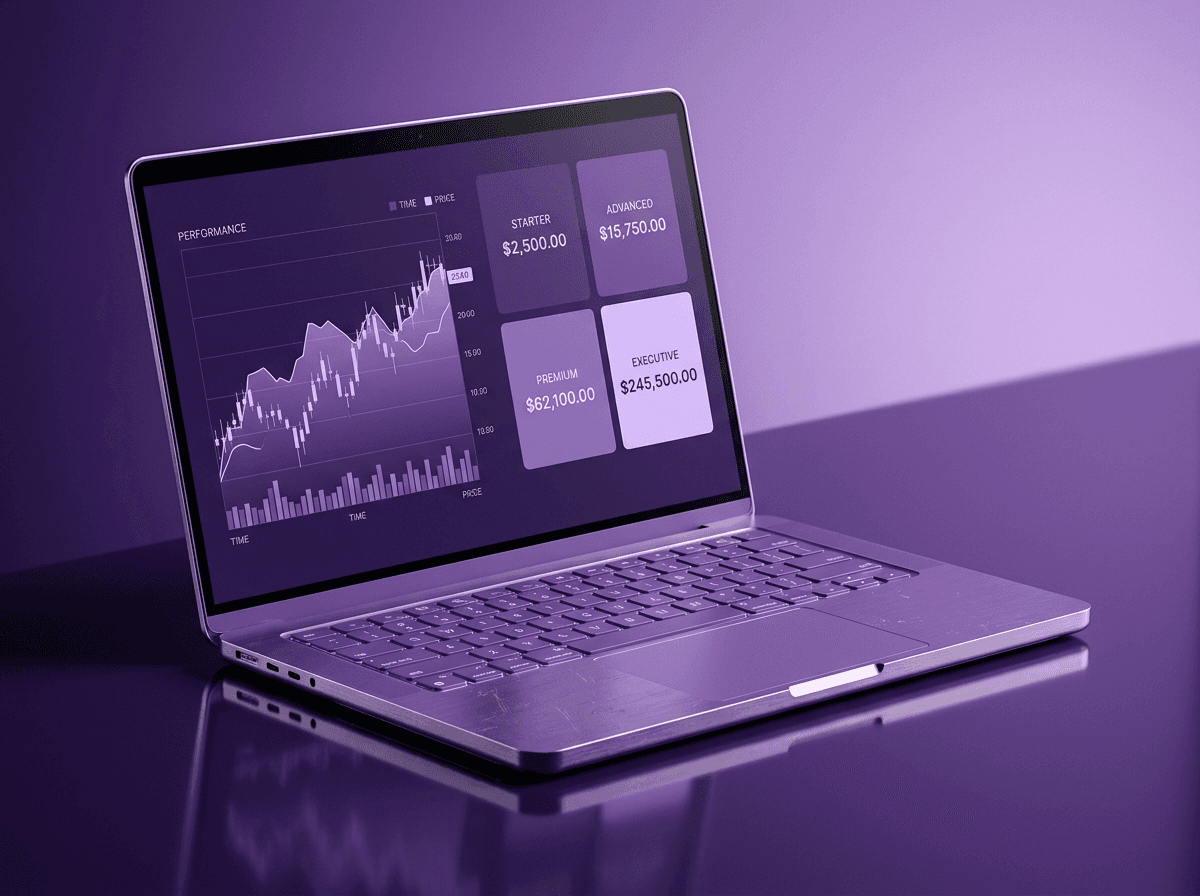
A funded trader uses someone else's capital to trade the markets, keeping a share of the profits. Prop firms hand you $10,000 to $200,000 in trading capital after you pass a qualification challenge. You risk their money, follow their rules, and split the gains (typically 60% to you, 40% to them). This solves the single biggest barrier most retail traders face: not having enough money in the account to make risk management math work.
The path from zero to funded is straightforward. Pick a firm, pass two phases, then trade conservatively to keep the account and scale up over time.
TL;DR
Prop firms give you $10k-$200k in capital after you pass a two-phase qualification challenge.
Phase 1 target is 10%, Phase 2 is 5%, with a 5% max daily loss and 10% max overall drawdown.
After funding, drop your risk to 1% per trade and aim for 5% monthly, not 10%.
De-risk to 0.5% per trade when your balance dips below $98k on a $100k account.
Scale by reinvesting payouts into additional accounts, not by cranking up lot sizes on one account.
The Undercapitalization Problem Most Traders Ignore
Here is the math nobody wants to hear. You have $100 in your account. You risk 1% per trade (the standard rule). That is $1 at stake per trade. Even at a 1:3 risk-to-reward ratio, a winning trade nets you $3. Do that ten times in a month with a 50% win rate, and you have made $10.
Ten dollars. For a month of screen time, analysis, and emotional stress.
The skill might be there. The capital is not. And without capital, good trading looks a lot like wasting time.
This is why most retail traders blow up. They know 1% risk is correct, but risking $1 per trade feels pointless. So they bump it to 5%, 10%, sometimes 20%. One bad streak wipes the account. Sound familiar?
The fix is not better entries or a new indicator. The fix is more capital. And prop firms exist specifically to solve that problem.
What Prop Firms Are (And Why They Exist)
A prop firm (short for proprietary trading firm) provides trading capital to individual traders. You trade their money on live or simulated markets. When you profit, you split the gains.
The typical profit split is 60/40 in your favor, though some firms offer up to 80/20. The firm takes the downside risk. If you blow the account, you lose the challenge fee, not $100,000.
Why would a company hand money to strangers? Because the business model works. Most traders fail the challenge phase, and the firm keeps the fees. The traders who do pass tend to be consistent enough to generate profits the firm shares in. Both sides win, just at different rates.
Think of it like renting a commercial kitchen instead of building one from scratch. You bring the skill, they bring the equipment. If you burn the place down, you lose your deposit but not your house.
The Common Prop Firms
Several firms dominate this space:
FTMO is widely considered the most trusted and longest-running option
Funding Pips offers competitive fee structures
FundedNext and Alpha Capital are popular alternatives
FTMO gets recommended most often for a reason: transparent rules, consistent payouts, and a track record. When you are putting up real money for a challenge fee, reputation matters.
Choosing Your First Prop Firm
Start with the account size that matches your current skill level, not your ambition.
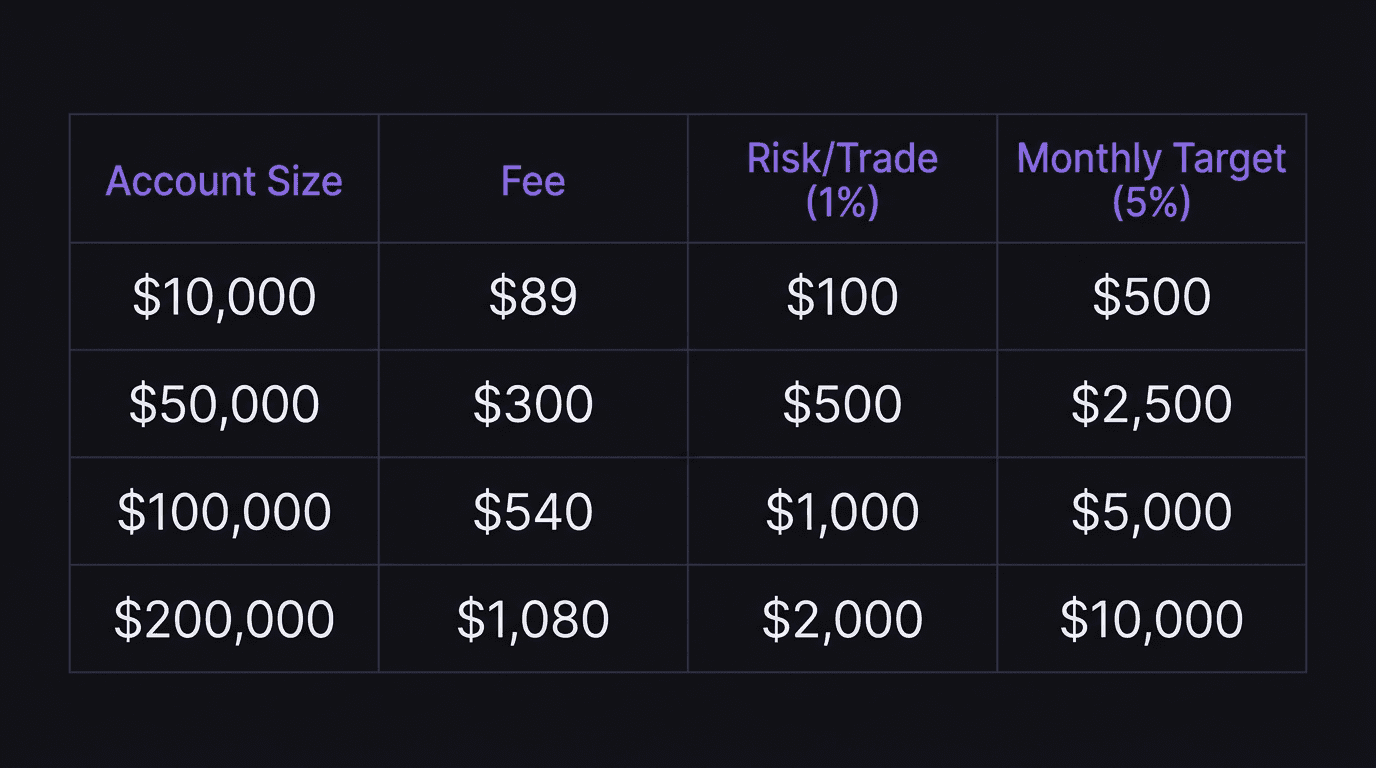
Account Size | Typical Fee | Risk Per Trade (1%) | Monthly Target (5%) |
|---|---|---|---|
$10,000 | ~$89 | $100 | $500 |
$50,000 | ~$300 | $500 | $2,500 |
$100,000 | ~$540 | $1,000 | $5,000 |
$200,000 | ~$1,080 | $2,000 | $10,000 |
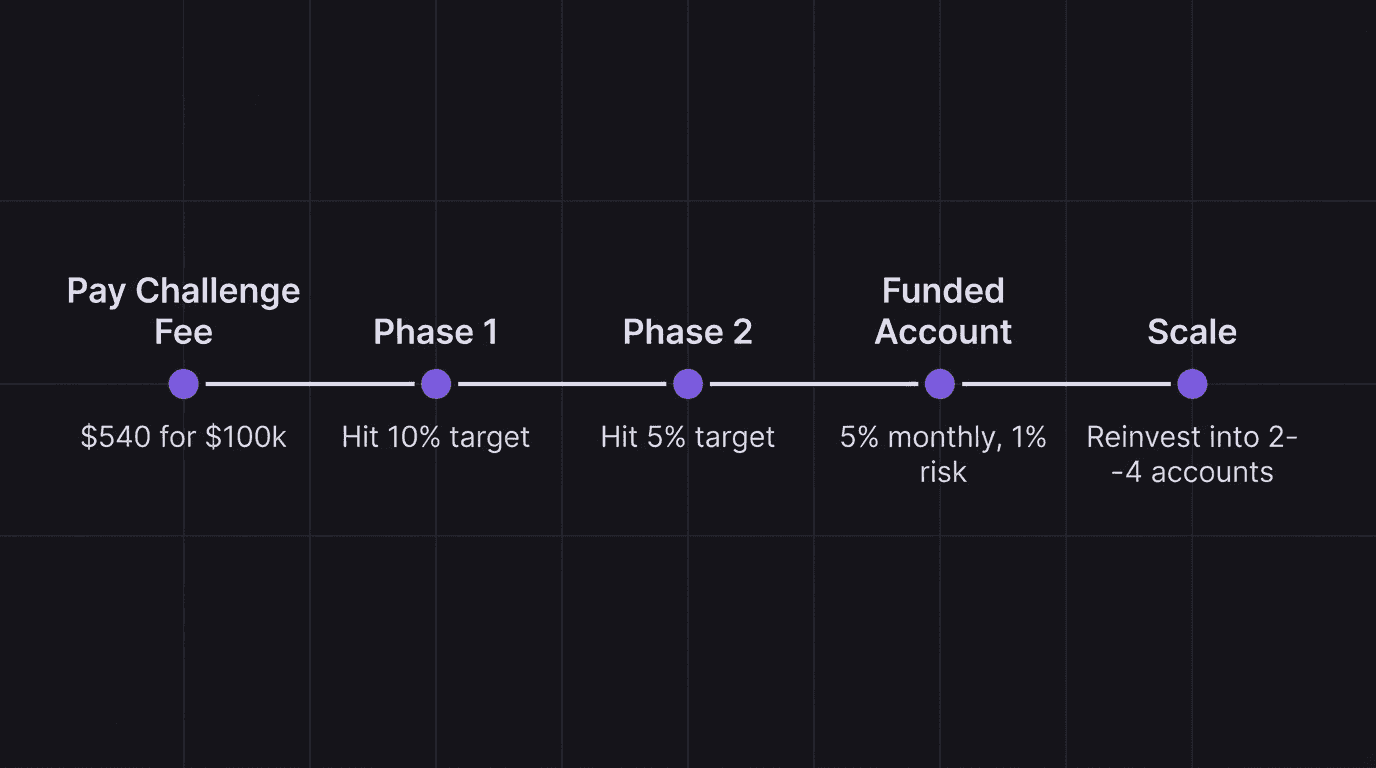
The fees are typically refundable after your first payout. So the $540 for a $100k account comes back to you once you are funded and profitable.
If you have never passed a challenge before, start with $10k or $50k. The rules are identical across account sizes. The only difference is the fee and the dollar value of each percentage point. Prove you can pass the process before committing $1,000+ to a larger account.
One common trading mistake here: jumping straight to a $200k account because it "makes the math better." The math only matters if you pass. Start where you can afford to fail once or twice while you learn the rules.
The Two-Phase Qualification Process
Every major prop firm uses a two-phase model. You need to hit a profit target while staying within drawdown limits. No shortcuts. No buying your way in.
Phase 1: The Challenge
Profit target: 10% of account balance
Maximum daily loss: 5%
Maximum overall drawdown: 10%
Minimum trading days: 4
Time limit: None (most firms removed this)
On a $100k account, that means growing the balance to $110,000 without ever losing more than $5,000 in a single day or $10,000 overall.
Phase 2: Verification
Profit target: 5% (half of Phase 1)
Same drawdown rules: 5% daily, 10% overall
Minimum trading days: 4
Time limit: None
Phase 2 exists to prove Phase 1 was not a fluke. The lower target reflects this. The firm wants to see consistent, repeatable trading, not a lucky streak.
How Daily Loss Actually Gets Calculated
This trips up a lot of traders. Your daily loss is not just closed trades. It includes:
Closed P&L for the day
Open floating P&L (unrealized losses on positions you are still holding)
Commissions and swap fees
So if you close the day with $2,000 in realized losses and have an open position floating at -$3,100, your daily loss is $5,100. That breaches the 5% limit on a $100k account. Account terminated.
This is why position sizing matters more in funded accounts than anywhere else. Every pip of floating loss counts against you in real time.
Walkthrough: Passing Phase 1 on a $100k Account
You start Phase 1 on a Monday. Your balance is $100,000. You risk 1% per trade ($1,000) with a standard 1:2 risk-to-reward setup.
Week 1: You take 5 trades on EUR/USD and GBP/USD during London and New York sessions. Three winners at 1:2 ($2,000 each), two losers ($1,000 each). Net: +$4,000. Balance: $104,000.
Week 2: Slower week. Two trades, one winner (+$2,000), one loser (-$1,000). Net: +$1,000. Balance: $105,000.
Week 3: You get antsy. You take 8 trades. Four winners, four losers. Net: +$4,000. Balance: $109,000.
Week 4: One more winner at 1:2 pushes you to $111,000. Phase 1 complete.
Notice the approach: 1% risk, consistent pairs, no massive lot sizes, no revenge trades after losses. The 10% target took four weeks. That is fine. There is no time pressure.
The traders who fail Phase 1 usually do not fail from bad entries. They fail from revenge trading after a losing day or from oversizing because they want to finish fast.
What Happens After You Get Funded
Passing the challenge is not the finish line. It is the starting line.
Your priority flips completely. During the challenge, you needed to hit 10% and 5%. After funding, your only job is capital preservation. The firm is watching. Blow through the drawdown limits and the account is gone, along with all the work you put in to get it.
The Shift: From Growth to Preservation
Aim for 5% monthly, not 10%. You already proved you can hit 10% during the challenge. Now slow down. Consistent 5% months compound faster than swinging for home runs.
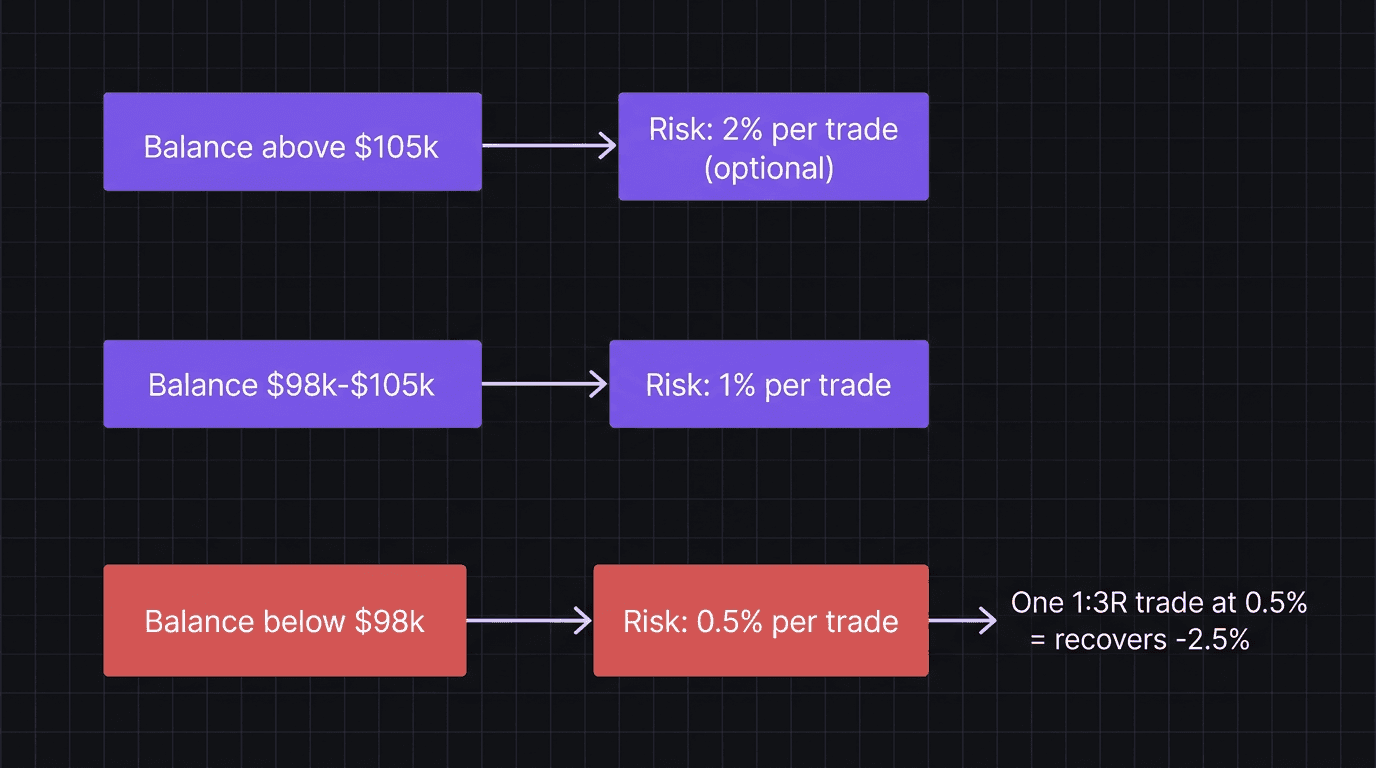
Risk 1% per trade until your balance drops to $98,000. Below that, cut to 0.5% per trade.
One good trade at 0.5% risk with a 1:3 reward recovers +1.5%, covering three losing trades at the same level. The math works in your favor when you stay patient.
The De-Risking Framework
This is the part most funded traders skip, and it costs them accounts.
At $100,000 balance, you have a 10% overall drawdown limit. That means your hard floor is $90,000. But you do not wait until $90,000 to adjust.
$100k to $98k: Risk 1% per trade. Normal operations.
Below $98k: Switch to 0.5% per trade. You are in capital preservation mode.
At $105k (5% buffer): Optionally increase to 2% per trade to accelerate growth.
The 0.5% risk level is your safety net. At 0.5%, you can take 16 consecutive losing trades before hitting the 10% drawdown limit from a $98k balance. That almost never happens with a tested strategy.
And here is the key insight: one winning trade at 0.5% risk with a 1:3 reward gives you +1.5%. That single trade recovers three losing trades at the same risk level. You are just one trade away from turning the corner.
Scaling: From One Account to Multiple
Once you are consistently profitable on one $100k account, the scaling strategy is simple: reinvest payouts into new accounts.
1x $100k at 5% monthly with a 60/40 split = $3,000/month to you
2x $100k accounts = $6,000/month
4x $100k accounts (or 2x $200k) = $10,000-$12,000/month
Do not scale by increasing risk on one account. Scale by adding accounts. Each account has its own drawdown rules, so blowing one does not affect the others.
Buffer rule: Never withdraw 100% of your profits. Leave a 2-5% buffer in the account for losing streaks. If your balance is $107,000, withdraw down to $103,000 or $104,000, not back to $100,000.
Walkthrough: What Not to Do After Getting Funded
You pass both phases and get your $100k funded account. The first week, you make $3,200. You feel unstoppable. Week two, you increase your risk to 3% per trade because "the account can handle it."
Tuesday hits. GBP/JPY gaps against you at London open. You lose $3,000 on one trade. Balance: $100,200. You take another trade to "make it back." Another $3,000 loss. Balance: $97,200.
Now you are below $98k, but you are still trading at 3% risk because you never set a de-risking threshold. Two more losses put you at $91,200. One bad day from termination.
The account that took you six weeks to earn is now hanging by a thread because you skipped the de-risking framework.
Had you switched to 0.5% risk at $98k, those same two losses would have cost $985 instead of $5,800. Balance: $96,215 instead of $91,200. Still in the game. Still recoverable.
How EdgeFlo Supports Funded Traders
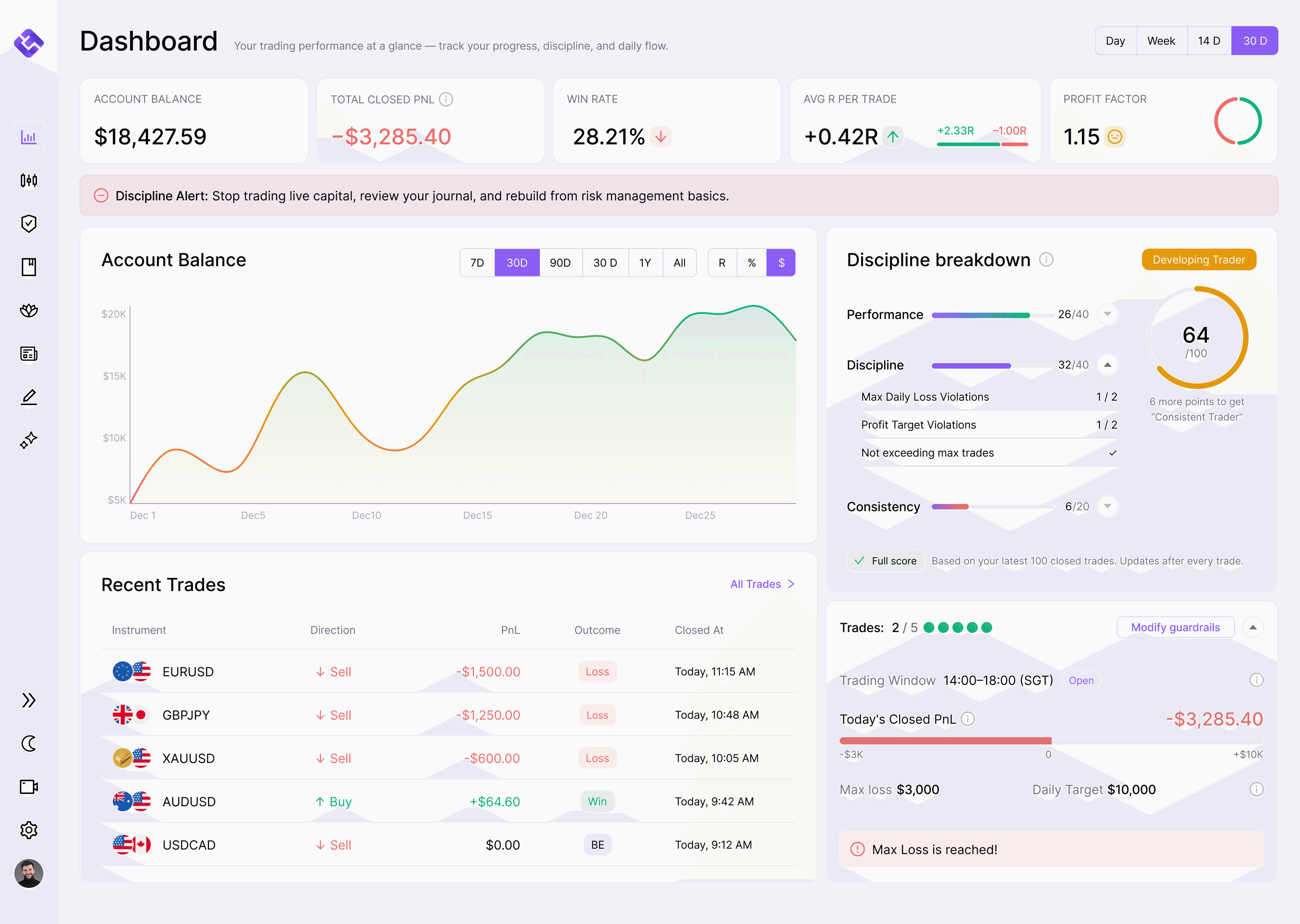
EdgeFlo connects directly to MT4, MT5, and cTrader, syncing your balances, positions, and orders in real time. For funded traders, this means you see your exact drawdown position at a glance, not after doing mental math.
The position sizing calculator auto-calculates lot size based on your account balance, risk percentage, and stop loss distance. Set it to 1% and it handles the math on every trade. When you need to de-risk to 0.5%, change one number. No spreadsheet, no guessing.
Pair that with a trade journal that auto-imports every trade, and you have a feedback loop showing exactly how your funded account is performing across days, weeks, and months.
Building Confidence Before the Challenge
You do not build confidence by watching motivational videos. Confidence comes from competence. And competence comes from data.
Before you pay a challenge fee, backtest your strategy on at least 100 trades. Then forward test on a demo account for 30 days. Track your win rate, average R, and maximum consecutive losses.
If your backtest shows consistent profitability within the firm's drawdown rules, you have evidence. Not hope. Evidence. That is what carries you through the inevitable losing streaks that come after funding.
Discipline before the trade. Discipline during the trade. Discipline after the trade. That sequence does not change at any account size.
The Edge Brief
Receive Insights on trading psychology, discipline, and the behavioral patterns that create consistent traders from our Founder and the EdgeFlo team, delivered to your inbox.
Think different. Trade different.
How much does it cost to become a funded trader?
What is the daily loss limit for funded accounts?
How long does it take to get funded?
Can you make a living as a funded trader?

Turn discipline on.
Every session.
EdgeFlo is the environment serious traders operate inside.
Start 7-Day Free Trial
Cancel anytime.
No long-term commitment.

Think Different, Trade Different.