

How to Get Funded Trading in 8 Months
A real trader went from zero experience to $850K in funding in 8 months. Here's the actual timeline, phases, and mistakes that shaped the path.
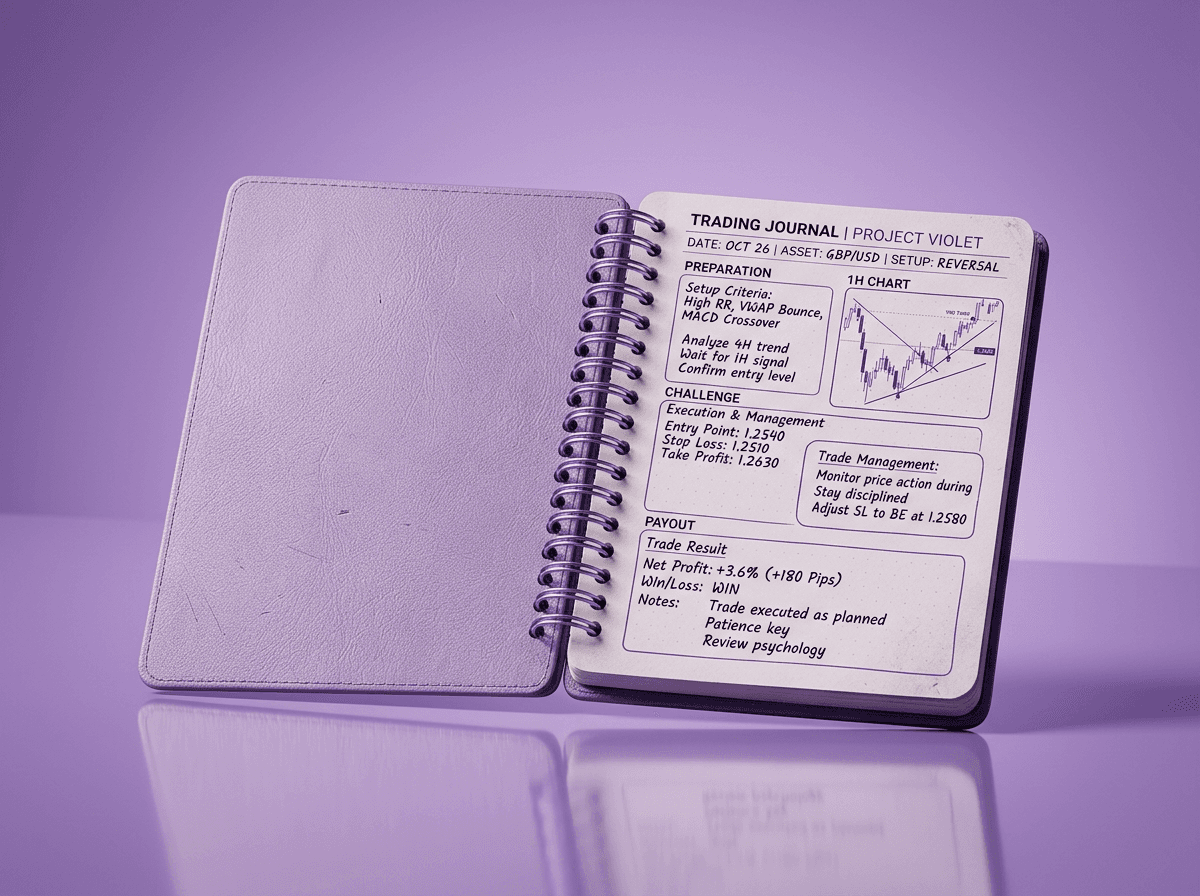
Getting funded as a trader takes most people 6 to 12 months of focused work. Not 6 weeks. Not a weekend course. One trader, Yousef, went from never having placed a trade to holding $850K in funded accounts across multiple prop firms in about 8 months. He spent the first 4 to 5 months purely learning, never touching a funded challenge. That patience is what most beginners skip, and it is the single biggest reason funded challenges end in failure.
Here is what the timeline actually looks like when someone does it right.
TL;DR
Expect 4-5 months of learning before you attempt a single funded challenge. Rushing this phase is the #1 reason traders blow challenges.
Your first funded accounts will probably fail. Budget for it. One trader lost an account 3 days after posting about his $400K funding on social media.
Start with larger accounts ($100K-$150K) if your strategy is solid. Smaller accounts have tighter margins that punish normal drawdowns.
Pick one trading session (London or New York) and stick with it. Trading both doubles your exposure to giving back profits.
The Realistic Funded Trading Timeline
Most content about getting funded makes it sound like a 30-day sprint. Pass a challenge, collect your account, start earning. The reality is messier and slower, but the payoff is much bigger when you respect the process.
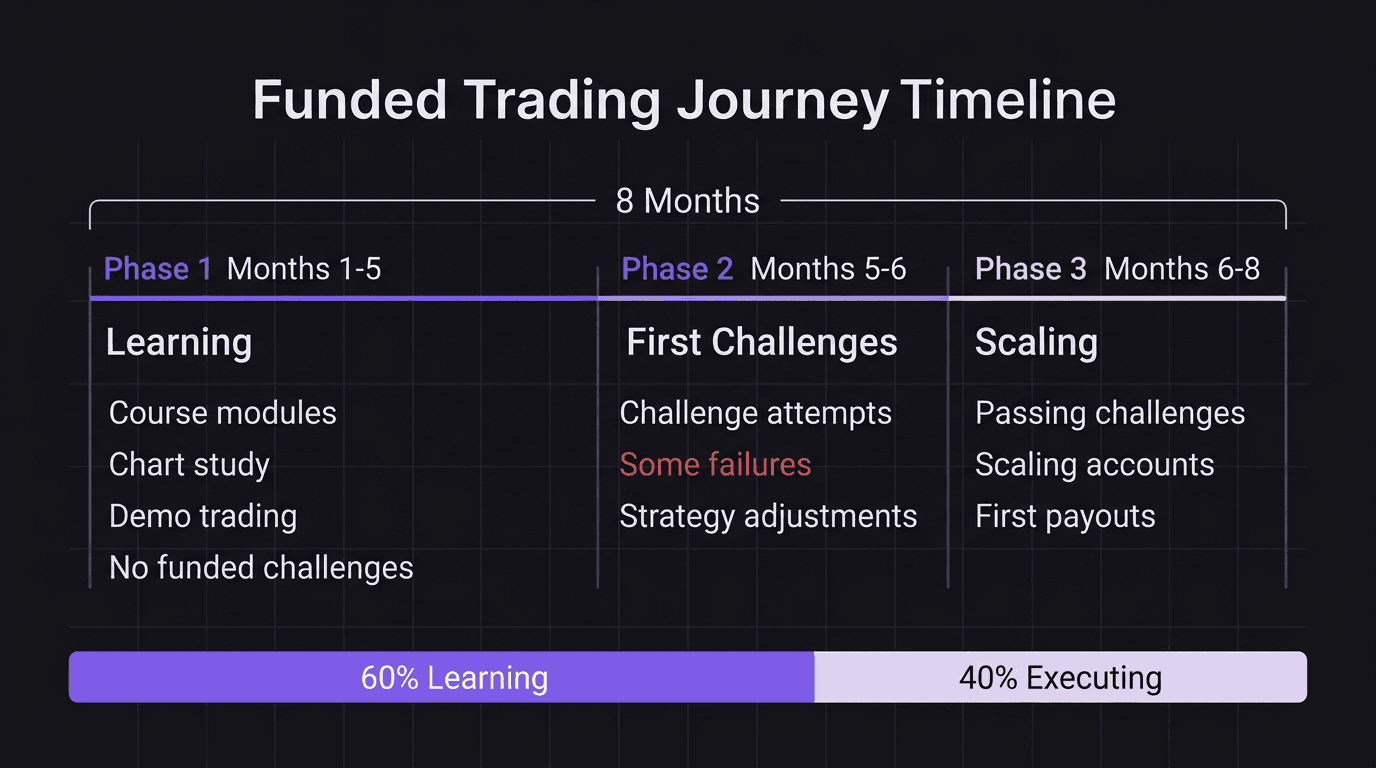
Yousef's timeline breaks into three distinct phases. He started in April 2025 with zero trading knowledge. By December 2025, he had $850K in funded capital across TopStep and Alpha Capital. His first payout was $5,000 from Alpha Capital.
That is 8 months total. But the breakdown matters more than the total number.
Months 1-5: Learning. Course modules, chart study, demo trading. No funded challenges.
Months 5-6: First challenge attempts. Some failures. Strategy adjustments.
Months 6-8: Passing challenges, scaling accounts, first payouts.
The ratio is roughly 60% learning, 40% executing. Most traders flip that ratio. They spend a few weeks watching videos and then throw money at challenges for months wondering why they keep failing.
Phase 1: Learn the System
The first phase is the one nobody wants to hear about. It is boring. There is no money coming in. You are watching charts move without trading them. You are reading about common trading mistakes and recognizing yourself in every example.
Yousef spent 4 to 5 months in this phase. He worked through structured course modules, studied market mechanics (inducement, market shift, liquidity concepts), and practiced on demo accounts. He did not rush it despite being 52 years old and having a successful career in cybersecurity behind him.
What "learning" actually means
It does not mean passively watching YouTube. It means:
Studying one strategy deeply. Yousef focused on a combination of market mechanics approaches. He did not try to learn 5 strategies at once.
Practicing that strategy on historical charts. Backtesting your trading strategy is where you build the pattern recognition that makes live trading feel slower.
Identifying your session. Yousef chose to trade London or New York, never both. He locked this in during the learning phase.
Documenting your rules. Writing down exact entry criteria, invalidation levels, and risk parameters before you ever risk real capital.
Walkthrough example: Yousef studied GBP/USD during the London session. He would mark the previous day's high and low, identify where liquidity was likely sitting above or below those levels, and wait for price to sweep that liquidity before looking for a market structure shift on the 5-minute chart. If price swept the previous day's low at 1.2640, shifted structure bullishly at 1.2655, he would enter long with a stop below 1.2635 targeting the previous day's high near 1.2710. During the learning phase, he tracked these setups on paper without placing real trades, building a log of 50+ examples before going live.
This phase is where your edge gets built. Skip it, and every challenge you attempt is basically a coin flip with fees attached.
Phase 2: Practice and Burn
Phase 2 is where reality hits. You have learned the strategy. You can identify setups on historical charts. Now you start trading live (or on sim accounts that feel live), and everything changes.
Yousef described this phase honestly. He overtraded. He revenge traded. He made every emotional mistake in the book. Sound familiar?
The difference between traders who get funded and traders who stay stuck is what happens after the burn phase. Yousef said he "woke up" and changed everything. He stopped trading both sessions. He stopped chasing losses. He accepted that if he could make $3,000 once, he could do it a thousand times, so there was no reason to stress over any single trade.
The practice-to-challenge transition
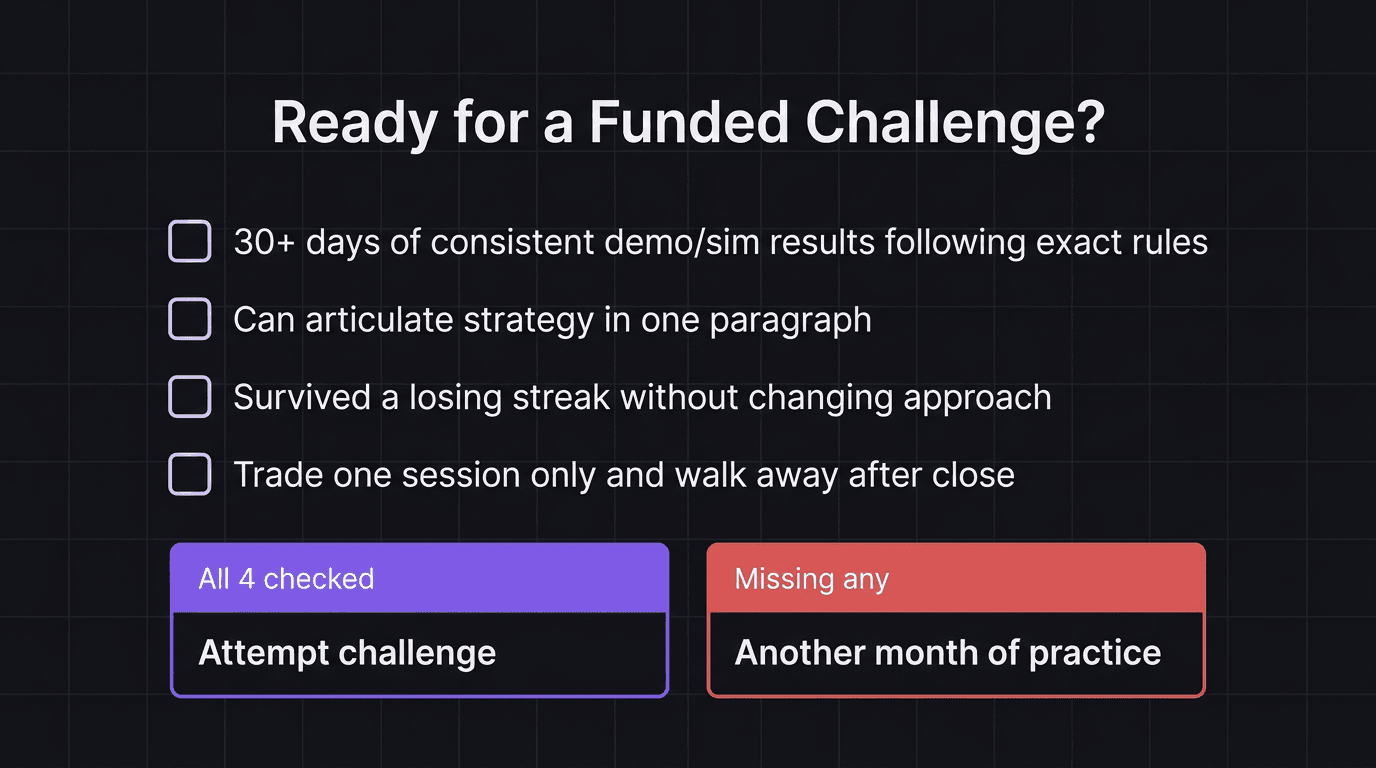
You know you are ready to attempt a funded trader challenge when:
You have at least 30 days of consistent demo/sim results following your exact rules.
You can articulate your strategy in one paragraph without hesitation.
You have survived a losing streak without changing your approach.
You trade one session only and walk away after that session closes.
If you cannot check all four boxes, you are not ready. Another month of practice costs nothing. A failed challenge costs real money.
What NOT to do: One common pattern is passing the practice phase technically but failing psychologically. A trader identifies valid setups on EUR/USD during New York, averaging 2R winners on a 1% risk model. On sim, they make $6,000 in a month on a $100K account. Then they enter a live challenge, take the same setup at 1.0920 long, and the trade goes 10 pips against them. Instead of holding to their stop at 1.0895, they panic-close for a 15-pip loss. Three hours later, they re-enter the same pair at a worse level because they want to "make it back." This is not a strategy problem. It is a discipline problem, and it means the practice phase was not finished.
Phase 3: Attempt Challenges and Scale
Once your practice results are consistent, you start attempting funded challenges. Here is where Yousef's approach gets interesting: he skipped the small accounts entirely.
Instead of starting with $10K or $25K challenges, he went straight to $100K and $150K accounts on TopStep. His reasoning was practical. Smaller accounts have tighter absolute drawdown limits, which means a normal string of losses can blow the account even when you are following your rules. Larger accounts give you more room to absorb the variance.
He also diversified across firms. TopStep for futures, Alpha Capital for forex. Different firms have different rules, and spreading across firms means losing one account does not wipe out your entire funded operation.
The account loss reality
Three days after posting on social media about reaching $400K in funding, Yousef lost one of his accounts. This is the part most "how I got funded" stories leave out.
He did not spiral. He did not change his strategy. He opened three more accounts and jumped to $850K total. His goal: $2M in funding by March 2026, then start trading his own capital.
The lesson is clear. Losing funded accounts is part of the process, not a sign you should quit. Managing funded accounts is an ongoing skill, not a one-time achievement. You will lose some. Budget for it emotionally and financially.
Scaling strategy
Start with 2-3 challenge accounts across 1-2 firms. Do not put all your eggs in one basket.
Build a buffer before taking payouts. TopStep funded accounts start at zero balance. You need to build profits before you can withdraw anything.
Take your first payout as soon as you qualify. Your first $5K payout proves the entire model works. Yousef's first payout from Alpha Capital was $5,000, and it changed his psychology around what was possible.
Reinvest failed challenge fees as a business expense. If you pass 3 out of 5 challenges, the 2 failures are your cost of doing business.
How EdgeFlo Supports Your Funded Journey
The hardest part of getting funded is not the strategy. It is executing that strategy consistently under pressure, trade after trade, session after session. EdgeFlo is built for exactly this problem.
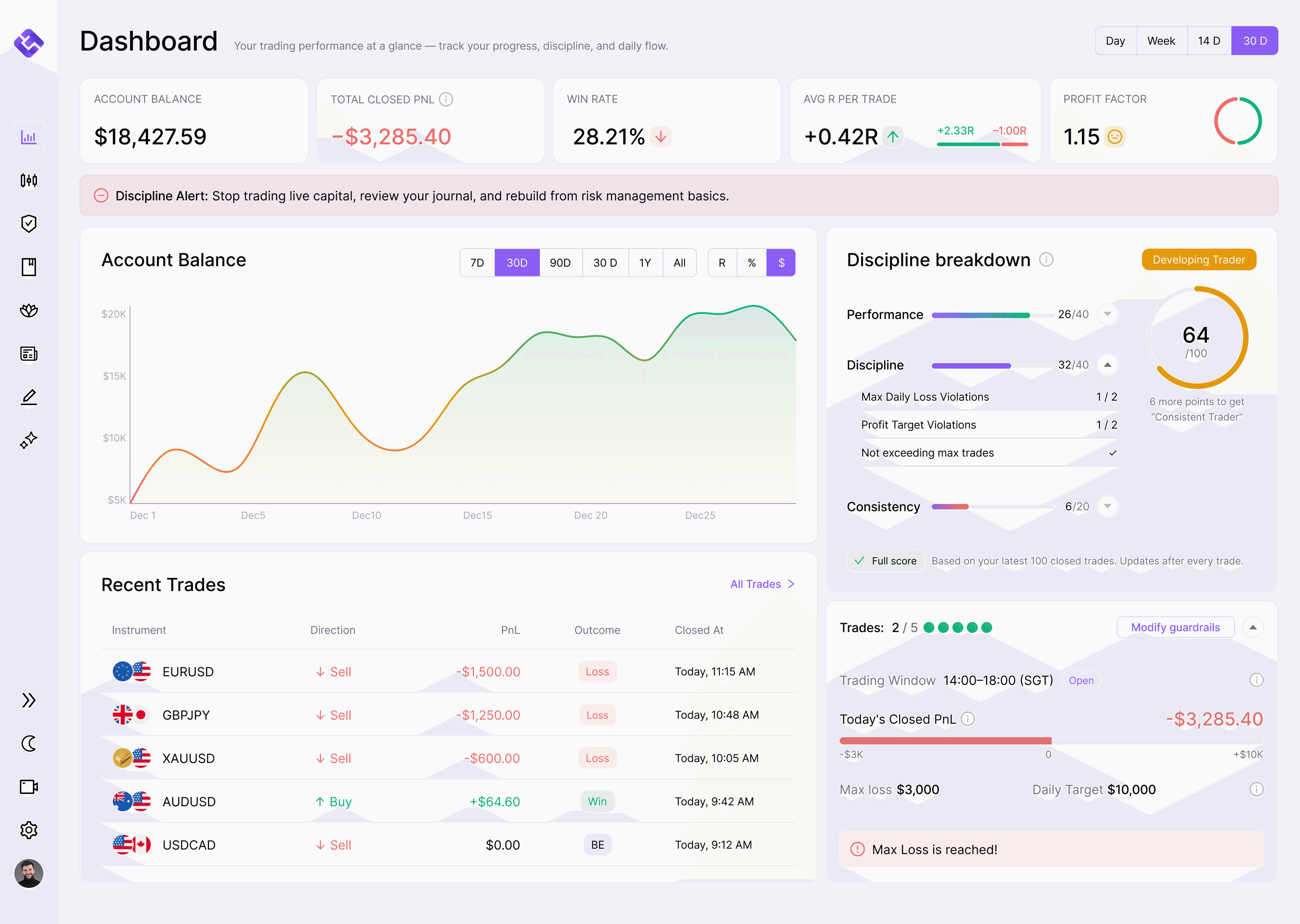
EdgeFlo's guardrails help you stick to your daily loss limits and risk-per-trade rules, which are the two most common reasons funded accounts get blown. You can set your prop firm's exact drawdown limits as guardrails, and EdgeFlo will restrict your trading when you approach those limits. You can override the restriction if you choose, but you have to make that decision consciously.
The trading journal auto-imports your trades and lets you tag the emotional state behind each one. After a few weeks, you start seeing patterns: which sessions you perform best in, which setups you overtrade, and where your discipline breaks down. That kind of visibility is what turns a 50% challenge pass rate into an 80% one.
The Edge Brief
Receive Insights on trading psychology, discipline, and the behavioral patterns that create consistent traders from our Founder and the EdgeFlo team, delivered to your inbox.
Think different. Trade different.
How long does it take to get funded trading from scratch?
Can you get funded with no trading experience?
Should I start with small or large funded accounts?
How many funded challenges will I fail before passing?

Turn discipline on.
Every session.
EdgeFlo is the environment serious traders operate inside.
Start 7-Day Free Trial
Cancel anytime.
No long-term commitment.

Think Different, Trade Different.