

How to Journal Manipulation Setups
Standard journal templates miss manipulation data. Learn the five fields every manipulation entry needs and how to review sweep patterns to sharpen your edge.

You can study liquidity sweeps, inducements, and institutional manipulation for months. You can watch every YouTube video. You can read every article. But none of that knowledge compounds unless you track what you actually see and trade.
Standard journal templates capture the basics: entry price, exit price, P&L, maybe a note about your emotions. They miss the data that matters most for manipulation-based trading. They do not record whether a sweep happened, what type of liquidity was targeted, or whether your entry was on the first touch or the second.
Without that data, you cannot refine your reads. And without refinement, you are just guessing with a fancy vocabulary.
TL;DR
Standard journal templates do not capture the fields you need for manipulation setups.
Five specific fields transform a generic trade log into a manipulation refinement tool.
Tagging sweep type, liquidity level, and mitigation timing builds a personal dataset of what works.
Weekly review sessions reveal which setups are high-probability for your style.
The journal is where pattern recognition becomes measurable edge.
Why Standard Journal Templates Miss Manipulation Data
Open any popular trading journal. You will find columns for date, pair, direction, entry, stop, target, P&L, and maybe a comment box. Some add risk-to-reward ratio and a screenshot.
That is fine for basic trade tracking. But if you are trading manipulation setups (liquidity sweeps, inducements, consolidation traps, news whipsaws), those fields tell you almost nothing about why the trade worked or failed.
Consider two losing trades:
Trade A: You entered a demand zone on the first touch, got swept by an inducement, and stopped out 10 pips before the real move.
Trade B: You entered after a confirmed sweep and structure shift, but the zone failed because a larger timeframe supply zone overhead rejected price.
In a standard journal, both look the same: a losing trade with a note that says "stopped out." But the lessons are completely different. Trade A tells you to skip the first mitigation. Trade B tells you to check for opposing higher-timeframe zones.
Without fields for sweep type, mitigation count, and zone context, you cannot distinguish between these failure modes. And if you cannot distinguish them, you cannot fix them.
The Five Fields Every Manipulation Entry Needs
Add these five fields to every manipulation trade in your journal. They capture the data that standard templates miss.
1. Sweep Type
What kind of liquidity sweep occurred before your entry?
Equal high/low sweep (stops above or below equal levels)
Range sweep (consolidation breakout and reversal)
News sweep (initial spike during high-impact event)
Inducement sweep (small structure break baiting early entries)
No sweep (you entered without a prior sweep, which is a flag)
2. Liquidity Level Targeted
What specific price level was the sweep targeting?
Record the exact level: "Equal lows at 1.0840" or "Range resistance at 1.2740." This lets you review later whether your level identification was accurate and whether the sweep reached your predicted target.
3. Entry Timing (Mitigation Count)
Was this the first time price visited the zone, the second, or the third?
First mitigation (higher risk, more inducement exposure)
Second mitigation (cleaner, usually after the first sweep)
Third+ mitigation (zone may be weakening from repeated tests)
Post-sweep first entry (zone formed after a sweep, so the first touch is already "cleaned")
4. Reaction Quality
How strong was the initial reaction from the zone?
Strong displacement (3+ candles moving away sharply)
Moderate bounce (1-2 candles, then slow continuation)
Weak tap (brief pause, no real displacement)
Failed (zone did not hold, price continued through)
5. Thesis Confirmation
Did the outcome confirm or deny your manipulation thesis?
Confirmed (sweep happened as expected, real move followed)
Partially confirmed (sweep happened but direction was wrong)
Denied (no sweep occurred, or the sweep was the real move, not the trap)
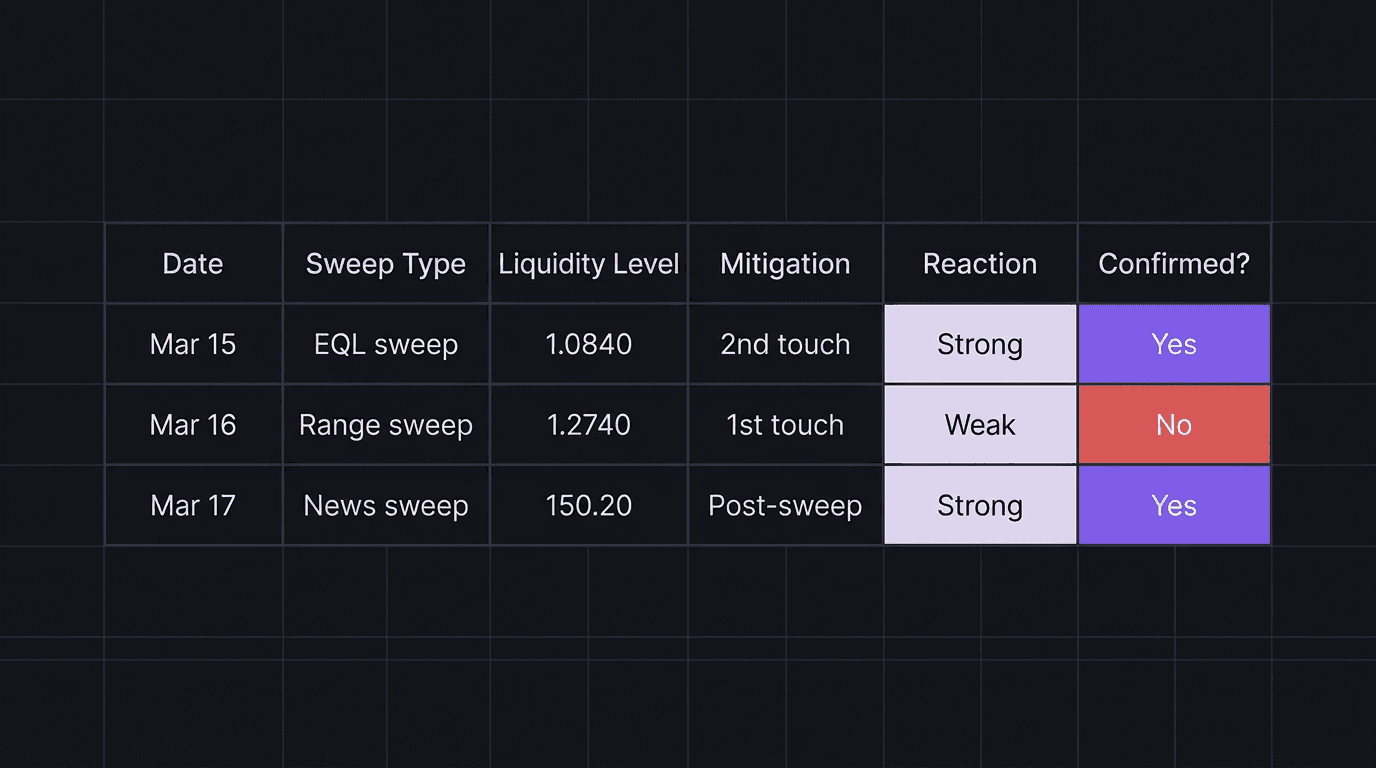
How to Tag Sweep Type, Direction, and Outcome
Tagging is only useful if it is consistent. Use the same labels every time so your data is filterable and comparable.
Here is a simple tagging system:
`BSL` = buy-side liquidity (stops above, swept upward)
`SSL` = sell-side liquidity (stops below, swept downward)
`EQL` = equal highs/lows sweep
`RNG` = range/consolidation sweep
`NEWS` = news event sweep
`IND` = inducement sweep
`WIN` = trade reached target
`BE` = trade closed at breakeven
`LOSS` = trade stopped out
`SKIP` = identified the setup but chose not to enter
The `SKIP` tag is important. Tracking setups you identified but did not trade tells you whether your patience is costing you or saving you. After a month, filter for `SKIP` entries and check whether they would have been winners or losers. That data calibrates your aggression level.
Walkthrough: A Week of Tagged Manipulation Entries
Monday: EUR/USD. SSL EQL sweep at 1.0850. 2nd mitigation. Strong reaction. WIN. +3.2R. Tuesday: GBP/USD. BSL RNG sweep at 1.2740. 1st mitigation. Weak reaction. LOSS. -1R. Wednesday: USD/JPY. SSL NEWS sweep at 150.20. Post-sweep entry. Strong reaction. WIN. +2.8R. Thursday: EUR/USD. SSL IND sweep at 1.0890. 1st mitigation. Failed zone. LOSS. -1R. Friday: GBP/USD. BSL EQL sweep at 1.2680. 2nd mitigation. Strong reaction. SKIP. Would have been +4.1R.
After this week, the patterns jump out. The 2nd mitigation and post-sweep entries won. The 1st mitigation entries lost. The skip on Friday was a missed winner, suggesting the trader could be slightly more aggressive on confirmed 2nd mitigations.
That is five minutes of tagging per day. Over a month, it becomes a statistically meaningful dataset.
Reviewing Your Manipulation Journal for Edge Refinement
The journal is not a diary. It is a dataset. And datasets need regular analysis.
Schedule a weekly review. Here is what to look at:
Filter by sweep type. Which sweep types produce the best outcomes for you? Some traders are excellent at reading news sweeps but terrible at inducement timing. Your data will tell you where your edge actually lives.
Filter by mitigation count. Compare the win rate and average R of first-mitigation entries versus second-mitigation entries. If the data confirms the first-mitigation rule, enforce it. If your first-mitigation entries actually perform well (because you only enter post-sweep zones), update your rule accordingly.
Look for skipped winners. Filter for `SKIP` entries that would have been winners. Are you skipping out of fear or out of discipline? If the skipped setups match your highest-probability filter (e.g., second mitigation, SSL EQL sweep), you may be leaving edge on the table.
Track reaction quality versus outcome. Do "strong reaction" entries outperform "moderate" ones? If so, add a rule to your plan: only enter when the initial zone reaction shows strong displacement.
After a few months, your manipulation journal becomes a personal playbook. It tells you exactly which setups work for you, which do not, and where your biggest improvements are hiding.
How EdgeFlo Auto-Tags Manipulation Patterns in Your Journal
Building a journal habit is hard enough without adding five extra fields to every entry. EdgeFlo reduces the friction.
The AI-powered trading journal auto-imports your trades from your broker account. You do not need to type in entry price, exit price, or P&L manually. That automation frees up your time and mental energy for the manipulation-specific tags that matter.
FloAI (Plus plan) can surface observations about the structural context of each trade, which helps you fill in the sweep type and reaction quality fields during your post-trade review. Instead of relying on memory (which degrades fast after a session), you have AI-assisted context that makes your tags more accurate.
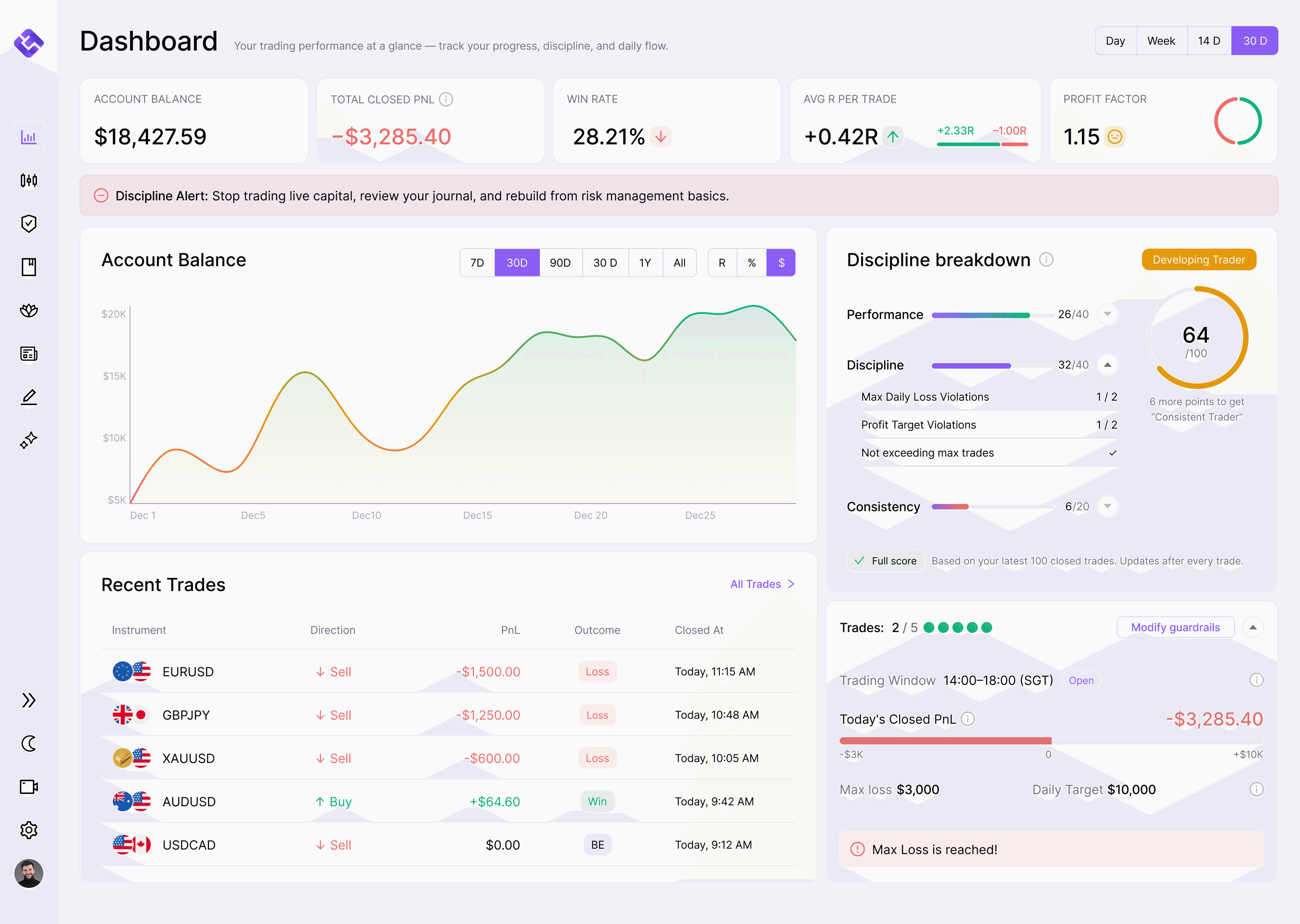
Over time, EdgeFlo's dashboard shows your stats filtered by the tags you assign. Pull up your win rate for "EQL sweep, 2nd mitigation" versus "RNG sweep, 1st mitigation" and the edge differences become obvious. That is not theory. That is your data, from your trades, on your pairs.
The best part: once you see the patterns in your own numbers, the discipline to wait for high-probability setups stops requiring willpower. It just becomes the obvious play.
The Edge Brief
Receive Insights on trading psychology, discipline, and the behavioral patterns that create consistent traders from our Founder and the EdgeFlo team, delivered to your inbox.
Think different. Trade different.
Why do standard journal templates miss manipulation data?
What five fields should a manipulation journal entry include?
How often should I review my manipulation journal?
Can journaling manipulation setups improve my win rate?
Turn discipline on.
Every session.
EdgeFlo is the environment serious traders operate inside.
Start 7-Day Free Trial
Cancel anytime.
No long-term commitment.

Think Different, Trade Different.