

Trading Goals: The Annual-to-Daily System That Drives Consistency
Set trading goals that actually stick. Use this annual-to-daily cascading system to turn vague ambition into structured daily action.
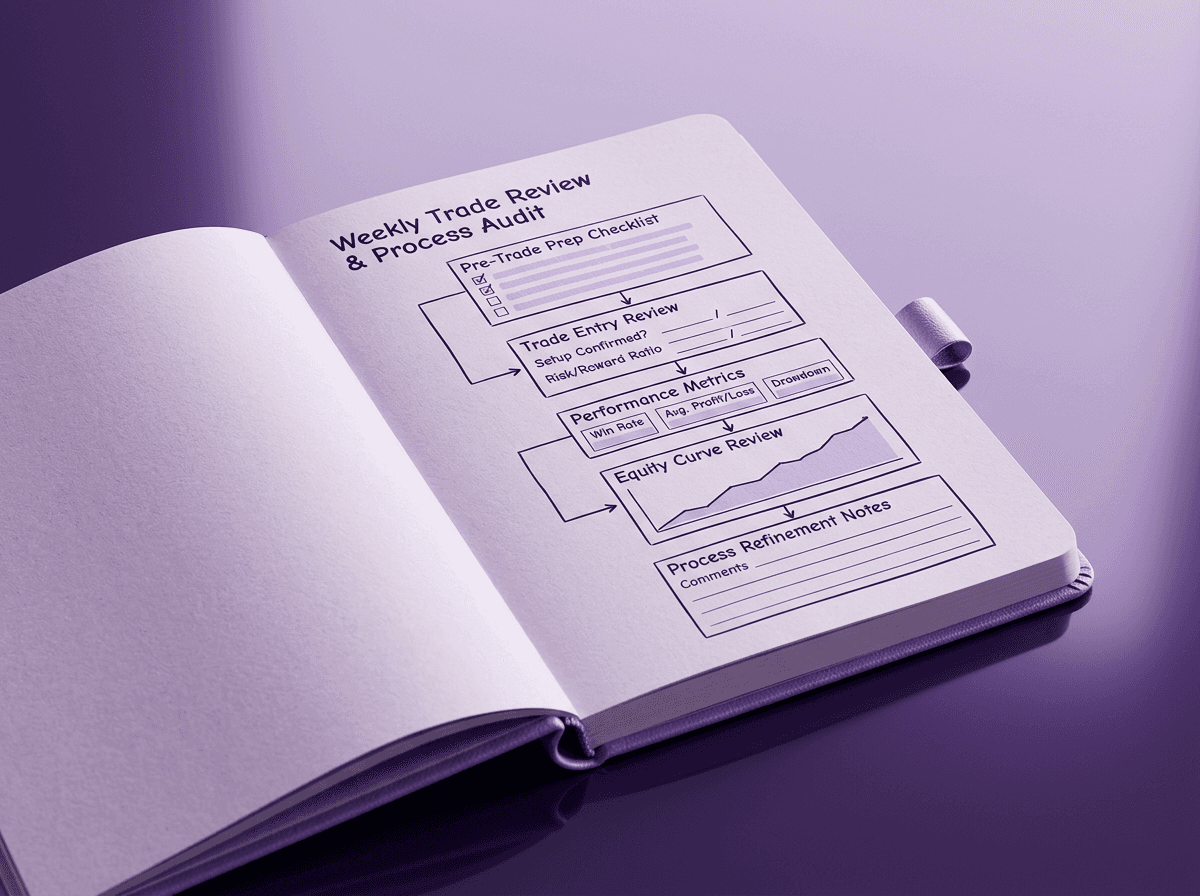
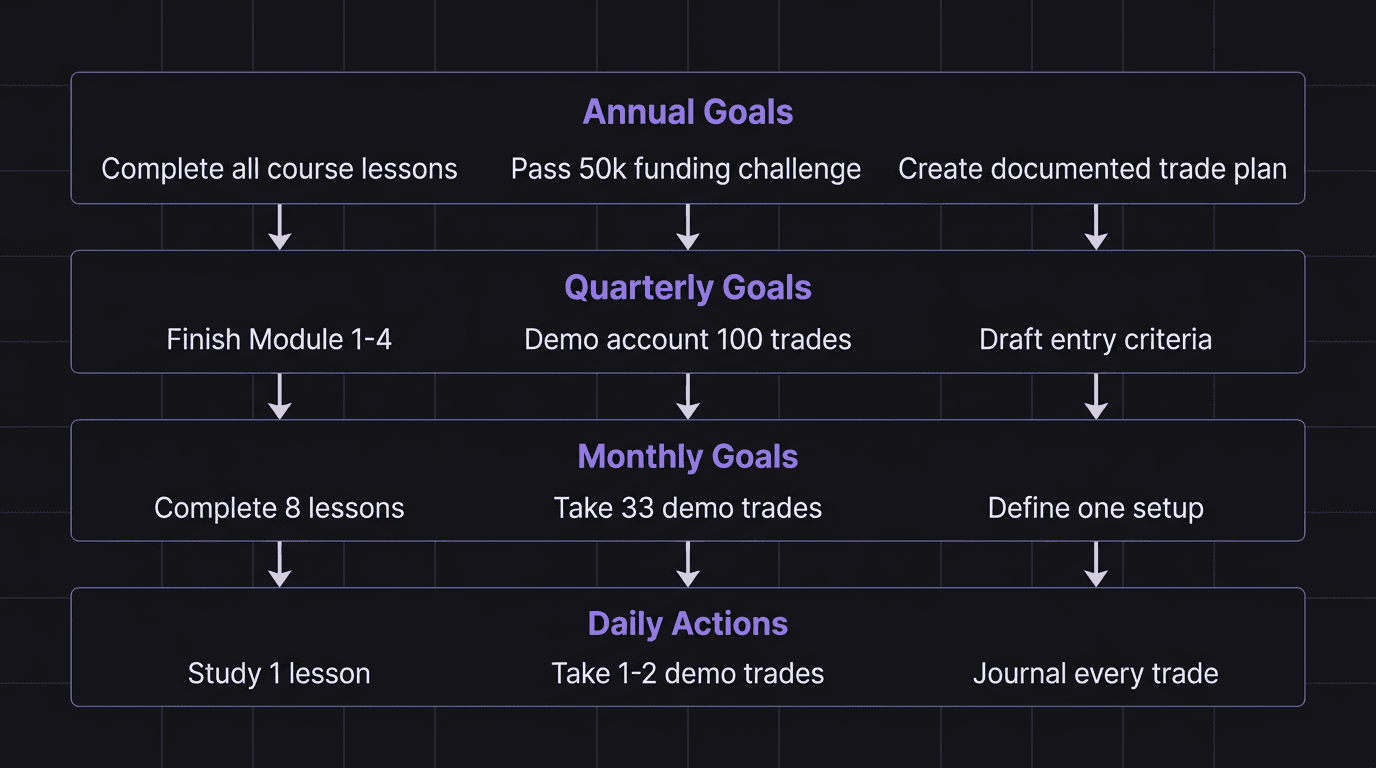
Trading goals work when they cascade from big to small. Set three annual goals, break each into quarterly milestones, then monthly actions, then daily tasks. Every level feeds the one above it. That structure turns "I want to be profitable" into something you can actually do today, this morning, in the next 30 minutes. Most traders skip this and wonder why January motivation disappears by March.
TL;DR
Set three annual trading goals, then reverse-engineer quarterly, monthly, and daily actions from each one.
Process goals (journal every trade, follow your plan) beat profit targets because you control them.
Visualize your goals every morning before the session starts.
Track daily wins and improvements to build a feedback loop.
Review and adjust at every level: daily, monthly, quarterly.
Why Most Trading Goals Fail
"I want to be a profitable trader." That sounds like a goal. It is not. It is a wish dressed up in trading clothes.
Most trading goals fail because they sit at the wrong altitude. They are either too high (annual profit targets with no plan underneath) or too low (random daily to-do lists disconnected from any bigger purpose). The gap between "make money" and "what do I do at 8 AM tomorrow" is where motivation dies.
The other killer? Profit-based goals you cannot control. You do not control whether a setup triggers. You do not control whether the market runs in your direction. You control your process, your preparation, and your discipline. Sound familiar?
A trader who sets "make $10,000 this quarter" will abandon the plan after two losing weeks. A trader who sets "follow my trading plan on every entry and journal every trade" stays in the game because the goal is about behavior, not outcome.
The Mistake That Compounds
> A trader sets a goal in January: "Pass my FTMO 50k challenge by June." Solid goal. But they never break it down. By February, they are still randomly taking trades on EUR/USD and GBP/JPY without a defined system. No monthly checkpoints. No weekly review. By March, the goal feels impossible. By April, they forget it exists. The problem was never the goal. It was the missing structure underneath it.
Annual Goals: The Big Three
Start with three annual goals. Not five, not ten. Three. Why three? Because you can actually remember three things without checking a spreadsheet.
Your annual goals answer one question: what does a successful year of trading look like for me? Not in dollar terms. In capability, system, and proof.
Good annual goals for a beginner trader:
Complete all course lessons in your chosen trading methodology
Pass a 50k funding challenge (or 25k, depending on your level)
Create a documented trade plan with entry criteria, risk rules, and exit strategy
Notice what these are not. They are not "make $50,000" or "quit my job." They are skill and system goals. You build the machine first. The output follows.
Write your three annual goals somewhere you will see them daily. A notebook, a sticky note on your monitor, your phone lock screen. The point is daily visibility. Every morning, look at them. Close your eyes. Visualize yourself actually achieving each one. This is not woo-woo motivation talk. It is pattern recognition for your brain. You rehearse the outcome so your daily actions feel connected to something real.
Quarterly Goals That Feed the Year
Your three quarterly goals should help you achieve your three annual goals. That sentence is the entire system. Read it again.
Take each annual goal and ask: "What needs to be true 90 days from now for me to be on track?" Then write it down.
If your annual goal is "pass a 50k funding challenge," your Q1 quarterly goal might be: trade a demo account for 100 trades using my exact strategy. You are not trying to pass the challenge yet. You are building the evidence that your system works before putting real pressure on it.
Quarterly goals should be measurable. "Get better at reading charts" is not measurable. "Complete 50 backtests on my A+ setup" is. You either did it or you did not.
Why 90 Days Works
Ninety days is long enough to build real skill but short enough to course-correct. If your quarterly goal was wrong, you only lost three months, not twelve. At the end of each quarter, sit down and review. Did you hit each goal? If not, why? Adjust the next quarter's targets based on honest reflection, not wishful thinking.
Monthly Goals That Feed the Quarter
Monthly goals are where the cascade gets tactical. Take each quarterly goal and divide it into monthly milestones.
If your Q1 quarterly goal is "100 demo trades with my strategy," your January goal is "33 demo trades." February, another 33. March, 34. Simple math, simple structure.
Monthly goals also catch drift early. You planned to take 33 trades in January and you took 12? That is a signal. Either the market was not giving setups, or you are hesitating. Both are worth investigating in your trading journal.
Here is where most traders add too much. Three monthly goals is the cap. If you have seven monthly goals, you have a wish list, not a plan. Pick the three that directly feed your quarterly targets and ignore everything else.
Daily Actions: Where Goals Become Real
Annual goals are inspiring. Quarterly goals are motivating. Monthly goals are clarifying. But daily actions are the only ones that actually happen.
Your daily action list should be short. Three things to accomplish today. That is it. Not ten things. Three. And they come directly from your monthly goals.
If your monthly goal is "complete 8 course lessons," your daily action is "study 1 lesson today." If your monthly goal is "take 33 demo trades," your daily action is "take 1-2 demo trades during London session."
The Daily Goal Ritual
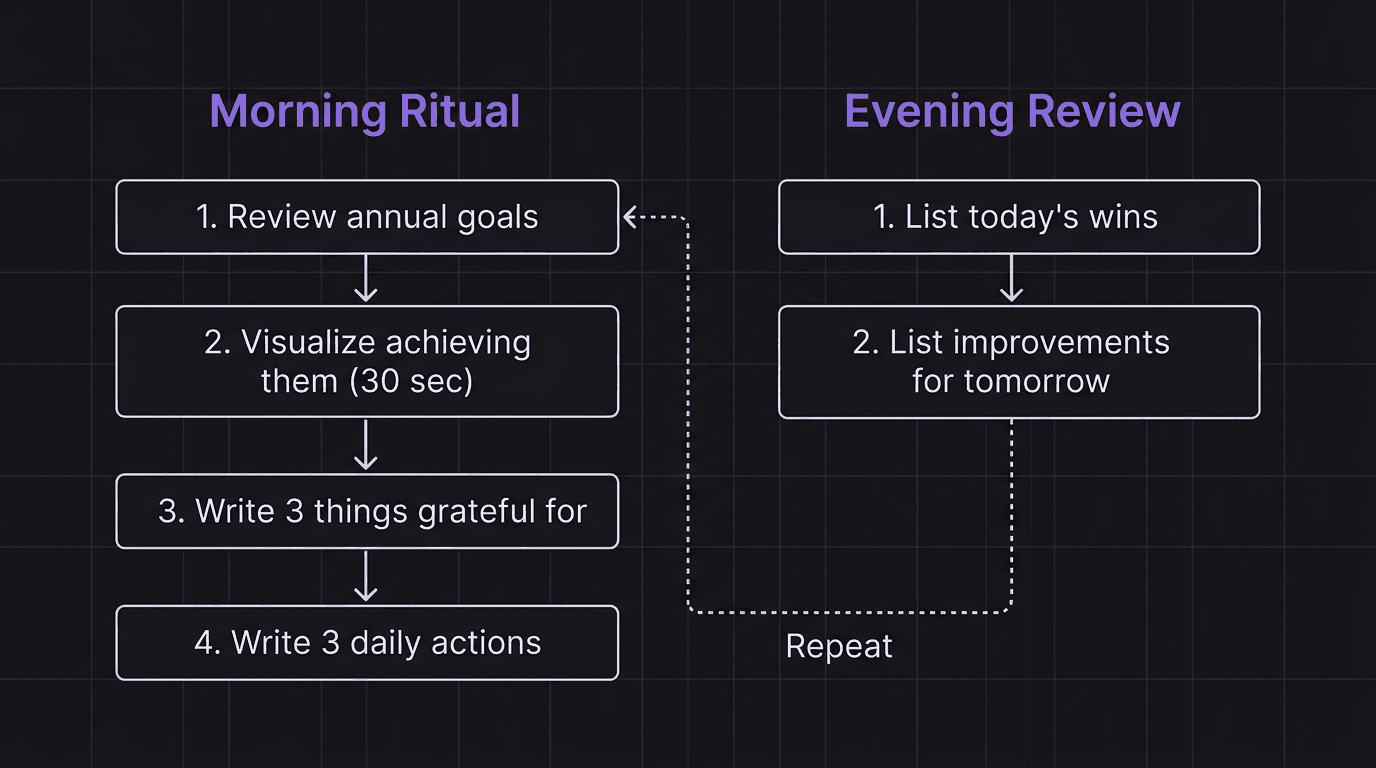
Every morning, before you open a chart:
Look at your three annual goals. Remind yourself what you are building.
Close your eyes and visualize achieving them. Thirty seconds. Not more.
Write three things you are grateful for. This sounds unrelated to trading. It is not. Gratitude shifts your baseline mood from scarcity (I need this trade to work) to abundance (I am building something real). Traders in scarcity mode make impulsive mistakes.
Write your three daily actions. Specific, achievable, connected to your monthly goal.
At the end of the day, review:
Wins: What went well today? Even small ones. "I followed my entry criteria on both trades." That counts.
Improvements: What would you do differently? Not self-criticism. Honest assessment. "I entered 5 minutes early because I was impatient. Tomorrow I wait for the candle close."
This end-of-day review is your daily journal habit in miniature. Over weeks, you build a pattern of wins and improvements that shows you exactly where you are growing and where you are stuck.
Building the Habit Stack
Ever noticed how goals fall apart on the days you "do not feel like it"? That is because you rely on motivation instead of structure. Stack your daily trading goals onto existing habits.
Wake up, brush teeth, make coffee, review goals. The goal review is not a separate event. It is part of your morning. The same way your pre-market routine is not optional. It is just what you do before trading.
Track these habits daily. Meditation, working out, clean diet, study trading, chart analysis, follow your mechanical plan, journal trades. A simple checkmark tracker (paper or digital) creates accountability that motivation alone cannot.
Walkthrough: A Cascading System in Action
> Sarah is a beginner trader six months into learning ICT concepts. Her annual goal: "Pass the FTMO 50k challenge by December." Her Q1 quarterly goal: "Complete the full ICT mentorship and demo trade 100 setups." Her January monthly goal: "Finish the first 8 lessons and take 25 demo trades on EUR/USD during London session." Her daily actions for January 15: study Lesson 6 (premium and discount zones), mark up EUR/USD on the 1H and 15M charts, and take one demo trade if a setup appears at the London open. She does not trade if no setup appears. That restraint is part of the process. At the end of the day, she writes: "Win: I identified a valid discount zone at 1.0845 and waited for the BOS before entering. Improvement: I almost entered early when price first touched the zone. Tomorrow, I wait for the break of structure candle to close."
That is what a cascading system looks like in practice. The daily action connects to the monthly goal connects to the quarterly milestone connects to the annual target. Nothing is disconnected.
How EdgeFlo Tracks Goal Progress
EdgeFlo Notebook includes templates for productivity, trading, performance review, and mindset. You can build your cascading goal system directly inside your trading environment, right next to your charts and journal.
Instead of switching between a goals app, a trading journal, and your charting platform, you keep everything in one place. Your annual goals sit in a Notebook page. Your daily actions are reviewed alongside your trade journal entries. Your end-of-day wins and improvements feed into your weekly and monthly reviews.
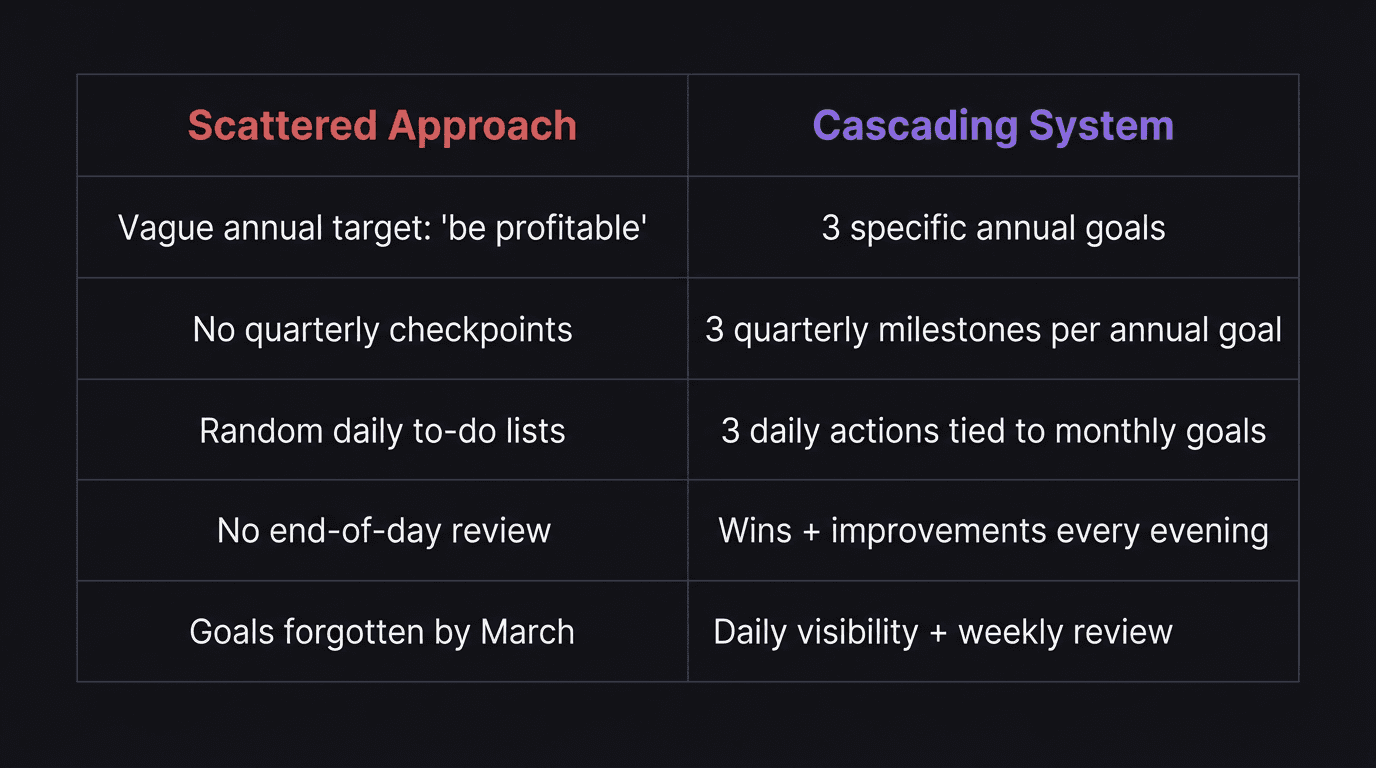
The structure works because visibility creates accountability. When your goals are visible every day, they stop being abstract intentions and start being a checklist you either completed or did not. That honesty, applied consistently, is how traders build the discipline that separates a hobby from a career.
The Edge Brief
Receive Insights on trading psychology, discipline, and the behavioral patterns that create consistent traders from our Founder and the EdgeFlo team, delivered to your inbox.
Think different. Trade different.
How many trading goals should I set per year?
Should I set profit targets as trading goals?
How often should I review my trading goals?
What is the cascading goal system for traders?

Turn discipline on.
Every session.
EdgeFlo is the environment serious traders operate inside.
Start 7-Day Free Trial
Cancel anytime.
No long-term commitment.

Think Different, Trade Different.