

Prop Firm Payout Strategy That Protects You
When should you take your first prop firm payout? Learn the timing, forex vs futures rules, and the compounding trade-off that keeps funded accounts alive.

Your prop firm payout strategy determines whether funded trading becomes a real income stream or an expensive hobby where profits disappear back into drawdowns. The core decision is timing: withdraw too early and you strip the buffer that protects your account. Wait too long and you leave earned money inside an account you could lose tomorrow. One funded trader lost an account three days after posting about his $400K in funding. If he had not already taken payouts, that profit evaporates with the account.
The answer is to build your buffer first, then withdraw the excess on a regular schedule. Here is exactly how to think about it.
TL;DR
Build a $10K-$15K profit buffer on a $100K account before your first withdrawal. This buffer absorbs losing streaks without threatening your drawdown limit.
Forex and futures firms have different payout structures. Futures firms like TopStep start you at zero balance, making early payouts riskier.
Take your first payout as soon as the buffer is secure. The first $5K in your bank account changes your psychology and proves the model works.
Regular smaller payouts beat infrequent large ones. Extract profits systematically instead of letting them accumulate in a vulnerable account.
The Payout Timing Decision
Most traders obsess over passing prop firm challenges and barely think about what happens after. But the payout phase is where funded trading either becomes sustainable or falls apart.
The pressure to withdraw starts immediately. You passed a challenge. Maybe you paid $500 for it. You want that money back, plus a return. The temptation to take your first $1,000 or $2,000 in profit is strong.
Resist it. Here is why.
Your funded account has a maximum drawdown limit, typically $3,000 to $6,000 on a $100K account depending on the firm. Every dollar you withdraw is a dollar removed from your cushion against that limit. If you are sitting on $5,000 in profit and withdraw $3,000, your remaining $2,000 buffer is dangerously thin. A normal 3-day losing streak risking 0.5% per trade ($500/trade) would eat through that buffer and put your account in immediate danger.
The first payout should come from a position of strength, not need. One trader waited until he had built significant profits in his Alpha Capital account before taking his first $5,000 payout. That patience meant his remaining buffer could absorb weeks of normal trading variance.
The payout timing formula
First payout threshold = Target buffer + Desired withdrawal amount
If your target buffer is $12,000 and you want to withdraw $5,000, you need $17,000 in profit before you touch anything. After the withdrawal, you still have $12,000 protecting your account.
After your first payout, shift to a monthly schedule:
End of month, calculate: Total profit minus target buffer = available payout.
If the number is positive, withdraw it.
If the number is negative, keep building. No withdrawal that month.
This removes emotion from the decision entirely. You never withdraw because you want money. You withdraw because the math says it is safe.
Forex vs Futures Payout Rules
Not all prop firms work the same way. The difference between forex and futures firm structures changes your payout strategy significantly.
Forex prop firms (Alpha Capital, FTMO, similar)
Forex firms typically fund your account with a simulated balance that matches your challenge size. Key characteristics:
Profit split: Usually 70-90% in your favor.
Payout schedule: Bi-weekly or monthly, depending on the firm.
Drawdown type: Usually a fixed drawdown from your starting balance. If you start at $100K with a $5,000 max drawdown, your account is terminated if equity drops below $95,000.
Buffer advantage: Because drawdown is measured from a fixed starting point, profits you build add directly to your cushion.
Walkthrough example: You have a $100K forex funded account with Alpha Capital. Fixed max drawdown of $5,000 (account terminates below $95K). You build $14,000 in profit, bringing your equity to $114,000. Your account can now drop $19,000 before termination ($114K - $95K). You withdraw $5,000. Your equity is $109,000. You can still drop $14,000 before termination. That is a massive cushion. You have secured $5,000 in cash and still have a very safe account position.
Futures prop firms (TopStep, similar)
Futures firms have a different, more challenging structure:
Zero starting balance. Your funded account begins with $0 in profit. The $100K or $150K is the firm's capital. You earn a share of profits you generate.
Trailing drawdown. Some futures firms use a trailing max drawdown that moves up with your equity but never moves down. If your account hits $105K and your trailing drawdown is $3K, your new floor is $102K. If equity drops to $102K, the account is terminated.
Payout timing. You cannot withdraw until you have built enough profit to cover the firm's minimum payout threshold.
The trailing drawdown is what makes futures payouts trickier. Every new high-water mark raises your floor. If you compound aggressively without withdrawing, your trailing floor can creep up to a level where a normal pullback terminates the account.
What NOT to do: On a TopStep $150K account with a $4,500 trailing drawdown, you build profits to $22,000 without withdrawing. Your trailing floor is now at $17,500. You have a losing week and give back $5,000 in profit, dropping to $17,000 in total profit. Your account is terminated because you dropped below the $17,500 trailing floor. If you had withdrawn $10,000 when you hit $18,000 in profit, you would have locked in cash and reset your exposure. The remaining $8,000 in the account would still be well above the floor.
Strategic implications
For forex accounts with fixed drawdowns: you can afford to build a larger buffer because profits do not raise your termination floor. Patience is rewarded.
For futures accounts with trailing drawdowns: you need to withdraw more frequently to prevent your floor from climbing too high. Leaving large profits in a trailing-drawdown account is actually riskier than taking regular payouts.
Building Your Buffer First
Before any payout strategy matters, you need the buffer. This is the non-negotiable foundation.
Buffer targets by account size
Account Size | Min Buffer | Comfortable Buffer | Calculation Basis |
|---|---|---|---|
$50K | $5,000-$7,000 | $8,000-$10,000 | 5x daily max loss + drawdown limit |
$100K | $10,000-$12,000 | $15,000-$18,000 | 5x daily max loss + drawdown limit |
$150K | $12,000-$15,000 | $18,000-$22,000 | 5x daily max loss + drawdown limit |
The formula: (Max daily loss x 5 trading days) + Max drawdown limit = Minimum buffer
For a $100K account risking 0.5% per trade with a max 3 trades per day, your max daily loss is $1,500. With a $4,500 drawdown limit: ($1,500 x 5) + $4,500 = $12,000 minimum buffer.
Buffer-building rules
Trade smaller during the buffer phase. Your position sizing during the first 4-6 weeks should be conservative. Risk 0.25-0.5% per trade, not 1%. You are building a cushion, not trying to maximize returns.
Set a strict daily loss limit. During buffer building, cap your daily loss at 50% of your normal max. If your normal max daily loss is $1,500, limit yourself to $750 during buffer phase. This protects against early account termination when your cushion is thinnest.
Do not withdraw anything during buffer building. Zero. Not $500 "just to test the system." Every dollar stays in the account until you hit your buffer target.
Track buffer progress daily. Know your exact cushion number at the end of every session. This awareness prevents careless risk-taking.
The Compounding vs Cashing Out Trade-Off
Once your buffer is built, you face the ongoing tension between compounding (leaving profits to grow the account) and cashing out (extracting profits regularly).
The case for cashing out
Risk reduction. Money in your bank account cannot be lost to a blown funded account.
Psychological proof. Regular payouts prove that funded trading generates real income. This reduces the anxiety that drives poor decisions.
Account diversification. Payout money can fund additional challenge attempts, spreading your funded capital across multiple firms and accounts.
The case for compounding
Larger position sizes. As your account grows, you can risk the same percentage on larger dollar amounts.
Faster scaling. Reinvested profits accelerate growth toward higher funding levels.
Fewer transactions. Less administrative overhead from withdrawal processing.
The balanced approach
For most traders, the answer is a hybrid: cash out regularly, but reinvest a portion into new challenges.
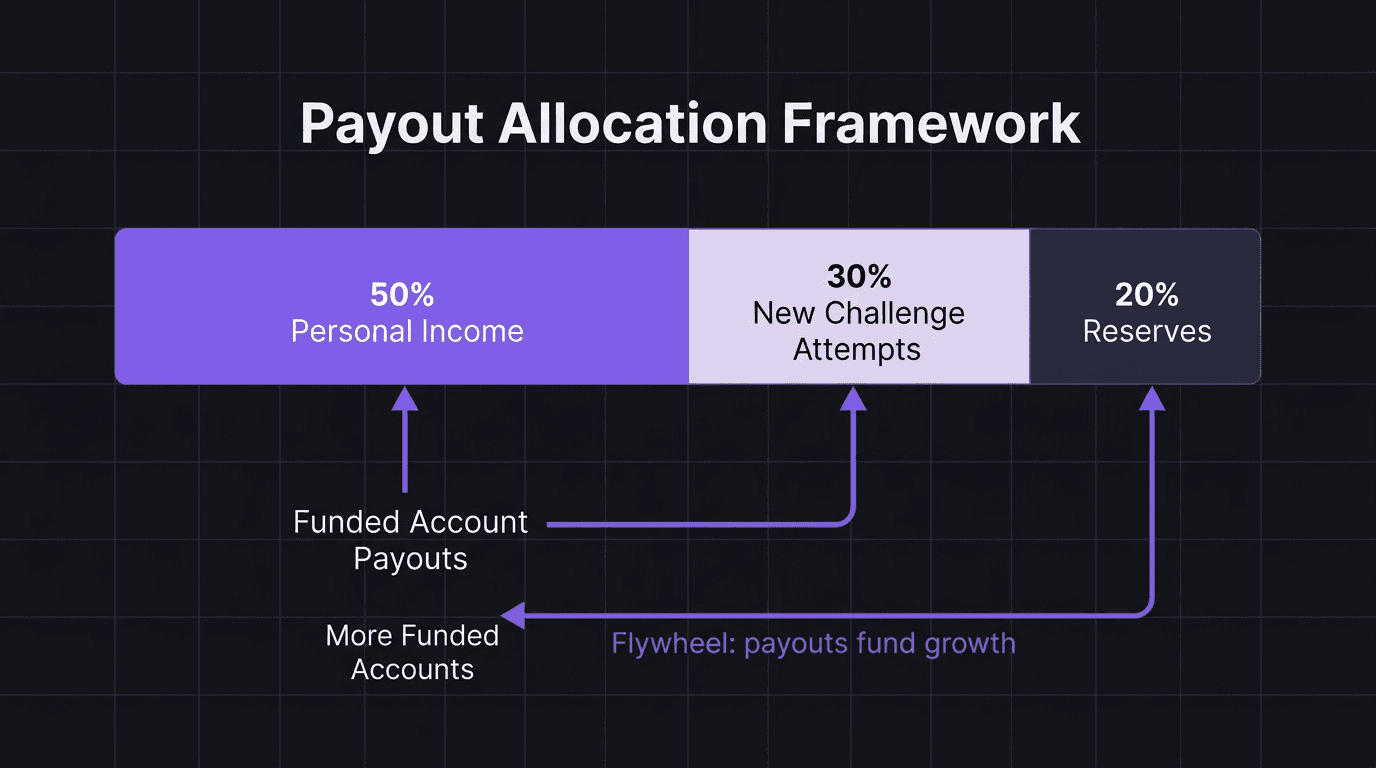
One trader's approach: build funded accounts across multiple firms (TopStep, Alpha Capital), take regular payouts from each, and use a portion of those payouts to attempt additional challenges. His goal of going from $850K to $2M in funding was funded partly by payouts from existing accounts. This creates a flywheel: profits from current accounts fund the challenges that generate more accounts.
This is a real prop firm scaling plan, not a gamble on a single account working forever.
Payout allocation framework
50% to personal income. This is why you are doing this.
30% to new challenge attempts. This funds your growth.
20% to reserves. This covers months where payouts are thin.
Adjust the ratios based on your situation, but the principle holds: never let 100% of your earnings stay inside funded accounts, and never spend 100% of your payouts.
How EdgeFlo Supports Your Payout Strategy
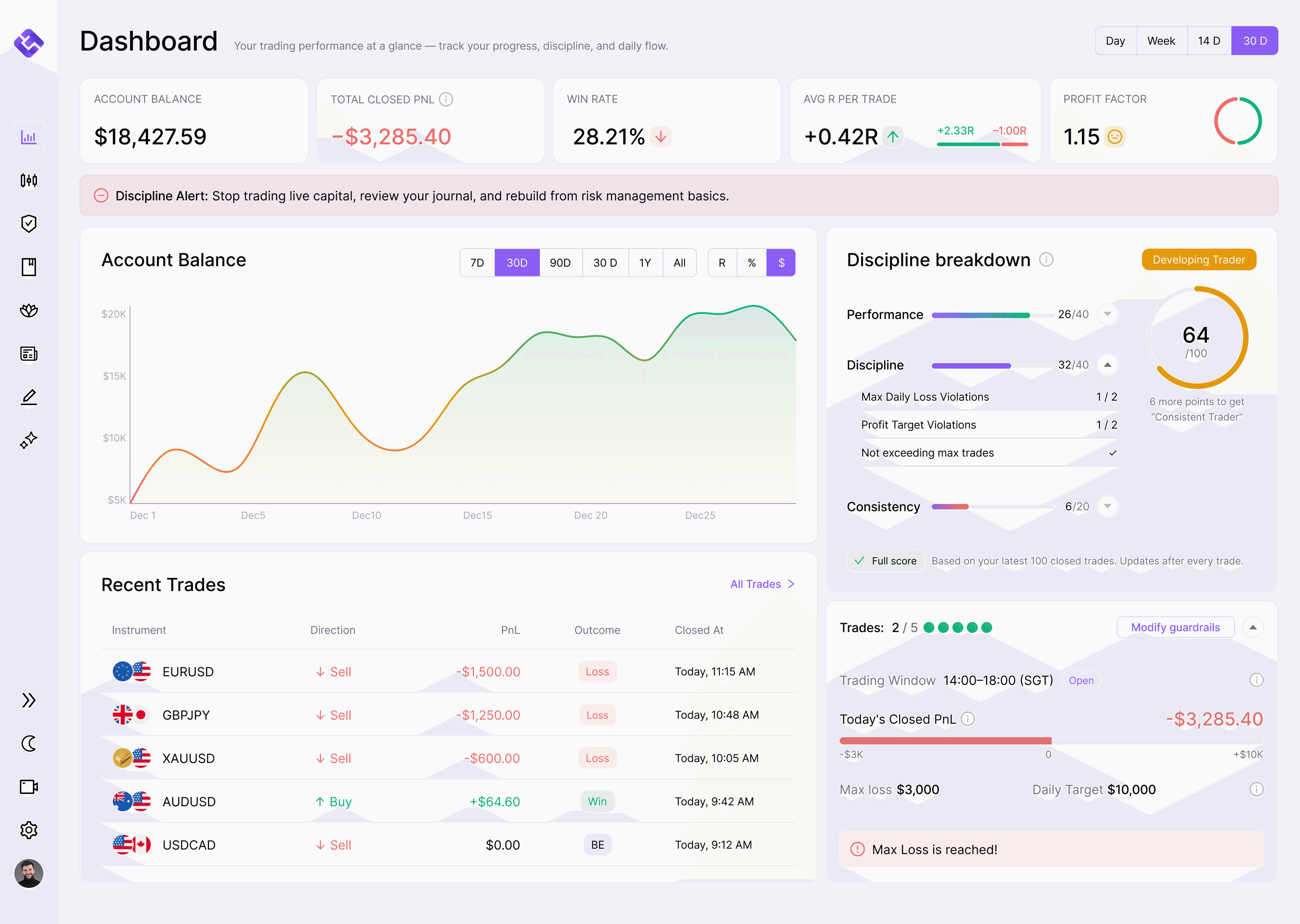
The decisions around payout timing come down to knowing your numbers: daily loss, buffer size, distance to drawdown limit. EdgeFlo makes these numbers visible during every trading session instead of forcing you to calculate them manually.
Set your prop firm's drawdown limit as a guardrail. EdgeFlo tracks your distance from that limit in real time and restricts trading when you get close. During the buffer-building phase, this is critical. You cannot accidentally trade your way to account termination if the guardrail triggers before you reach the danger zone. You can override it, but you have to choose to.
The trading journal provides the session-level data you need to calculate buffer progress. After each day, you can see exactly how much cushion you have built, how your recent risk levels compare to your targets, and whether your buffer is growing or shrinking. This visibility turns the buffer from an abstract concept into a concrete number you track daily, which is the difference between traders who protect their funded accounts and traders who lose them to careless withdrawals.
The Edge Brief
Receive Insights on trading psychology, discipline, and the behavioral patterns that create consistent traders from our Founder and the EdgeFlo team, delivered to your inbox.
Think different. Trade different.
When should I take my first prop firm payout?
What is the difference between forex and futures prop firm payouts?
Should I compound profits or take regular payouts?
How much of my prop firm profits can I keep?

Turn discipline on.
Every session.
EdgeFlo is the environment serious traders operate inside.
Start 7-Day Free Trial
Cancel anytime.
No long-term commitment.

Think Different, Trade Different.