

Trading Hesitation: Why You Freeze Before Good Entries
You see the setup, you know the plan, and you freeze. Learn why certainty-seeking causes hesitation and how to execute based on probabilities instead.
You see the setup. It matches your plan. The entry level is right there. And you freeze. You wait for one more candle, one more confirmation, one more reason to feel sure. By the time you click, price has moved 15 pips and the risk-to-reward no longer works. You watch the trade you should have taken hit your target without you.
This is not a discipline problem. It is a certainty problem. And it is one of the most expensive habits in trading.
TL;DR
Trading hesitation comes from seeking certainty in a probabilistic environment.
Your brain treats uncertainty as danger, which triggers a freeze response before entries.
Waiting for "one more confirmation" is not caution. It is fear wearing a smart disguise.
The fix is mechanical: replace live decisions with pre-written if-then rules that remove the judgment moment.
Building execution reps through deliberate practice rewires the freeze response over time.
The Certainty Trap
Every trader knows the market deals in probabilities. A 60% win rate means 4 out of 10 trades will lose. You accept this intellectually. But the moment your cursor hovers over the buy button with real money on the line, your brain rejects the math and demands certainty.
This is not weakness. It is biology. Your amygdala treats financial risk the same way it treats physical danger. It does not care about your backtest or your edge calculation. It sees potential loss and triggers a freeze response: stop, assess, wait for more information before acting.
The problem is that in trading, more information does not equal more certainty. One more candle does not make the setup safer. It just moves the entry further from the optimal level and compresses your reward while keeping your risk the same.
Sound familiar? You watch, you wait, you miss. Then you feel frustrated, and the frustration pushes you into the next trade without waiting for a setup at all. Hesitation and impulsive entries are two sides of the same coin: both are fear responses, just pointed in opposite directions.
What Hesitation Actually Costs
Missed trades do not show up in your journal. That is what makes hesitation so dangerous. Blown trades appear in your P&L. Hesitation is invisible.
But the cost is real. If your system generates 8 A-grade setups per month and you hesitate on 3 of them, you are running a different system than the one you backtested. Your backtest assumed you took every qualifying trade. Your live execution skips 37.5% of them, and those skipped trades are not random. They are usually the ones near support and resistance levels where the move is sharpest and the initial discomfort is highest.
Walkthrough: The Missed EUR/USD Entry
You are watching EUR/USD during the London session. Price has been trending bullish, making higher highs and higher lows on the 1-hour chart, confirming your daily bias. It pulls back into a demand zone at 1.0840 that you marked during your pre-market analysis. Your plan says: if price taps 1.0840 and the 15-minute candle closes bullish, go long with a stop at 1.0810 and a target at 1.0920.
Price hits 1.0840. A 15-minute candle closes with a strong bullish body. Your entry trigger fires. But you hesitate. "What if it sweeps lower first?" You wait for the next candle. It opens bullish and moves to 1.0855. Now your entry is 15 pips worse. Your stop is still at 1.0810 (45 pips away instead of 30), and your target is still 1.0920 (65 pips away instead of 80).
Same setup, same market, same outcome. But the hesitation cut your reward-to-risk nearly in half. At 1 standard lot on EUR/USD ($10 per pip), the planned trade risks $300 for $800. The hesitated trade risks $450 for $650. That 15-pip delay cost you $150 in extra risk and $150 in lost reward.
You did not lose money on the trade. You left it on the table because your brain wanted one more candle of certainty.
Why "Just Be More Disciplined" Does Not Work
Telling a hesitant trader to be more disciplined is like telling someone afraid of heights to just not look down. The fear response is not happening in the rational part of the brain. It is happening in the limbic system, which processes threats faster than your prefrontal cortex can override.
This is why thinking in probabilities matters so much. When you truly internalize that every trade is one of a hundred, the pressure on any single entry drops. You are not betting your future on this one click. You are executing one line in a spreadsheet that only makes sense over 50 or 100 repetitions.
But intellectual understanding is not enough. You need mechanical systems that bypass the decision moment entirely.
The Mechanical Fix: If-Then Execution
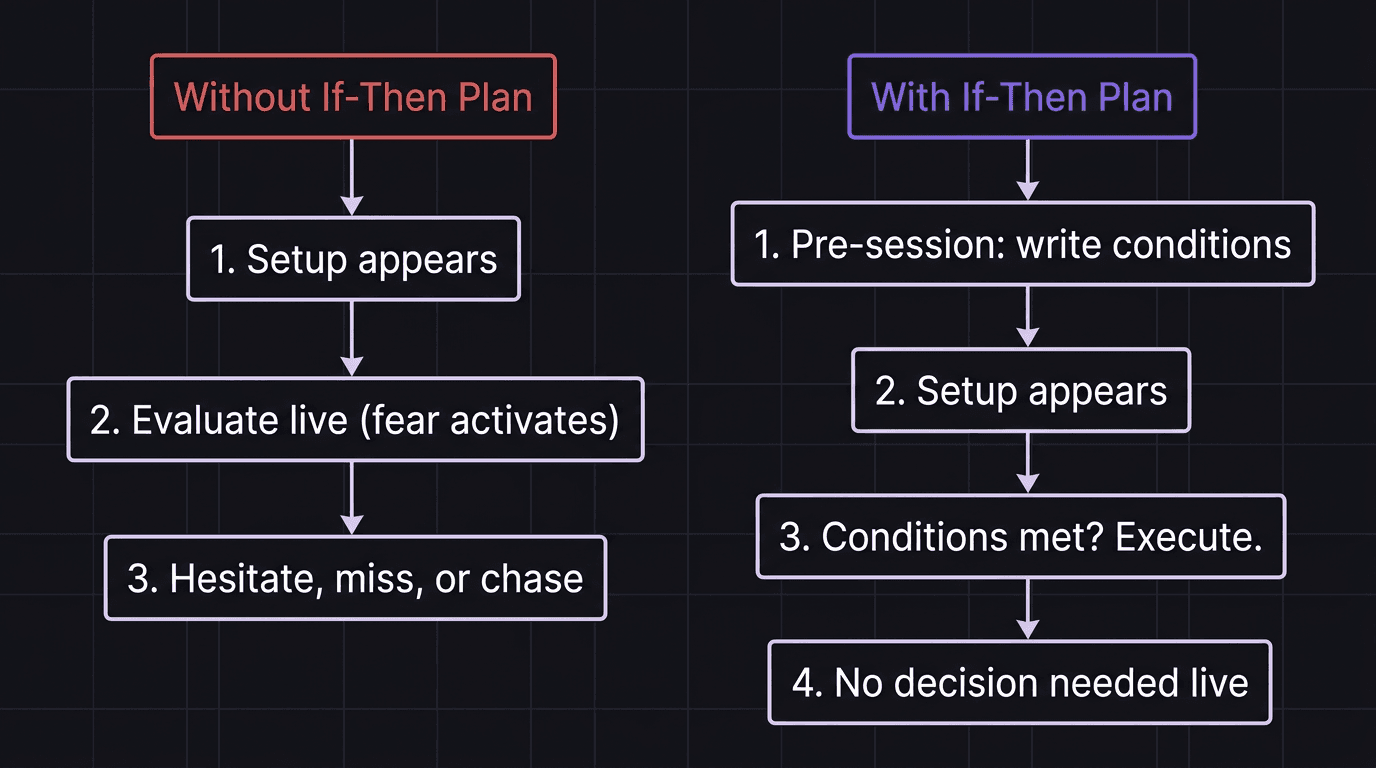
The most effective hesitation cure is removing the live decision. Instead of looking at the chart and deciding in real time whether to enter, you write the decision before the session starts.
Your pre-trade checklist should be specific enough that the entry becomes a mechanical action:
If price reaches 1.0840 and the 15-minute candle closes bullish and the 1-hour trend is up, then enter long at market. Stop at 1.0810. Target at 1.0920. Position size: calculated from 1% risk.
When all conditions are met, you click. No evaluation. No additional confirmation. No "let me see one more candle." The if-then plan already contains your judgment. The live moment is just execution.
This works because it shifts the cognitive load from the high-pressure live moment to the calm pre-session planning window. You make the hard decision when there is no money on the line. By the time the setup appears, the only task is following the instruction you already wrote.
Building Execution Reps
Mechanical rules help, but the freeze response does not vanish overnight. You need repetition to rewire it. Here is how:
Forward test on small size first. Take your system and trade it at the smallest lot size your broker allows. The goal is not profit. The goal is reps. Execute every qualifying setup without hesitation for 30 trades. Track your hesitation rate (how many setups you saw but did not take).
Score the hesitation, not the outcome. Add a field to your journal: "Did I execute within 5 seconds of the trigger firing?" A trade that loses but was executed cleanly is a win for this exercise. A trade that wins but was entered 2 minutes late after agonizing is a failure.
Review the misses weekly. Screenshot every setup you hesitated on and did not take. At the end of the week, check: would those trades have hit target? Over 20 to 30 samples, you will see that your missed trades perform about the same as your taken trades. That data is the strongest cure for hesitation because it proves, with your own evidence, that waiting did not protect you.
Walkthrough: What Not to Do
A trader watches GBP/USD during New York session. Price breaks below a key level at 1.2650 with momentum. His plan says to short the retest. Price retests 1.2650 and the 5-minute candle closes bearish. Everything checks out.
He freezes. "What if it is a fakeout?" He pulls up the 1-hour chart, then the daily, then checks the economic calendar. Nothing has changed. But 4 minutes have passed. Price has already dropped to 1.2620. He enters the short at 1.2620 instead of 1.2650.
His stop is still at 1.2670 (now 50 pips away instead of 20). His target was 1.2580 (now 40 pips away instead of 70).
He turned a 3.5R trade into a 0.8R trade. The setup was right. The hesitation turned a great trade into one that barely covers the risk. He should have either entered at the trigger or skipped the trade entirely. Chasing after a hesitation is the worst of both worlds.
Hesitation vs. Legitimate Caution
Not every pause is hesitation. Sometimes the setup genuinely does not meet your criteria, and waiting is correct. The difference:
Legitimate caution: "The 15-minute candle has not closed yet. My rule says wait for the close." You are following your plan. This is discipline, not fear.
Hesitation: "The candle closed bullish. My conditions are met. But I want to see one more candle just to be safe." You are adding conditions that are not in your plan because you are afraid.
If you catch yourself inventing new requirements at the moment of entry, that is hesitation. Write it down. Track it. Over time, you will see the pattern clearly: the added conditions do not improve your hit rate. They just delay your entries and shrink your R:R.
How EdgeFlo Helps You Execute Without Freezing
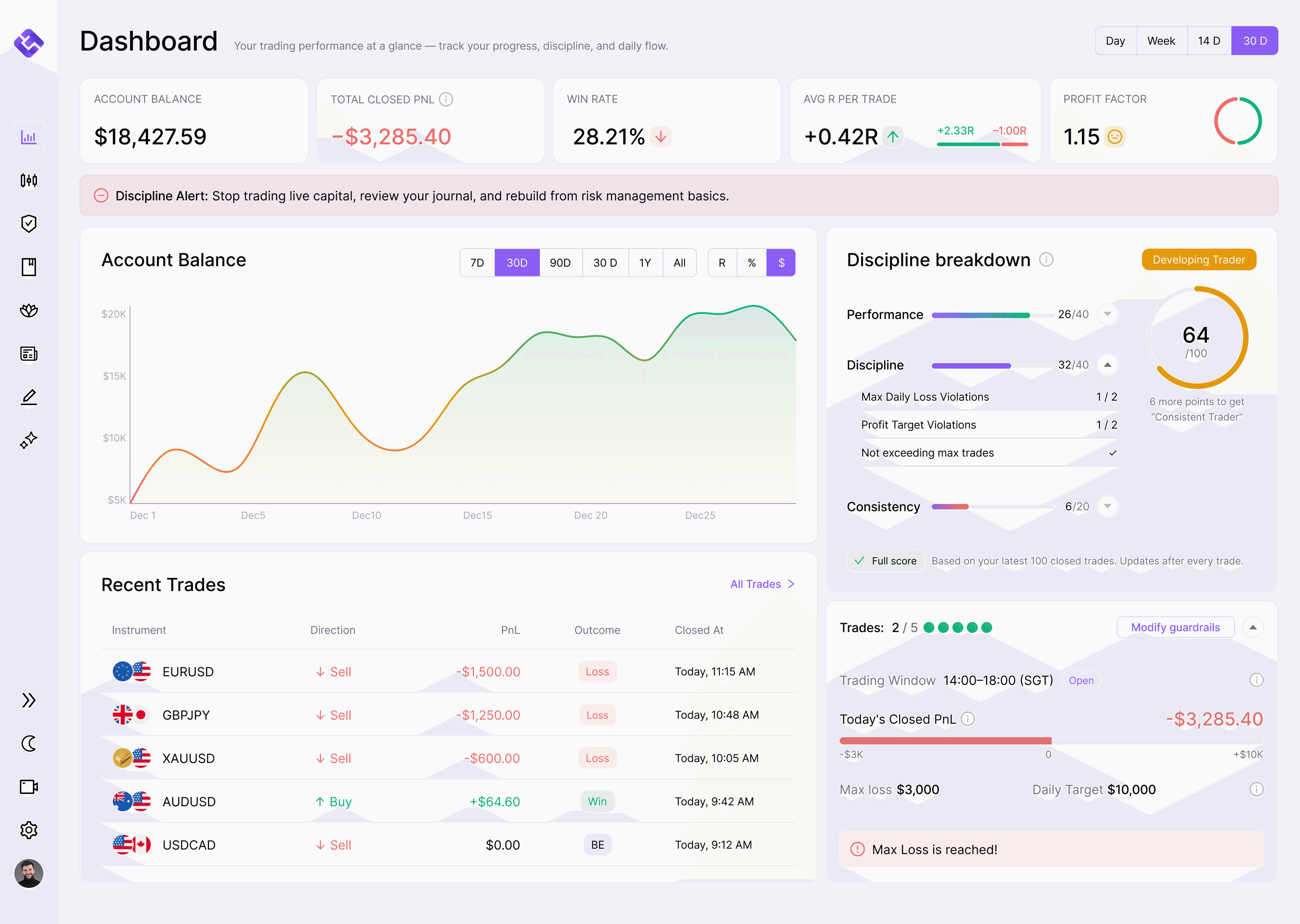
EdgeFlo's Edge plan builder keeps your if-then rules visible right next to the chart during your session. You do not have to remember your plan or pull it from a notebook. The conditions are on screen, and the entry becomes a checkoff rather than a judgment call.
The one-click trading feature reduces the mechanical friction between decision and execution. When hesitation lives in the gap between "I should enter" and physically clicking the button, shortening that gap matters.
After each trade, the journal prompts you to tag whether the entry was on-plan, delayed, or missed. Over 30 to 60 trades, this data shows your hesitation rate in hard numbers, giving you the evidence you need to trust your system over your feelings.
The Edge Brief
Receive Insights on trading psychology, discipline, and the behavioral patterns that create consistent traders from our Founder and the EdgeFlo team, delivered to your inbox.
Think different. Trade different.
Why do I hesitate even when the setup matches my plan?
Is hesitation in trading a sign of a bad strategy?
How do I stop freezing before entries?
Does trading hesitation get better with experience?

Turn discipline on.
Every session.
EdgeFlo is the environment serious traders operate inside.
Start 7-Day Free Trial
Cancel anytime.
No long-term commitment.

Think Different, Trade Different.