

Think in Probabilities: Detach from Every Trade Outcome
Probabilistic thinking in trading means detaching from single trade outcomes and trusting your edge across hundreds of trades. Here is how to build that mindset.
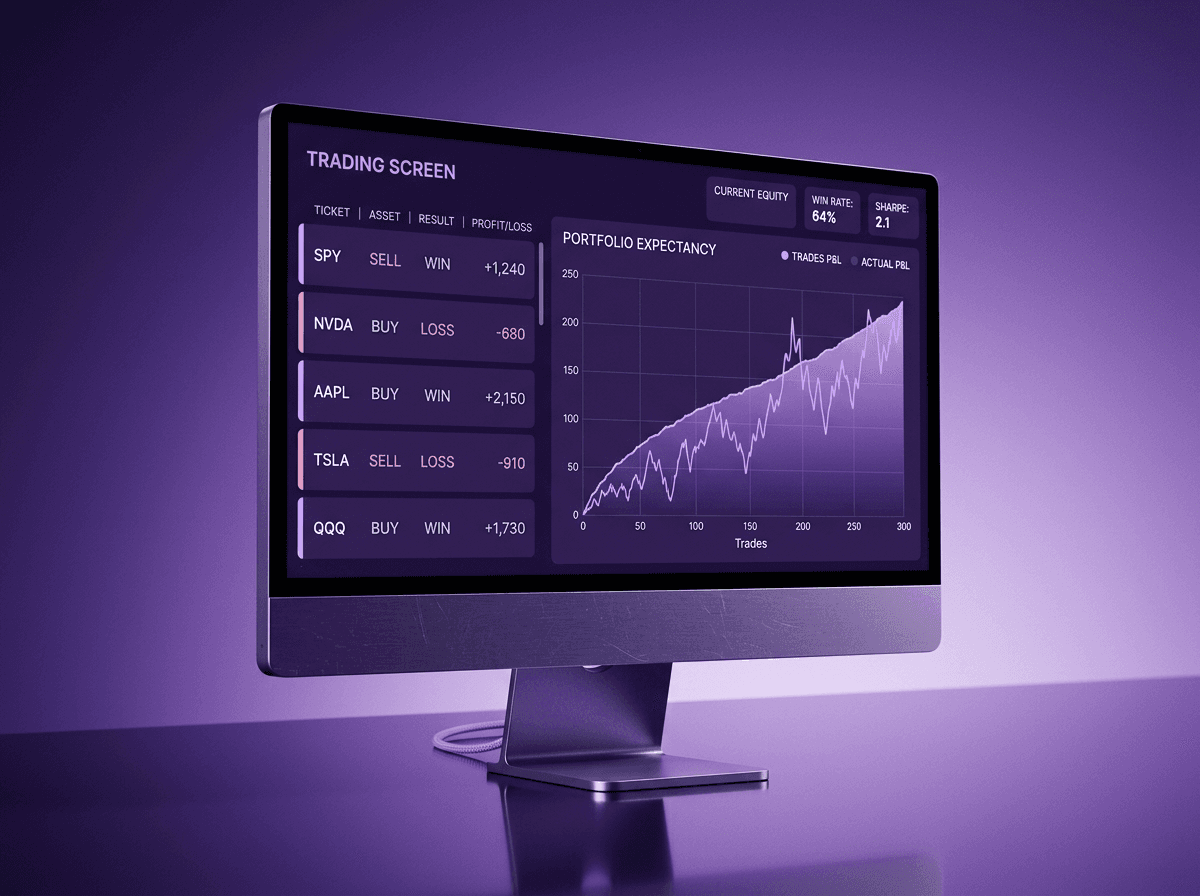
Probabilistic thinking in trading means accepting that any single trade can go against you, even when your edge is real. You do not need to predict the next candle. You need to execute a plan that has a positive expectancy across a large number of trades and trust the math to do its work over time.
Most traders understand this intellectually. Almost none of them actually trade this way. The gap between knowing it and living it is where accounts bleed out.
TL;DR
Every individual trade outcome is random. Your edge only shows across hundreds of executions.
A 60% win rate strategy will still produce five, six, or even seven consecutive losses. That is normal.
You do not need to know what happens next to make money. You need a plan and the discipline to run it.
Reacting to the market beats predicting it. Adapt to what price does, not what you think it should do.
Tracking your stats over a series of trades is the only way to stay rational when single outcomes feel personal.
Why Individual Trade Outcomes Don't Matter
You place a textbook setup. Clean structure, confluence at the level, risk defined. It loses.
Next trade. Same quality setup. Same process. It loses again.
By the third loss, something shifts. You start wondering if your strategy is broken. You second-guess the next entry. Maybe you skip it entirely, and that one would have been a 3R winner.
Sound familiar?
This is what happens when you attach meaning to individual trade results. You treat each outcome like a verdict on your ability, your strategy, your future. But a single trade tells you almost nothing. It is one coin flip in a series of thousands.
Think of it like this. A casino does not care if a single blackjack hand goes to the player. They know the math. Over 10,000 hands, the house edge plays out. They do not sweat individual results because they think in aggregates.
Your trading account works the same way. A strategy with a positive trading expectancy will produce profits over a large enough sample. But "large enough" is not 10 trades. It is not 50. Depending on your win rate and risk-reward profile, it could take 100 to 500 trades before the numbers converge with your backtest.
The problem is that most traders judge their system after 10 losers and abandon it after 20.
The Five Truths That Change How You See Trades
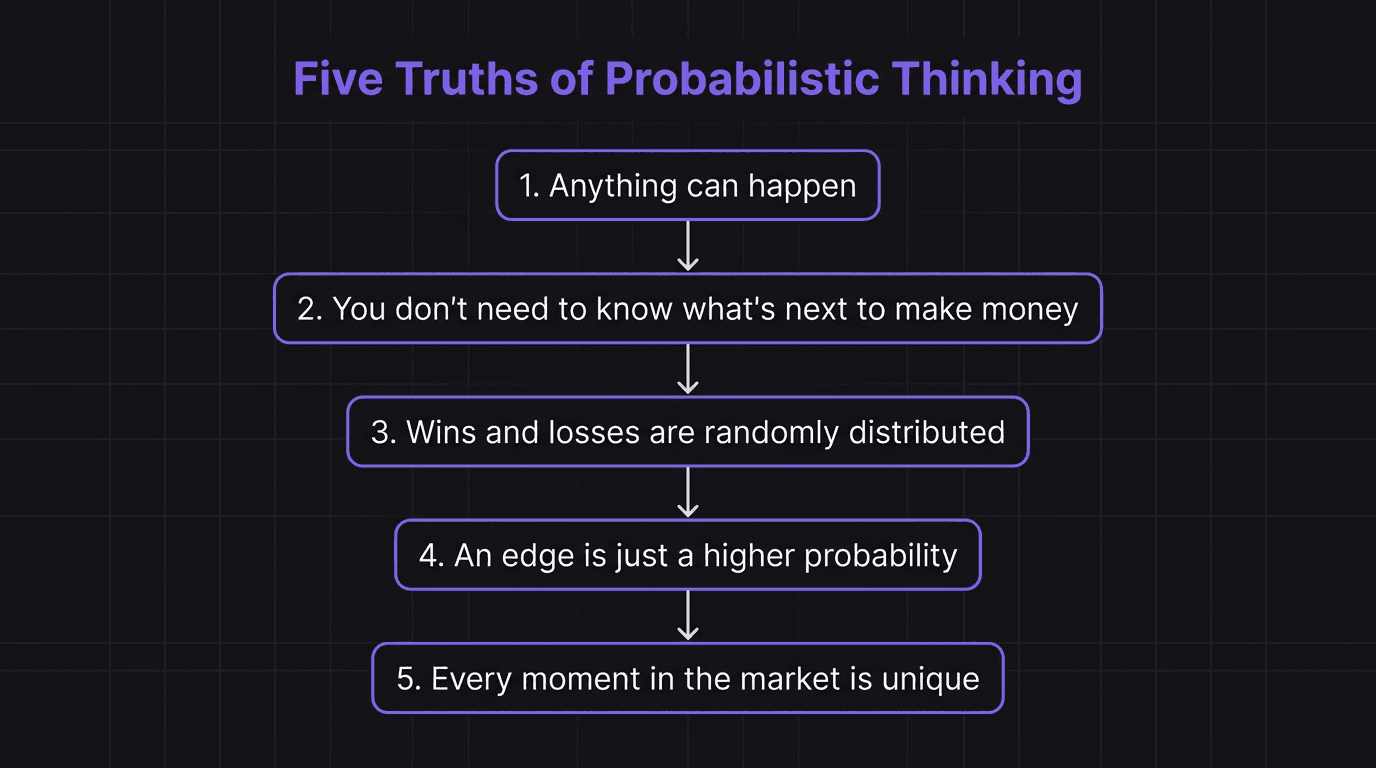
Mark Douglas laid out five fundamental truths in "Trading in the Zone" that form the backbone of probabilistic thinking. These are not motivational quotes. They are operating principles.
1. Anything can happen.
No amount of analysis guarantees the next candle. News hits. Liquidity sweeps run stops. Algorithms trigger cascades. Your perfect setup can fail for reasons that had nothing to do with your analysis.
2. You do not need to know what happens next to make money.
This is the one that trips people up. Your brain wants certainty before it risks capital. But certainty does not exist in markets. What exists is probability, and probability only requires execution over a series.
3. There is a random distribution between wins and losses for any given set of variables.
Your 60% strategy does not win 6 out of every 10 trades in neat little batches. The wins and losses are scattered randomly. You could win 8 in a row, then lose 5 in a row, and still be right on pace for 60% over 200 trades.
4. An edge is just a higher probability of one thing happening over another.
Not a guarantee. Not a cheat code. Just a slight statistical lean in your favor that compounds over time. That is all you need, and it is enough.
5. Every moment in the market is unique.
The pattern that looks identical to last Tuesday's setup is not the same trade. Different participants, different liquidity, different macro context. Treating it as "the same" setup that "should" work the same way is how you create expectations that the market has no obligation to meet.
These five truths are not something you read once and absorb. They are something you remind yourself of every session until they become your default operating mode.
Random Distribution: Your 60% Strategy Will Still Lose Five in a Row
This is where the concept stops being abstract and starts being uncomfortable.
The Walkthrough: 60% Win Rate, 10 Trades, Zero Comfort
Say you have a strategy that wins 60% of the time with a 2:1 reward-to-risk ratio. You backtested it over 300 trades. The numbers are solid. You risk 1% per trade.
Here is your first week:
Trade | Pair | Result | P&L |
|---|---|---|---|
1 | EUR/USD | Loss | -1.0% |
2 | GBP/JPY | Loss | -1.0% |
3 | AUD/USD | Loss | -1.0% |
4 | EUR/USD | Loss | -1.0% |
5 | USD/CAD | Loss | -1.0% |
6 | GBP/USD | Win | +2.0% |
7 | EUR/JPY | Win | +2.0% |
8 | AUD/USD | Win | +2.0% |
9 | USD/CHF | Win | +2.0% |
10 | EUR/USD | Win | +2.0% |
After five straight losses, you are down 5%. The trading fear creeps in. Your finger hovers over the next entry and hesitates. "Maybe I should sit this one out." You skip trade 6. It wins. Now you are angry at yourself and revenge-enter trade 7 with double size.
This is what happens when you do not understand random distribution. The five losses were not a signal that your strategy failed. They were a completely normal sequence within a 60% win rate.
After all 10 trades, you are up 5% on the account. The math worked. But only if you took every single trade.
Here is the uncomfortable part: a 60% win rate can produce runs of 7 or 8 consecutive losses. A 30% win rate (which can still be hugely profitable with high R:R) can lose 8 to 9 trades in a row. This is not a bug. It is the nature of random distribution.
The only way to survive those streaks is to know they are coming, expect them, and keep executing anyway.
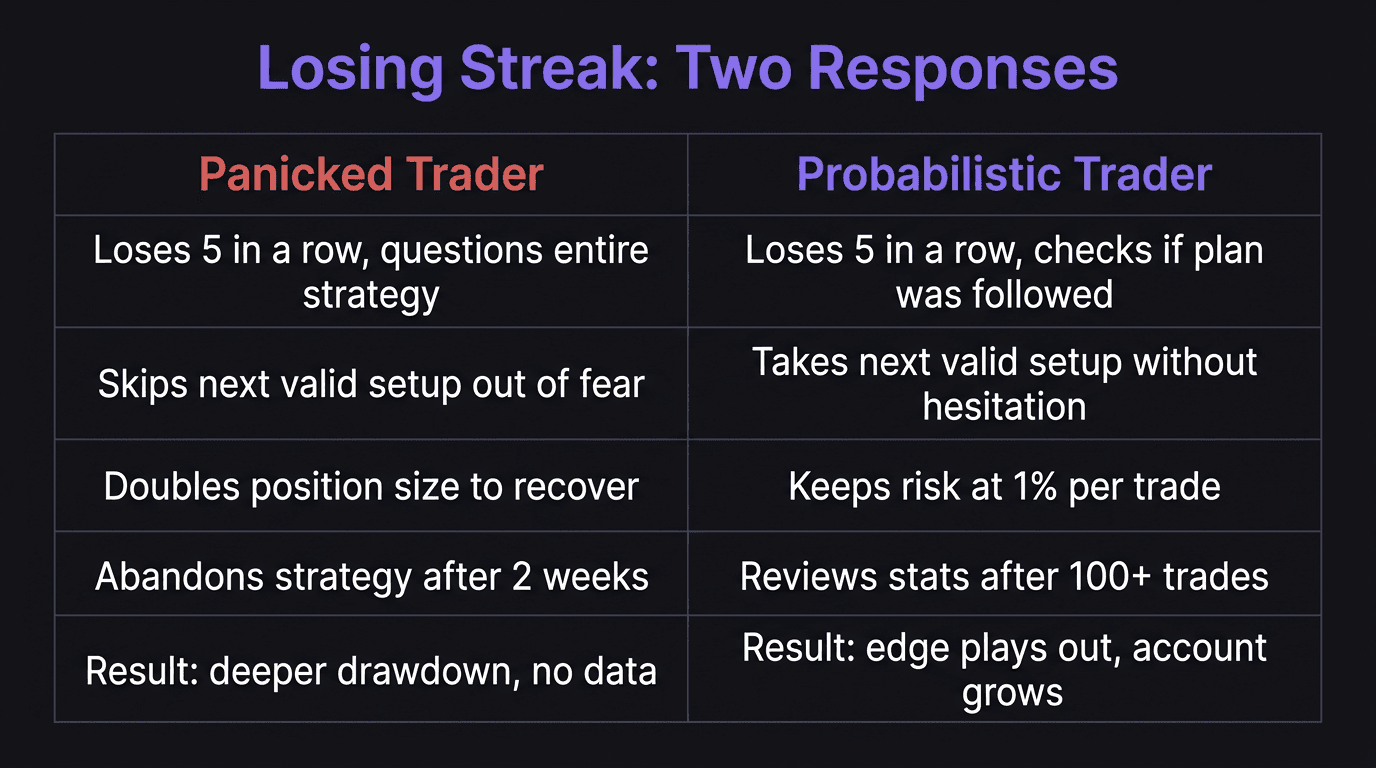
If every loss puts you one step closer to the next win (statistically, it does), you can look forward to the next opportunity instead of dreading it. That reframe is the difference between a losing streak that destroys your account and one that is just a normal Tuesday.
How to React Instead of Predict
"React and adapt to the market. Never predict what the market will do."
That quote sounds simple. Living it is a different story.
Prediction feels productive. You analyze the chart, form a thesis, and feel confident about where price is heading. The problem is that your confidence has no bearing on what actually happens. Anything can happen, remember?
What Reacting Looks Like in Practice
Reacting means you have a plan before the session starts. You know your levels, your setups, and your invalidation points. When price reaches one of your levels, you check: does this still meet my criteria? If yes, you enter. If the criteria are not met, you wait.
There is no "I think it is going up." There is only "price is above my level, structure is intact, and my checklist says go."
Example of reacting vs. predicting: You are watching GBP/USD on the 1-hour chart. Price pulls back to a demand zone at 1.2650 that aligns with the daily trend. A prediction-based trader thinks, "It is definitely bouncing here" and goes long immediately. A reaction-based trader waits for a bullish engulfing candle to close above the zone, confirms volume, and then enters with a stop below the zone at 1.2620. Same zone. Very different process. The predictor gets stopped out on a deeper sweep to 1.2615. The reactor either gets filled on the confirmation candle or stays flat because the signal never came.
Reacting protects you from your own bias. When you wait for the market to confirm your level before entering, you filter out trades where your "feeling" was the primary input.
This is where trading confidence actually comes from. Not from being right about direction, but from knowing that your process handles uncertainty without breaking down.
How EdgeFlo Surfaces the Data That Keeps You Rational
Probabilistic thinking is easier to talk about than to practice. Your brain wants to attach emotion to every trade result. The counter to that is data, visible, consistent, reviewed after every session.
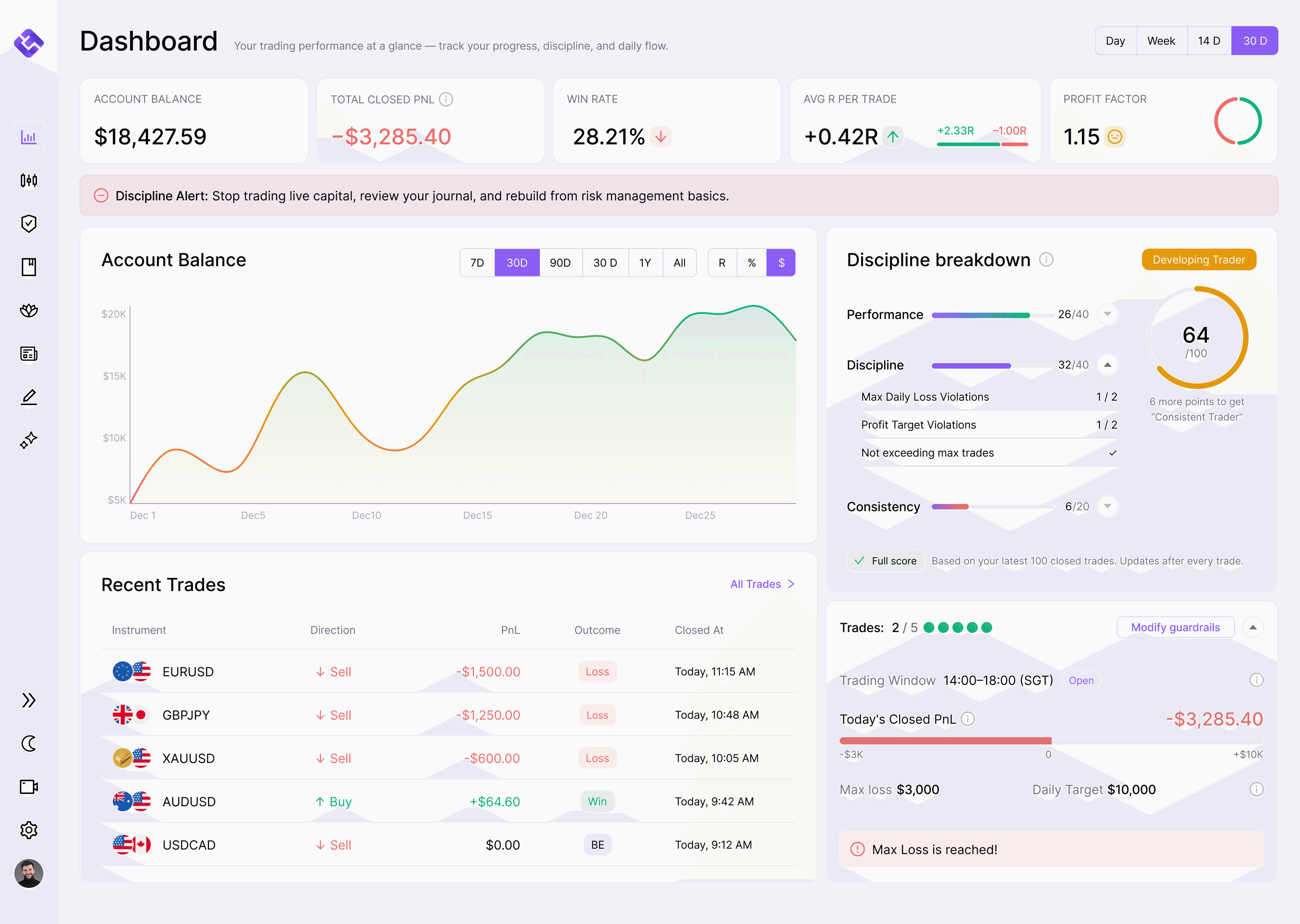
EdgeFlo's dashboard shows your win rate, profit factor, and EdgeScore across a series of trades. Not after one trade. Not after a good week. Across the full sample. When you can see that your strategy holds a 58% win rate over 150 trades, a five-trade losing streak stops feeling like an emergency and starts looking like what it is: noise.
The journal tracks patterns across your trades over time. You can see whether your losing streaks correlate with specific setups, times of day, or market conditions. That turns a vague "I keep losing" into a specific "I lose on breakouts during London close." Specific problems have specific fixes.
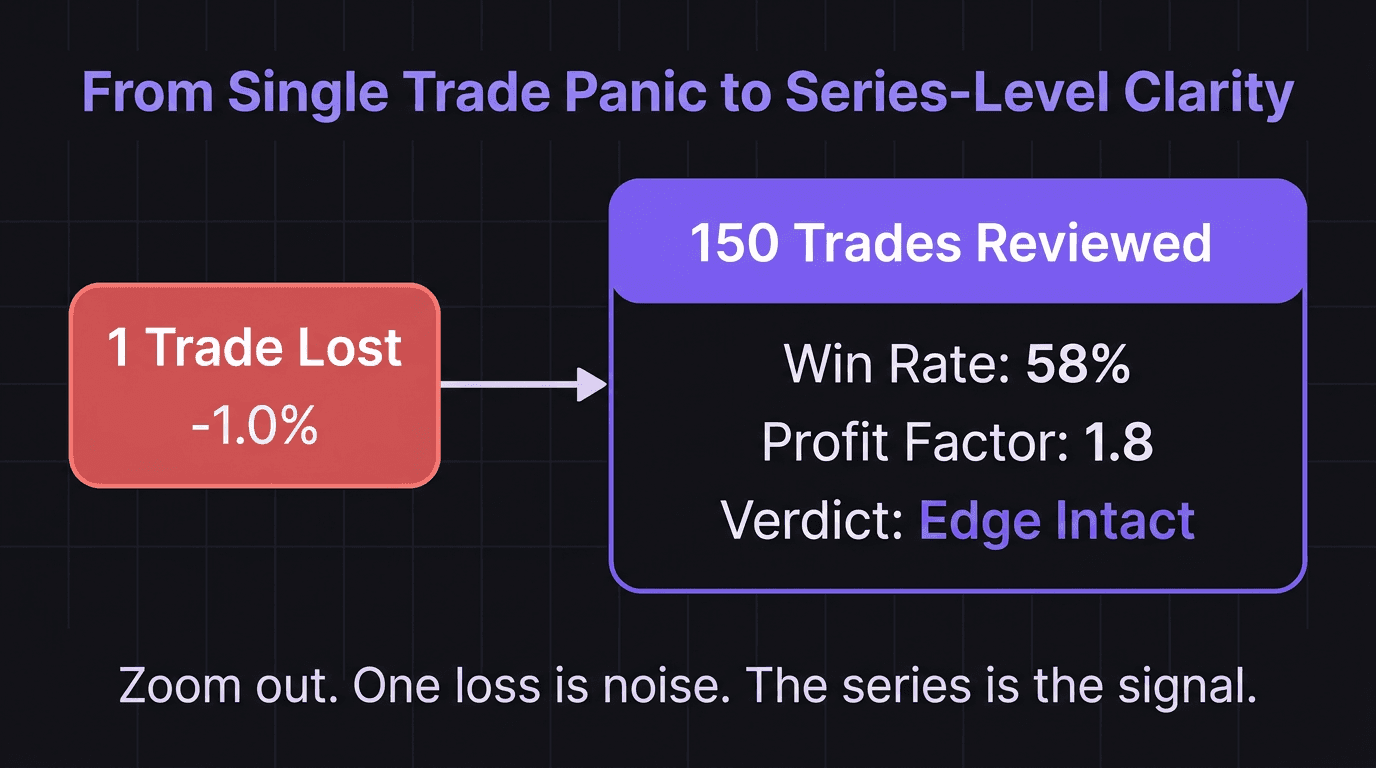
When you trade inside a system that surfaces your actual numbers, you stop relying on memory and gut feeling. Memory is biased. It amplifies losses and forgets the quiet wins. Data does not have that problem.
The real shift in probabilistic thinking does not happen when you read about it. It happens when you have 200 journal entries proving that your edge is real, your process works, and the losing streaks were always temporary.
The Edge Brief
Receive Insights on trading psychology, discipline, and the behavioral patterns that create consistent traders from our Founder and the EdgeFlo team, delivered to your inbox.
Think different. Trade different.
What is probabilistic thinking in trading?
Can a profitable strategy still lose five trades in a row?
How many trades does it take for a win rate to show?
How do I stop emotional reactions to losing trades?

Turn discipline on.
Every session.
EdgeFlo is the environment serious traders operate inside.
Start 7-Day Free Trial
Cancel anytime.
No long-term commitment.

Think Different, Trade Different.