

Trading Identity Shift: Become Who You Need to Be
A trading identity shift changes your default behavior. Until your self-image matches the trader you want to be, your habits will hold you back.
A trading identity shift is the moment you stop operating as the trader you used to be and start behaving as the trader you need to become. Your personality dictates your personal reality. If your self-image is still the overleveraged, impulsive, insecure version of yourself, your results will reflect that person. The shift is not a motivation spike or a new strategy. It is a permanent change in how you think, what you believe about yourself, and which actions feel natural. Until your identity catches up with your ambitions, your old habits will scale with your success and pull you back to where you started.
TL;DR
Your trading results are a mirror of your self-image, not just your strategy.
Success amplifies your existing habits, both good and destructive.
Thoughts shape beliefs, beliefs shape actions, actions shape results.
A trading identity shift requires conscious daily effort, not a single "aha" moment.
Self-esteem in trading comes from doing hard things consistently, not from winning trades.
Your Identity Dictates Your Results
Ever passed a funded challenge, hit a solid green week, or finally nailed a string of clean trades, only to give it all back within days?
That is not bad luck. That is your identity pulling you back to baseline.
Your self-image works like a thermostat. It has a set point. When your results exceed what you believe you deserve, something inside you corrects course. You start taking low-quality setups. You skip your trading rules. You crank up lot size. You stop journaling. Not because you forgot the process, but because the old version of you does not believe it belongs at that level.
Think about lottery winners. Their bank account jumps from $20 to a million overnight. Within a few years, most of them are broke again. Rappers who sign their first deal, entrepreneurs who hit a sudden windfall. The pattern repeats across every field. The money arrives before the identity catches up, and the old habits spend it all.
The same thing happens in trading. A trader flips $50 into $10,000 on a small account. They feel invincible. They buy a funded challenge expecting to crush it with the same approach. Two losses in, their confidence crumbles. They chase setups, break rules, and hit max drawdown. Not because the strategy failed. Because the person executing it was still operating from an identity built on insecurity and short-term dopamine hits.
Why Old Habits Scale with Success
Here is something most traders never consider: success does not erase your bad habits. It amplifies them.
Think about your morning routine. You brush your teeth, brew coffee, check your phone. These habits do not disappear when your income doubles. They follow you. The same is true for your trading habits. If you overleveraged when you were trading a $500 account, you will overleverage on a $50,000 funded account unless you make a conscious decision to change.
Nothing changes if nothing changes.
A trader chasing dopamine on a demo account will chase dopamine on a live account. A trader who revenge trades after a $50 loss will revenge trade after a $5,000 loss. The stakes grow, but the behavior stays locked to the old identity.
This is why some traders pass their first funded challenge and then blow the account within two payouts. They earned the capital, but they had not earned the self-esteem to manage it. Self-esteem comes from doing hard things, from journaling losses when you would rather close the laptop, from sitting out a session when no setup meets your criteria, from reviewing your mistakes when every part of you wants to pretend they did not happen.
Without that foundation, success becomes a trap. You get the money, but you do not have the internal infrastructure to keep it.
The Cycle: Thoughts, Beliefs, Actions, Results
Your trading identity operates in a loop. Understanding the loop is the first step to breaking it.
It works like this: your thoughts create your beliefs. Your beliefs drive your actions. Your actions produce your results. And your results reinforce your thoughts.
A trader who thinks "I always give back my profits" starts to believe they are incapable of holding gains. That belief leads to actions like moving stop losses, cutting winners short, or overleveraging to "make it back fast." Those actions produce poor results, which confirm the original thought. The loop tightens.
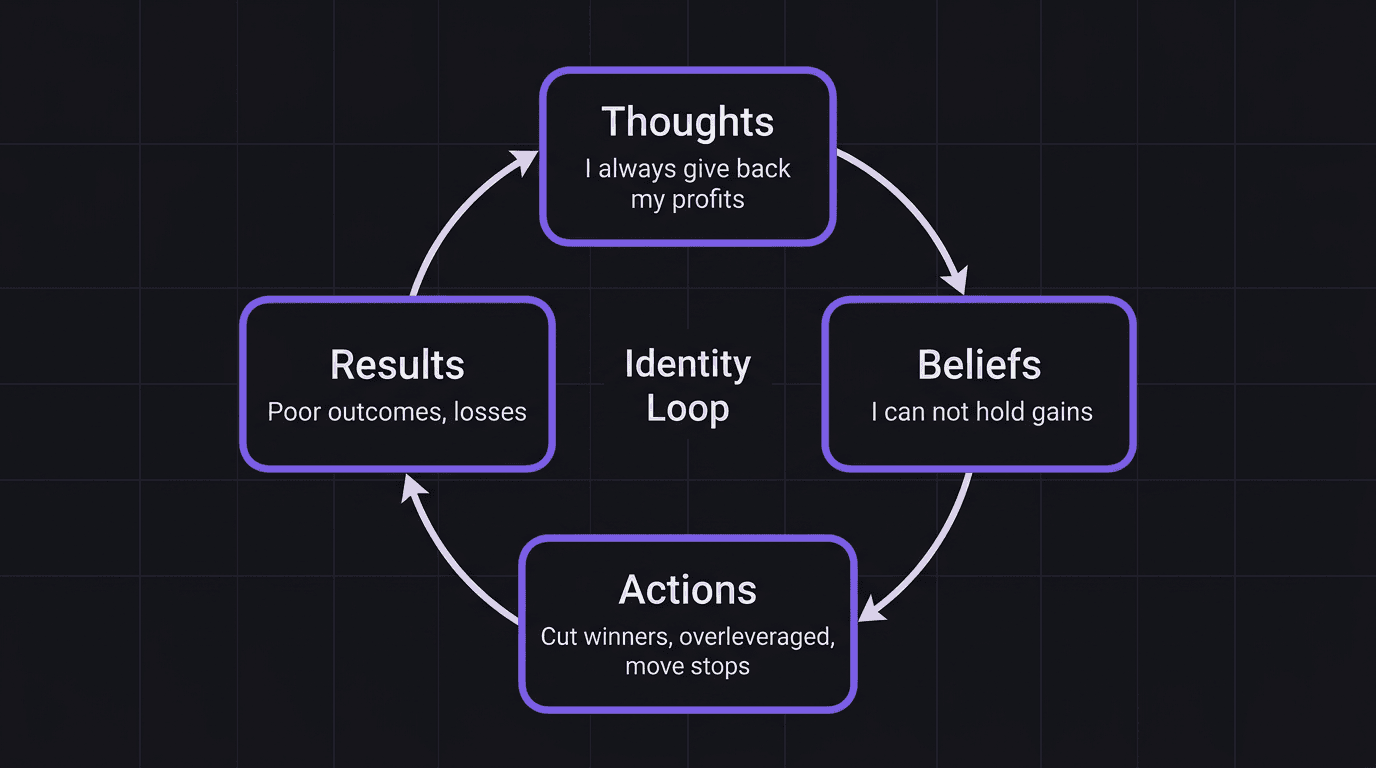
Sound familiar? The trader stuck in this loop does not need a new indicator or a different entry model. They need to interrupt the cycle at the thought level.
The opposite loop exists too. A trader who thinks "I follow my process regardless of outcome" builds a belief in their own discipline. That belief drives patient, rule-based execution. That execution produces more consistent results over time. And those results reinforce the original thought.
Same market. Same strategy. Different identity running the controls.
Walkthrough: Identity Shift from Gambler to Professional
The Gambler Phase
A trader buys a $50,000 funded challenge. They have been flipping small accounts, turning $100 into $200, $50 into a few thousand. The confidence is sky high.
First trade: 2% risk on EUR/USD at London open. Loss. Down $1,000. No big deal, there is still room.
Second trade: another 2% risk. Another loss. Now they are down $2,000 (4% of the account). Suddenly, confidence evaporates. The self-image cracks. They are not the trader who flips accounts anymore. They are the trader who is about to fail another challenge.
What happens next is predictable. They start taking every setup that looks halfway decent. Quality drops. Position sizes stay the same or increase. They stop following their pre-market checklist. They stop journaling. Within a week, they hit max drawdown and lose the challenge.
The strategy did not fail. The identity did. This trader's self-image was built on excitement and quick wins, not on process and patience. When the quick wins stopped coming, there was nothing underneath to hold the structure together.
The Professional Phase
Six months later, the same trader tries again. But this time, something is different. They spent those six months doing the unglamorous work.
They backtested their strategy across 200 trades. They know the win rate (42%), the average R (2.8R), and the expected drawdown sequences. They journaled every session, tagging emotions and reviewing mistakes weekly. They built a trading confidence that came from data, not from feelings.
When they take the new challenge, the first two losses do not crack them. They expected drawdowns. Their self-image is no longer "the trader who flips small accounts." It is "the trader who executes a tested process." That identity holds steady through the losing streak because it was built on evidence, not on dopamine.
They pass the challenge in 47 days. Not because they found a better strategy. Because they became a different person.
How to Rebuild Your Trading Identity
You cannot think your way into a new identity. You have to act your way into it. Here is how.
Start with What You Do, Not What You Know
Most traders know exactly what they should be doing. The gap is between knowing and doing. Close it with one rule change at a time.
Pick one behavior that the trader you want to become would do every single day. Journal after every session. Follow your pre-trade checklist without exception. Review your week every Sunday. Start with one. Make it non-negotiable.
Every time you keep that promise to yourself, your self-image shifts slightly. Compound that over weeks and months. That is how identity changes. Not through affirmations or visualization alone, but through repeated action that proves to your brain you are someone different now.
Detach from Outcomes
As long as your identity is tied to winning and losing, you are fragile. One bad week can send you spiraling back into old patterns.
The traders who sustain success focus on process metrics. Did I follow my rules today? Did I journal? Did I stay within my risk parameters? Those questions have answers you control. "Did I make money today?" does not.
When you stop chasing the $10,000 monthly payout and start chasing mastery, something shifts. The pressure drops. You stop overleveraging to hit a number. You stop forcing trades that do not meet your criteria. You focus on getting 1% better every day, and the money follows the competence.
Extend Your Timeline
Your goal is probably not unrealistic. Your timeline is.
If you are trying to pass a funded challenge in two weeks, you will break every rule to get there. If you give yourself three months, you can afford to be patient. You can afford to sit out slow days. You can afford to take only A-grade setups.
The bigger the goal, the longer the timeline needs to be. And here is the counterintuitive part: the longer your timeline, the easier the goal becomes. You are not cramming everything into a pressure cooker. You are compounding small improvements daily.
Build Self-Esteem Through Difficulty
Self-esteem does not come from winning trades. It comes from doing hard things when you do not feel like doing them.
Journaling a losing day. Reviewing a week where you broke three rules. Sitting through a session with zero trades because nothing met your criteria. Reflecting honestly on why you moved your stop loss instead of pretending it did not happen.
These are the reps that build the trader you want to become. Every time you do the hard thing, you deposit evidence into your identity bank. Over time, that account balance shifts who you believe you are.
Trading ego tells you that you have already figured it out. A genuine identity shift requires admitting you have not, and then doing the work to close the gap. Trading complacency sneaks in after a few good weeks, making you skip the habits that got you there. Guard against both.
How EdgeFlo Supports the Shift
Sanctuary guides you through structured mindset resets and rewire routines. When you recognize that you are operating from the old identity (reactive, emotional, undisciplined), Sanctuary provides a framework to pause and recalibrate before your next session. It does not force the shift, but it gives you the tools to practice it consistently.
FloAI coaching (Plus only) surfaces patterns in your psychology and self-awareness over time. It highlights recurring emotional states and behavioral loops you might not catch on your own, helping you see the gap between who you are and who you are becoming.
The journal's emotion tagging feature lets you track identity patterns across weeks and months. When you tag frustration, overconfidence, or fear after each session, you build a dataset of your own psychology. Over time, you can see whether your emotional baseline is shifting or whether the old identity is still running the show.
The Edge Brief
Receive Insights on trading psychology, discipline, and the behavioral patterns that create consistent traders from our Founder and the EdgeFlo team, delivered to your inbox.
Think different. Trade different.
What is a trading identity shift?
How long does a trading identity shift take?
Can you shift your trading identity without changing your strategy?
What is the biggest sign your trading identity has not shifted?

Turn discipline on.
Every session.
EdgeFlo is the environment serious traders operate inside.
Start 7-Day Free Trial
Cancel anytime.
No long-term commitment.

Think Different, Trade Different.