

Trading Day Structure: The 3-Phase Routine That Works
Build a complete trading day structure with pre-market prep, execution, and post-market review. One connected flow so nothing gets skipped.
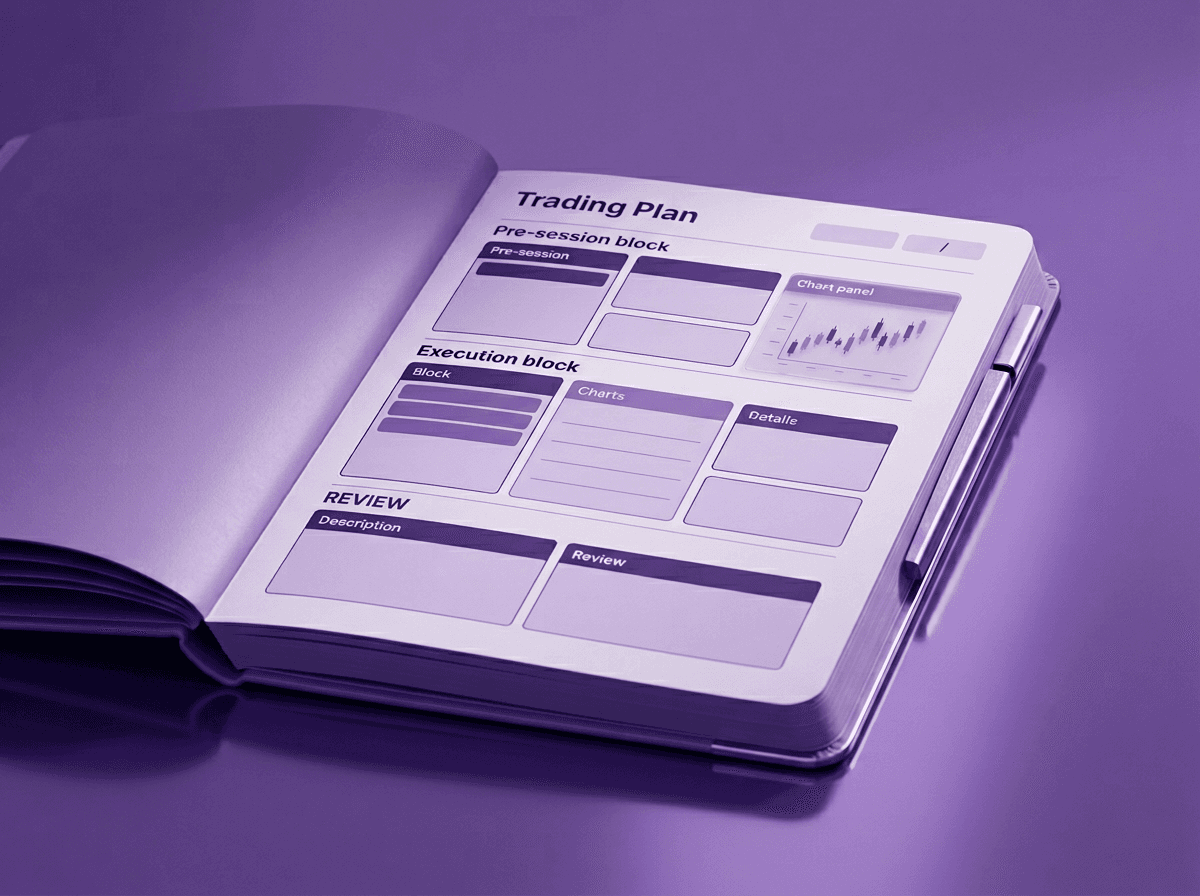
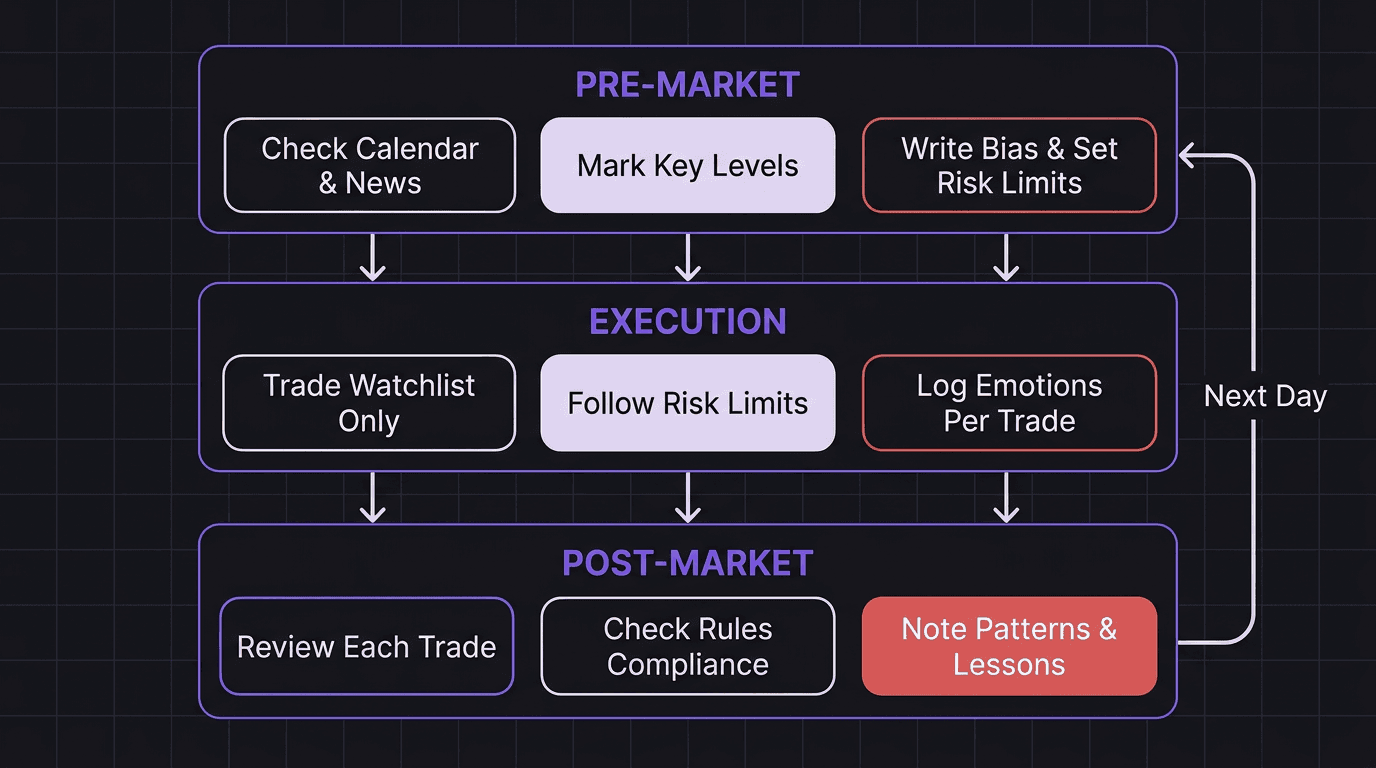
A trading day structure is a three-phase routine that covers everything before, during, and after your trading session. It connects pre-market preparation, live execution, and post-market review into a single workflow so you complete every step instead of skipping the ones that feel optional. Most traders who struggle with consistency do not have a strategy problem. They have a structure problem: they skip preparation, trade reactively, and never review what happened.
TL;DR
A complete trading day has three phases: pre-market prep, execution session, and post-market review.
Pre-market locks in your bias, levels, and rules before emotion enters the picture.
Execution means following the plan you wrote down, not the impulse you feel in the moment.
Post-market review is where real learning happens, and it is the phase most traders skip.
Doing all three in one connected flow prevents you from cherry-picking only the parts you enjoy.
Pre-Market: Prepare Before You Trade
The pre-market phase exists for one reason: to make decisions when you are calm instead of when money is on the line.
Think about how you shop for groceries. If you walk in without a list, you buy stuff you do not need. The same thing happens with charts. You sit down, see a candle moving fast, and suddenly you are in a trade you never planned.
A solid pre-market routine does not need to be complicated. Here is what matters:
Check the calendar. What news events could move your pairs today? High-impact releases change everything. If NFP drops in an hour, you want to know before you enter, not after your stop gets blown.
Mark your levels. Support, resistance, key swing highs and lows on the higher timeframe. These are your guardrails for the session.
Write your bias. Not "I think EUR/USD is going up." That is a feeling. Write it like this: "Bullish above 1.0850. Target: 1.0920. Invalid below 1.0810." Specific. Measurable. Falsifiable.
Set your risk limits. How many trades today? What is your max loss for the session? Decide now, not after your second loser.
The whole thing takes 15-20 minutes. That is it. But those 15 minutes are the difference between trading with a plan and trading from your gut.
Walkthrough: What Happens Without Pre-Market Prep
You wake up, grab your coffee, open your charts at 8:15 AM. GBP/USD is dropping hard. It has already fallen 60 pips from London open. You think "this has to bounce" and buy at 1.2640 with no stop loss and no plan. The pair drops another 40 pips to 1.2600 before you panic-close for a $200 loss on a 0.5-lot position (0.5 lots x $10/pip x 40 pips = $200). You had no levels marked, no bias written, no daily loss limit set. One impulsive trade and you are down for the day before your first planned setup even appeared.
That is what skipping pre-market looks like. You trade what the chart shows you in the moment instead of what your analysis told you in advance.
Execution: Follow the Plan, Not Your Feelings
Execution is the phase most traders think they are good at. They are not. They are good at clicking buttons. Clicking buttons is not execution. Execution means taking only the trades that match the plan you wrote during pre-market.
Here is the hard part: during a live session, your brain will generate reasons to break your trading rules. "This one looks really good." "I'll just take a small position." "The setup is close enough." Every one of those sentences is your emotions overriding your plan.
Disciplined execution comes down to three things:
Trade what you planned. If GBP/USD is not on your watchlist today, it does not exist. Other pairs moving is not your problem.
Use your risk limits. If you said three trades max, trade three closes the session. Not "maybe one more if it's a really good setup."
Record how you feel. Are you anxious? Bored? Revenge-hungry? Noting your emotional state while trading is the raw data your review phase needs.
The execution session is not the time for analysis. That was pre-market. And it is not the time for reflection. That comes post-market. Execution is about one thing: following the plan.
Walkthrough: Plan vs. Impulse
You marked EUR/USD bullish above 1.0850 during pre-market. During the session, price drops to 1.0830, below your invalidation level. Your gut says "buy the dip, it'll bounce." Your plan says the bullish idea is dead below 1.0850. You close your chart and check your other watchlist pair. No trade on EUR/USD today. Later, EUR/USD drops to 1.0780. Your plan saved you from a losing trade. You did not earn anything, but you protected your capital. That is execution.
Sound boring? Good. Boring execution is consistent execution.
Post-Market: Review While Memory Is Fresh
This is the phase that separates traders who improve from traders who repeat the same mistakes for years. And it is the phase almost everyone skips.
Post-market review is not "look at your P&L and feel good or bad." It is a structured check of what you did, why you did it, and whether it matched your plan. Do it the same day, while the trades are fresh in your head. Waiting until the weekend means you have already forgotten the emotional context that drove your decisions.
Here is a simple review checklist:
Did I follow my pre-market plan? Yes or no. If no, which rule did I break and why?
Did I stay within my risk limits? Number of trades, max loss, position size, did the numbers match what I set?
What was my emotional state? Were there moments I felt anxious, greedy, or bored? Did those emotions affect my entries or exits?
What is one thing I would do differently tomorrow? Not five things. One. Make it specific.
Writing this down matters. Not in your head. On paper, in a spreadsheet, or in a journal. A trading habit tracker helps you spot patterns across days and weeks that you would never catch in a single session.
Brad from the 1% Club puts it bluntly: the work needs to be done, and it needs to be reviewed. He defines learning as changing behavior. If you do not review, you do not change. You just repeat.
What a Review Entry Looks Like
Date: Tuesday. Trades taken: 2 of 3 allowed. P&L: +$85. Rules followed: Yes on trade 1 (waited for confirmation at 1.0860 as planned). Partial no on trade 2, entered 5 minutes before London close, which is outside my session window. Emotion note: Felt FOMO on the second trade because the first one worked. Tomorrow's adjustment: No entries in the last 30 minutes of my session window.
That takes five minutes. Five minutes that most traders skip because they already "know" what happened. But knowing and writing it down are different things. Writing forces honesty.
Why the Full Loop Matters
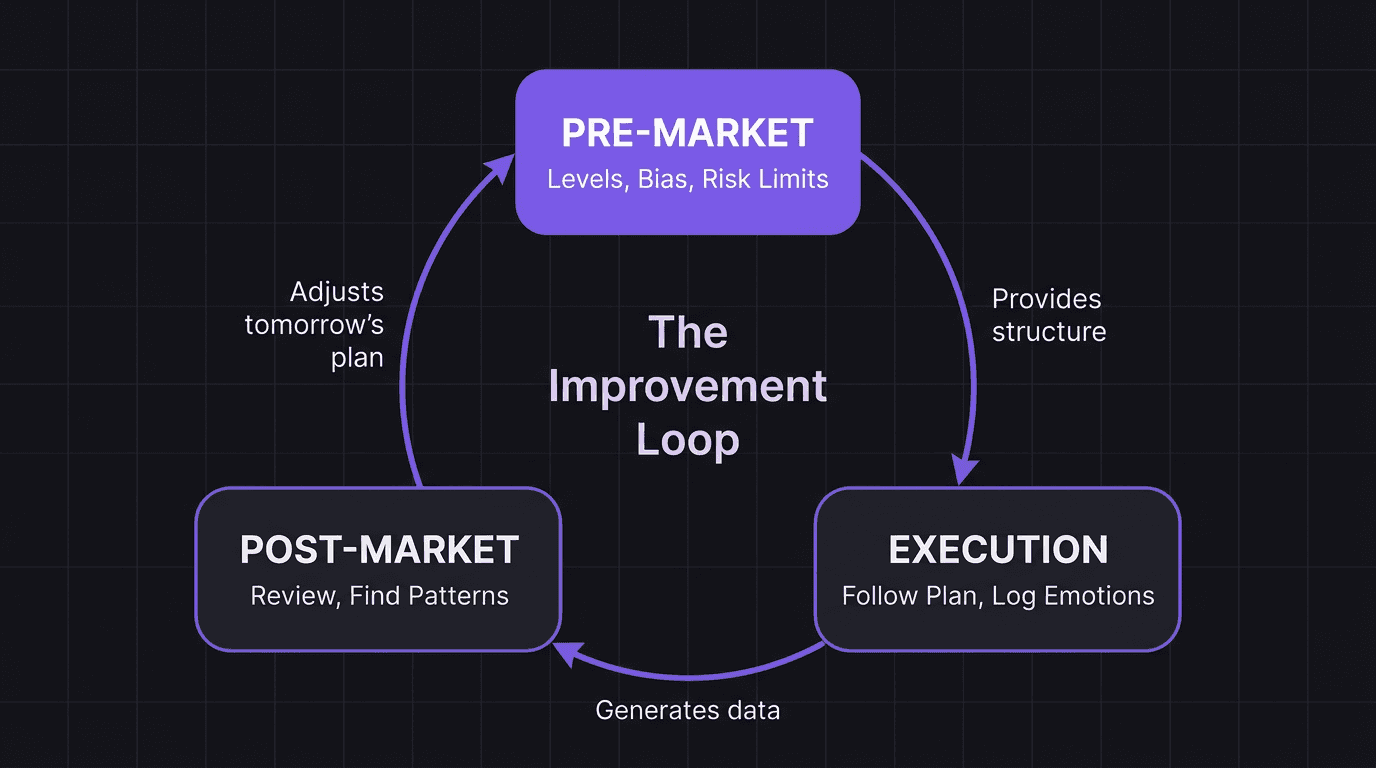
Any one of these three phases is useful on its own. Pre-market prep is good. Execution discipline is good. Post-market review is good. But doing all three as a connected loop is what actually creates improvement over time.
Here is why: each phase feeds the next.
Pre-market gives execution a structure to follow.
Execution generates data for review.
Review generates adjustments for tomorrow's pre-market.
Skip one and the loop breaks. Skip pre-market, and execution becomes impulsive. Skip review, and pre-market never improves because you have no feedback. Skip execution discipline, and your review is just a list of emotional trades with no plan-based data to compare against.
Most daily trading planners only cover the preparation phase. They help you plan the day but say nothing about what to do during or after. That is half a system. A trading day structure covers the full loop.
The reason traders skip phases is not laziness. It is friction. Each phase lives in a different tool. Pre-market in a notebook. Execution on a broker platform. Review in a spreadsheet or journal app. By the time you switch between three tools, the post-market review feels like homework and gets dropped first.
One connected workflow removes that friction. When the next step is already in front of you, you do it. When you have to open a separate app, log in, and recreate context from memory, you do not.
How EdgeFlo Connects Pre, During, and Post
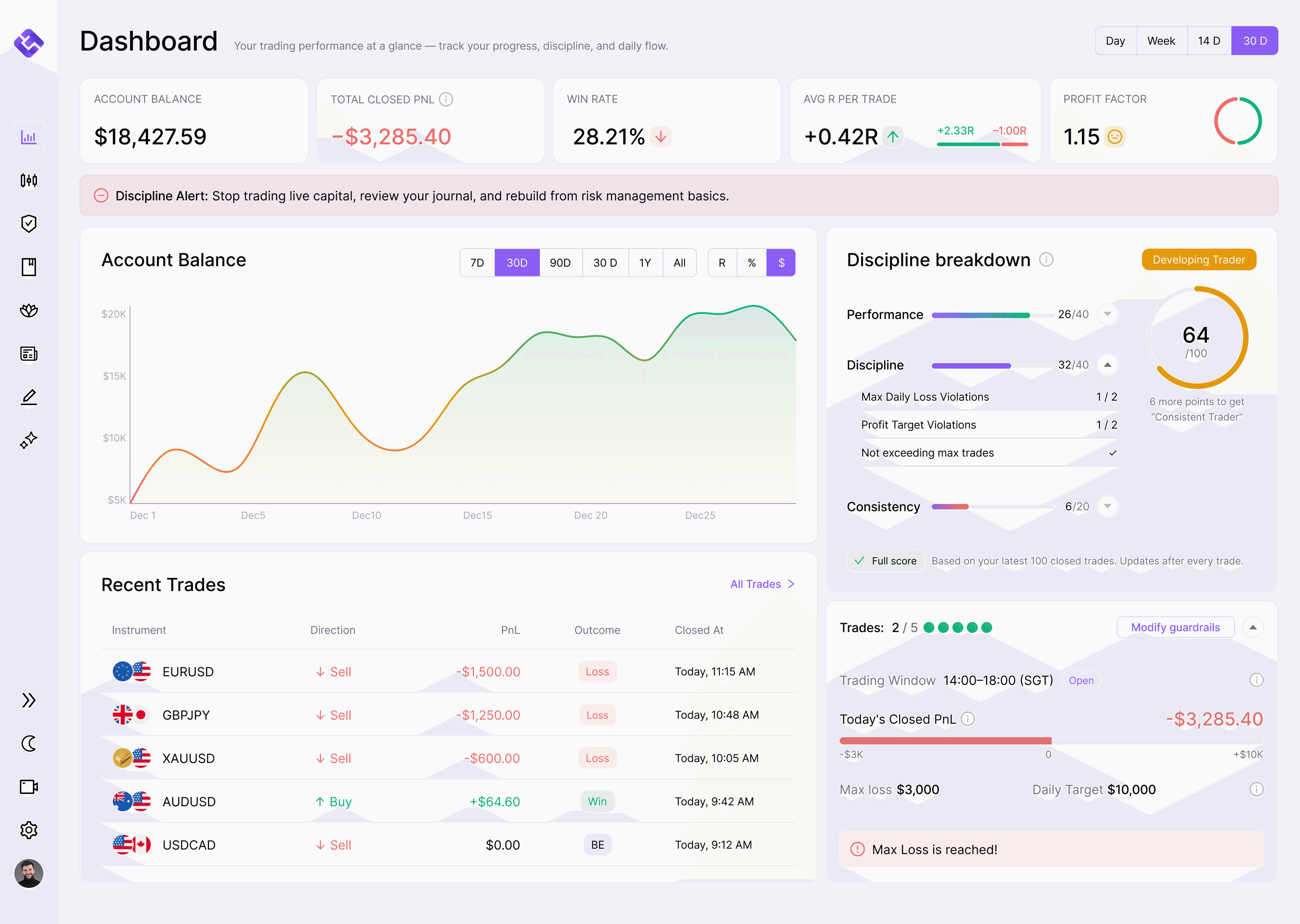
EdgeFlo is the world's first trading super app covering pre-market, trading, and post-market in one place. Instead of juggling a notebook, a broker platform, and a separate journal app, you move through all three phases without switching tools.
The pre-market routine is built into the platform. When you open the platform, a banner shows your preparation steps. You can complete each one before trading, or skip them if you choose. Mark levels, write your bias, set risk limits. You see your trading playbook right next to your chart, not buried in a different app.
During execution, EdgeFlo tracks your trades against the limits you set. Hit your max trades for the day? The buy and sell buttons gray out. Hit your daily loss cap? Same thing. You can override if you need to, but you have to make that decision consciously. And after you close a trade, it asks how you felt, that emotion data flows straight into your journal. Your post-trade review is already half-done by the time the session ends. No switching apps, no recreating context from memory. The full loop runs in one place, so nothing gets skipped.
The Edge Brief
Receive Insights on trading psychology, discipline, and the behavioral patterns that create consistent traders from our Founder and the EdgeFlo team, delivered to your inbox.
Think different. Trade different.
How long should a trading day structure take?
Do I need a trading day structure if I only take a few trades per week?
What is the most important part of a trading day structure?
Can I adjust my trading day structure over time?

Turn discipline on.
Every session.
EdgeFlo is the environment serious traders operate inside.
Start 7-Day Free Trial
Cancel anytime.
No long-term commitment.

Think Different, Trade Different.