

Daily Planner for Traders: Structure Your Day in 30-Minute Blocks
Build a daily planner for trading with 30-minute blocks. Stop wasted screen time and reactive decisions with this structured trading day template.
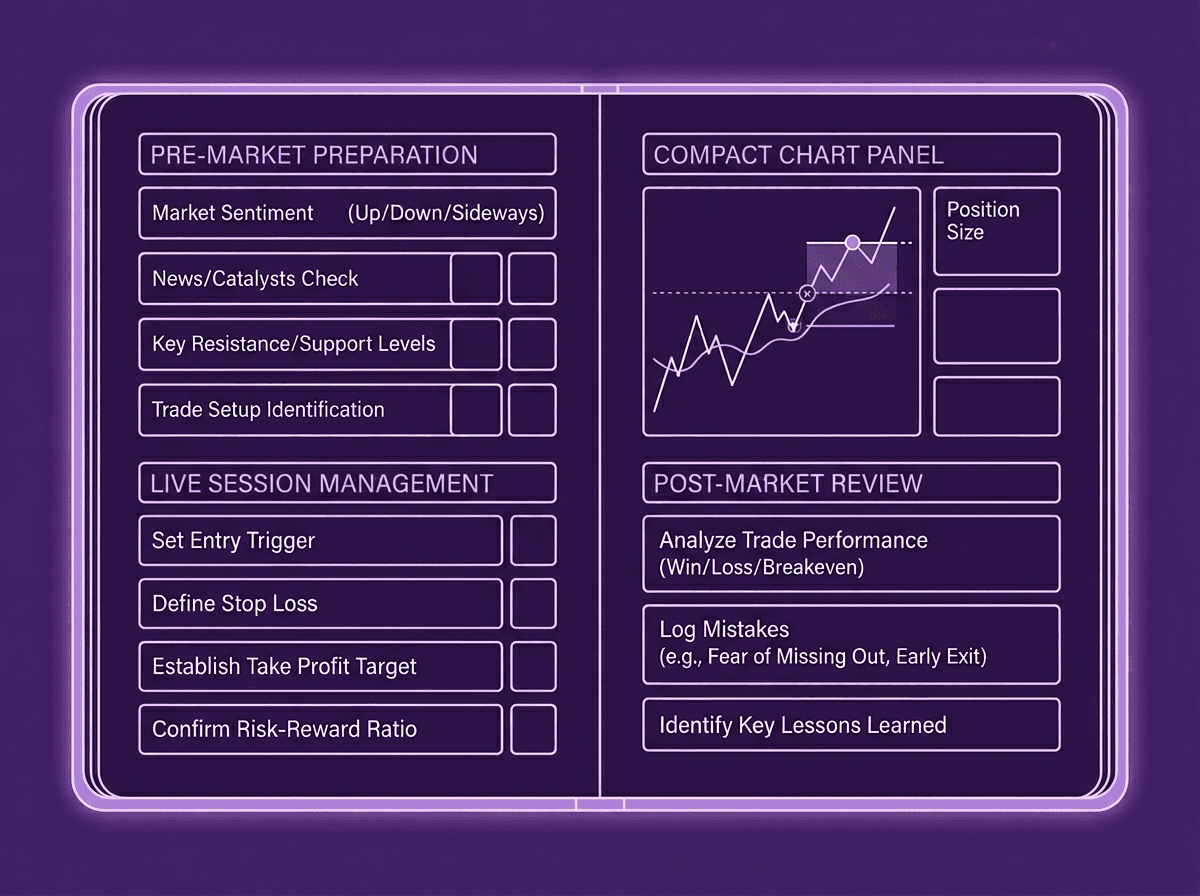
A daily planner for traders structures your entire day into 30-minute blocks, from wake-up to wind-down. Each block gets one purpose: prep, trading, review, study, or rest. This eliminates the biggest productivity killer in trading, which is sitting in front of charts for 10 hours with no plan, reacting to every candle, and calling it "work." Structured days produce better trades because you show up prepared, trade your window, and leave.
TL;DR
Block your trading day into 30-minute slots with a single task per block.
Active trading is only 2-4 hours of your day, not the entire day.
Start each morning with a goal review and pre-market prep, not chart-staring.
Write three things to accomplish today, then review wins and improvements every evening.
Structure prevents the aimless screen time that leads to overtrading and revenge trades.
Why Unstructured Days Lead to Bad Trades
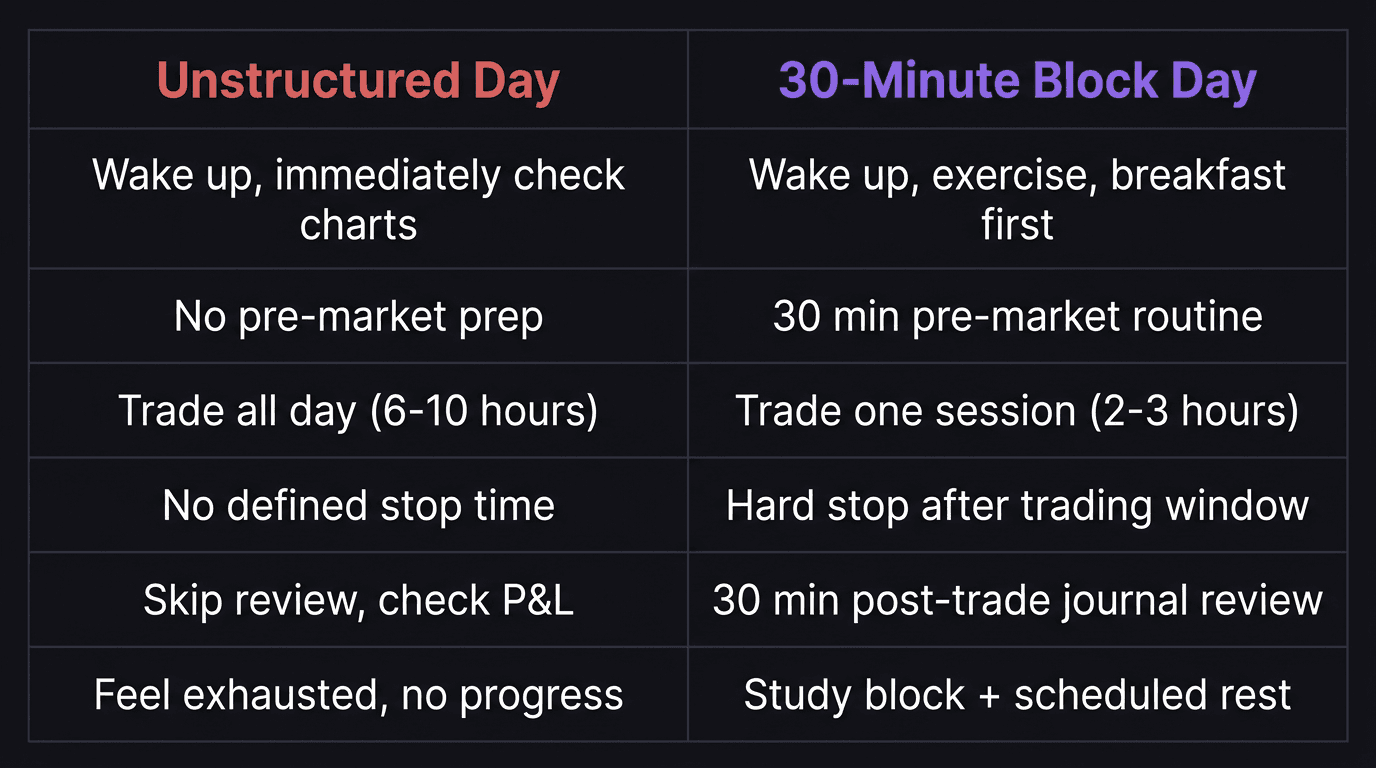
Picture this. You wake up at 7:30, grab your phone, check a chart. Price moved overnight. You feel behind. You skip breakfast, sit down at the computer, and start scrolling through pairs. No levels marked. No bias formed. No plan. But a candle just closed bullish on GBP/USD, so you take the trade. It reverses. You take another trade to make it back. By noon, you are down three trades and your discipline is gone.
That is what an unstructured day looks like. And it is the default for most retail traders.
The problem is not laziness. It is the absence of structure. When every minute of your trading day is an open question ("should I trade now? should I look at another pair? should I study?"), your brain defaults to the most stimulating option. Usually, that means taking trades you should not take.
Unstructured screen time is the gateway to every common trading mistake. Overtrading, revenge trading, FOMO entries, abandoning your plan. All of them start with "I was just watching the charts and then..."
Ever counted how many hours you actually spend trading versus how many hours you spend staring at charts? For most traders, the ratio is brutal.
The 30-Minute Block Method
The fix is simple. Plan every 30 minutes of your day. Not just the trading hours. The entire day, from when you wake up to when you stop working.
Why 30 minutes? Because it is long enough to complete a meaningful task and short enough to prevent drift. A one-hour block leaves room for distraction in the second half. A 15-minute block is too short for deep work. Thirty minutes is the sweet spot.
Here is how it works:
List your daily categories. Personal care, exercise, meals, pre-market prep, active trading, post-trade review, study, and rest.
Assign each category to a time block. Trading gets a fixed window. Study gets a fixed window. Rest is scheduled, not earned.
Protect the boundaries. When your trading block ends, you stop trading. When your study block starts, you study. No "just one more trade" bleeding into review time.
The key principle: your trading session has a start time and an end time. If you trade the London session, your active trading block might run from 8:00 AM to 11:00 AM. After that, you are done. Close the charts. The market will be there tomorrow.
A Sample Trading Day (7 AM to 6 PM)
This is a template, not a rule book. Adjust the times to fit your kill zone and personal schedule. The structure matters more than the specific hours.
Time | Block | Activity |
|---|---|---|
7:00 AM | Personal | Wake up, wash up |
7:30 AM | Health | Exercise (30 min) |
8:00 AM | Personal | Breakfast |
8:30 AM | Pre-market | Review goals, gratitude, 3 daily tasks |
9:00 AM | Pre-market | Mark levels, check calendar, form bias |
9:30 AM | Trading | Active trading session begins |
10:00 AM | Trading | Active trading |
10:30 AM | Trading | Active trading |
11:00 AM | Trading | Active trading |
11:30 AM | Trading | Last entries, manage open positions |
12:00 PM | Review | Close trades, screenshot charts |
12:30 PM | Review | Journal entries, log stats |
1:00 PM | Break | Lunch, step away from screens |
1:30 PM | Break | Rest or walk |
2:00 PM | Study | Chart analysis, replay, or course work |
2:30 PM | Study | Continue study |
3:00 PM | Study | Backtesting or reading |
3:30 PM | Break | Free time |
4:00 PM | Planning | Next-day level markups |
4:30 PM | Planning | Review weekly progress |
5:00 PM | End-of-day | Wins and improvements review |
5:30 PM | Personal | Done for the day |
Notice what this schedule includes that most traders skip: exercise before trading, a hard stop after the session, dedicated study time that is separate from trading, and a proper end to the workday.
Trading is not a 12-hour activity. The market runs 24 hours, but you should not. Your best decisions come in a focused 2-3 hour window when you are prepared, rested, and following a plan.
Walkthrough: What Happens Without a Schedule
> Marcus trades EUR/USD on the 15-minute chart. He usually targets the New York session open. On Monday, he wakes up late at 9:15 AM, skips his pre-market routine, and opens his laptop mid-candle. He sees price pushing up from 1.0870 and enters long at 1.0882 without checking the daily bias or marking levels. Price retraces to 1.0865 and stops him out. He re-enters long at 1.0878 because "the setup is still valid." Stops out again at 1.0860. Now he is down two trades and it is 10:30 AM. He spends the next four hours watching charts, looking for a trade to recover. By 3 PM he takes a third trade on GBP/USD (a pair he does not normally trade) and loses again. Total: three losses, zero process, seven hours of screen time. On Tuesday, he follows his 30-minute block schedule. He exercises at 7:30, eats breakfast at 8:00, does pre-market prep at 8:30 (marks 1.0840 as a key demand zone, confirms bullish daily bias), and enters his trading block at 9:30. Price sweeps 1.0840 at 10:15. He enters long at 1.0848 after a break of structure on the 5-minute chart. Target: 1.0890. He hits target by 11:00, journals the trade, and closes charts at 12:30. One trade. One win. Five hours of total work time.
The difference was not skill. It was structure.
Three Things to Accomplish Today
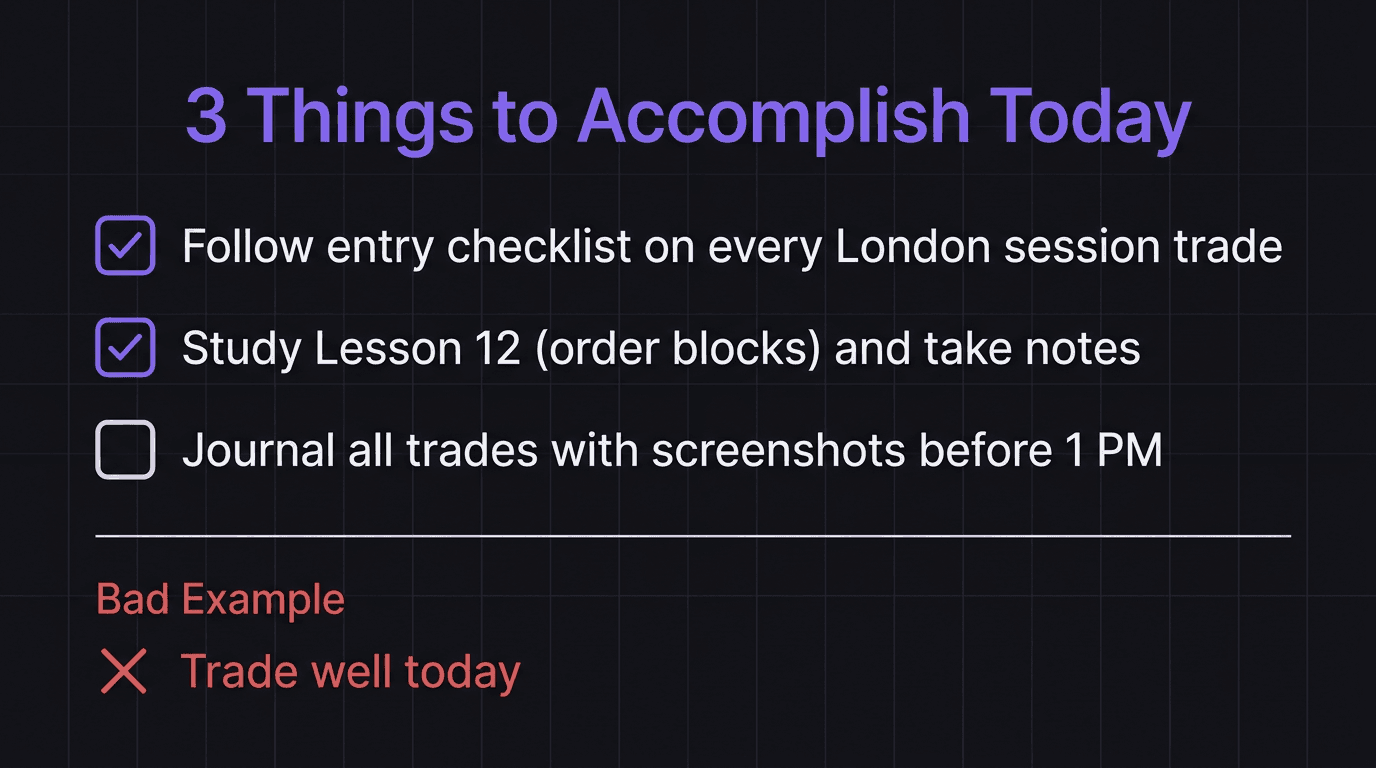
Every morning, after your goal review and gratitude practice, write down three things you want to accomplish today. Not ten. Three.
Why three? Because three is achievable. Ten is a fantasy. When you write ten goals for the day, you complete four, feel bad about the six you missed, and start tomorrow already behind. Three goals completed builds momentum. You end the day feeling capable.
Your three daily goals should be specific and connected to your bigger monthly targets. Not "trade well today." Try:
Follow my entry checklist on every trade during London session
Study Lesson 12 on order blocks and take notes
Journal all trades with screenshots before 1 PM
Each of those is binary. You either did it or you did not. There is no "kind of" with good daily goals.
End-of-Day Wins and Improvements
This is the part most traders skip, and it is the part that matters most for long-term growth.
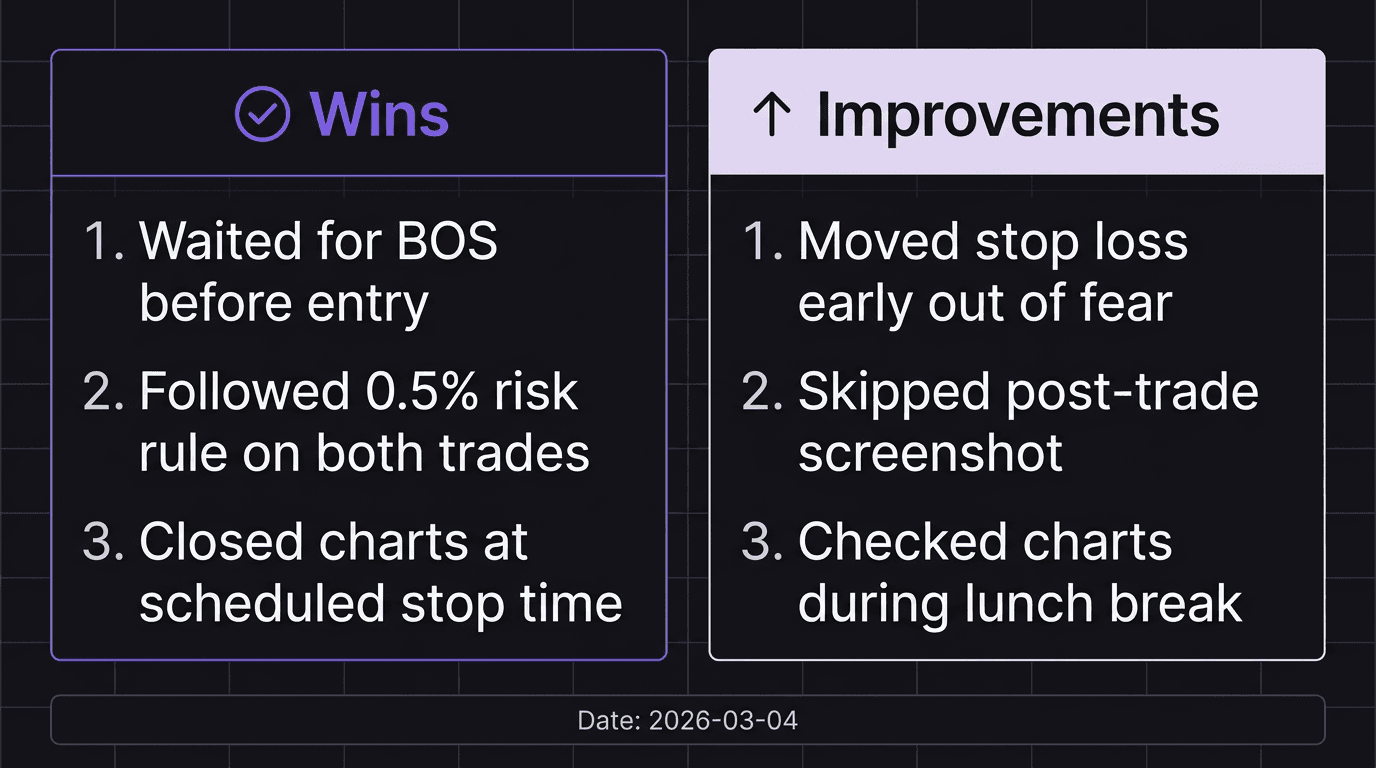
At the end of your trading day (your scheduled end, not "whenever you finally close the laptop"), take 15-20 minutes for two lists:
Wins: What went right today? Be specific. Not "good day" but "I waited for the break of structure before entering, even when price was moving fast." Small process wins compound faster than big P&L wins.
Improvements: What would you change? This is not self-punishment. It is coaching yourself. "I moved my stop loss tighter because I was nervous about giving back profit. Next time I keep the original stop." That is useful. "I suck at trading" is not.
Write these in your trading journal. Over weeks, patterns emerge. You start seeing the same wins repeat (which means those habits are locking in) and the same improvements recur (which means those are your real growth edges).
Do this matter? Absolutely. A trader who reviews daily for 90 days has 90 data points of self-coaching. A trader who "reviews when they feel like it" has maybe 8. Who improves faster?
The Compound Effect of Daily Review
Think about it like this. Your daily review is a feedback loop. Win recorded today becomes confidence tomorrow. Improvement noted today becomes a rule change next week. Over a month, you have adjusted your process 15-20 times based on real data, not theory. Over a quarter, you are a fundamentally different trader than someone who skipped this step.
The traders who journal wins and improvements daily are the same ones who pass funding challenges, stick to their risk rules, and avoid the mistakes that blow accounts. Not because they are smarter. Because they built a system that teaches them from their own experience.
How EdgeFlo Supports Structured Trading Days
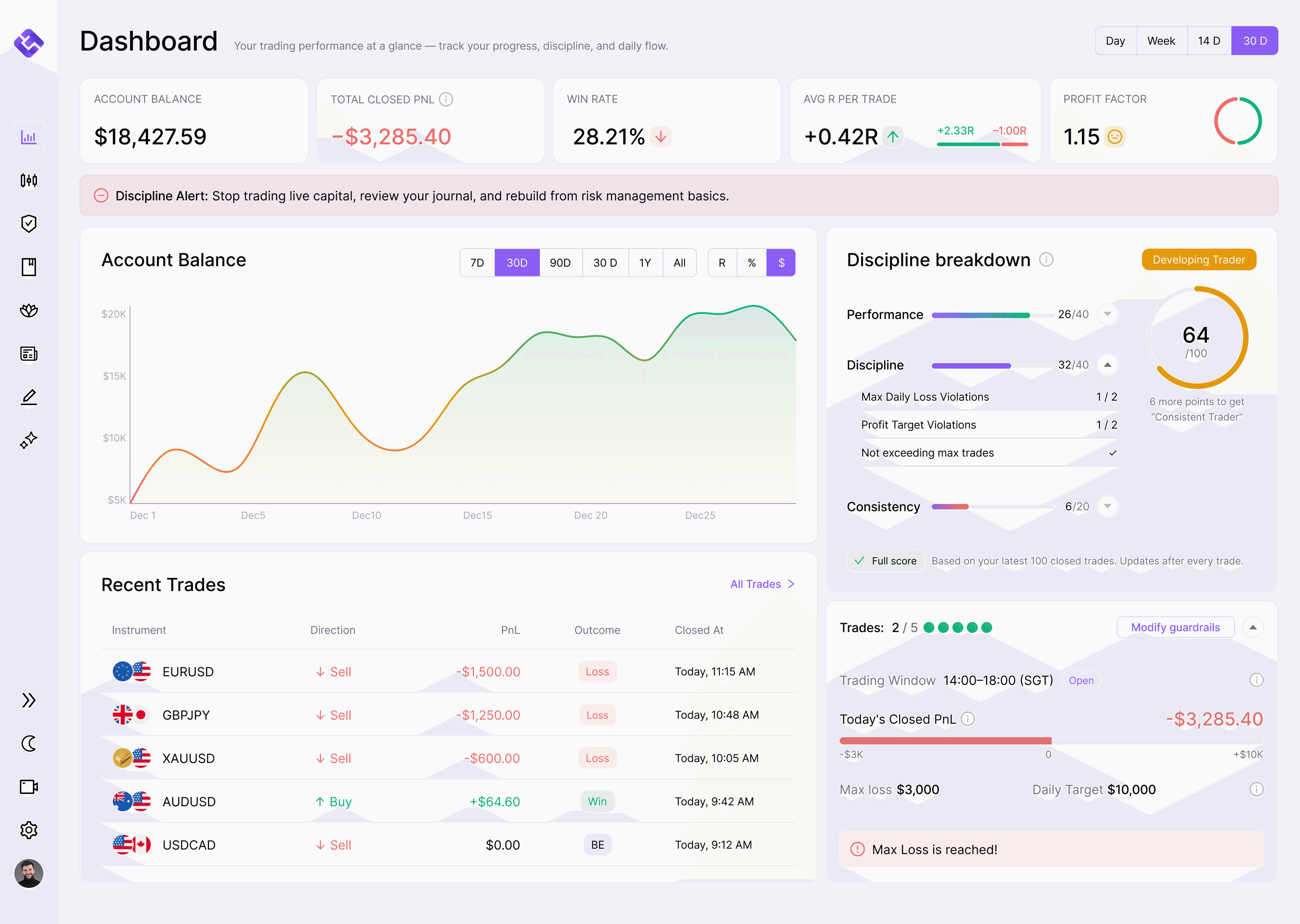
EdgeFlo's pre-market routine is a customizable checklist you complete before trading. It is not enforced (you can skip it), but having it built into your trading environment means the prompt is always there. You open EdgeFlo, the checklist appears, and the structure starts before you even look at a chart.
Your daily planner, goal review, and trade journal all live in the same workspace as your charts. No switching between a planning app, a journal app, and a charting platform. When everything is in one place, you are more likely to follow the process because the friction is gone.
The daily review becomes part of closing your session, not a separate chore you "should" do later. That proximity between trading and reflection is what makes the habit stick. Structure is not about willpower. It is about designing your environment so the right action is the easiest action.
The Edge Brief
Receive Insights on trading psychology, discipline, and the behavioral patterns that create consistent traders from our Founder and the EdgeFlo team, delivered to your inbox.
Think different. Trade different.
How should a trader plan their day?
How many hours a day should I spend trading?
What should a trader do before the market opens?
Should traders track daily wins and losses?

Turn discipline on.
Every session.
EdgeFlo is the environment serious traders operate inside.
Start 7-Day Free Trial
Cancel anytime.
No long-term commitment.

Think Different, Trade Different.