

Trading Discipline Transformation: How It Happens
How undisciplined traders transform into consistent executors. The real stages from overtrading and revenge trading to calm, confirmation-based trading.
Discipline is not a personality trait you either have or you do not. It is a skill that gets built through a specific, predictable transformation, and almost every consistently profitable trader went through the same messy version of it. The transformation starts with a phase of chaos (overtrading, burning accounts, revenge entries) and ends with a calm, confirmation-based process where you only take trades that meet your criteria. The part nobody talks about is the middle: the moment where something clicks and you stop trying to outsmart the market.
TL;DR
Every trader goes through an undisciplined phase of overtrading, revenge trading, and account damage.
The transformation starts with a specific wake-up moment, not gradual improvement.
Confirmation-based execution replaces emotional trading when you build a process you trust.
Discipline becomes boring on purpose, and that boredom is the sign it is working.
Trading rules only matter if you follow them when following them is hard.
The Undisciplined Phase Everyone Goes Through
Here is what the undisciplined phase actually looks like. Not the theoretical version. The real one.
You open your charts at London session. You see movement. You enter. Maybe you checked your plan, maybe you did not. The trade goes against you, and within 10 minutes you are in a second trade trying to recover the first one. By noon you have taken six trades, four of them losses, and your account is down 3%.
Your spouse or partner notices. Yousef, a trader from France who eventually scaled to $850,000 in funded accounts, described it plainly: his wife watched him lose money and said, "You are burning accounts, what are you doing?" He had no good answer.
The hallmarks of this phase are predictable:
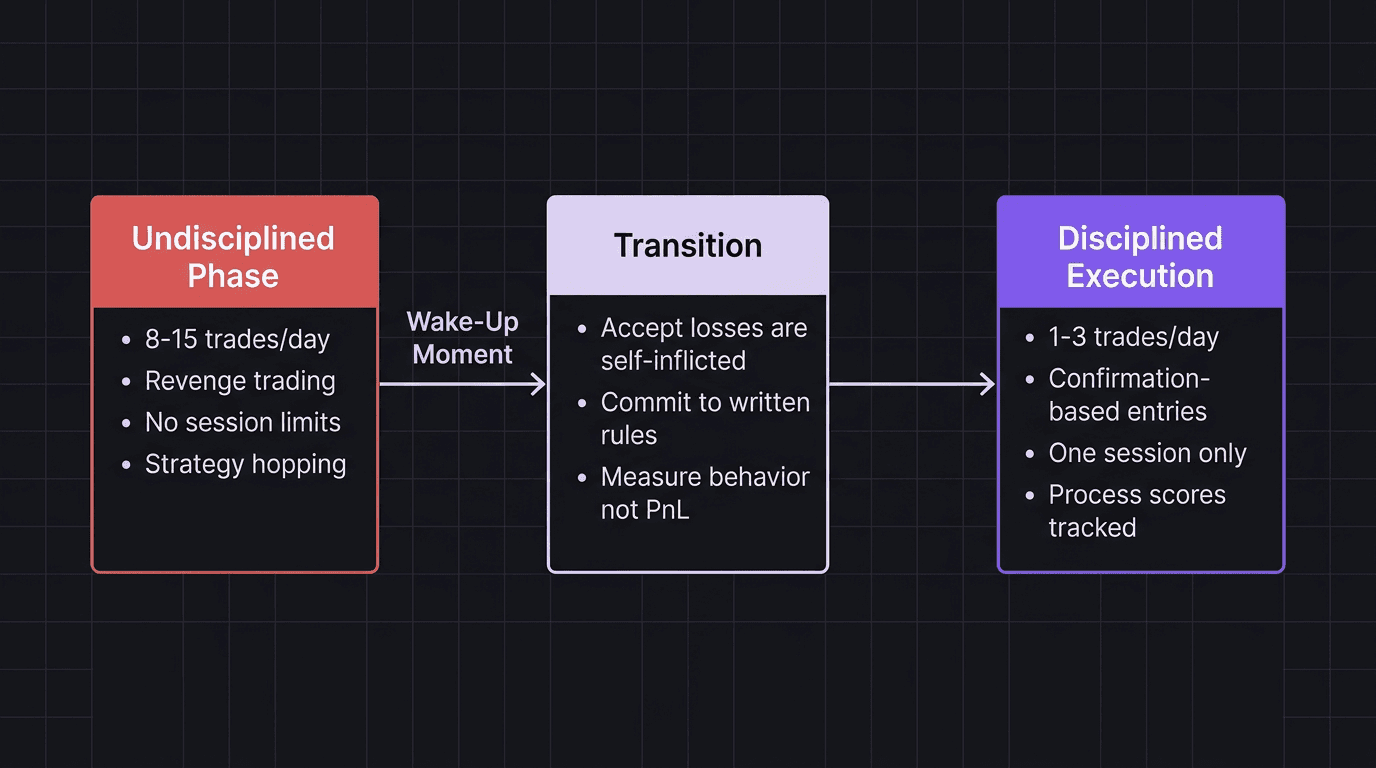
Overtrading: Taking 8 to 15 trades per day when your strategy calls for 2 to 4.
Revenge trading: Doubling position size after a loss to "get it back."
No session boundaries: Trading London, New York, and Asian sessions back to back because "there is always a setup."
Strategy hopping: Switching from order blocks to moving averages to Fibonacci after three losing trades.
No journaling: You do not review trades because you do not want to see the pattern.
Does any of this sound familiar? If so, you are not broken. You are in the phase that every trader passes through before they figure out what discipline actually means.
A Walk Through the Undisciplined Day
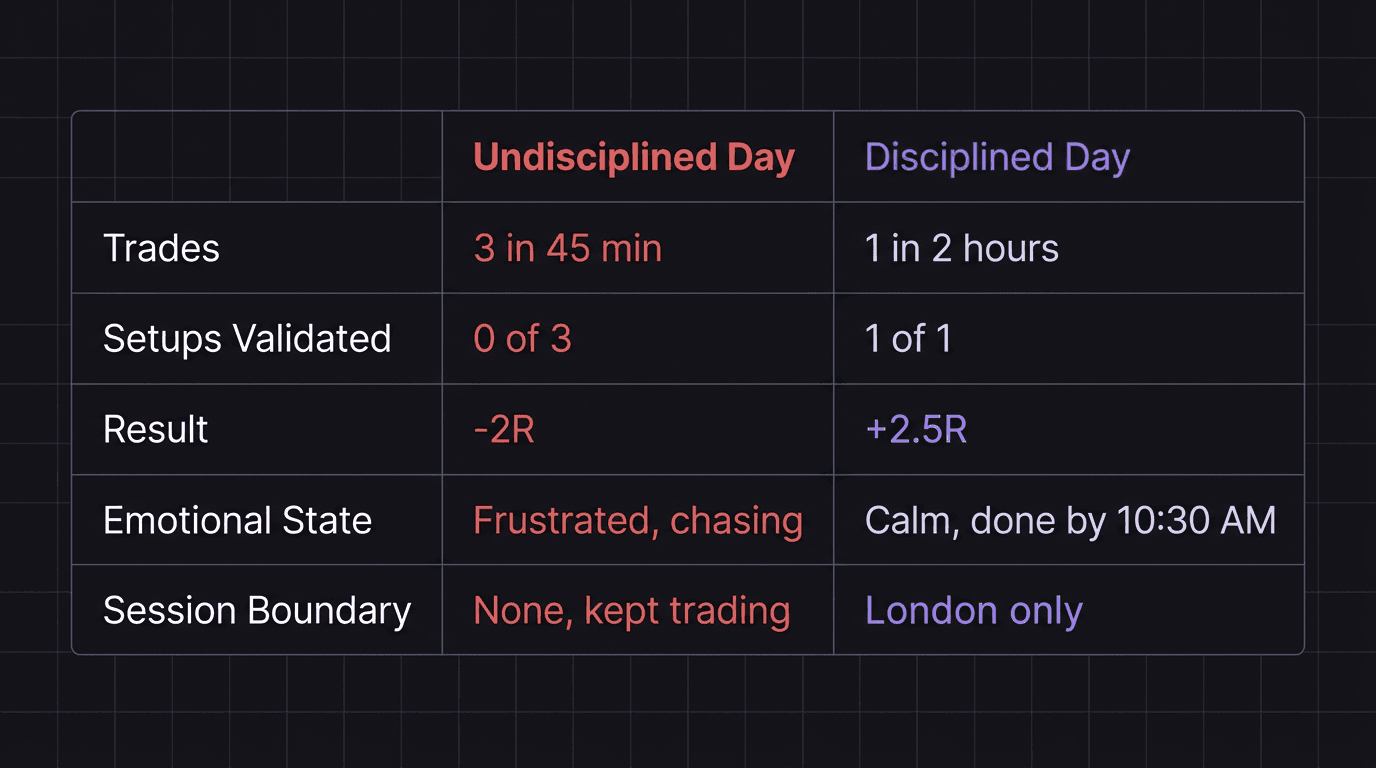
You are trading EUR/USD on the 15-minute chart. London opens with a sweep of the Asian high. You enter short without waiting for a market structure shift. Price drops 15 pips, you feel validated, but you do not take profit because you want more. Price reverses, hits your entry, and you close at breakeven. Frustrated, you immediately enter long on a weak pullback. Stopped out for 1R. Now you are emotional. You switch to GBP/JPY because "it is moving," enter with double your normal lot size, and lose another 1.5R in 20 minutes. Three trades in 45 minutes, two losses, zero planned entries. This is the undisciplined day on repeat.
What the Wake-Up Moment Looks Like
The transformation does not happen gradually. It happens because of a specific event that makes the cost of staying undisciplined painfully obvious.
For some traders, it is blowing an account. For others, it is failing a funded challenge on the last day. For Yousef, it was the accumulation of burned accounts and his wife's honest reaction. He described his turning point in one sentence: "I woke up and said I will change everything the way I'm doing."
That sentence matters. He did not say he would learn a new strategy. He did not say he would find better entries. He said he would change how he was doing things. The strategy was already there. The execution was the problem.
What Changes at the Wake-Up Moment
The shift is not about knowledge. It is about identity. You stop seeing yourself as someone who needs a better strategy and start seeing yourself as someone who needs a better process.
Specifically, three things tend to change at once:
You accept that your losses are self-inflicted. Not bad luck, not market manipulation, not a flawed indicator. Your behavior is the variable.
You commit to rules before the session starts. Not "I will try to follow my plan." You decide: "I will trade London only. I will take a maximum of 3 trades. I will use 0.5% risk per trade." Written down. Non-negotiable.
You start measuring behavior, not just PnL. Did you follow the plan? Did you wait for confirmation? Did you stick to your session? Those become the metrics, not whether you made money on a given day.
A pre-market routine becomes the anchor. It is not about analyzing markets. It is about deciding, before any price action appears, exactly what you will and will not do.
Building a Confirmation-Based Process
Once the wake-up moment happens, you need something to replace the impulsive entries. That something is a confirmation-based process.
Confirmation trading means you do not enter a trade until multiple conditions align. No single signal is enough. You wait for structure, you wait for a sweep, you wait for a shift, and then you enter. If any piece is missing, you do not trade.
Yousef described his process in three words: "Inducement, market shift, liquidity." That is his confirmation stack. He does not trade unless all three align on his timeframe.
What a Confirmation-Based Day Looks Like
It is 8:30 AM London time. You have completed your pre-market routine. You have marked the previous day's high and low, identified the nearest liquidity pools, and written down your bias for the day. EUR/USD sweeps the Asian session low at 8:45 AM. You watch. A 15-minute candle closes above the sweep level, creating a bullish market structure shift. You wait for a pullback into the order block that formed during the shift. At 9:10 AM, price taps the zone. You enter long with a stop below the order block, risking 0.5% of your account. Target is the previous day's high. Price hits your target by 10:30 AM for a 2.5R gain. You close your charts. London session is done.
That is one trade. One session. No drama. Compare this to the undisciplined day where three trades in 45 minutes produced two losses and a flat.
The Confirmation Stack
Build your own version using these questions as filters:
Liquidity: Has a key level been swept? (Stops hunted, equal highs/lows taken.)
Structure: Has the market shifted direction on your execution timeframe?
Entry zone: Is price pulling back into a discount or premium zone where your edge lives?
If all three are present, you have a trade. If any one is missing, you wait. Following a pre-trade checklist consistently comes from this kind of repetition, not from trading more often.
Staying Disciplined When It Feels Boring
Here is the part most articles skip. Once you build the process and start following it, you will feel bored. Deeply bored. And that boredom will tempt you to "just take one extra trade" or "try a different pair today."
This is the second danger zone. The first danger zone is the undisciplined phase. The second is the disciplined phase where boredom pulls you back into old habits.
Yousef's discipline was tested three days after posting $400,000 in funded accounts. He lost one account. Most traders would spiral. He did not. He had already built the process: "If I made $3K once, I can do it thousands of times. Why stress?" He replaced the lost account and added three more, scaling to $850,000.
How to Survive the Boredom Phase
Redefine what a good day means. A good day is not a profitable day. A good day is a day where you followed your rules. Some of your best days will have zero trades because nothing met your criteria.
Did you complete your pre-market routine?
Did every trade meet your confirmation criteria?
Did you respect your session boundary?
If all three are yes, it was a successful day regardless of PnL.
Shrink your session window. If you trade London and New York, pick one. Yousef's rule was clear: "If I got money from London, I don't want to give it back to New York." Fewer hours at the screen means fewer opportunities for discipline to slip.
Accept that discipline looks boring from the outside. Your trading screens will be closed by 11 AM some days. You will have nothing to post on social media. You will feel like you are not doing enough. That feeling is the confirmation that you are doing it right.
The rules you set only prove their value on the days you want to break them. Anyone can follow a plan when the market cooperates. Discipline is what you do when the market is slow, your last trade lost, and there is a "maybe" setup forming on a pair you do not normally trade.
How EdgeFlo Supports Your Discipline Transformation
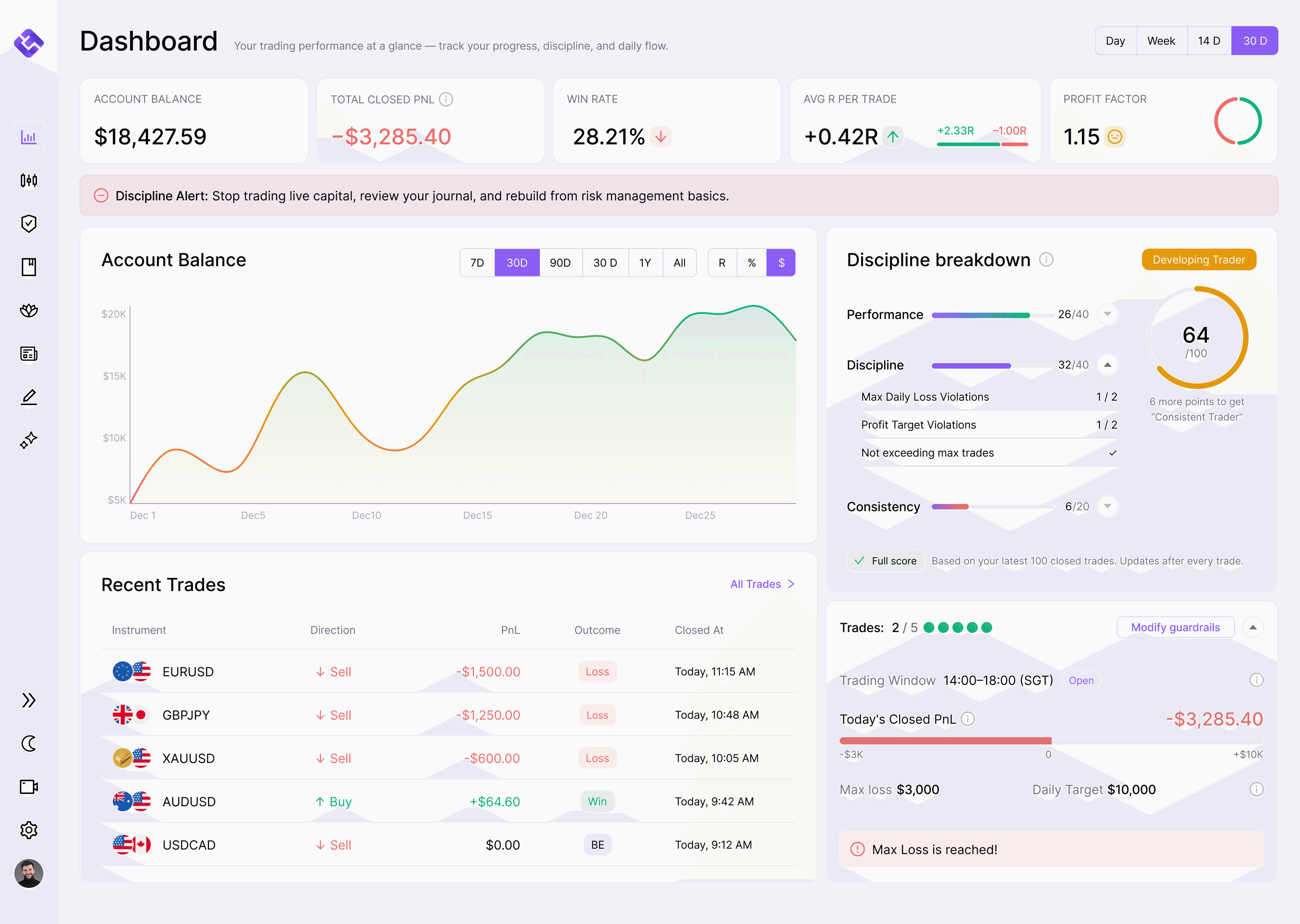
EdgeFlo is built for the exact transition described in this article. The Guardrails feature lets you set session boundaries, daily trade limits, and loss caps before the market opens. When you hit your limit, EdgeFlo flags or blocks the trade button. You can override it, but you have to consciously choose to break your own rule. That one extra step of friction stops the autopilot revenge cycle that costs most traders their accounts.
The Edge trade plan builder keeps your confirmation criteria visible on screen while you trade. Your rules are not buried in a notebook or a note on your phone. They are next to your chart, and after each trade, you report whether you followed them. Over time, this builds a discipline summary that shows you the direct connection between rule-following and profitability.
For the boredom phase, the AI-powered journal and weekly reports (Plus plan) surface patterns you might miss on your own: which sessions produce your best trades, how many trades per day correlate with your highest win rate, and whether your process scores predict your monthly PnL. These insights keep you engaged with your process even when the process itself feels monotonous.
The Edge Brief
Receive Insights on trading psychology, discipline, and the behavioral patterns that create consistent traders from our Founder and the EdgeFlo team, delivered to your inbox.
Think different. Trade different.
How long does it take to become a disciplined trader?
Can you trade profitably without discipline?
What is the biggest sign of an undisciplined trader?
Do professional traders ever break their rules?

Turn discipline on.
Every session.
EdgeFlo is the environment serious traders operate inside.
Start 7-Day Free Trial
Cancel anytime.
No long-term commitment.

Think Different, Trade Different.