

Trading Conviction: Build Trust in Your Edge
Trading conviction comes from data and kept promises, not motivation. Build trust in your edge through testing, journaling, and execution proof.
Trading conviction is trust in your strategy that survives losing streaks, and it only comes from two sources: data proving the edge works, and a track record of keeping promises you made to yourself. Motivation fades after three losses. Pep talks evaporate when your account is red. But a trader who has 100 tracked trades showing positive expectancy and a journal full of followed rules does not panic at loss number four. That trader has proof. Conviction is not a feeling you summon. It is evidence you collect. If you cannot point to hard numbers showing your strategy works, you do not have conviction yet. You have hope. And hope is not a trading plan.
TL;DR
Trading conviction comes from data (backtests, forward tests, tracked results) and kept promises (following your rules consistently).
Copying someone else's strategy without testing it yourself guarantees you will quit after a few losses.
The backtest-to-live pipeline (backtest, forward test, journal, review) is the fastest path to unshakable trust.
Conviction survives losing streaks only when you have a large enough sample proving your edge.
Rebuilding conviction after a drawdown requires going small, tracking everything, and letting the data speak.
Why You Lack Conviction (And Why Motivation Fails)
Ever copied a strategy from YouTube, taken three losses, and decided the whole approach was broken? You are not alone. This is the most common conviction failure in trading, and it has nothing to do with the strategy itself.
The problem is ownership. When you use someone else's system without testing it, you have zero data proving it works for you. No backtest results. No forward test journal. No sample of 50 trades showing how the strategy performs across different conditions. So the first time variance hits (and it always hits), you have nothing to fall back on except belief. And belief crumbles fast under pressure.
Here is what actually happens. You take two or three losses in a row. Your confidence drops because you have no evidence telling you those losses are normal. You start taking low-quality setups out of frustration. You blow through your drawdown limit. Then you blame the strategy and move on to the next one.
Sound familiar? The real issue is not the strategy. It is that you never built the evidence base that turns hope into conviction.
Motivation is the same trap. You watch a trading video, feel fired up, and trade with energy for a week. Then the energy fades because motivation is a temporary chemical response, not a structural foundation. Trading confidence built on motivation collapses the moment results do not match expectations.
Conviction built on data does not care about your mood. It cares about your spreadsheet.
Conviction from Data: The Backtest-to-Live Pipeline
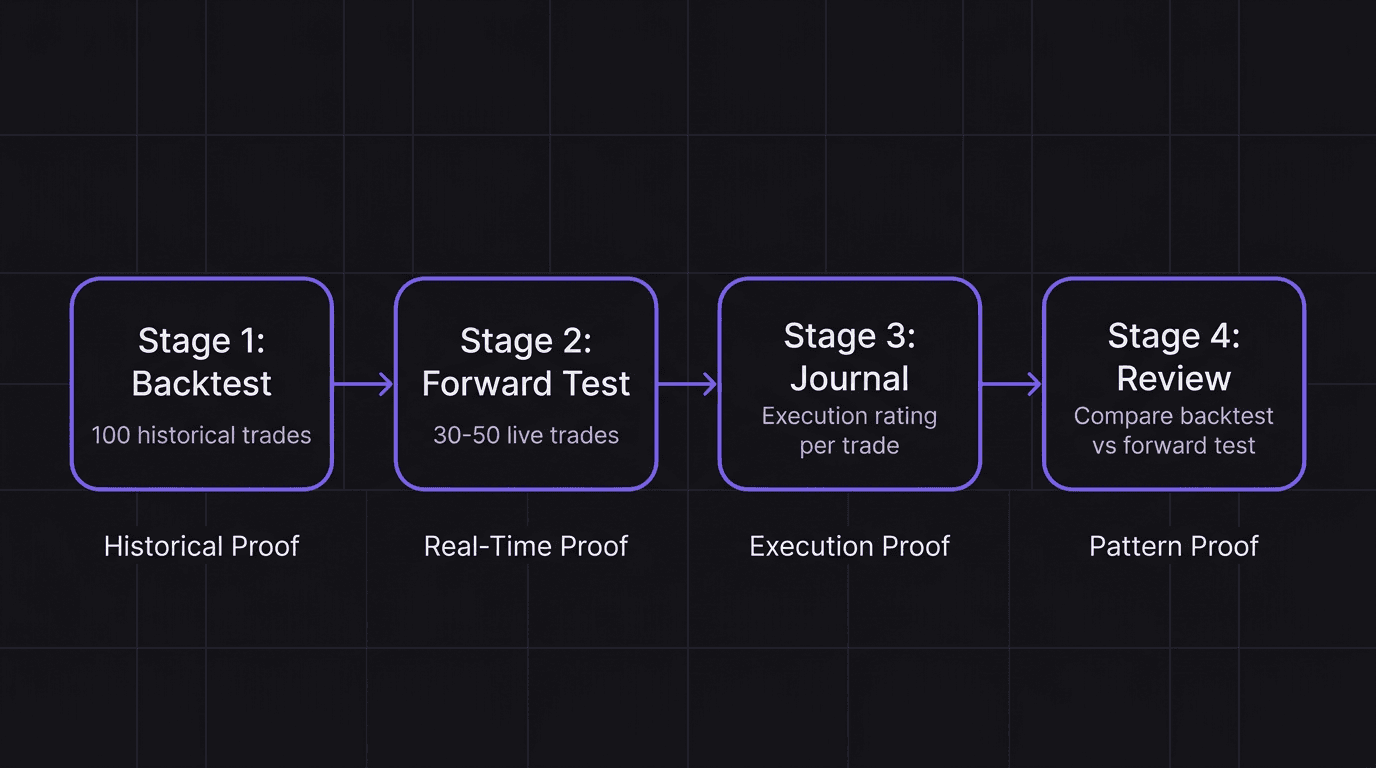
The fastest way to build trading conviction is a pipeline that moves your strategy from theory to proof in four stages. Each stage adds a layer of evidence.
Stage 1: Backtest (Historical Proof)
Go through at least 100 historical setups on your chosen pair and timeframe. Record every entry, stop, target, and outcome. At the end, you should know your win rate, average R, and expectancy. If the numbers are positive, you have the first layer of evidence. If not, refine before moving forward.
This is where most traders skip ahead. They see a strategy that "looks good" and jump straight to live trading. That is like taking a test without studying and wondering why you failed.
Backtesting your strategy properly means you can answer one question: over 100 trades, does this system make money? If you cannot answer that with a number, you are guessing.
Stage 2: Forward Test (Real-Time Proof)
Backtests prove a concept. Forward testing proves you can execute it. Trade the strategy on a demo or small live account for 30 to 50 trades. Track every detail the same way you did in the backtest.
The forward test answers a different question: can you actually follow these rules when real candles are moving? Most traders discover execution gaps here. They hesitate on entries. They move stops. They skip setups that looked obvious in hindsight. The forward test exposes all of it.
Stage 3: Journal (Execution Proof)
Every forward test trade gets a post-trade review. Did you follow the plan? Was the entry clean? Did you manage the trade according to your rules? Rate your execution separate from the outcome.
This is where conviction starts compounding. When you see 40 out of 50 trades executed according to plan, you know something concrete: you can follow your own rules. That knowledge is worth more than any backtest statistic.
Stage 4: Review (Pattern Proof)
After the forward test sample is complete, review the aggregate data. Compare forward test results to backtest results. If they are reasonably close, you now have two independent data sets confirming the edge. That is conviction you can lean on.
If the numbers diverge significantly, the review tells you exactly where to look. Execution gaps, missed setups, emotional trades. Fix those, run another 30-trade sample, and compare again.
Conviction from Promises Kept
Data is half the equation. The other half is something most trading education ignores: self-trust.
Every time you say "I will only take A+ setups today" and then take a B-minus setup because you were bored, you break a promise to yourself. Do that enough times and your subconscious stops believing anything you commit to. You lose trust in your own word, and that erosion shows up as hesitation, second-guessing, and abandoning trades mid-flight.
The source of this idea is blunt: confidence and conviction come from two things. Data, and keeping the promises you make to yourself. If you do not trust your edge, you do not trust yourself. And you do not trust yourself because you have not given yourself a reason to.
So how do you rebuild that self-trust?
Start small. Pick one rule you will follow for the next five trading days. Not ten rules. One. Maybe it is "I will not trade in the first 15 minutes of London open." Maybe it is "I will journal every trade before I close the platform." Whatever it is, keep it achievable and track it.
After five days, you have five kept promises. That does not sound like much, but it is a reversal of the pattern. Instead of breaking commitments and eroding trust, you are stacking evidence that you do what you say. Extend to ten days. Then twenty. Each kept promise compounds like interest on your self-trust account.
This is why knowing your edge matters so much. When you own the system (built it, tested it, journaled the trades), you are not borrowing someone else's conviction. You earned yours through the work.
Walkthrough: 50 Trades That Built Unshakable Trust
The Setup
A trader (we will call him Marcus) had been jumping between strategies for eight months. ICT concepts one month, supply and demand the next, then harmonic patterns. Every time he hit three or four losses, he switched. His account was flat but his frustration was compounding.
Marcus finally committed to one approach: a simple break-of-structure entry on GBP/USD during London session, with a 1:3 risk-to-reward minimum. Nothing fancy. One pair, one session, one setup type.
The Backtest Phase
He went back through six months of GBP/USD London session charts and marked every valid setup. He found 87 qualifying trades. Results: 34% win rate, average winner 3.2R, average loser 1R. Expectancy: 0.42R per trade. The math worked, but Marcus did not feel conviction yet. He had seen strategies "work" in backtests before.
The Forward Test (Where Conviction Started)
Marcus traded the system on a $500 live account for 50 trades over two months. He risked 1% per trade ($5). He journaled every trade: entry reason, execution quality (1 to 5 scale), emotional state, and outcome.
Here is what his data showed after 50 trades:
Win rate: 32% (close to the 34% backtest)
Average winner: 2.9R (slightly below backtest, because he moved his stop to breakeven too early on a few trades)
Average loser: 1R
Expectancy: 0.25R per trade
Execution score average: 3.8 out of 5
Trades where he broke a rule: 7 out of 50
The Moment Conviction Clicked
Trade 38 was a loss. Trade 39 was a loss. Trade 40 was a loss. Three in a row. Eight months earlier, this is where Marcus would have quit and switched strategies. But this time he opened his journal, looked at the aggregate numbers, and saw he was still net positive by 6.2R across 40 trades. The losses were within the expected variance from his backtest.
He took trade 41 according to plan. It hit 3.4R. He did not feel relief. He felt something quieter: trust. Not in the outcome, but in the process. The data said the edge was real. His execution scores said he could follow the rules. Three losses did not change either of those facts.
That is what conviction feels like. It is not excitement. It is not motivation. It is the absence of doubt because the evidence has already answered the question.
How to Rebuild Conviction After a Losing Streak
A losing streak does not destroy conviction if your conviction was built on data in the first place. But it can feel like destruction if you are not careful.
Here is a practical framework for getting back on track.
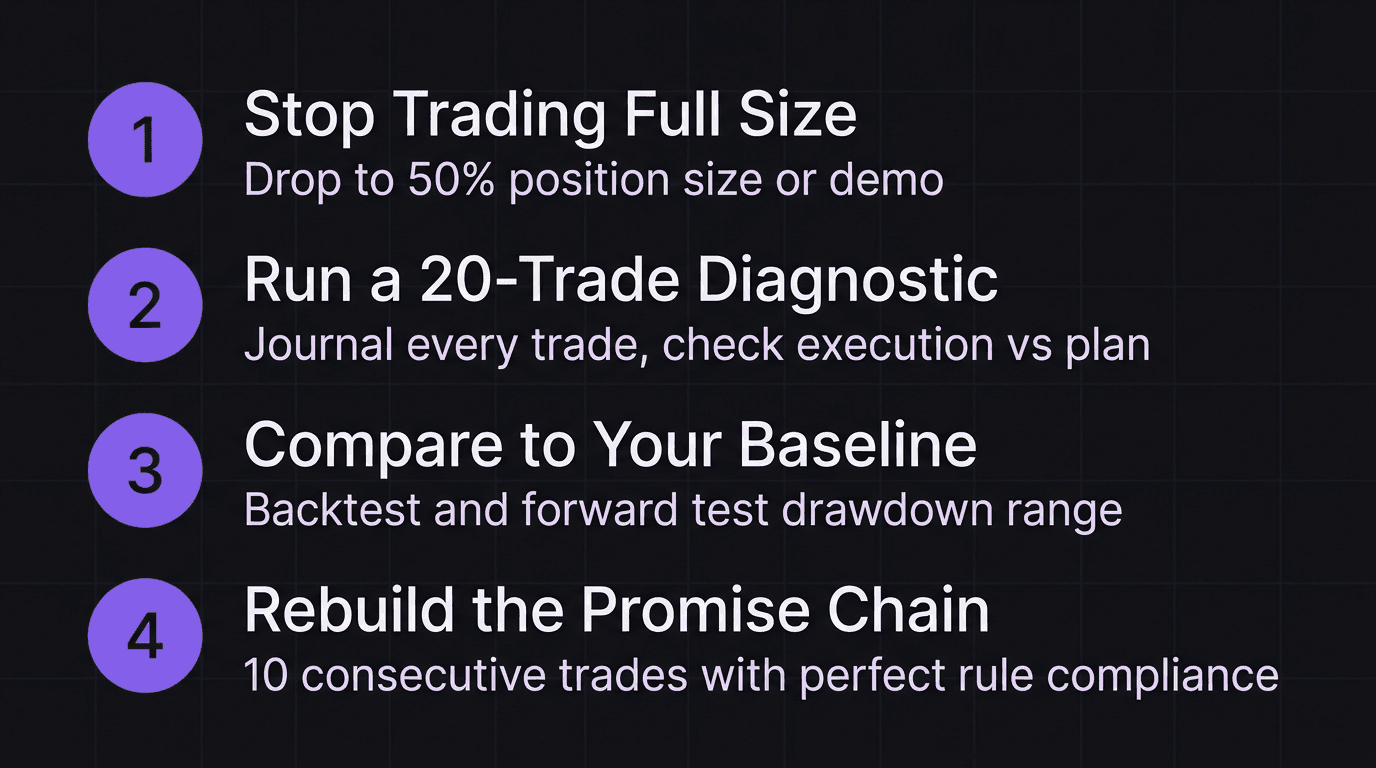
Step 1: Stop Trading Full Size
Drop to 50% of your normal position size, or switch to a demo account. This is not about protecting your account (though it does that). It is about removing the emotional weight so you can focus on execution quality instead of dollar amounts.
Step 2: Run a 20-Trade Diagnostic
Trade the next 20 setups at reduced size and journal every one. Focus on one question: am I executing the plan, or have I drifted? Compare your recent execution scores to your baseline from the forward test.
If execution is clean but results are poor, it is variance. Your conviction should hold because the process is intact.
If execution has drifted (skipping setups, moving stops, entering early), you found the problem. It is not the strategy. It is you.
Step 3: Compare to Your Baseline
Pull up your backtest and forward test data. Where does the current drawdown sit relative to the maximum drawdown from those tests? If you are within the historical range, the losing streak is normal. If you have exceeded it, dig into whether the market conditions have shifted or your execution has changed.
Step 4: Rebuild the Promise Chain
Pick one execution rule and follow it perfectly for ten consecutive trades. Do not aim for profitability. Aim for compliance. Stack ten kept promises and watch how your decision-making sharpens.
How EdgeFlo Turns Data into Conviction
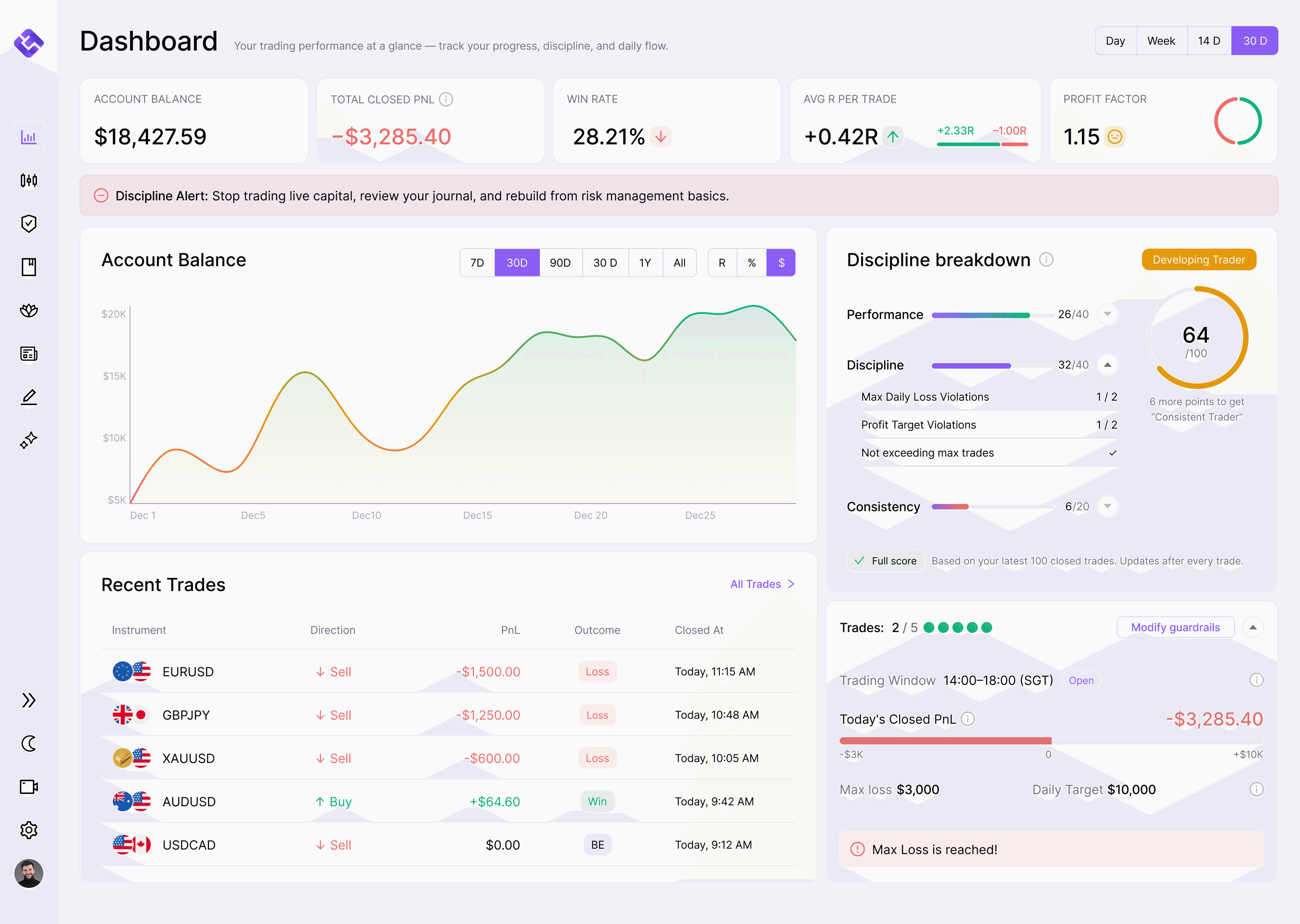
Building conviction requires data you can trust, and that means your tracking system needs to be consistent and honest. EdgeFlo's dashboard shows long-term edge statistics (win rate, average R, expectancy) across your entire trade history, so you always have a clear answer to "does my strategy actually work?" That number does not lie, and it does not reset when you have a bad week.
The journal provides trade-by-trade execution proof. Every entry, every exit, every emotion tag builds the evidence base that turns "I think my strategy works" into "I know it works because I have 200 tracked trades showing positive expectancy." When three losses hit, you open the journal and see the full picture instead of just the recent pain.
Your Edge plan stores the tested strategy for reference, right next to the chart. When doubt creeps in mid-session, the plan is there: the exact rules you backtested, the exact criteria you forward tested, the exact system that earned your conviction. You do not have to remember it under pressure. You just read it.
The Edge Brief
Receive Insights on trading psychology, discipline, and the behavioral patterns that create consistent traders from our Founder and the EdgeFlo team, delivered to your inbox.
Think different. Trade different.
How long does it take to build trading conviction?
Can you have conviction with a 40% win rate?
What is the difference between trading confidence and conviction?
How do you rebuild conviction after blowing an account?

Turn discipline on.
Every session.
EdgeFlo is the environment serious traders operate inside.
Start 7-Day Free Trial
Cancel anytime.
No long-term commitment.

Think Different, Trade Different.