

Trading Confidence: Build It Through Proof, Not Pep Talks
Real trading confidence comes from backtesting data, forward testing results, and journaling proof. Not affirmations. Here is the three-stage system.
Trading confidence comes from one place: proof that your strategy works. Not motivational videos. Not affirmations in the mirror. Not one lucky winning streak. Real confidence is built through backtesting data, forward testing results, and a journal full of trades where you followed your rules. Everything else evaporates the moment you hit a losing streak.
You will not get confidence by shouting positive statements at yourself. You get it by putting in the work, collecting the evidence, and trusting the numbers instead of your feelings.
TL;DR
Confidence comes from competence. No shortcut exists. You need proof your strategy works.
Three stages build real confidence: backtest (50+ trades), forward test (2-4 weeks live demo), then live with small size.
Discipline has three checkpoints: before the trade (plan review), during (patience for setups), after (journaling).
Journaling is the confidence engine. It converts individual trades into long-term evidence that your process works.
A 30-40% win rate is enough with proper risk-to-reward. Confidence doesn't require winning most trades.
Why Confidence Keeps Disappearing After Losses
You've felt this. Three winning trades and you feel unstoppable. One loss and suddenly you're questioning everything. Your strategy, your timing, your ability to do this at all.
That's not a confidence problem. It's a source problem.
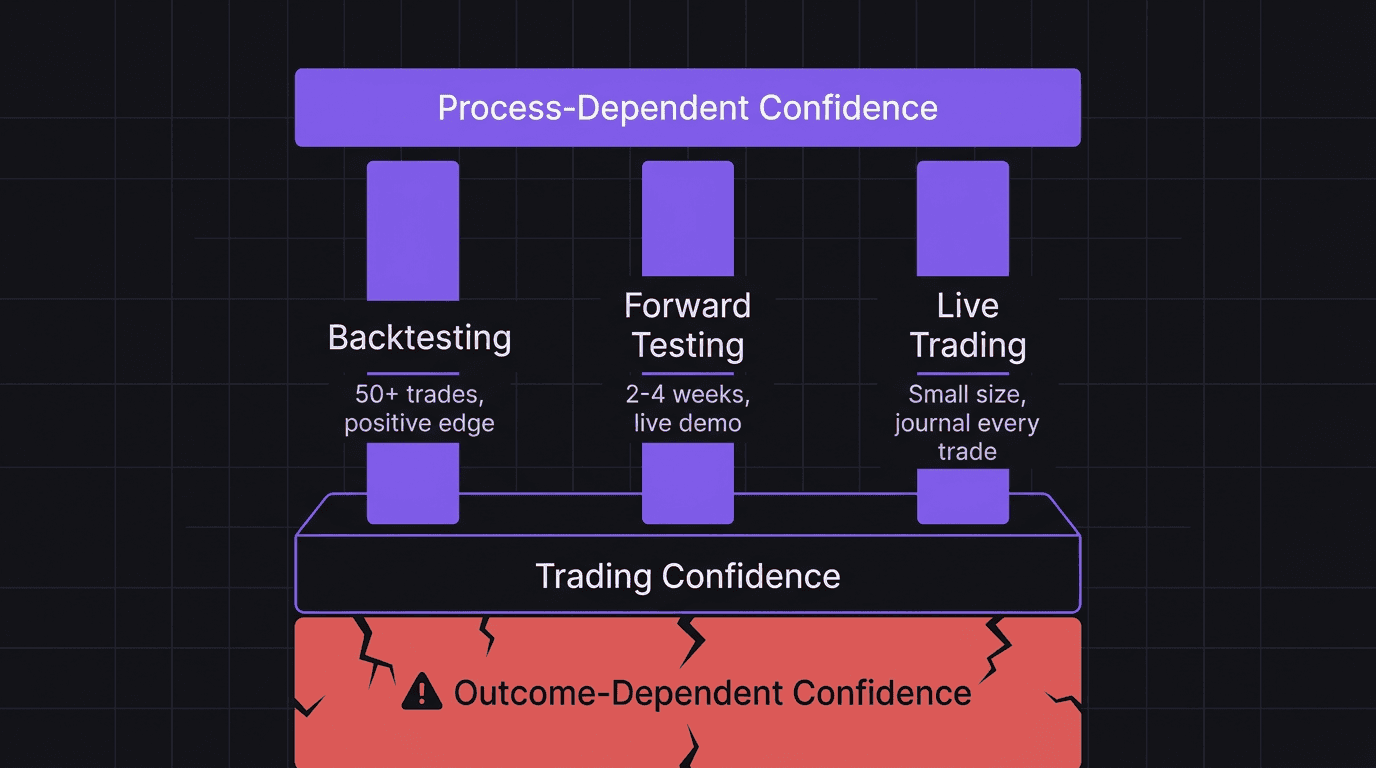
Most traders base confidence on their last few trades. Win two, feel great. Lose two, feel terrible. This is outcome-dependent confidence, and it's as stable as a candle in a windstorm. Every trade changes how you feel about yourself.
The alternative is process-dependent confidence. Did you follow your plan? Did you wait for your setup? Did you respect your stop? If the answer is yes on all three, the trade outcome doesn't matter. The loss was a cost of doing business, not evidence that you're a bad trader.
But you can't just decide to be process-confident. You need data that proves your process works. That's where the three stages come in.
Confidence from Competence: The Only Source That Sticks
Here's the uncomfortable truth about trading psychology: you can't think your way into confidence. You have to earn it.
A surgeon isn't confident because they read a book about surgery. They're confident because they've done hundreds of procedures and tracked the outcomes. They know their success rate. They know which complications they've handled. That data is the foundation.
Trading works the same way. Your confidence should rest on three pillars:
Backtesting data that shows your strategy has a positive edge over 50+ trades
Forward testing results that confirm the backtest wasn't a fluke
Live trade records that prove you can execute the plan under real pressure
Without these three, you're guessing. And guessing doesn't produce confidence. It produces anxiety dressed up as hope.
Ever noticed that confidence crashes hardest after common trading mistakes? Not because the loss was big, but because you know you broke your own rules. The mistake reveals that your confidence was built on hope, not evidence.
The Three Stages: Backtest, Forward Test, Live
Each stage serves a specific purpose. Skip one and your confidence has a hole in it.
Stage 1: Backtesting (1-2 Months)
Go through historical charts and apply your strategy manually. Mark every entry, stop, and target. Record each trade as if you took it live. You need a minimum of 50 trades to have statistically meaningful data.
Win rate (30-40% is fine with 1:3+ R:R)
Average R:R (aim for 1:3 minimum, 1:5 is ideal)
Maximum consecutive losses (this tells you what your worst streak looks like)
Expectancy (average win size times win rate minus average loss size times loss rate)
After 50+ trades, you'll know whether your strategy has an edge. That knowledge is the first layer of real confidence. Not "I think this works." Instead: "Over 50 trades, this strategy returned 3.2R per month with a max losing streak of 5."
See the full backtesting process here.
Stage 2: Forward Testing (2-4 Weeks)
Now run the strategy in real time on a demo account. Same pairs, same session, same rules. The difference from backtesting: you don't know the outcome when you enter.
This stage tests execution under uncertainty. Can you actually pull the trigger when the setup appears? Can you hold through pullbacks? Can you accept the stop loss without moving it?
Many traders discover that their backtesting confidence crumbles when they have to make live decisions. That's the point. Forward testing reveals the gap between knowing the plan and executing the plan.
Stage 3: Live Trading (Ongoing)
Start with the smallest position size your broker allows. The goal for the first month is not profit. It's proof that you can execute the strategy with real money on the line.
Track every trade in your journal. After 20-30 live trades, compare your results to your backtest data. If they're similar, your confidence now rests on triple-verified evidence. If they're different, you've found a problem to fix before it costs you real capital.
Discipline Before, During, and After Every Trade
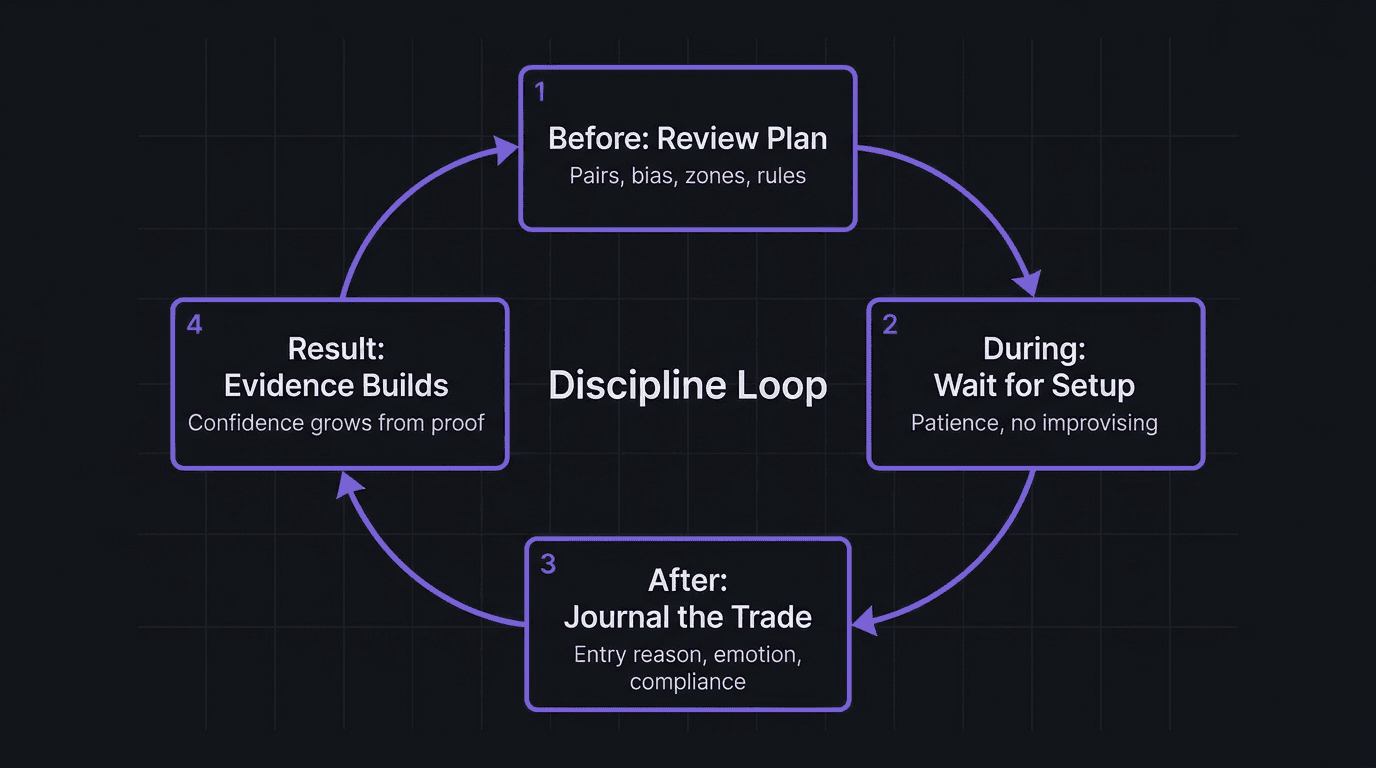
Confidence and discipline are connected. Disciplined execution creates evidence. Evidence creates confidence. Confidence makes discipline easier. It's a loop.
But the loop has to start somewhere. It starts with three checkpoints.
Before the trade: review your plan. Before you even look at a chart, revisit your pre-market routine type preparation. What pairs are you watching? What's your bias? Where are your zones? If you don't have answers to these questions before the session starts, you're improvising. And improvising erodes confidence faster than losing.
During the trade: patience for setups. The hardest discipline isn't entering. It's waiting. Your backtest data shows that your setup appears 2-3 times per session. If you've been staring at charts for an hour with no setup, the disciplined move is to keep waiting. The undisciplined move is to "find" a setup that isn't really there.
After the trade: journal it. Every single trade. Win or loss. Did you follow the plan? What was your emotional state at entry? What would you do differently? This is where individual trades become long-term data.
Walkthrough: Discipline Loop in Action
> You're watching GBP/USD during London session. Your plan says: wait for price to sweep below the Asian session low, then look for a bullish structure break on the 5-minute chart. > > 9:15 AM: Price is consolidating above the Asian low. No sweep yet. You sit and wait. > > 9:45 AM: You see a "close enough" setup. Price dipped near the low but didn't sweep it. The temptation is to enter early. You don't. Your rule says sweep, not "close to sweep." > > 10:10 AM: Price sweeps the Asian low to 1.2640, then rockets back up. 5-minute chart shows a bullish break of structure. You enter long at 1.2660. Stop at 1.2630 (30 pips). Target at 1.2750 (90 pips, 1:3 R:R). > > 10:55 AM: Price hits target. +90 pips. But the confidence boost isn't just from the win. It's from the 55 minutes you spent waiting while the wrong setups tempted you. You followed the plan. The plan worked. That's evidence. > > After session: You journal the trade. Entry reason: Asian low sweep + bullish BOS on M5. Emotion at entry: calm (waited for confirmation). Outcome: 1:3 hit. Rule compliance: 100%.
That journal entry is worth more than the 90 pips. It's a data point that says "when I follow my rules, the strategy delivers." Stack 20 of those entries and your confidence stops depending on the last trade.
How Journaling Builds Long-Term Confidence
A single trade tells you nothing about your ability. Fifty trades tell you everything.
Your journal is the machine that converts scattered trades into a confidence database. After one month of consistent journaling, you can answer questions that used to keep you up at night:
"Does my strategy actually work?" (Check your win rate and expectancy over 30+ trades.)
"Am I getting better or worse?" (Compare this month's compliance rate to last month's.)
"Should I trust this setup?" (Filter your journal by setup type and see the R:R distribution.)
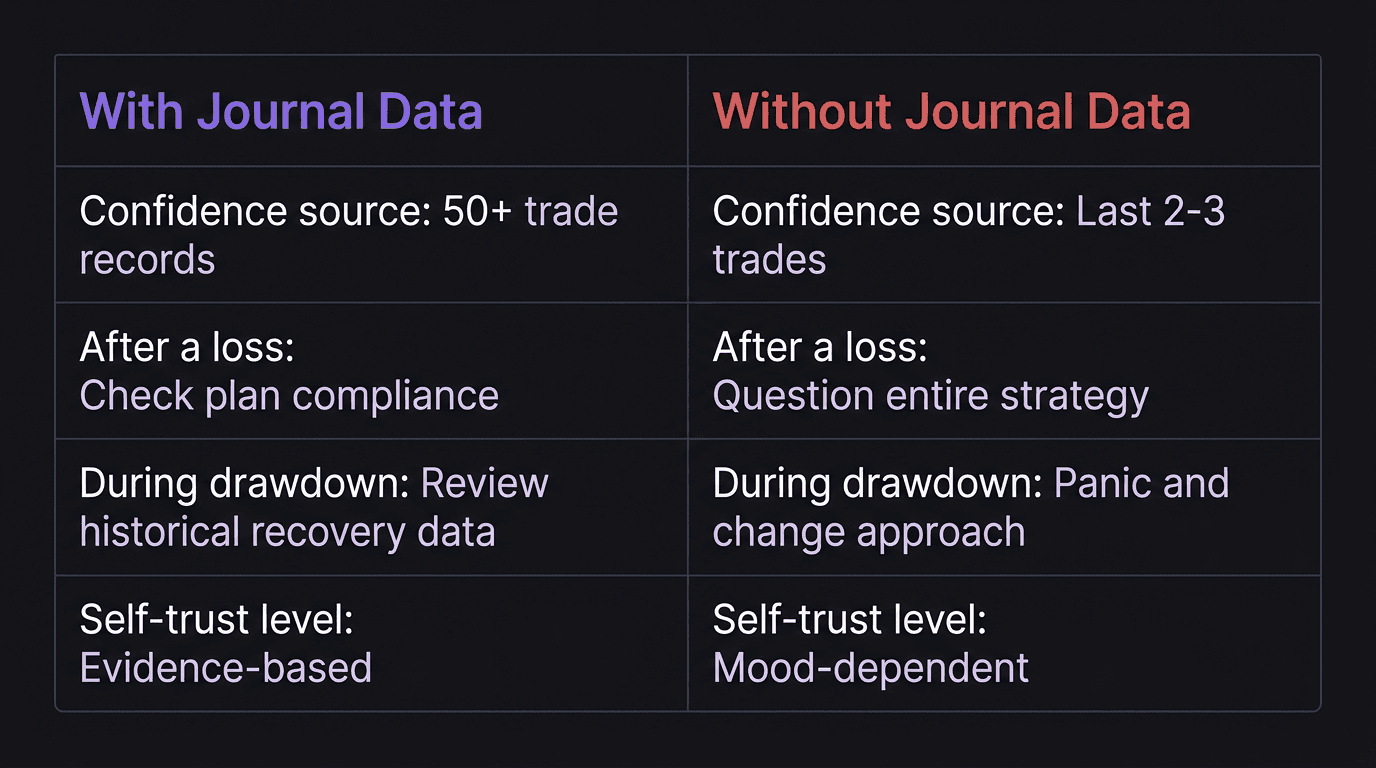
Without a journal, you're relying on memory. And memory is unreliable. You'll remember the big wins vividly and forget the small losses that actually matter more. Your confidence becomes a distorted story instead of an accurate record.
The traders who struggle most with trading fear are almost always the ones without journal data. They have nothing concrete to anchor their confidence to. Every trade feels like a coin flip because they have no evidence suggesting otherwise.
Write it down. Every time. Not because someone told you to, but because the data is the confidence.
How EdgeFlo Reinforces Confidence Through Data
The hardest part of building confidence through data is collecting the data consistently. When you're tired after a losing session, journaling feels pointless. But that's exactly when the data matters most.
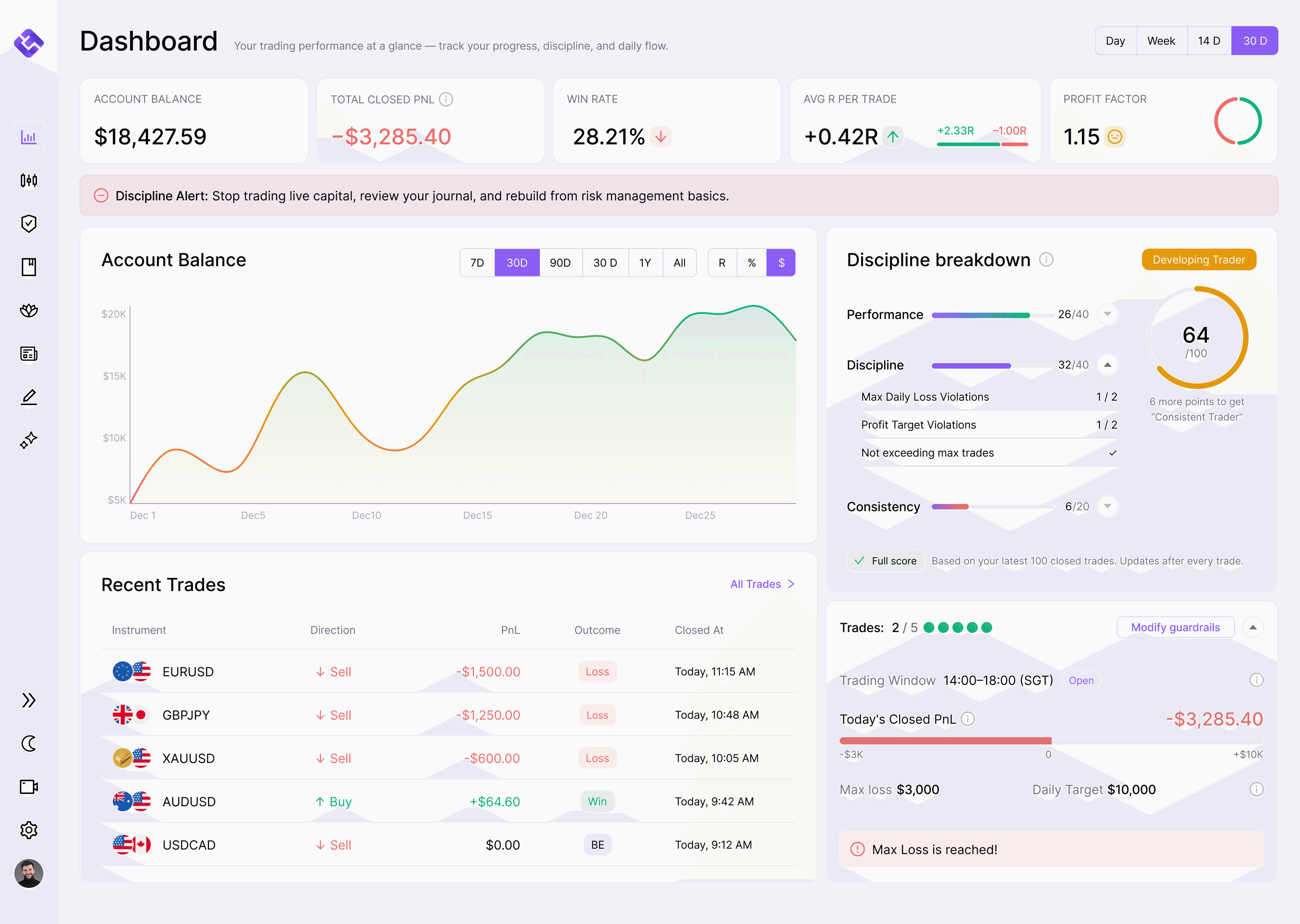
EdgeFlo's journal auto-imports your trades and supports emotion tagging at entry and exit. You don't have to manually type every entry price, stop loss, and lot size. The trade data is already there. You just add the context: why you entered, how you felt, and whether you followed your plan.
For traders on the Plus plan, Edge Plan Stats tracks win rate, net PnL, trades taken, and compliance per plan. That means you can see, at a glance, whether your trading journal data supports your current confidence level. If your compliance rate is 90% and your strategy has a positive expectancy over 40 trades, you have a factual reason to trust yourself. If compliance is at 60% and expectancy is negative, you know exactly what to fix. Either way, the guessing is gone.
The Edge Brief
Receive Insights on trading psychology, discipline, and the behavioral patterns that create consistent traders from our Founder and the EdgeFlo team, delivered to your inbox.
Think different. Trade different.
How do I build confidence in trading?
Why do I lose confidence after a losing trade?
Do affirmations help with trading psychology?
How long does it take to become a confident trader?

Turn discipline on.
Every session.
EdgeFlo is the environment serious traders operate inside.
Start 7-Day Free Trial
Cancel anytime.
No long-term commitment.

Think Different, Trade Different.