

Losing Streak: Why 5 Losses Don't Mean Your Strategy Is Broken
A 5-trade losing streak is statistically normal. Learn the math behind drawdowns, why your brain overreacts, and how to tell real problems from random variance.

Five losses in a row and your stomach drops. You start scrolling through your trade log wondering what went wrong. Maybe the strategy is broken. Maybe you should switch to something else. Maybe you should stop trading for a week.
Hold on. Before you blow up your process, you need to check the math. Because a 5-trade losing streak, even with a solid win rate, is not a signal that anything is broken. It is one of the most predictable events in trading.
Every single trade is independent. Just because you lost the past 5 trades does not mean you will lose the next one. But your brain does not process it that way, and that gap between math and emotion is where most traders destroy good strategies.
TL;DR
A trader with a 55% win rate will hit 5 consecutive losses more often than you think. The math says it is inevitable over enough trades.
Your brain treats each loss as confirming a pattern, but trades are independent events. Loss #5 has the same odds as loss #1.
The real danger is not the losing streak itself. It is the revenge trading and strategy-hopping that follows.
Cut position size during drawdowns instead of stopping entirely. Smaller risk lets you keep collecting data without the emotional weight.
Track your trading expectancy over 30+ trades before concluding anything is broken.
Losing Streaks Are Normal (Here's the Math)
Think of it like flipping a weighted coin. You have a coin that lands heads 55% of the time. Would you be shocked to see 5 tails in a row? You should not be.
The probability of 5 consecutive losses with a 55% win rate is:
0.45 x 0.45 x 0.45 x 0.45 x 0.45 = 0.0185, or about 1.8%
That sounds rare. But here is the part most traders miss: you are not flipping the coin 5 times. You are flipping it hundreds of times. Over 200 trades, the probability of experiencing at least one 5-trade losing streak jumps above 50%. Over 500 trades, it is nearly certain.
Even with a 30% win rate, you can still lose 8 or 9 trades in a row. That is not the strategy failing. That is probability doing what probability does.
Walkthrough: The 55% Win Rate Reality Check
A trader runs a EUR/USD strategy on the 1-hour chart. Win rate over the past 6 months: 55%. Average winner: 1.5R. Average loser: 1R. The strategy has positive expectancy.
In week 3 of March, the trader takes 5 trades on GBP/USD and EUR/USD. All 5 lose. Each is a clean setup that followed every rule in the plan.
The trader's first instinct: "My strategy stopped working." But look at the numbers. The probability of 5 straight losses at a 55% win rate is 1.8%. Over the 200 trades this trader takes per year, a 5-loss streak was going to happen.
The trader who understands this takes trade #6 without flinching. The trader who does not starts tweaking indicators, switching timeframes, or sitting out for two weeks, missing the next 4 winners.
A 30% win rate does not necessarily mean you will win 3 out of the next 10 trades. It could take 100, 500, or even 1,000 trades for the underlying expectancy to show. So many traders do not get this: they think just because they have a certain win rate, the wins will distribute evenly. They will not.
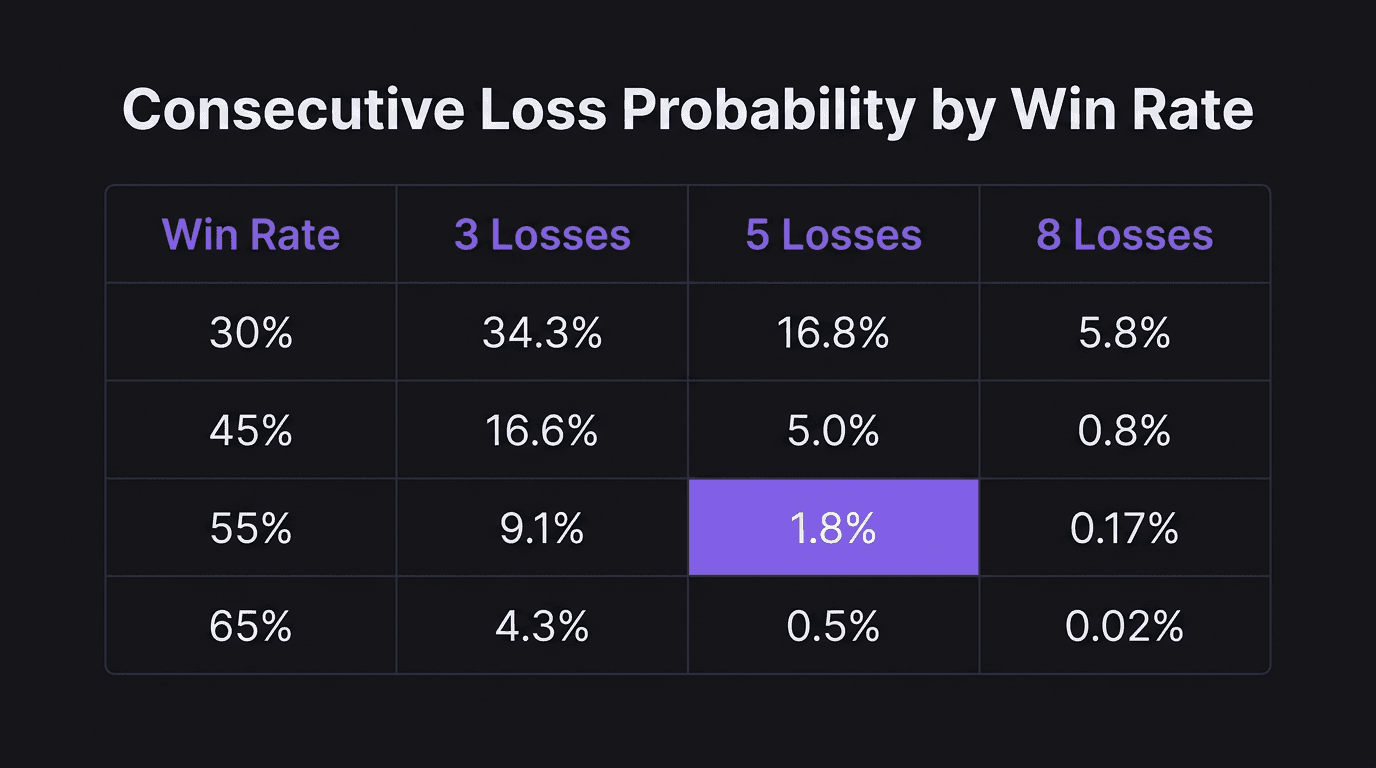
This table makes one thing clear: even a strong 55% strategy will hand you 5 losses in a row. And a 30% win rate strategy (common in trend-following) will produce 8-loss streaks regularly.
Why Your Brain Panics After Three Losses
Your brain is built for pattern recognition. That was useful when spotting predators on the savanna. It is terrible for evaluating random sequences of trade outcomes.
After loss #1, you barely notice. After loss #2, you get a flicker of doubt. By loss #3, your brain is screaming that something is wrong. Psychologists call this recency bias: you weigh recent events far more heavily than older ones.
Here is the problem. When you are on a winning streak, you automatically feel invincible. That is a recipe for disaster. And when going through a losing streak, you start losing every ounce of faith in your strategy. Both reactions are wrong.
The emotional spiral usually goes like this:
Doubt (losses 2-3): "Is my strategy still working?"
Fear (losses 4-5): "I need to stop before I lose more." This is where trading fear starts driving decisions instead of data.
Abandonment (losses 5+): "This strategy is broken. I need a new one."
But every single trade is not related. Loss #5 carries the same probability as trade #1. Your brain cannot accept this because it evolved to find patterns, not to think in probabilistic thinking terms.
The worst part? If every loss actually puts you closer to a win (because the probabilities must converge over a large sample), you should look forward to the next trading opportunity, not dread it. But that requires trusting the math over your gut, and almost nobody does that naturally.
Real Problem vs Random Variance: How to Tell
So if a losing streak does not automatically mean your strategy is broken, how do you know when it actually is? You need a framework that separates noise from signal.
The 30-Trade Rule
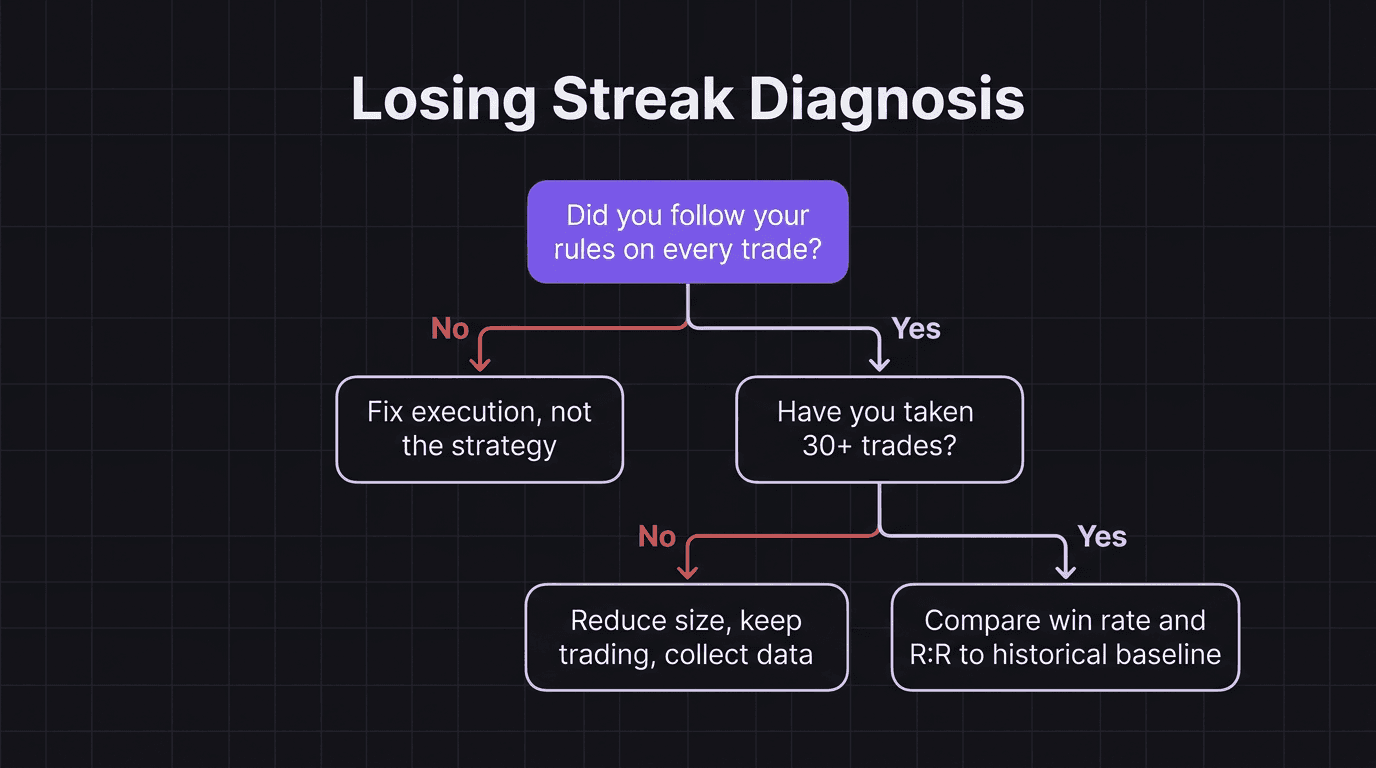
Do not evaluate your strategy on 5 trades. Or 10. Or even 20. You need at least 30 to 50 trades executed cleanly (following your rules every time) before you have enough data to draw conclusions.
Five losses in a row is a data point. Thirty trades with a win rate 15 percentage points below your historical average is a pattern.
Three Questions to Ask During a Streak
Before you change anything, answer these honestly:
Did I follow my rules on every losing trade? If you did not, the losses are not the strategy's fault. They are execution failures. Fix the execution, not the system.
Has the market context changed? A range-bound strategy will bleed during a trending month. That is not broken. That is a mismatch between strategy type and market conditions.
Is my sample size large enough? If you have taken fewer than 30 trades since the streak started, you do not have enough data. Keep trading at reduced size and collect more information.
Walkthrough: The Trader Who Switched Too Early
A trader runs a momentum strategy on USD/JPY, 4-hour chart. Historical win rate: 52%. After 7 trades in two weeks (4 losses, 3 wins, but the losses came first as a 4-trade streak), the trader panics and switches to a mean-reversion system they found on YouTube.
Over the next month, the new system produces 12 trades: 5 wins, 7 losses. Meanwhile, the original momentum strategy (if they had kept running it) would have caught a strong USD/JPY move that produced 3 consecutive 2R winners.
The lesson: 7 trades is not a sample. The trader abandoned a positive-expectancy strategy based on noise and replaced it with an untested one. That is not adapting. That is panic.
The Survival Rules for a Drawdown Phase
Knowing the math is one thing. Living through a drawdown is another. Here are the rules that keep your account and your psychology intact during a losing streak.
Rule 1: Cut Size, Not Frequency
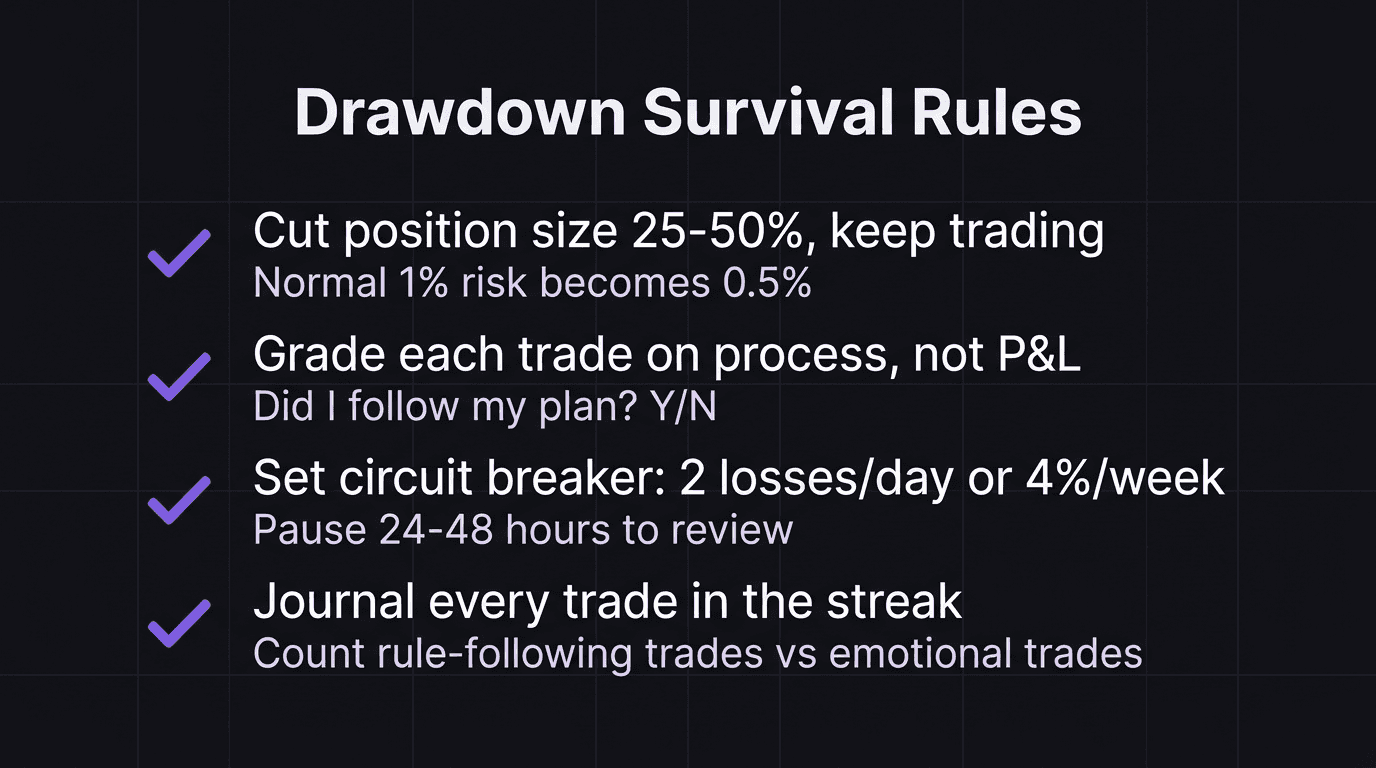
The instinct is to stop trading entirely. That is almost always wrong. When you stop, you miss the trades that would have ended the streak. Instead, reduce your position size by 25% to 50%.
If you normally risk 1% per trade, drop to 0.5%. The smaller risk means each loss hurts less, which keeps your emotions in check. And you keep collecting data, which is the only way to know if the streak is random or real.
Rule 2: Grade Process, Not Outcomes
After each trade during a drawdown, ask one question: "Did I follow my plan?" If yes, the trade was a success regardless of the P&L. If no, identify what you broke and fix that specific behavior.
This keeps your focus on the controllable (execution) instead of the uncontrollable (whether this particular trade wins or loses).
Rule 3: Set a Circuit Breaker
Pick a drawdown level where you pause, not permanently, but for 24 to 48 hours. Common levels:
Daily: 2 consecutive losses or 2% account drawdown in a single session
Weekly: 4% drawdown from the week's starting balance
A circuit breaker is not about quitting. It is about giving yourself time to review whether the losses were clean (rule-following) or dirty (emotional trades). The difference determines your next step. This ties directly into trading drawdown recovery: the process of rebuilding from a rough stretch without making it worse.
Rule 4: Journal the Streak
Write down every trade in the streak with one extra column: "Followed plan? Y/N." At the end of the streak, count the Y's and N's. If all Y's, the streak was variance and you did your job. If half are N's, you have a discipline problem, not a strategy problem.
How EdgeFlo Shows Whether Your Edge Is Still Working
Telling yourself "trust the math" is easy. Actually trusting it when your account is red for 8 straight days is harder. That is where having the data visible makes the difference.
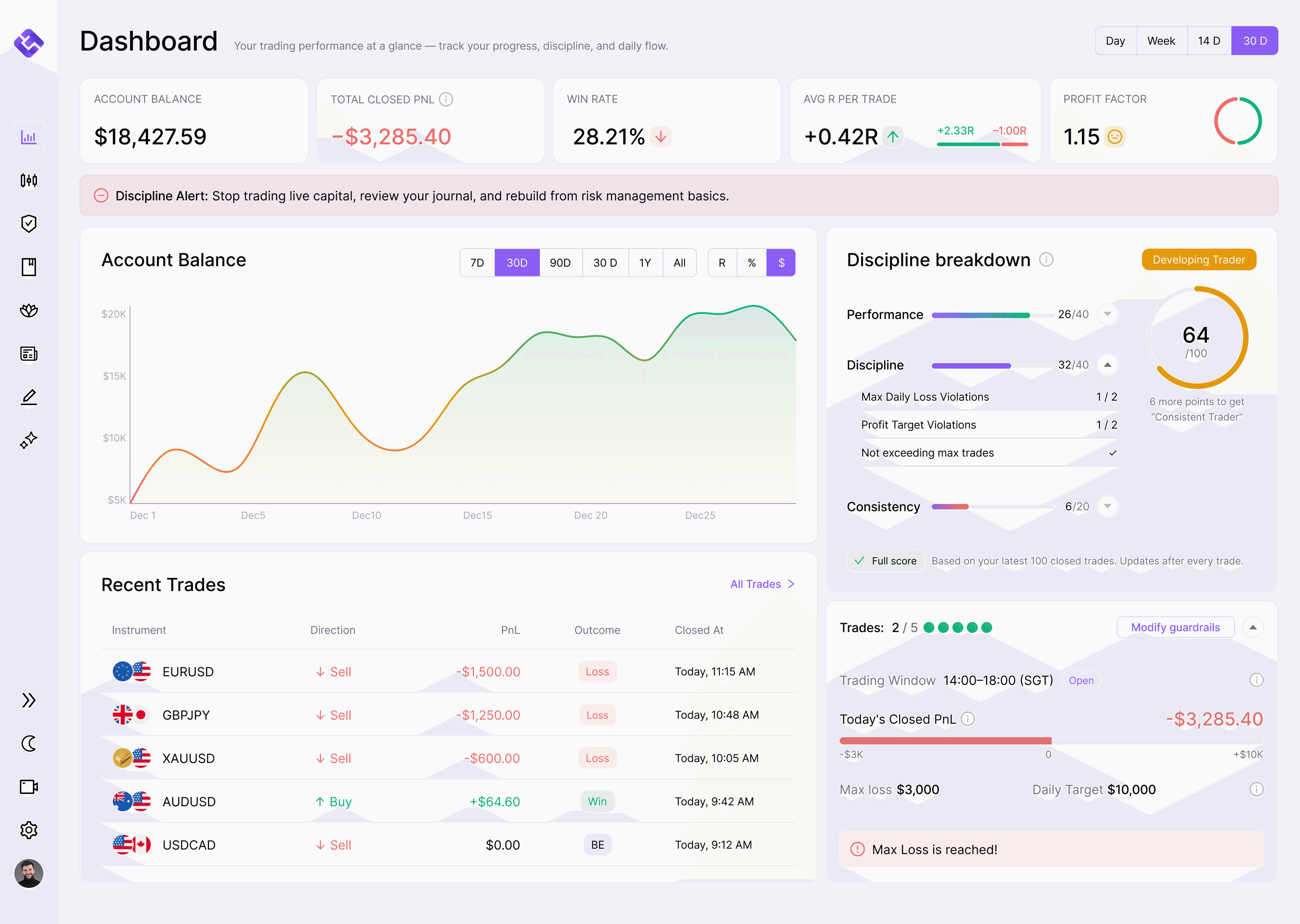
EdgeFlo's dashboard tracks your win rate, profit factor, and EdgeScore over time, not just on a per-trade basis but across rolling windows. So when you hit a 5-trade losing streak, you can pull up your 50-trade and 100-trade metrics and see whether the edge is still intact. If your rolling win rate over 100 trades is still near your baseline, the streak is noise. The data says so, and you can see it.
For Plus users, the weekly AI report surfaces patterns you might miss during a drawdown. It can flag whether your recent losses cluster around a specific session, pair, or setup type. That turns a vague feeling of "everything is going wrong" into a specific, diagnosable data point. Maybe your London session setups are fine but your New York entries are slipping. That is actionable. "My strategy is broken" is not.
The point is not to remove the discomfort of losing. Losing streaks will always feel bad. The point is to separate what you feel from what the data shows, so you make your next decision based on evidence instead of emotion.
The Edge Brief
Receive Insights on trading psychology, discipline, and the behavioral patterns that create consistent traders from our Founder and the EdgeFlo team, delivered to your inbox.
Think different. Trade different.
How many losses in a row is normal in trading?
Should I change my strategy after a losing streak?
How do I know if my trading strategy is actually broken?
How do I stay disciplined during a drawdown?

Turn discipline on.
Every session.
EdgeFlo is the environment serious traders operate inside.
Start 7-Day Free Trial
Cancel anytime.
No long-term commitment.

Think Different, Trade Different.