

Strategy Hopping: Why Switching Systems Keeps You Losing
Strategy hopping kills trading results. Learn why switching systems after losses is an instant gratification trap and how to commit to one strategy.
Strategy hopping is the single fastest way to guarantee you never become profitable. You take a few losses, panic, Google a new system, start fresh, take a few more losses, and repeat. The strategy was never the problem. You never stayed long enough to find out if it worked. Every system has losing streaks. Professional traders know this. They stick with one approach, refine their execution, and let the edge play out over hundreds of trades. Hopping between methods resets your learning curve to zero every time.
TL;DR
Strategy hopping resets your learning curve to zero with every switch, making it impossible to develop real skill in any single approach.
Losing streaks are normal in every profitable strategy. Three or four losses in a row is not evidence that a system is broken.
The urge to switch strategies is an instant gratification response, not a logical evaluation of performance.
You need 50 to 100 trades minimum before you have enough data to judge whether a strategy actually works.
Commit to one system, track your results, and refine execution instead of searching for a system that never loses.
The Strategy Hopping Cycle
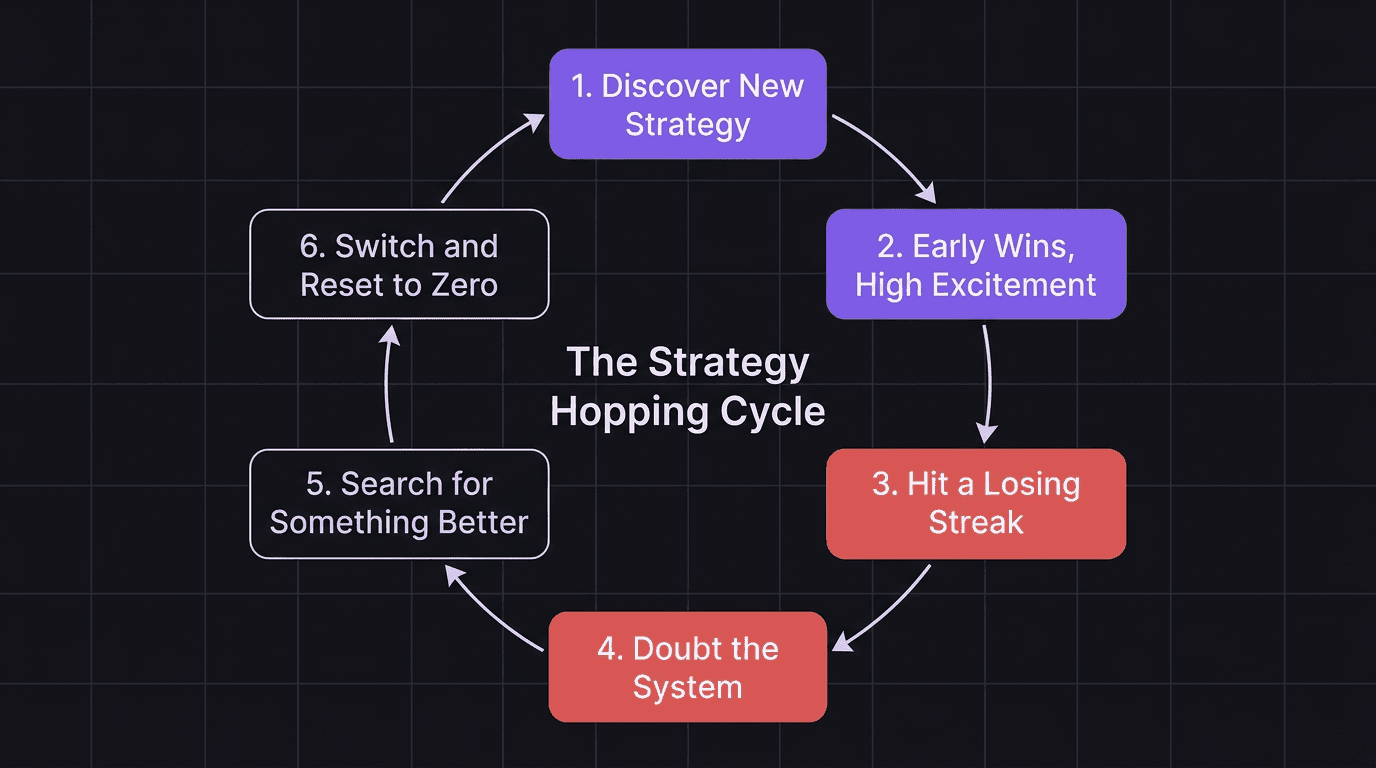
Here is what the cycle looks like. You find a strategy on YouTube or a trading forum. Maybe it is ICT concepts. Maybe it is a moving average crossover. Maybe someone on Twitter posted a 90% win rate backtest. You are excited. This is the one.
You take your first few trades. The first one wins. The second one wins. You are a genius. Then you hit a losing streak. Three losses in a row. Four. Your account is down 6%. The excitement evaporates. Doubt creeps in.
So you start browsing again. You stumble across SMC (Smart Money Concepts). Different terminology, different entry model, same promise. You switch. And the cycle restarts.
This is what most traders do for months or even years. They rotate through strategies like Netflix shows, never finishing a single season. ICT to SMC to supply and demand to indicator stacking to price action to Wyckoff. Each switch feels like progress. It is not. It is avoidance.
Walkthrough: The Hopper vs. The Committer
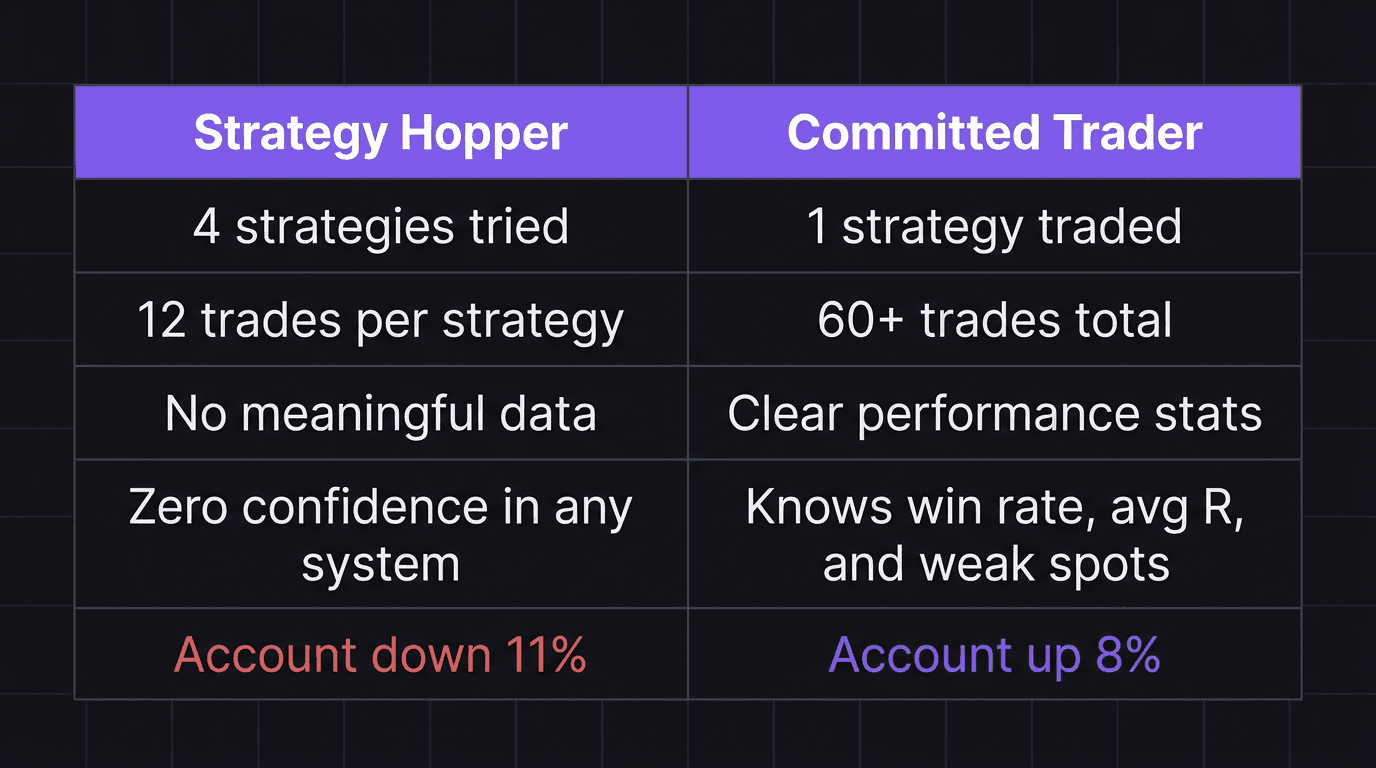
Trader A starts with an ICT-based strategy in January. After two weeks and 12 trades (7 wins, 5 losses), she hits a rough patch with three consecutive losses on GBP/USD during London session. She abandons ICT and switches to an SMC approach she saw on YouTube. She spends a week learning the new terminology, takes 8 trades over two weeks (4 wins, 4 losses), then switches again to a simple EMA crossover strategy after a particularly painful loss on EUR/USD where her stop got swept at 1.0845 before price reversed in her original direction. By March, she has tried four strategies and has zero confidence in any of them. Her account is down 11%.
Trader B starts with the same ICT strategy in January. Same rough patch. Same three consecutive losses on GBP/USD. But instead of switching, she opens her trading playbook and reviews the setups. She notices her entries were rushed on two of the three losses. She was not waiting for full confirmation. She adjusts her entry criteria, keeps trading the same system, and by March she has 60 trades logged. Her win rate is 48% with a 2.1R average winner. She is up 8%. Same strategy. Different commitment level.
The difference between these two traders is not intelligence or talent. It is patience. Trader B gave her system enough trades to reveal its actual performance. Trader A never will.
Why Losses Feel Like Strategy Failure (But Aren't)
Here is the part nobody wants to hear. No matter what strategy you use, you will still have losing streaks, periods of doubt, and uncertainty. Every single system. Even the ones used by hedge fund traders pulling seven figures.
A strategy with a 55% win rate will regularly produce streaks of four, five, even six losses in a row. That is basic probability. It is not a sign that something is broken. It is math.
But your brain does not process it that way. After three losses, your brain tells you this story: "The strategy does not work. You need a new one." That story feels true. It feels urgent. And it is almost always wrong.
The problem is that most traders evaluate strategy performance on a sample of 5 to 15 trades. That is not a sample. That is noise. You need at least 50 to 100 trades in live conditions before you can draw any real conclusion about whether a trading edge actually exists.
Think about it this way. If you flipped a fair coin 10 times and got 7 heads, would you conclude the coin is rigged? Of course not. Ten flips is not enough data. But traders do exactly this with their strategies every day. They take 8 trades, lose 5, and conclude the system is broken.
The losses are not telling you the strategy failed. They are telling you that you have not traded it long enough to know.
The Instant Gratification Trap
Strategy hopping is just another form of instant gratification. And it makes sense when you look at the world we live in. Everything is built around getting what you want right now. Netflix gives you the next episode automatically. Uber Eats delivers food in 20 minutes. TikTok serves a new dopamine hit every 15 seconds.
Trading does not work that way. Results take months to materialize. A real edge reveals itself over hundreds of trades, not a handful. But your brain, trained by years of instant feedback loops, cannot handle that timeline.
So when a strategy delivers three losses in a row, your brain treats it the same way it treats a boring Netflix show. Skip it. Find something better. Something that works right now.
This is why so many traders keep searching for the holy grail strategy. They take a few losses, get frustrated, and start looking for the one system that never loses. That system does not exist. But the search for it feels productive. It feels like you are working on your trading.
You are not. You are avoiding the actual work, which is sticking with one approach long enough to get good at executing it.
Every time you switch, you lose something you cannot get back: reps. Repetitions with a single system build pattern recognition, entry timing, and the trading confidence to hold through drawdowns. You cannot develop that by switching systems every two weeks.
How to Stick With One System Long Enough
Knowing that strategy hopping is destructive does not automatically fix it. You need a structure that keeps you committed when the losses pile up. Here is what actually works.
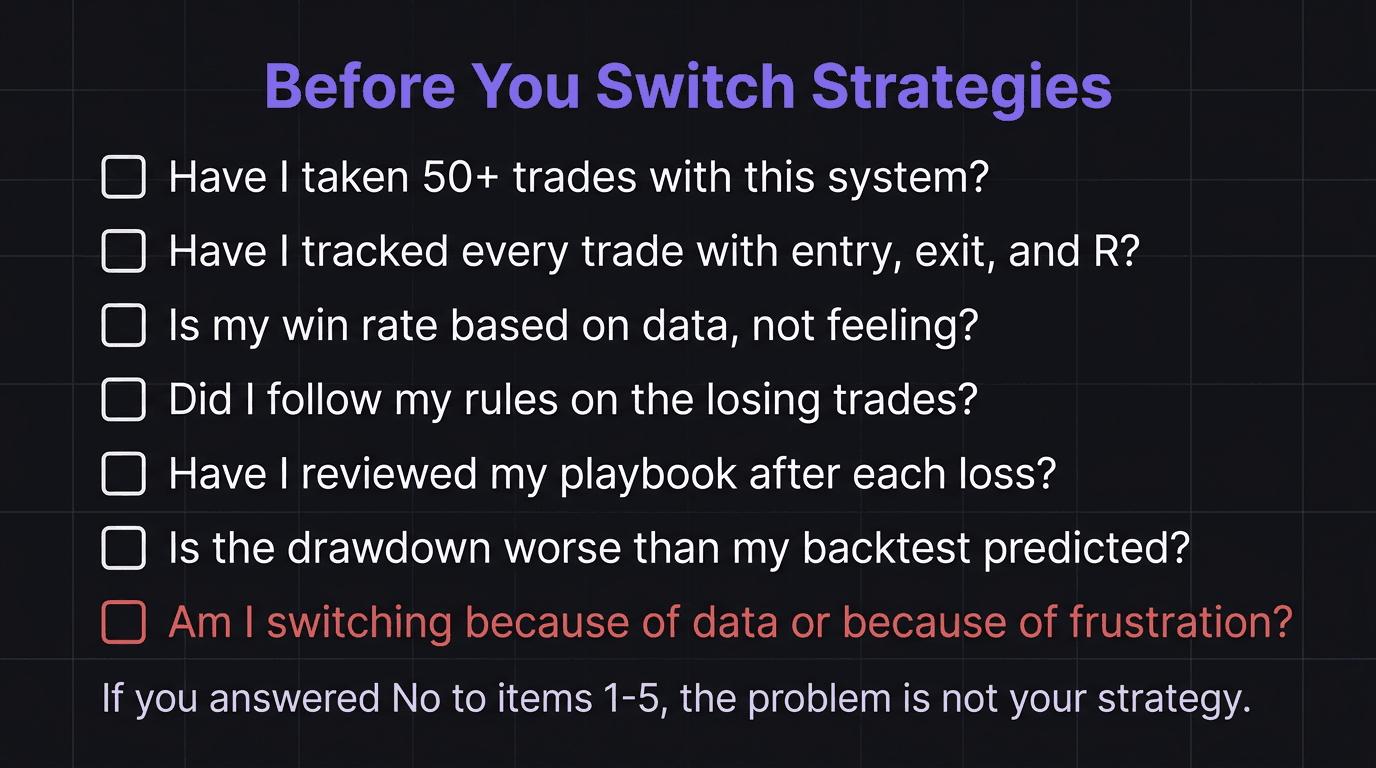
Pick a strategy and write it down. Not in your head. On paper or in a document. Define the exact entry criteria, the exit rules, the timeframes, and the pairs you trade. If you cannot explain your strategy in one page, it is too complicated. A written plan becomes a reference point when doubt hits. You stop guessing and start checking.
Set a minimum trade count before evaluation. Before you take your first trade, decide how many trades you will take before you allow yourself to evaluate the system. Fifty is a reasonable minimum. Write that number down. When you hit loss number six and your brain screams "switch," you look at your trade count. If you are at trade 22, you keep going. The decision was already made.
Track everything. Log every trade with entry, exit, R-multiple, and a one-sentence note on whether you followed your rules. This is not optional. Without data, every losing streak feels like evidence that the strategy is broken. With data, you can see that your win rate is actually 51% and your average winner is 1.8R. That is an edge. You just could not see it because you were focused on the last three trades.
This is where backtesting trading strategy work pays off. If you tested the system before you traded it live, you already know its expected drawdown. When you hit that drawdown in real trading, it is not a surprise. It is confirmation that the system is behaving normally.
Separate execution errors from strategy errors. When you lose a trade, ask one question: "Did I follow my rules?" If the answer is yes, the loss is part of the system. Accept it. If the answer is no, the loss is an execution problem. Fix your execution, not your strategy. Most traders who think they have a strategy problem actually have an execution problem. This is one of the most common trading mistakes out there, and it is completely fixable without switching systems.
How EdgeFlo Locks You Into One Plan
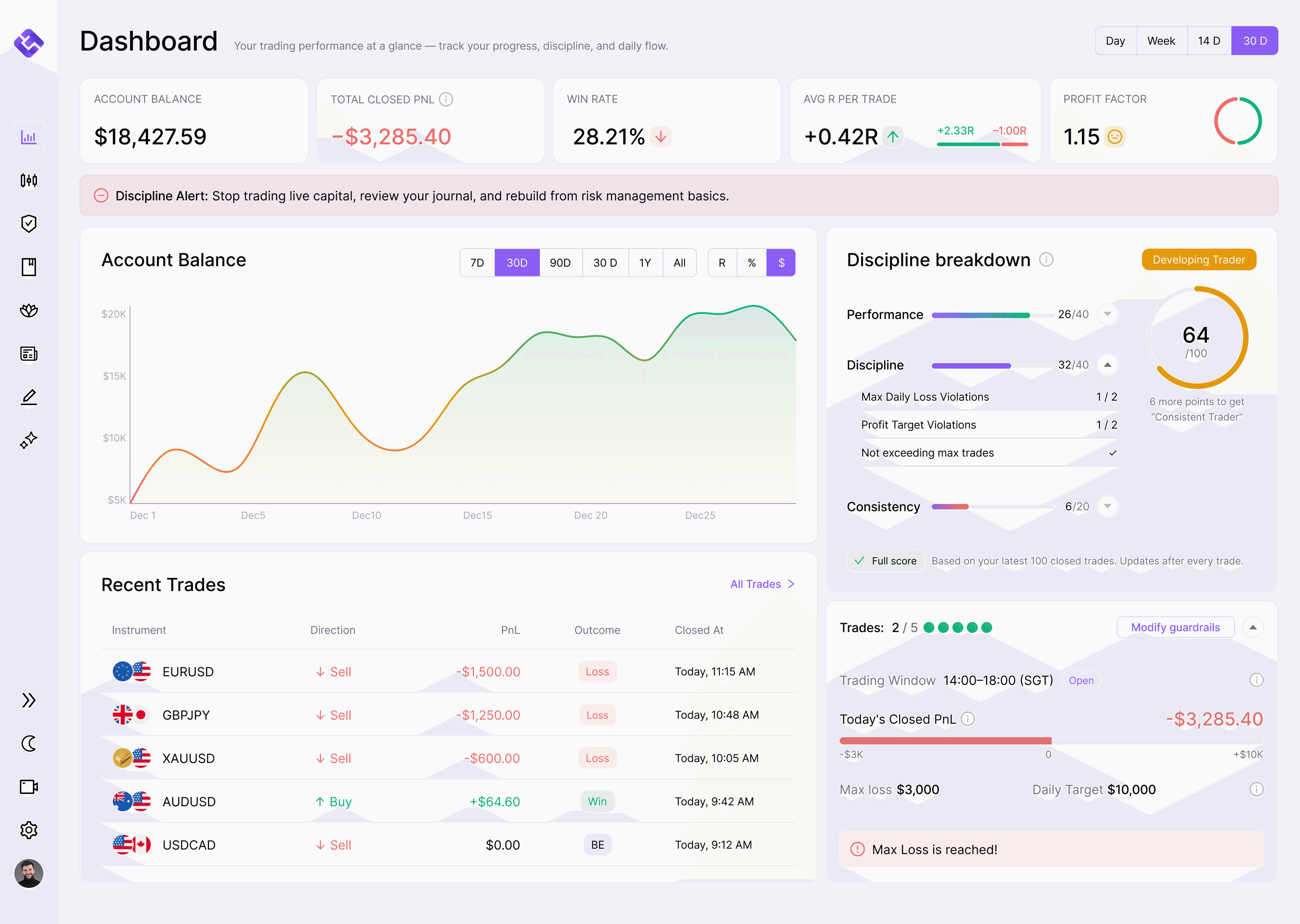
EdgeFlo's plan builder is designed around a simple principle: you trade one active strategy at a time. Not three. Not five. One. You document your setup criteria, your risk rules, and your exit plan in a single written plan that stays visible while you trade.
This matters because the moment you write your strategy down and commit to it inside your workspace, switching becomes a deliberate act. You cannot passively drift into a new system. You have to actively change your documented plan. That friction is the point. It slows down the impulsive "this is not working, let me try something new" reaction and forces you to evaluate whether the switch is data-driven or emotion-driven.
Plan stats (available on Plus) track your performance against your documented strategy over time. Instead of guessing whether your system works based on how you feel after the last three trades, you can see actual numbers across your full trade history. When you can see that your system has a positive expectancy over 60 trades, a four-loss streak stops feeling like a crisis. It starts looking like what it actually is: a normal part of trading.
The Edge Brief
Receive Insights on trading psychology, discipline, and the behavioral patterns that create consistent traders from our Founder and the EdgeFlo team, delivered to your inbox.
Think different. Trade different.
What is strategy hopping in trading?
How long should I test a trading strategy before switching?
Is it ever okay to switch trading strategies?
Why do traders keep looking for the perfect strategy?

Turn discipline on.
Every session.
EdgeFlo is the environment serious traders operate inside.
Start 7-Day Free Trial
Cancel anytime.
No long-term commitment.

Think Different, Trade Different.