

Mechanical Trading Plan: Build Rules You Can Follow Under Pressure
Build a mechanical trading plan with clear entry criteria, minimum confluences, risk rules, and A+ setup examples so you can execute without second-guessing.
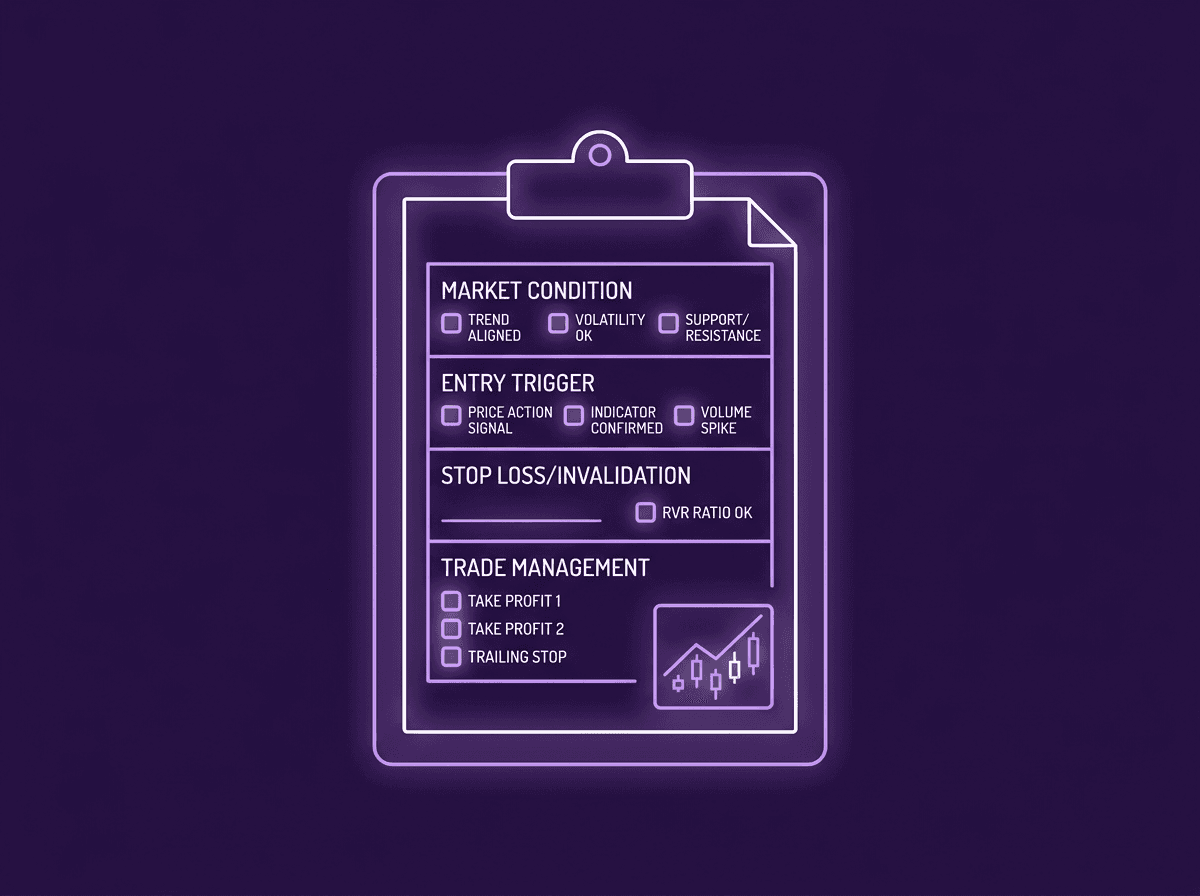
A mechanical trading plan is a written rulebook that removes guesswork from every trade you take. It defines your entry criteria, minimum confluences, risk parameters, and exit rules before you open a chart. When price moves fast and your emotions spike, the plan tells you what to do so you don't have to figure it out in the moment. Most traders who blow accounts don't lack chart knowledge. They lack a system that works when they're stressed, tired, or chasing a loss. A mechanical plan fixes that by turning trading decisions into a checklist you either pass or fail.
TL;DR
A mechanical trading plan predefines every decision: entry, management, exit, and risk.
Set minimum criteria (at least 2-3 confluences) so you stop taking low-quality trades.
Document your A+ setups with screenshots so you recognize them instantly.
Condense the full plan into a one-page simplified playbook for live sessions.
Review and update your plan weekly based on journal entries.
What Makes a Trading Plan Mechanical
Most traders have some version of a plan. It lives in their head. "I trade support and resistance." "I look for trends." That is not a plan. That is a vague intention.
A mechanical trading plan converts every trading decision into a binary: yes or no. Either the setup meets your written criteria, or it doesn't. There is no "maybe" trade.
Think of it like a pilot's pre-flight checklist. A pilot doesn't glance at the wing and think "looks fine." Every item gets checked off. If one fails, the plane stays on the ground. Your trades should work the same way.
The difference between a discretionary plan and a mechanical one comes down to precision. A discretionary plan says "look for bullish structure." A mechanical plan says "price must break above the most recent lower high on the 1H timeframe, retest the broken level, and show a bullish engulfing candle within the kill zone."
One of those you can follow at 2 AM after three losing trades. The other falls apart the moment your emotions get involved.
The Core Components: Entry, Management, Exit, Risk
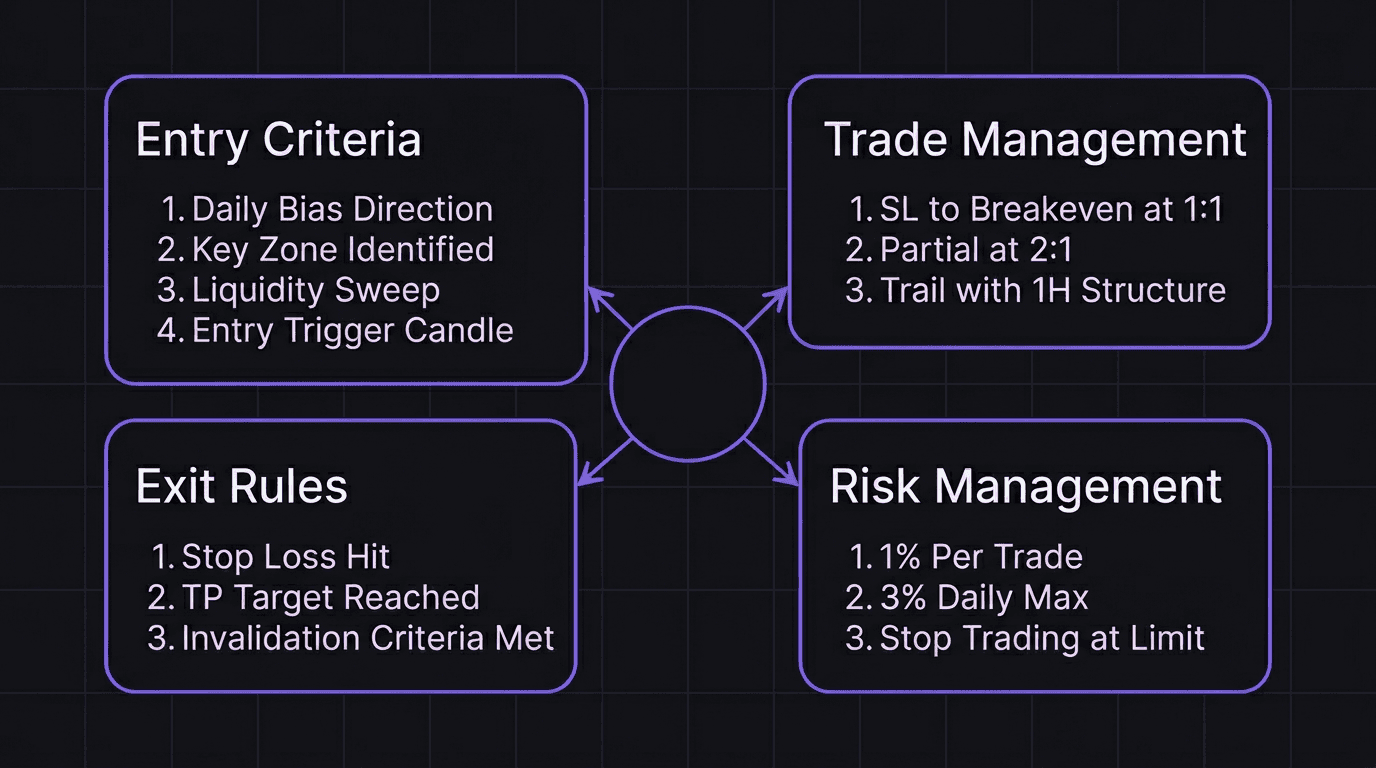
A complete mechanical plan has four sections. Skip one and you create a gap where emotion fills in.
Entry Criteria
Your entry section answers: "When exactly do I open a trade?" This is not a paragraph of theory. It is a numbered list of conditions that must all be true.
Example entry criteria for a supply and demand trader:
Daily bias is bullish (higher highs, higher lows on 4H)
Price is in a discount zone
Unfilled demand zone present on 1H
Liquidity sweep below the demand zone
Bullish entry candle on 15M inside the zone
If all five are true, you take the trade. If any one is missing, you wait. No exceptions.
Trade Management
This section tells you what to do after entry. When do you move stop loss to breakeven? Do you take partials? At what level?
Write it out like this:
Move SL to breakeven after price reaches 1:1 risk-to-reward
Take 50% off at 2:1
Trail remaining position using 1H structure
Exit Rules
Your exit criteria define when you close, win or lose. This includes your stop loss placement (not just "below the zone" but exactly where), your take-profit targets, and any conditions that invalidate the trade idea.
Risk Management
Two numbers matter here: risk per trade and daily loss limit. A mechanical plan locks these in writing.
Common starting point: 1% risk per trade, 3% daily max drawdown. Hit the daily limit and you're done for the day. No negotiating with yourself.
Sound strict? It is. That's the point. Position sizing is not something you figure out after entering a trade.
Setting Minimum Criteria and Confluences
Here is where most plans go soft. A trader writes entry criteria but treats them as suggestions. "Well, only three of the five were there, but it looked good."
That thinking costs money.
Minimum criteria means the absolute floor. The lowest bar a trade must clear before you consider it. Brett Goh, who teaches this through his trading dashboard system, calls it building your "ultimate playbook" with rules for point of interest selection, trade execution, and specific confluences that must be present.
Confluences are the individual checkboxes. Each one adds evidence that the trade will work. Common confluences include:
Trend alignment on the higher timeframe
Price at a key level (supply/demand zone or market structure level)
Session timing (trading during the London or New York kill zone)
Liquidity sweep before entry
Candlestick confirmation on the entry timeframe
Set a minimum. Two confluences might be your floor for any trade. Three makes it a solid setup. Four or more? That is your A+ trade.
The point is binary decision-making. Count the confluences. If the count is below your minimum, the trade does not exist. You don't negotiate. You don't "feel" your way in.
Walkthrough: Confluence Counting in Action
> Pair: EUR/USD | Timeframe: 1H + 15M entry | Date: A Tuesday during London session
>
> You mark the 4H trend as bullish (confluence 1). Price pulls back into a 1H demand zone sitting in the discount range below 50% of the recent swing (confluence 2). You see a liquidity sweep below the demand zone on the 15M, taking out the equal lows (confluence 3). A bullish engulfing candle forms inside the zone during the London kill zone (confluence 4).
>
> That is four confluences. Your minimum is three. This qualifies as a valid trade. You enter at the close of the engulfing candle, stop loss below the swept low, targeting the recent swing high.
>
> Now imagine the same setup, but there is no liquidity sweep. Price just floats into the zone. That drops you to three confluences, which still meets your minimum. But compare it to the four-confluence version. The setup without the sweep has less edge. You might still take it, but with reduced size.
>
> What if the trend is also unclear? Now you're at two confluences, below your minimum. No trade. Walk away.
This is how a mechanical plan protects you. It removes the "it looks good enough" trap that causes most trading mistakes.
How to Document A+ Setups
An A+ setup is the best version of your trade. Everything lines up. Every confluence fires. These are the trades you want to size up on and the ones you want burned into your memory.
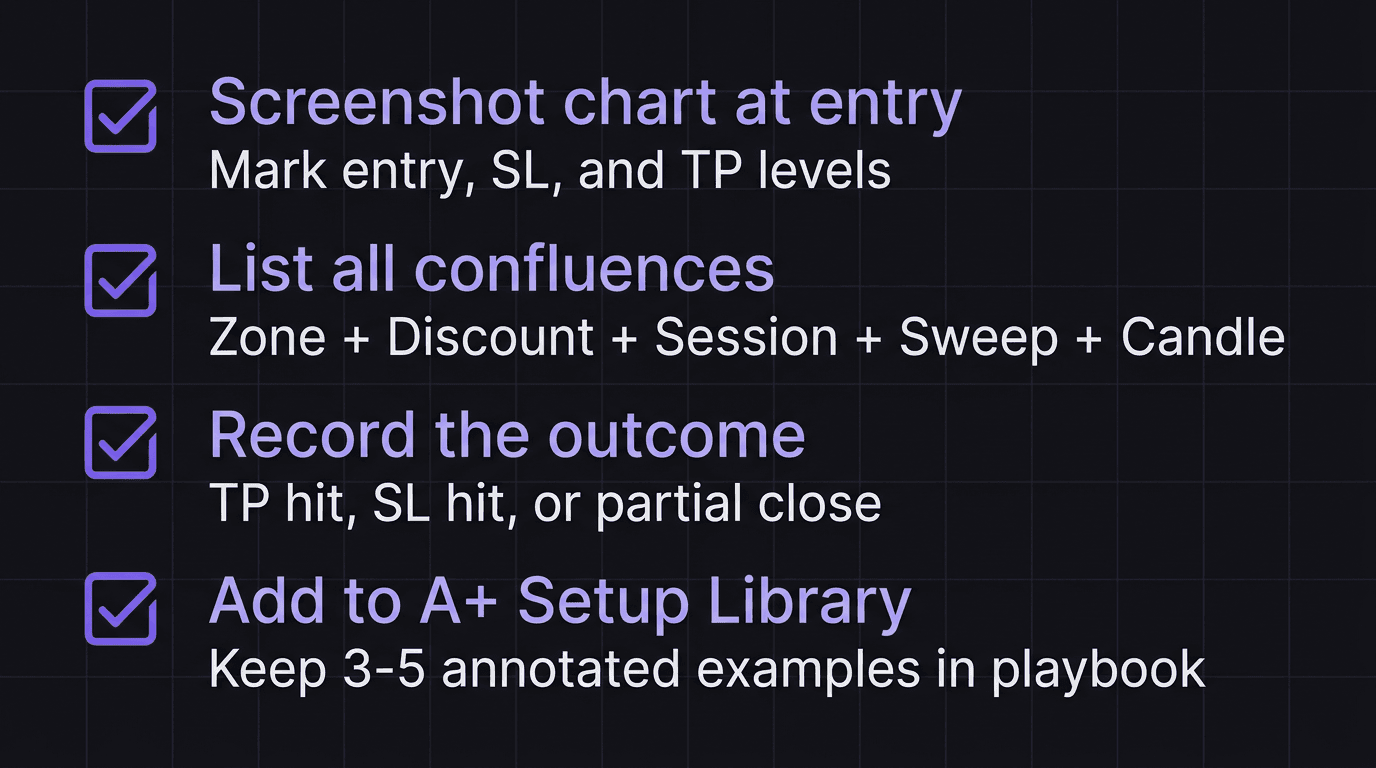
Here is how to document them:
Take a screenshot of the chart at the moment of entry. Mark your entry, stop loss, and target.
List every confluence present. Not just "it was in a zone." Write: "1H demand zone, discount pricing, London session, liquidity sweep below zone, bullish engulfing on 15M."
Record the outcome. Did it hit TP? Did it sweep your SL first then reverse? What happened?
Add it to your playbook. Keep a section of your plan called "A+ Setup Examples" with 3-5 annotated screenshots.
Why bother? Because in real time, you won't remember what a perfect setup looks like. Your brain will convince you that a B- setup is actually an A+. The screenshots keep you honest.
Brett Goh's approach to this is specific: within the trading dashboard, the playbook includes dedicated space for A+ setup screenshots alongside the mechanical rules. When you're about to take a trade, you compare what's on your chart to your documented A+ examples. Does it match? Take it. Does it fall short? Skip it or reduce size.
Review your A+ examples weekly when you review your journal. Over time, you will notice patterns, like your A+ setups clustering around certain sessions or certain types of liquidity sweeps.
The Simplified Playbook (One-Page Version)
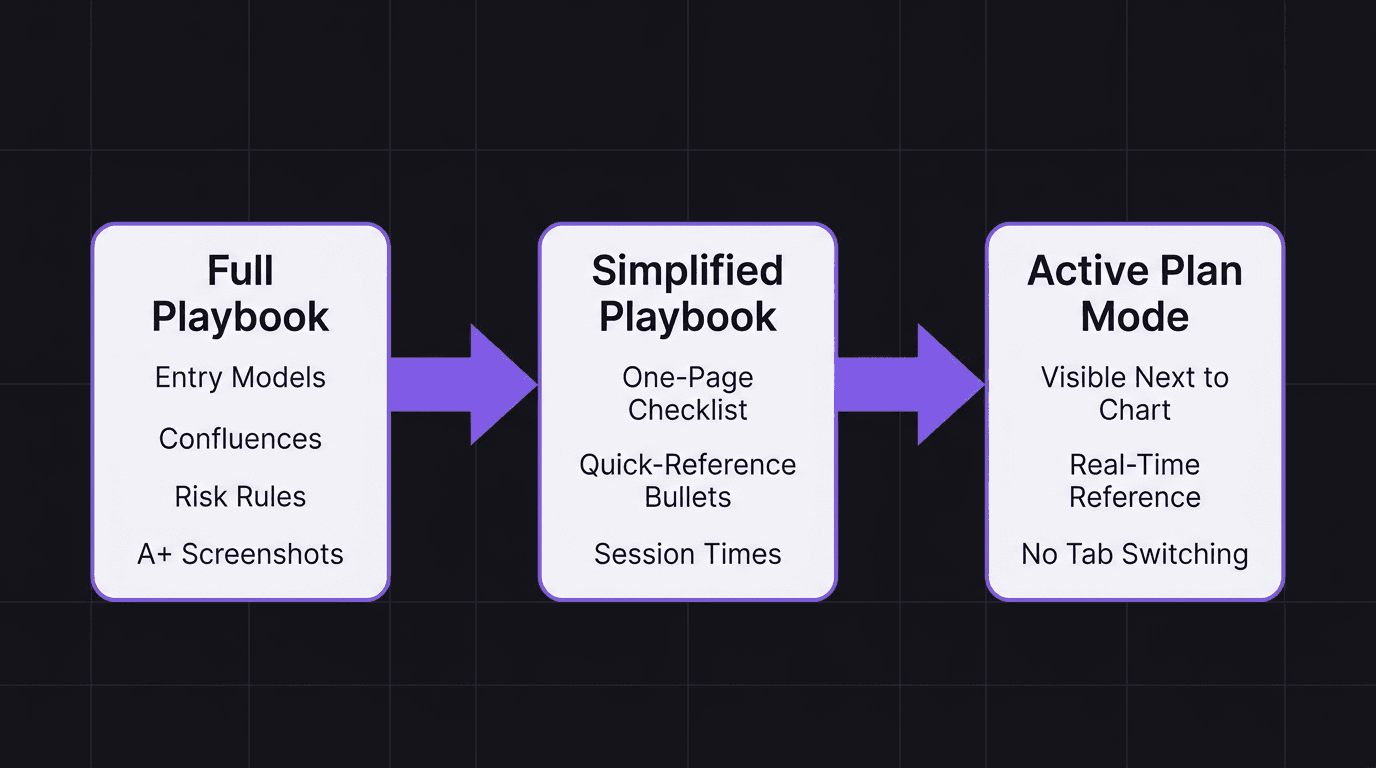
Your full mechanical plan might be several pages. Entry models, confluence tables, risk parameters, A+ screenshots, trade management flowcharts. That is your reference document, your "ultimate playbook" as Brett Goh calls it.
But during a live session, you don't need several pages. You need one page.
The simplified playbook is a condensed version of your full plan. One page. Quick-reference bullet points for each section. Keep it next to your chart while you trade.
Here is a template:
[ ] HTF trend direction confirmed
[ ] Price in premium/discount zone
[ ] Key level identified (demand/supply)
[ ] Liquidity sweep present
[ ] Entry candle on LTF
SL to BE at 1:1
50% off at 2:1
Trail with 1H structure
1% per trade
3% daily max
Stop after daily max hit
London: 07:00-10:00 GMT
New York: 12:00-15:00 GMT
That is it. One page. Every trade gets checked against this before entry. After entry, the management section tells you exactly what to do. No improvisation.
The full playbook stays for your pre-market routine and weekly review sessions. The simplified version stays on screen during live trading.
How EdgeFlo Keeps Your Plan Visible
Building a mechanical plan is step one. The harder part is actually following it when the market moves fast and your instincts scream to deviate.
EdgeFlo's Edge feature (Trade Plan Builder) lets you create and document your strategy, define your entry rules, and set one plan as active. You write your plan once, organize it with the same sections covered here (entry criteria, confluences, management, risk), and save it inside the platform.
The real value is Active Plan Mode. It displays your trading plan right next to your chart during execution. No switching tabs. No opening a separate document. Your rules stay visible exactly when you need them most, when you're about to click "buy" or "sell."
The Edge Brief
Receive Insights on trading psychology, discipline, and the behavioral patterns that create consistent traders from our Founder and the EdgeFlo team, delivered to your inbox.
Think different. Trade different.
What is a mechanical trading plan?
How many confluences should a mechanical trading plan require?
What is an A+ setup in trading?
Can I use a one-page trading playbook instead of a full plan?

Turn discipline on.
Every session.
EdgeFlo is the environment serious traders operate inside.
Start 7-Day Free Trial
Cancel anytime.
No long-term commitment.

Think Different, Trade Different.