

Why Tracking Your Trades Is the Only Way to Improve
Tracking trades through journaling reveals your real edge, exposes hidden flaws, and turns random results into a refinement loop. Here is how.
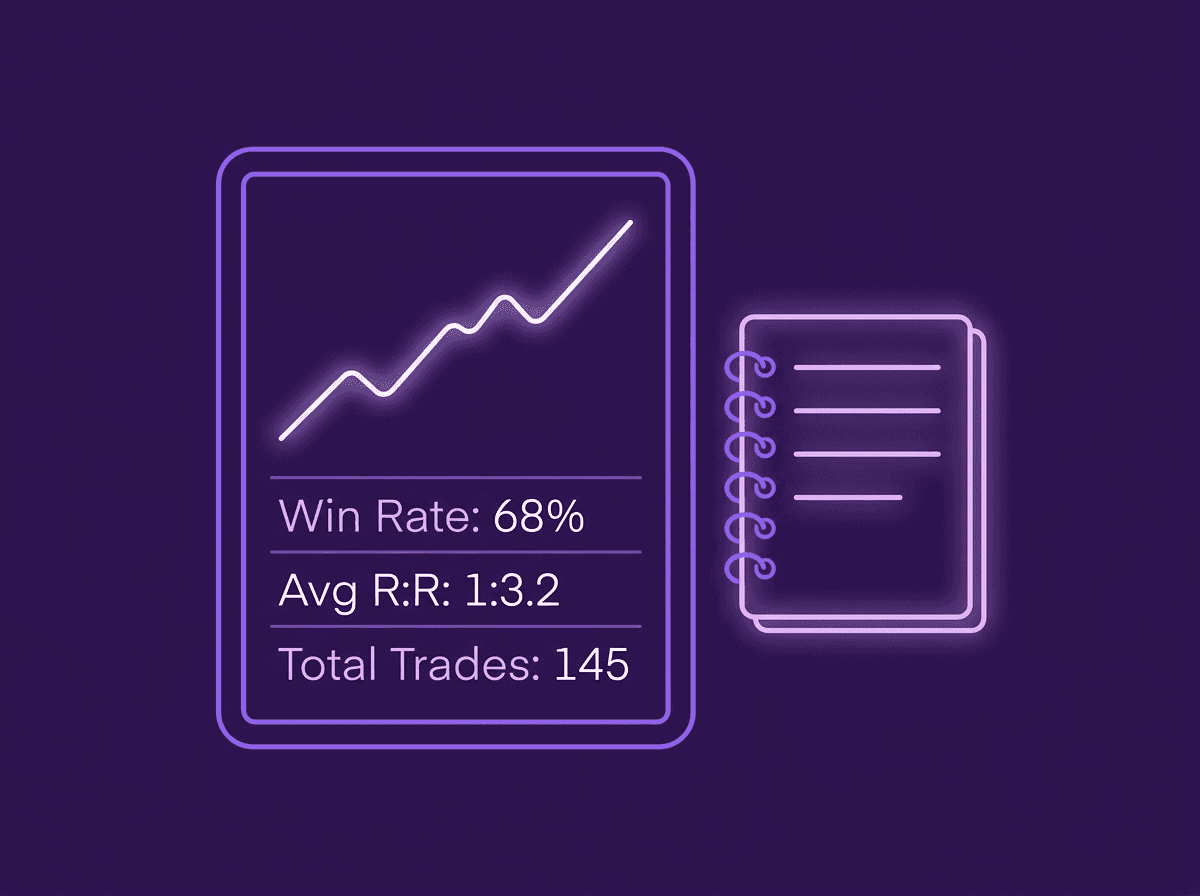
Tracking your trades through a journal is the only reliable way to find out whether your strategy actually works. Without data, you are guessing. You might feel like your approach is profitable, but feelings lie. Numbers do not. A journal turns vague impressions into concrete metrics you can act on.
If you cannot measure your trading performance, you cannot improve it. That is not motivational advice. It is a mechanical fact.
TL;DR
Without tracking, you have no way to know whether your strategy has a real edge or you have just been lucky.
Your journal should capture the pair, time frame, entry, exit, risk, R result, and a plan-adherence note for every trade.
At least 30 to 50 trades on one strategy are needed before win rate and expectancy become meaningful.
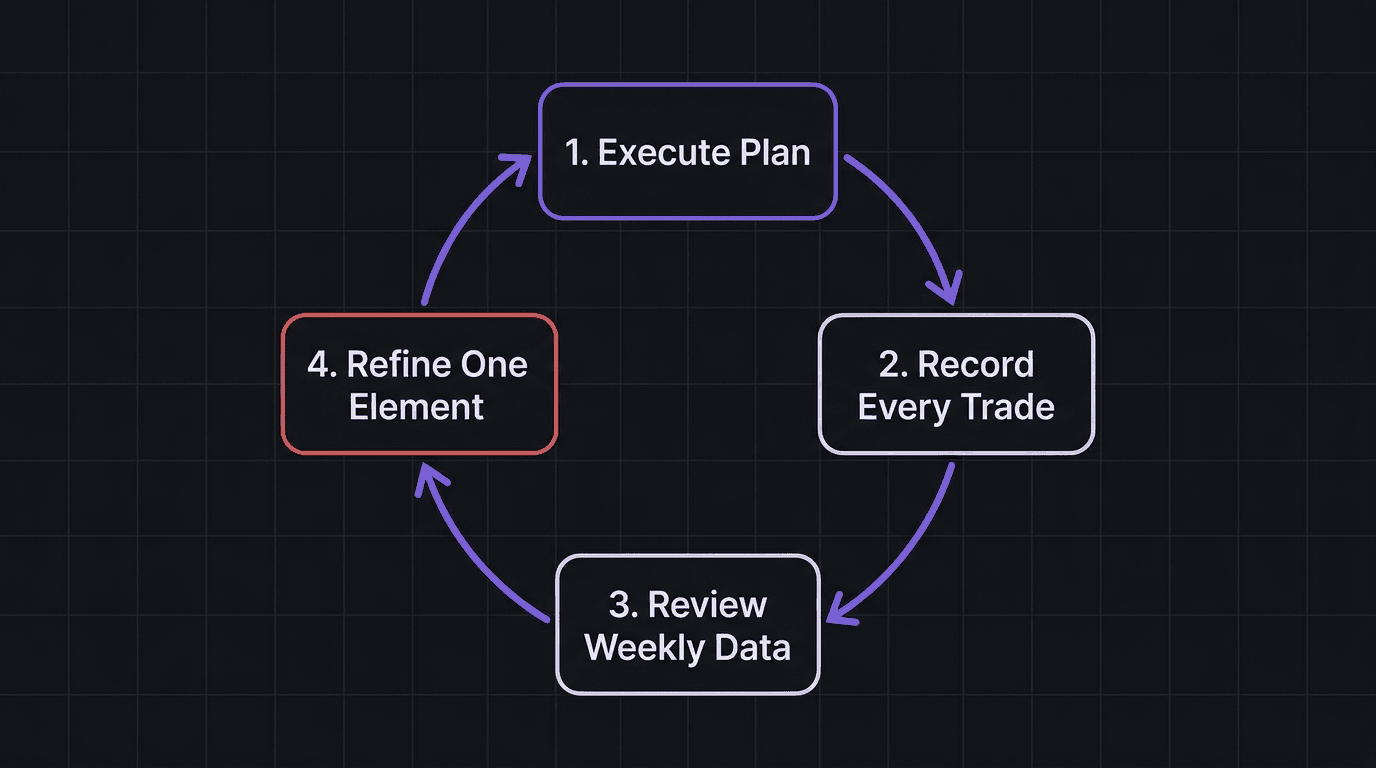
Tracking creates a feedback loop: execute, record, review, refine. Repeat.
The goal is not to journal for the sake of journaling. It is to find flaws you cannot see in real time.
What Happens When You Cannot Measure
Ever had a week where you felt like you traded well, then checked your account balance and realized you lost money? Or the opposite, a week that felt terrible but you actually came out ahead?
That disconnect happens because your brain does not process trading results objectively. You remember the painful losses vividly and forget the quiet wins. You remember the one trade that ran 5R and ignore the five trades that stopped out at 1R each.
Without tracking, you are working from a distorted picture. And a distorted picture leads to distorted decisions.
Here is what happens when traders try to improve without data:
They switch strategies after a few losses, not knowing the losses were normal for their win rate
They keep a setup that "feels profitable" even though it has a negative expectancy over 50 trades
They blame psychology for losses that are actually strategy problems
They cannot tell whether last month was better or worse than the month before
The result is strategy hopping. Today you trade one approach. Tomorrow you trade another. Next week you trade whatever feels right. And because you never stayed on one approach long enough to gather data, you never find out what actually works.
If you cannot track it, you cannot refine your trading edge. It is that simple.
The Data Your Journal Should Capture
A trading journal does not need to be complicated. It needs to be consistent. Every trade, same fields, same format.
Here is what to record for each trade:
Field | Why It Matters |
|---|---|
Date and time | Shows session patterns (are you better at London open or New York?) |
Pair | Reveals which instruments you perform best on |
Time frame | Confirms whether your entry time frame matches your plan |
Entry price | Anchors the trade for review |
Stop loss price | Lets you calculate risk in pips |
Take profit price | Lets you calculate reward in pips |
Lot size | Combined with pip value, shows dollar risk |
Risk % | Confirms you followed your risk rule |
R multiple result | The single most important metric for measuring quality |
Plan adherence | Did you follow your rules? Yes or no. |
Notes | One sentence on what you observed |
That is it. No essays. No paragraph-long reflections on your feelings. One row per trade, filled in right after you close the position.
If you want a ready-made format, the trading journal template article walks through a spreadsheet layout you can copy.
The plan adherence column is the one most traders skip, and it is the most valuable. Over 50 trades, if your win rate on plan-adherent trades is 55% but your win rate on off-plan trades is 30%, the problem is not your strategy. The problem is execution.
How Tracking Reveals Your Real Edge
Once you have 30 to 50 trades logged, patterns start appearing that you could never see in real time.
Walkthrough: Discovering a Hidden Flaw
A trader journals 40 trades over two months on GBP/USD using a 1-hour supply and demand strategy with a 3R target. The overall results: 18 wins, 22 losses. Win rate is 45%. Average winner is 2.8R (some trades closed early). Average loser is 1R.
Math check: Win rate = 18 / 40 = 45%. Loss rate = 22 / 40 = 55%. Expectancy = (0.45 times 2.8R) minus (0.55 times 1R) = 1.26R minus 0.55R = 0.71R per trade.
The strategy has a positive expectancy of 0.71R per trade. But the trader felt like it was losing because of a 7-trade losing streak in week three.
Digging deeper, the journal shows 12 of the 22 losses happened on Fridays. When Friday trades are removed, the win rate on Monday through Thursday jumps to 64%. The Friday sessions had wide spreads and low follow-through.
The fix: stop trading this setup on Fridays. A one-line rule change that turns a "mediocre" strategy into a strong one.
That discovery is impossible without data. You would never notice the Friday pattern from memory alone.
Here are the metrics that matter most when reviewing your journal:
Win rate across different setups, sessions, and pairs
Average R on winners versus losers (are you cutting winners short?)
Plan adherence rate (are losses coming from the plan or from breaking the plan?)
Equity curve shape (steady uptrend, choppy, or declining?)
Walkthrough: The Mistake of Not Tracking
A different trader uses the same GBP/USD strategy but does not journal. After the 7-trade losing streak, they abandon the approach entirely and switch to a scalping strategy on USD/JPY. They lose another 10 trades learning the new setup. If they had tracked, they would have seen the overall strategy was profitable and the losing streak was a normal statistical cluster within a 45% win rate.
From Random to Refined: The Feedback Loop
Tracking is not the end goal. It is the beginning of a feedback loop that compounds over time.
The loop works like this:
Execute your plan mechanically for a set of trades (20 to 30 minimum)
Record every trade using the same fields
Review the data at the end of each week or month, looking for patterns (a structured post-trade review process helps here)
Refine one element of your plan based on what the data shows
Go back to step one
This is how professional traders operate. They do not reinvent their strategy every week. They make small, data-driven adjustments. Drop one underperforming session. Tighten the entry criteria for a specific pair. Widen the stop on a time frame that gets clipped too often.
Each adjustment is small. But over six months, those adjustments add up to dramatically different results.
The opposite of this loop is what most traders do: trade randomly, feel bad about losses, change everything, trade randomly again. No data, no feedback, no improvement. Just motion.
Consistent action leads to consistent data. Consistent data leads to consistent refinement. Consistent refinement leads to consistent results. Every link in that chain depends on the one before it.
How EdgeFlo Makes Tracking Automatic
The biggest reason traders stop journaling is friction. Opening a spreadsheet after every trade, typing in numbers, and switching between apps kills momentum. Most journals die within two weeks.
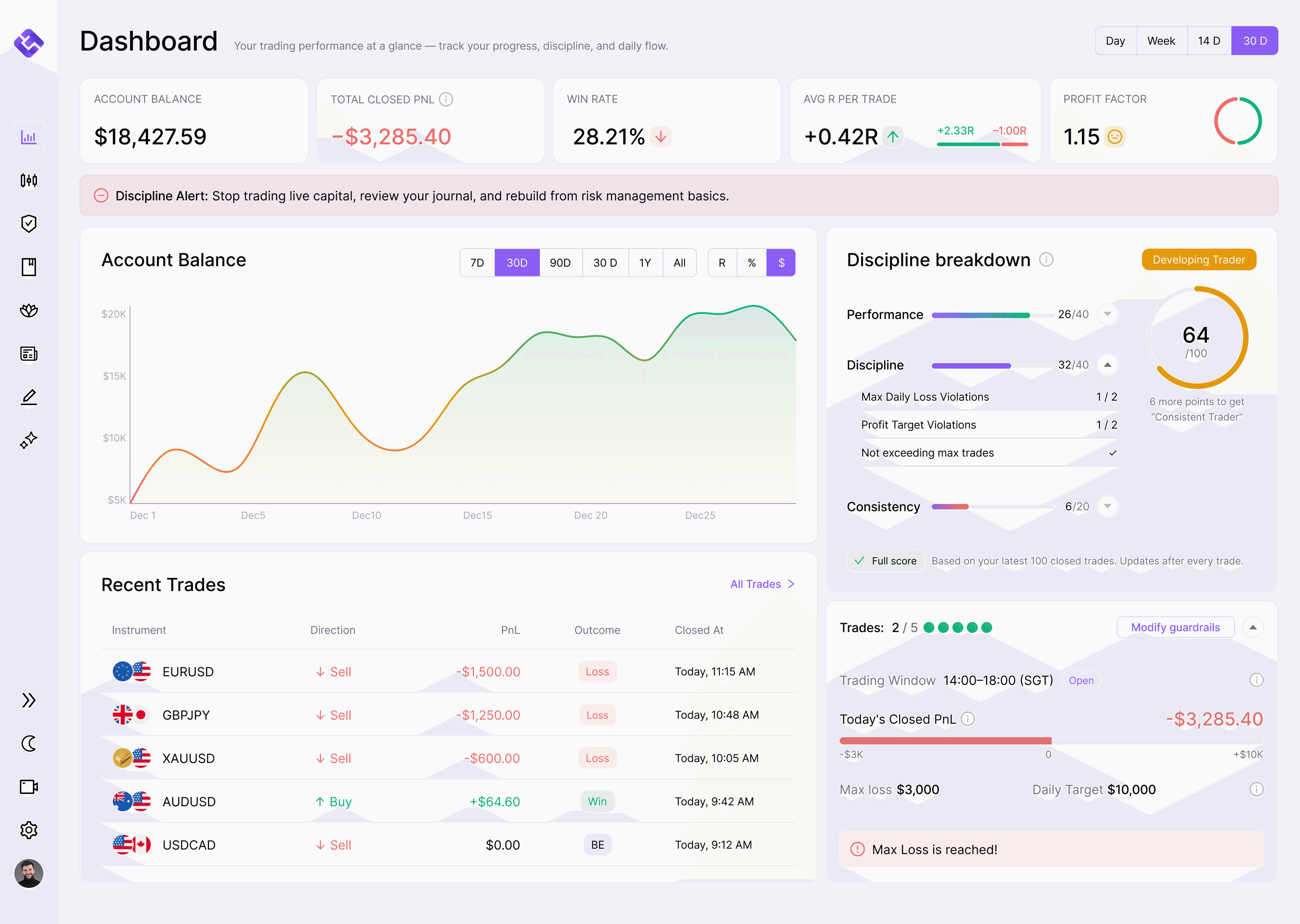
EdgeFlo's AI-powered trading journal removes that friction. Trades auto-import from your broker, so the data captures itself. You add emotion tags and plan-adherence notes with a tap, not a paragraph. The journaling workflow is built into the same platform where you execute, so there is no app-switching.
The weekly AI report (available on the Plus plan) surfaces patterns in your data automatically, highlighting which sessions, pairs, and setups produced the best results. Instead of spending an hour parsing a spreadsheet, you get a summary that points you straight to the refinement step. That is the feedback loop, built into your trading environment.
The Edge Brief
Receive Insights on trading psychology, discipline, and the behavioral patterns that create consistent traders from our Founder and the EdgeFlo team, delivered to your inbox.
Think different. Trade different.
What should I track in my trading journal?
How does tracking trades improve performance?
How many trades do I need before the data is useful?
Can I improve without a trading journal?

Turn discipline on.
Every session.
EdgeFlo is the environment serious traders operate inside.
Start 7-Day Free Trial
Cancel anytime.
No long-term commitment.

Think Different, Trade Different.