

Why the Gym Teaches You More About Trading Than Any Course
Gym discipline transfers directly to trading. Learn why voluntary discomfort, consistency, and progressive overload build the exact muscle traders need.
You have taken every course. Watched every YouTube video. Read the books on market structure, risk management, and trading psychology. And you still break your rules, overtrade on slow days, and give back profits when you feel emotional.
The missing piece is not more information. It is the physical practice of choosing discomfort voluntarily, repeatedly, on a schedule, without negotiation. That is what the gym teaches.
Trading and physical training share the same core demand: do the uncomfortable thing consistently when nobody is watching, when results are invisible, and when quitting would feel so much easier. The trader who can hold a losing position according to plan is using the same mental muscle as the person who finishes the last set when every fiber wants to stop.
TL;DR
The gym builds discipline through voluntary discomfort, which is exactly what trading demands.
Consistency in physical training transfers directly to consistency in executing your trading plan.
Progressive overload in the gym mirrors progressive skill building in trading: add one variable at a time.
Physical routines before trading sessions reduce cortisol and prime your brain for calm decision-making.
You do not need to be an athlete. You need to show up and push through resistance daily.
The Shared Muscle: Discipline Through Discomfort
Every meaningful action in trading is uncomfortable. Waiting for your setup when the market is moving without you. Watching a trade pull back 15 pips against you and keeping your stop where it belongs. Sitting out on a day when you have been flat for a week and want desperately to "make something happen."
Discipline is not the ability to follow rules when it is easy. It is the ability to follow them when following them hurts. And that ability is trainable.
The gym is the clearest training ground for this skill. When you are under a barbell and your muscles are screaming, you have a choice: rack the weight or finish the rep. Nobody is watching. Nobody cares. The only person who knows whether you stopped at 8 reps or pushed to 10 is you.
Sound familiar? The only person who knows whether you followed your trading plan or took an impulsive entry is you. The discipline muscle is the same.
You actively choose suffering in the gym so that when the market throws pain at you, your nervous system knows how to handle it. You have practiced sitting with discomfort. You have trained the reflex to push through rather than react.
Walkthrough: The Rep You Want to Skip
You are doing squats. Your program says 4 sets of 8 reps at a specific weight. Set 3, rep 6. Your legs are burning. Your brain says: "Two more reps and one more set. That is enough for today." You know the right call. You also know how easy it would be to rack the bar.
You finish all 4 sets. Nothing heroic. Just doing what you said you would do.
Now shift to trading. You are watching EUR/USD during London session. Your plan says to wait for a demand zone at 1.0820 to get tapped. Price is at 1.0855 and dropping slowly. Your brain says: "Close enough. The zone is just below. Enter now and get a better price." You know the right call. You also know how easy it would be to click buy.
You wait. Price drops to 1.0818, sweeps the zone, reacts with a bullish candle. You enter at 1.0825 with your stop at 1.0805 and a target at 1.0885.
A 3R trade. Only possible because you waited. And waiting is a skill you trained in the gym by finishing sets you wanted to quit.
Consistency Over Intensity in Both Arenas
New gym-goers make the same mistake as new traders: they go too hard on day one. Three-hour session. Every machine. Sore for a week. Then they do not go back for a month.
Traders do the same. They start journaling with 500-word entries for every trade, marking up 12 timeframes, running three hours of backtesting daily. Within two weeks, they burn out and go back to winging it.
The people who build real results in both the gym and trading share one trait: they show up consistently at a sustainable intensity. Five sessions a week, 45 minutes each, for years, beats one three-hour monster session followed by three weeks off.
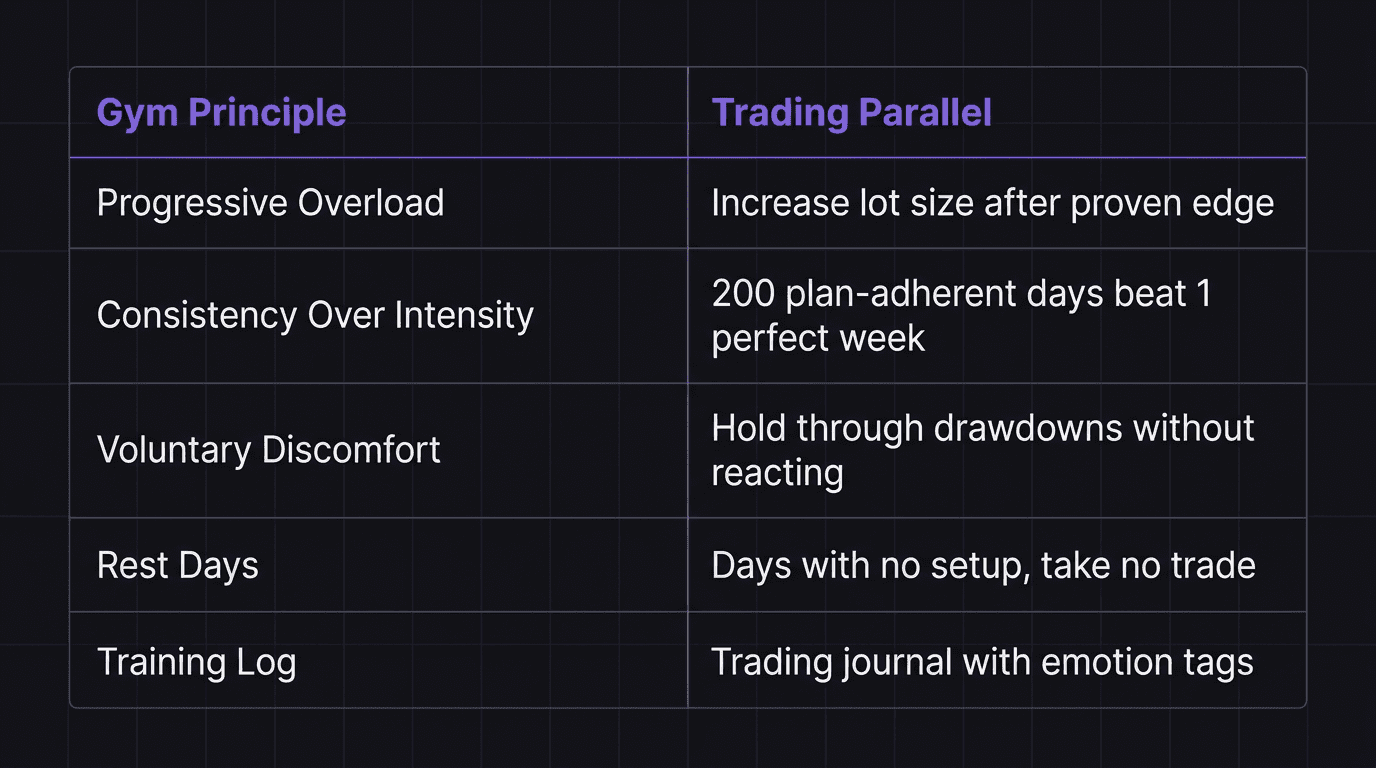
Trading consistency follows the same law. Trading your plan every day for 200 days straight produces more edge than trading perfectly for one week and then chaotically for the next three.
The gym teaches this viscerally. You cannot squat 300 pounds on your first day. You cannot build a six-month equity curve in one week. Both require showing up when you do not want to, doing the boring work, and trusting that the compound effect will show up eventually.
How Physical Routines Reset Your Trading Psychology
This is not just theory. The physiological effects of exercise directly improve trading performance.
Cortisol reduction. High cortisol levels (from stress, poor sleep, or sedentary behavior) make you more reactive, more impulsive, and less patient. A 30-minute workout before your session drops cortisol significantly. You sit down at your charts calmer and less likely to chase.
Dopamine regulation. Exercise produces a healthy dopamine release. If you have already gotten your dopamine hit from a workout, you are less likely to seek it from an impulsive trade. This is why traders who do not exercise tend to overtrade: the brain is looking for stimulation, and the market provides it in the most expensive possible way.
Focus duration. Regular exercise increases your ability to sustain focus for extended periods. If your trading session runs 3 to 4 hours, you need the cognitive endurance to stay sharp through the entire window. Fit traders report fewer attention lapses during their sessions.
Emotional reset. Had a bad trading day yesterday? Instead of carrying the frustration into today's session, a morning workout gives you a physical outlet. You process the stress through movement instead of through revenge trades.
A pre-market routine that starts with physical activity is one of the highest-leverage changes you can make. It does not add a single pip of technical knowledge, but it changes the quality of every decision you make during the session.
The Progressive Overload Parallel
In the gym, progressive overload means gradually increasing the demand on your body. Add 5 pounds to the bar each week. Add one more rep. Reduce the rest period by 10 seconds. Small, incremental increases that compound into massive strength gains over months and years.
Trading works the same way. You do not jump from a $1,000 account to a $100,000 funded account overnight. You progress:
Learn the strategy on a demo account.
Forward test with tiny position sizes.
Trade live with 0.01 lots.
Increase to 0.05 lots after 50 consistent trades.
Move to 0.1 lots after 100 trades with positive expectancy.
Apply for a funded challenge when your data proves your edge.
Each step is a small increase in demand. Just like adding 5 pounds to the bar, each increase tests whether your foundation can handle the extra weight. If you skip steps in the gym, you get injured. If you skip steps in trading, you blow your account.
The trader who understands progressive overload never sizes up after a winning streak "because it feels right." They size up when the data supports it, after a statistically significant sample, with a plan for what happens if the higher size does not work.
Building trading confidence follows the same pattern. You do not wake up confident one day. You build it rep by rep, trade by trade, through accumulated proof that your process works.
How EdgeFlo Builds Trading Discipline Like a Training Program
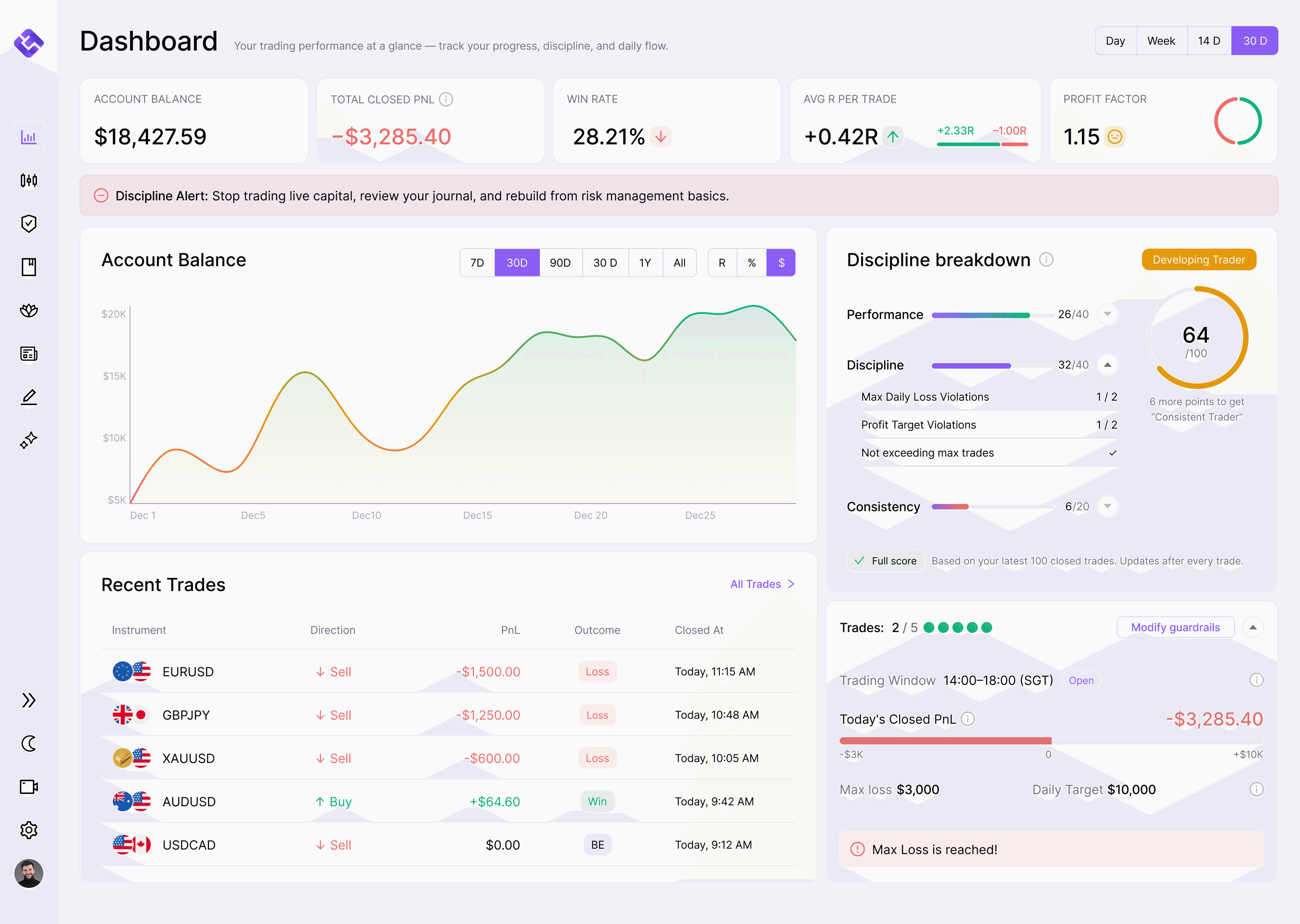
EdgeFlo structures progressive skill building through staged challenges and structured routines. Your pre-market checklist ensures preparation before every session, just like a warm-up before lifting. The trading rules you set (max trades per day, daily loss limit, risk per trade) act as guardrails, the same way a spotter prevents you from dropping the bar.
The journal captures every session the way a training log tracks every workout. Over time, you can see your discipline improving: fewer off-plan trades, better adherence to your setup criteria, steadier emotional state.
The parallel is direct. The gym builds your body by forcing consistent effort against resistance. EdgeFlo builds your trading by structuring consistent execution against the market's psychological pressure. Both work because they make discipline a system, not a mood.
The Edge Brief
Receive Insights on trading psychology, discipline, and the behavioral patterns that create consistent traders from our Founder and the EdgeFlo team, delivered to your inbox.
Think different. Trade different.
How does gym discipline help with trading?
What type of exercise is best for traders?
Can physical fitness actually affect trading performance?
How often should traders exercise?

Turn discipline on.
Every session.
EdgeFlo is the environment serious traders operate inside.
Start 7-Day Free Trial
Cancel anytime.
No long-term commitment.

Think Different, Trade Different.