

Why Traders Can't Scale Up (And How to Fix It)
Profitable on small accounts but failing at scale? Learn why traders can't scale up, the psychology behind lot size fear, and a gradual scaling protocol.
Why Profitable Traders Fail When They Scale Up
You are profitable on a $1,000 account. You follow your plan, take clean setups, and your equity curve climbs steadily. Then you get funded or deposit a larger amount, and everything falls apart. The same strategy, the same setups, the same market. But now you freeze, exit early, skip entries, and give back profits you would have kept on the smaller account.
Why traders can't scale up has almost nothing to do with strategy. It has everything to do with what happens in your head when the numbers get bigger.
TL;DR
Scaling failure is psychological, not strategic. The same system that works at $1,000 works at $50,000.
Dollar fixation causes traders to react emotionally to normal fluctuations at higher lot sizes.
Rushing from a small account to a large one creates a shock that overrides discipline.
Gradual scaling (increasing lot size in small steps over 20 to 30 trade blocks) builds tolerance.
The metric that proves you are ready to scale is plan adherence, not profitability.
The Scaling Barrier
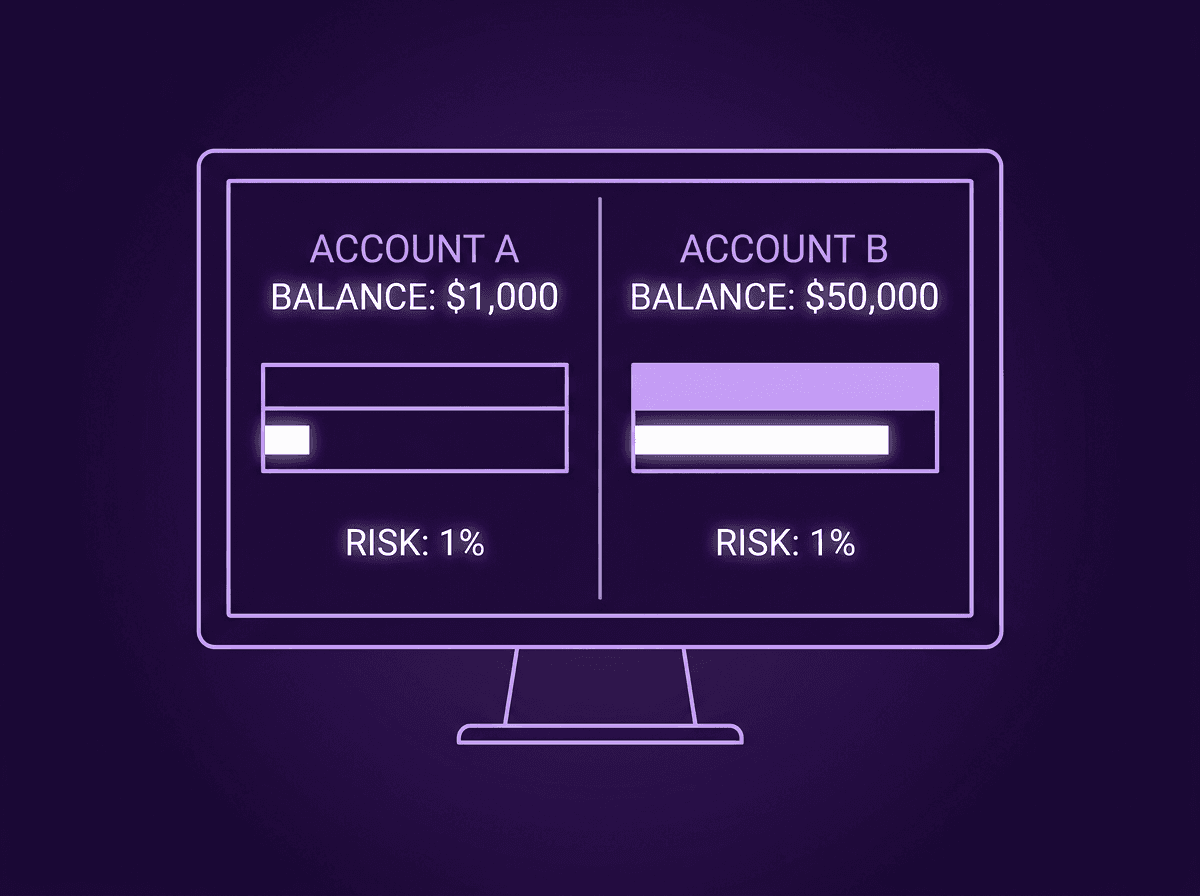
On a $1,000 account at 0.5% risk, a losing trade costs you $5. You barely feel it. You log the loss and move on.
On a $50,000 funded account at the same 0.5% risk, a losing trade costs you $250. The percentage is identical. But $250 triggers something different in your brain. That might be a car payment. A week of groceries. A number you associate with real consequences.
Your system did not change. Your risk percentage did not change. Your emotional reaction changed. And that reaction now drives your execution.
This is the scaling barrier. It is not a strategy problem. It is a lot size psychology problem.
Psychology at Higher Lot Sizes
When the dollar figures get large enough to feel real, three things happen:
You Start Watching the P&L
On a small account, you can ignore the floating P&L because the numbers are insignificant. On a funded account, you watch every tick. A 10-pip drawdown on 2 lots of EUR/USD is $200. You see $200 disappearing from your screen. Your stop loss is 25 pips away, but you cannot stomach another $300 of drawdown. You close early. The trade would have hit your target.
You Hesitate on Entries
Your setup fires. Higher timeframe aligned, demand zone swept, entry trigger confirmed. But the lot size calculator says 1.8 lots. You have never traded 1.8 lots before. You hesitate. By the time you decide to enter, price has moved 12 pips and the risk-to-reward no longer meets your criteria. You skip the trade. It runs 60 pips without you.
You Tighten Risk After Losses
On a small account, you take your planned 1R losses and move on. On a funded account, after two 1R losses ($500 total), you reduce your risk to 0.25% "just for safety." Now you need twice as many winners to recover the same ground. Your system's math no longer works because you changed the input.
Walkthrough: The Scaling Shock
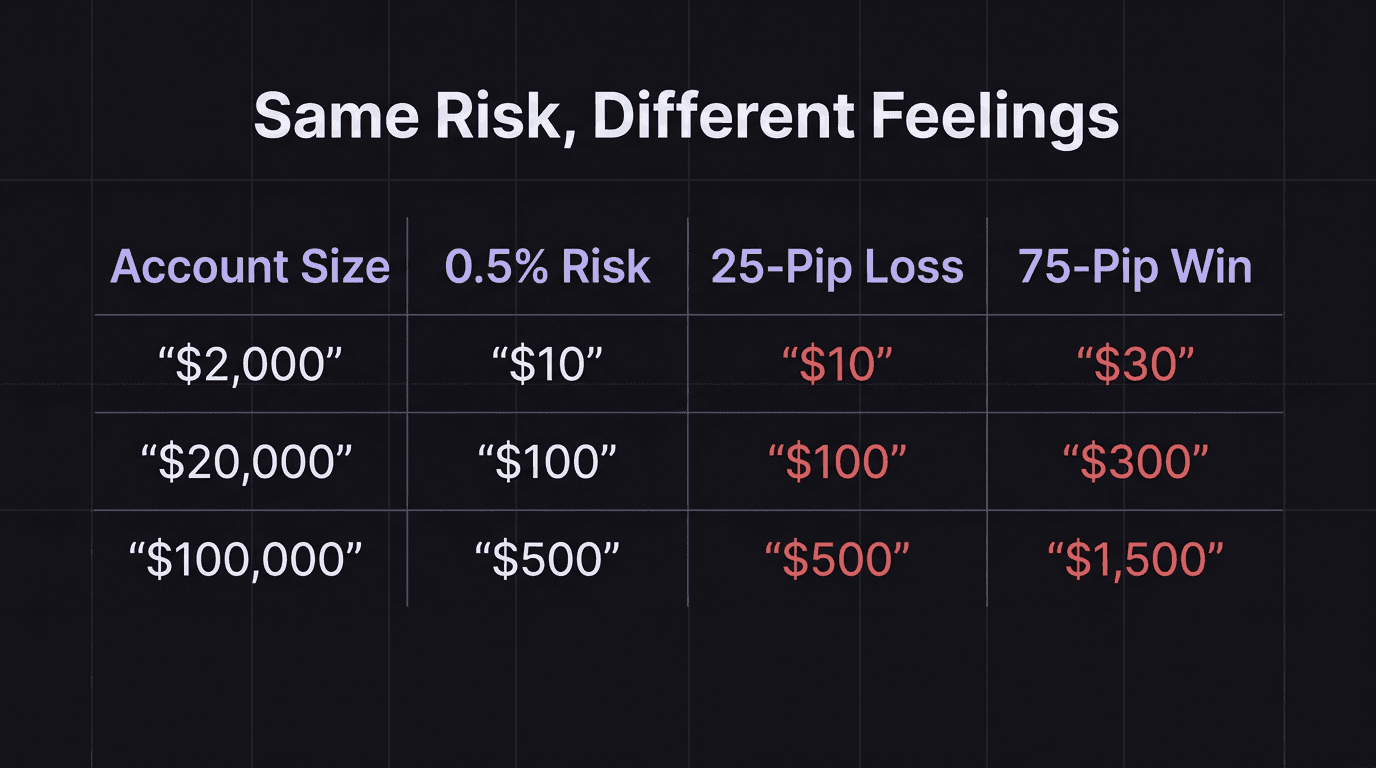
A trader consistently profits on a $2,000 live account. Risk per trade: 0.5% ($10). She trades 0.1 lots on EUR/USD. $1/pip. Her average winner is 3R ($30). Average loser: 1R ($10). Win rate: 42%. Expectancy: (0.42 times $30) minus (0.58 times $10) = $12.60 minus $5.80 = $6.80 per trade.
She passes a funded challenge and receives a $100,000 account. Same 0.5% risk, now $500 per trade. She trades 2 lots. $20/pip. Same setup fires on GBP/USD. She enters at 1.2650, stop at 1.2625 (25 pips), target at 1.2725 (75 pips).
Risk: 2 lots = $20/pip. $20 times 25 pips = $500. Target: $20 times 75 pips = $1,500.
Price dips 15 pips. She is down $300 in 4 minutes. On the $2,000 account, that same dip was $15. Barely noticeable. Now $300 feels like her account is collapsing. She closes at a $300 loss instead of waiting for her stop at $500 or her target at $1,500.
She just turned a planned 1R loss into an early emotional exit and missed a 3R winner. The system did not fail. Her tolerance for the dollar figures failed.
Gradual Scaling vs Jumping
The fix is not to force yourself to be comfortable with large numbers. The fix is to increase the numbers so slowly that comfort builds naturally.
Think of it like weight training. You do not walk into a gym for the first time and load 150 kg on the squat bar. You start with the empty bar, add 5 kg per week, and six months later 150 kg feels normal. Your body adapted because the increases were small enough that each step was manageable.
Position sizing works the same way.
The Gradual Scaling Protocol
Establish a baseline. Trade your system for at least 30 trades at your current lot size. Record your plan adherence rate, not just your P&L.
Increase by 20% to 25%. If you trade 0.1 lots, move to 0.12 or 0.13 lots. Not 0.2 lots. The increase should be small enough that you barely notice it.
Trade 20 to 30 trades at the new size. Monitor two things: plan adherence rate and whether your emotional state changes. If your adherence stays above 80% and you are not hesitating or closing early, move to the next increment.
Repeat. Each increment should be 20% to 25% of the current size. Over 4 to 5 increments and 100 to 150 trades, you will have doubled your lot size without the psychological shock.
If adherence drops below 70%, step back. Reduce to the previous size and trade another 20 trades before trying again. This is not failure. It is data telling you the increase was too fast.
What Not to Do
Do not go from 0.1 lots to 1.0 lot because you "feel ready." Do not jump from a demo account to a $100,000 funded account without trading live capital at smaller sizes first. The gap between demo and funded is not just about lot sizes. It is about the weight of real consequences, and your brain needs time to adjust to that weight.
The Numbers That Prove You Are Ready
Your account balance does not prove you are ready to scale. Your plan adherence rate does.
If you follow your risk per trade rules, take only planned setups, and maintain an 80% or higher adherence rate across 50 trades at your current size, you have earned the next increment. The data says you can handle it. That is where real trading confidence comes from.
If your adherence is below 70%, scaling will make every problem worse. Fix execution quality at the current level first.
Here is the checklist before each size increase:
30 or more trades at current lot size
Plan adherence rate at 80% or higher
No revenge trades in the last 20 trade block
Average R per trade matches your backtested expectancy (within 0.2R)
You can describe your emotional state during the last 5 losses as "neutral" or "minor frustration" (not panic, anger, or despair)
If all five boxes are checked, increase the size. If not, stay where you are. Trading at a smaller size while profitable is still making money. Trading at a larger size while panicking is losing it.
Trading fear at higher lot sizes is normal. What matters is whether the fear changes your behavior. If it does, the size is too big. If it does not, you are ready.
How EdgeFlo Helps You Scale Without Spiraling
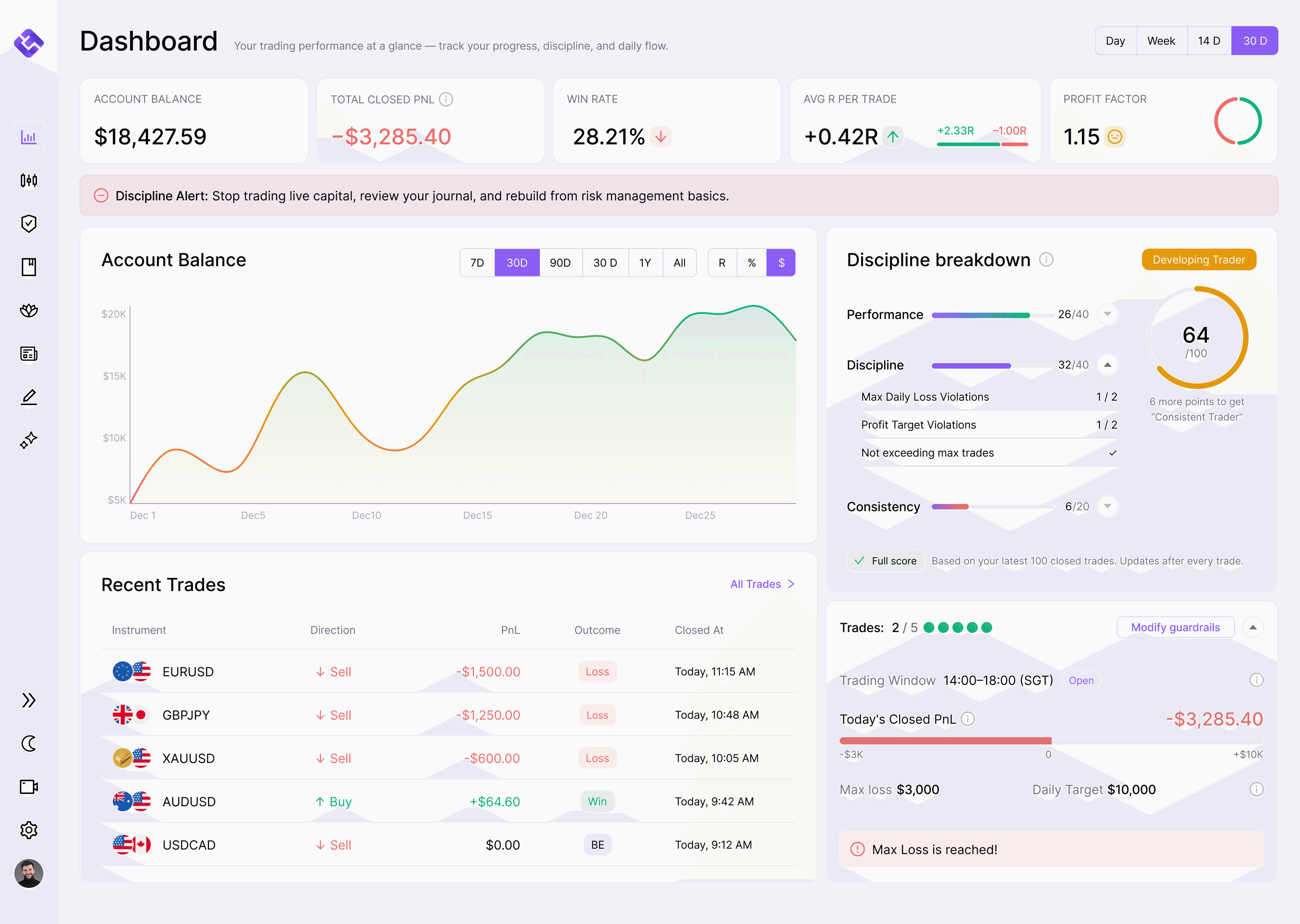
EdgeFlo tracks your plan adherence rate alongside your standard performance metrics. When you increase your lot size, the dashboard shows whether your execution quality changes at the new level. If your adherence drops, the data catches it before your account does.
The auto risk calculator ensures your position size stays at your planned percentage regardless of account size. You enter the pair, your stop distance, and your risk percentage, and the correct lot size appears. No mental math, no emotional rounding up because "the setup looks strong."
Guardrails like daily loss limits scale with your account automatically, keeping the same percentage protection whether you are trading 0.1 lots or 2.0 lots. The system grows with you so the rules do not have to change when the numbers do.
The Edge Brief
Receive Insights on trading psychology, discipline, and the behavioral patterns that create consistent traders from our Founder and the EdgeFlo team, delivered to your inbox.
Think different. Trade different.
Why do I fail when I increase my lot size?
How do I scale up my trading account?
Should I jump from demo to a large funded account?
What is the biggest psychological barrier to scaling?

Turn discipline on.
Every session.
EdgeFlo is the environment serious traders operate inside.
Start 7-Day Free Trial
Cancel anytime.
No long-term commitment.

Think Different, Trade Different.