

Skin in the Game: Why Real Trading Beats Studying
Skin in the game changes how you trade. Learn why live execution, failing, and reviewing builds competence faster than books or demo accounts ever will.
You can read every trading book on the shelf, watch a thousand YouTube videos, and still blow your first live account in a week. That gap between knowing and doing is not a knowledge problem. It is a skin in the game problem.
Skin in the game trading means putting real money behind your decisions so the outcome actually matters. When your capital is on the line, your brain processes information differently. You notice things demo accounts never taught you: the hesitation before clicking buy, the urge to move your stop, the sick feeling after a loss you should have avoided. That exposure is where real trading confidence comes from. Not from another course. From surviving the arena.
TL;DR
Reading about trading and doing it live are two completely different skills. Real money changes your psychology.
The fastest path to competence is live execution combined with honest review, not more study.
Failing in the live market teaches you what no textbook can: how you actually behave under pressure.
Four activities compound your skill over time: live trading, backtesting, journaling, and reviewing.
Competence builds confidence. Not the other way around.
Why Books and Videos Are Not Enough
Books give you frameworks. Videos show you setups. Neither one can replicate the feeling of watching a trade go against you with $500 at stake. That emotional gap is the whole problem.
Here is what happens to most beginners. They study for weeks or months. They learn about support and resistance, candlestick patterns, risk management ratios. They feel ready. They open a live account, place their first real trade, and immediately discover that knowing where to place a stop loss and actually keeping it there are two different things.
Think about learning to drive. You can read the manual cover to cover, memorize every road sign, ace the written test. But the first time you merge onto a highway with trucks flying past at 120 km/h, your hands are shaking. That is the difference between theory and skin in the game. The manual did not prepare you for the adrenaline.
Trading works the same way. The emotional component is invisible until you have real money moving. And the emotional component is where most traders self-destruct. They revenge trade after a loss. They overtrade because they feel behind. They abandon their plan because the chart "looks different" today.
The Demo Trap
Demo accounts are the worst offender. They simulate the mechanics but remove the one thing that matters: consequence.
Example: The Demo-to-Live Gap
A beginner spends three months on a demo account trading EUR/USD. She hits a 62% win rate with a 1.8R average. She switches to a $2,000 live account. Within two weeks, her win rate drops to 41%. Same strategy. Same pairs. Same timeframes. What changed? Her. She started cutting winners early because real profits felt fragile. She held losers longer because closing a loss with real money felt like admitting failure. She doubled position sizes after a losing day because she wanted to "get back to even." The strategy did not break. Her behavior did.
That story plays out thousands of times a day across brokers worldwide. The strategy was never the problem. The trader's relationship with real risk was the problem. And no amount of demo practice can train you for that relationship.
The Arena Is Where You Learn
There is a reason gladiators did not learn sword fighting by reading scrolls. The arena is where you find out who you really are.
Brad Goh, a seven-figure trader who built his career over seven years, puts it bluntly: "I didn't learn by reading a bunch of books or watching a bunch of videos. I learned by doing. I learned by failing. I learned by blowing accounts. I learned by reviewing my mistakes continuously and just refining my trade plan."
That is not anti-education. Books and courses have their place as starting points. But the transfer from knowledge to competence only happens when you are in the live market with real consequences.
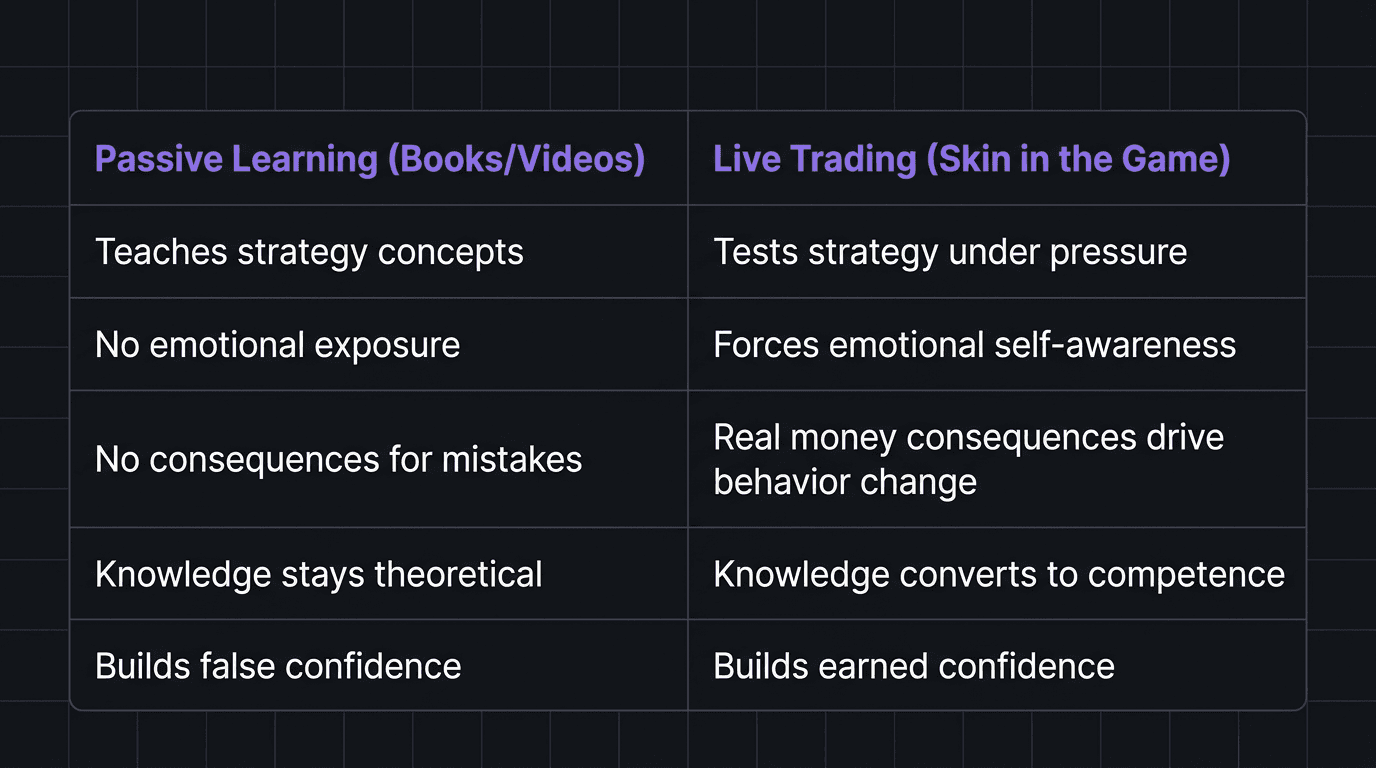
Live trading forces three things that passive learning cannot:
Real-time decision making under pressure. When GBP/USD drops 40 pips in 90 seconds during a news spike, you do not have time to check your notes. You react based on what you have practiced, not what you have memorized.
Emotional self-awareness. You will not discover your trading mistakes in a textbook. You will discover them at 10:47 AM on a Tuesday when you move your stop loss for the third time because you "feel like" the trade will come back.
Pattern recognition through repetition. Reading about a double bottom and spotting one forming in real-time while your entry order is live are experiences separated by a canyon.
Failing Builds Competence
Nobody wants to hear this, but failure is the raw material of competence. Every blown stop, every emotional entry, every revenge trade that goes sideways is a data point. The question is whether you do anything with it.
Most traders fail and then repeat the same patterns. They lose money, feel bad, take a break, come back, and do the exact same thing. That is not learning. That is just suffering.
Real learning means changing behavior. If you blew your daily loss limit because you chased a setup that was not in your plan, the lesson is not "I should be more careful." The lesson is: "I entered a trade without checking my plan first. I need a physical checkpoint before every entry."
Example: The Same Mistake, Two Outcomes
Trader A takes a short on GBP/USD at 1.2650 without confirming his bias. Price rallies to 1.2710 and stops him out for a 60-pip loss. On a 0.2 lot position, that is $120 gone (0.2 lots x $10/pip x 60 pips). He is annoyed. He immediately goes long trying to ride the momentum and gets chopped out again for another $80. He closes the platform, watches Netflix, and comes back the next morning like nothing happened.
Trader B takes the exact same short at 1.2650 and gets stopped at 1.2710 for the same $120 loss. She closes the platform, opens her trading journal, and writes down: "Entered short without confirming higher-timeframe bias. Higher timeframe was bullish. I ignored it because the 15-minute chart looked bearish." She tags the emotion as "overconfident" and notes she skipped her pre-market routine. Next session, she checks the higher-timeframe bias before every entry. She does not repeat that specific mistake.
Same failure. Same dollar amount. Completely different trajectories.
The difference is not talent. The difference is whether you treat failure as feedback or as noise. Trader B has skin in the game and a system for extracting lessons from it. Trader A just has skin in the game.
Competence is not the opposite of failure. Competence is what happens when you fail, review, adjust, and repeat. Over months, the adjustments compound. Your mistakes get smaller. Your pattern recognition sharpens. Your emotional triggers become familiar instead of overwhelming. That earned competence is the only foundation for real trading confidence.
The Four Activities That Compound
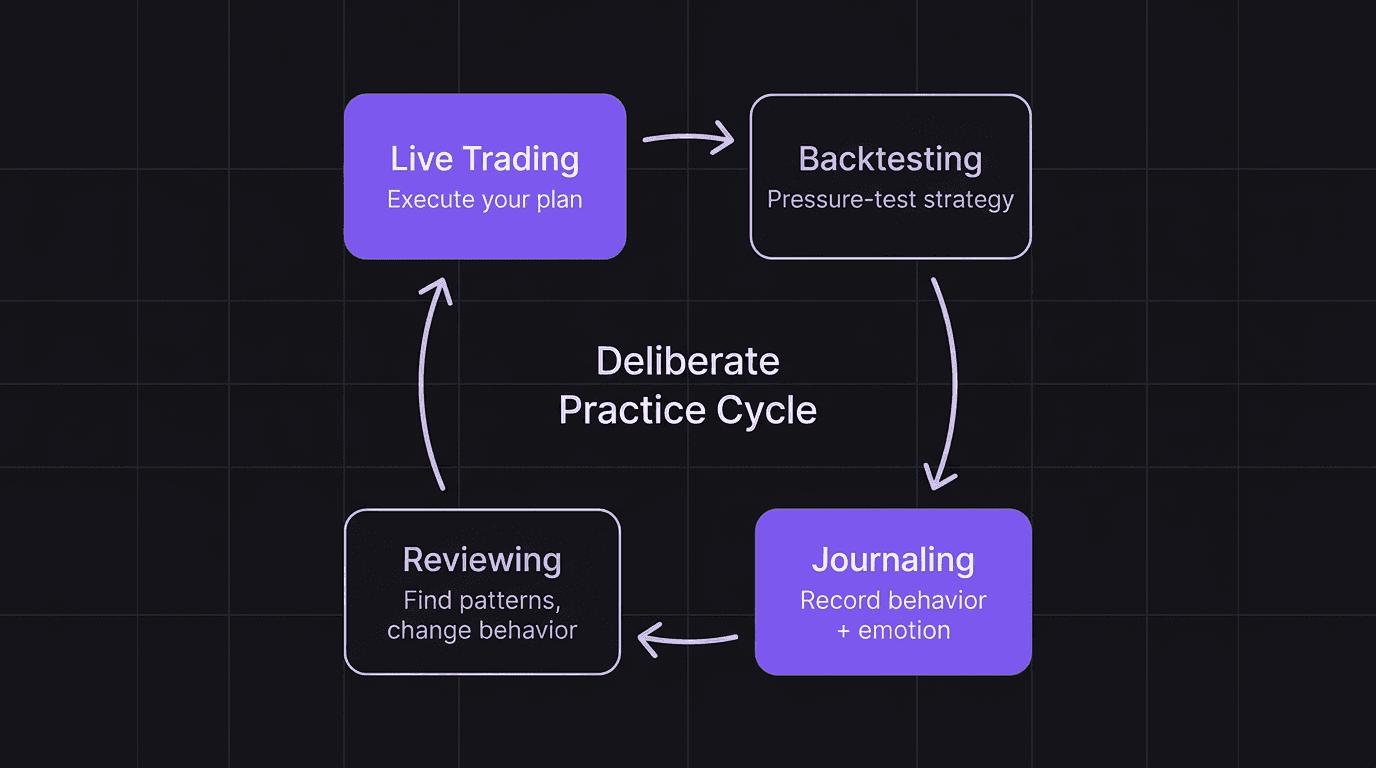
If skin in the game is the philosophy, these four activities are the practice. Brad distilled his own seven-year development into a simple framework: live trading, backtesting, journaling, and reviewing. That is the whole list.
"Those are all you need. Anyone can work when they have motivation or inspiration, but very few can work when nobody's watching. And the people who can do all this boring stuff, and they do it for years, those are the guys that win."
Here is what each one actually does:
Live Trading
This is the arena. You execute your plan against a market that does not care about your feelings. Every session builds pattern recognition, emotional awareness, and decision-making speed. The key word is "deliberate practice." Going live without a plan is just gambling with extra steps.
Backtesting
Forward testing and backtesting let you pressure-test your strategy in historical conditions. It is the training ground before the arena. It builds conviction in your approach so that when a live trade goes against you, you can hold your nerve because you have already seen 200 instances of the same setup play out.
Journaling
Recording what you did, why you did it, and how you felt while doing it creates a trail of behavioral data. Without a journal, you are flying blind. With one, you start noticing things like: "I lose money every Monday" or "I overtrade when I am up for the week" or "I skip my stop loss on the third trade of the day."
Reviewing
This is where the compounding happens. Reviewing is not just re-reading your journal entries. It is actively looking for patterns, recurring mistakes, and behavioral triggers. Then changing something specific before your next session.
Most traders do one or two of these. Almost nobody does all four consistently. The traders who do all four are the ones who compress years of development into months. Not because they are smarter. Because they are extracting more lessons per unit of screen time.
How EdgeFlo Keeps You in the Arena Longer
The hardest part of skin in the game is not the first trade. It is showing up for the 200th trade with the same discipline you had on day one. That is where most traders burn out or blow up.
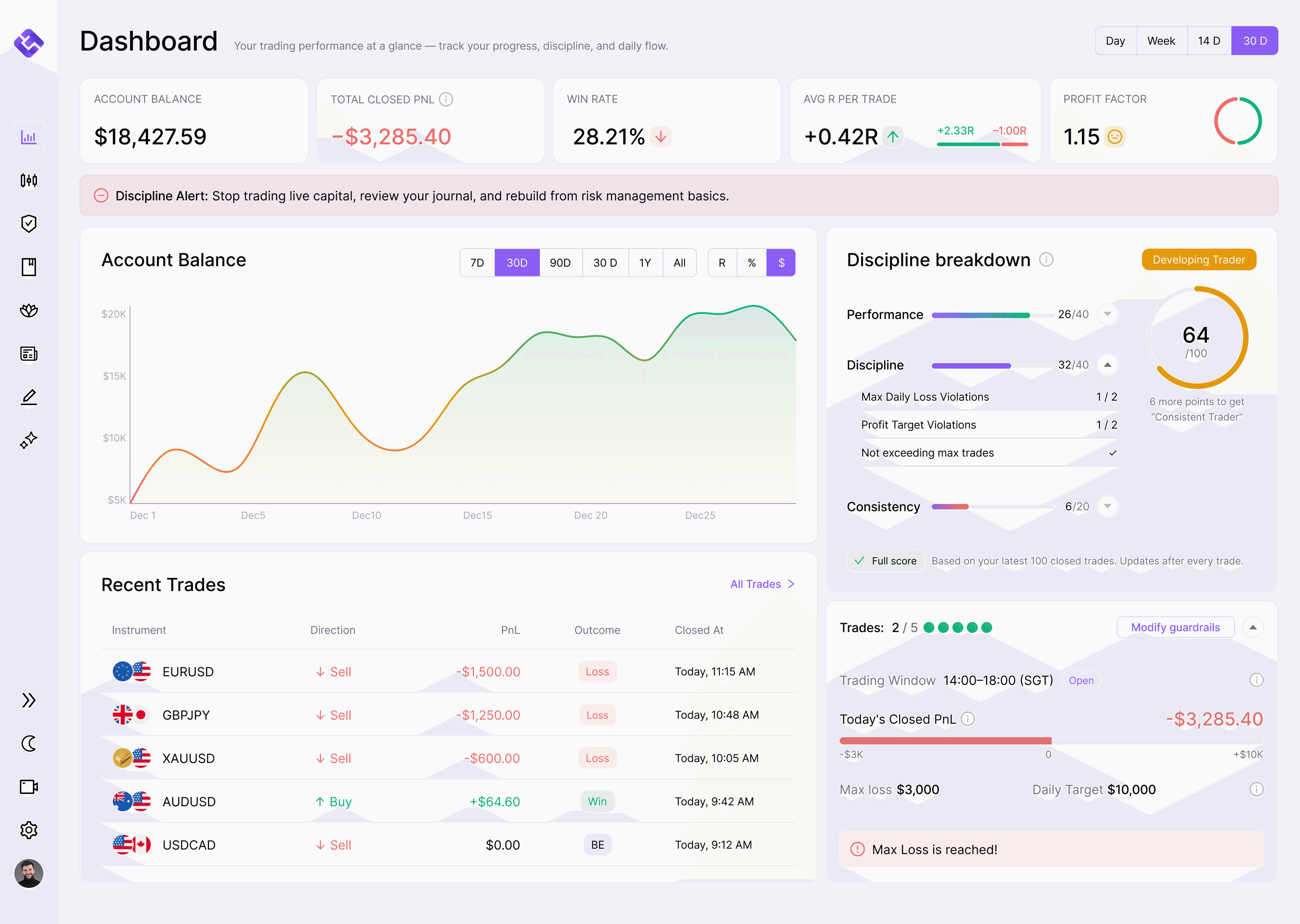
EdgeFlo connects directly to cTrader/ TradeLocker for live execution, so you are trading in the real arena with real consequences. But it wraps that execution in guardrails you set yourself: daily loss limits, max trade counts, and automatic lot sizing based on your risk rules. You can override any of them, but you have to consciously choose to break your own rules. That friction is the difference between impulsive trading and deliberate trading.
The built-in AI-powered trading journal captures your trades automatically and lets you tag emotions right after each position closes, when the feeling is still raw and honest. Weekly AI reports, available on the Plus plan, surface the behavioral patterns you would miss reviewing manually. Over time, that feedback loop does exactly what the four-activity cycle demands: it helps you fail, review, adjust, and get back into the arena with a sharper edge.
The Edge Brief
Receive Insights on trading psychology, discipline, and the behavioral patterns that create consistent traders from our Founder and the EdgeFlo team, delivered to your inbox.
Think different. Trade different.
What does skin in the game mean in trading?
Why is demo trading not enough preparation for live markets?
How long does it take to build trading competence?
Can you learn trading from books and courses alone?

Turn discipline on.
Every session.
EdgeFlo is the environment serious traders operate inside.
Start 7-Day Free Trial
Cancel anytime.
No long-term commitment.

Think Different, Trade Different.